What you'll learn
- What sociologists mean by culture and why it is central to identity.
- How to distinguish subculture, folk culture, mass culture, popular culture, high culture, low culture and global culture.
- How culture links to socialisation, power, class, ethnicity, gender and globalisation.
- How to evaluate different views of culture for AO3.
Starting point: what is culture?
In Sociology, a conception is a way of understanding or defining something. So “different conceptions of culture” means the different ways sociologists classify and interpret cultural life.
Culture
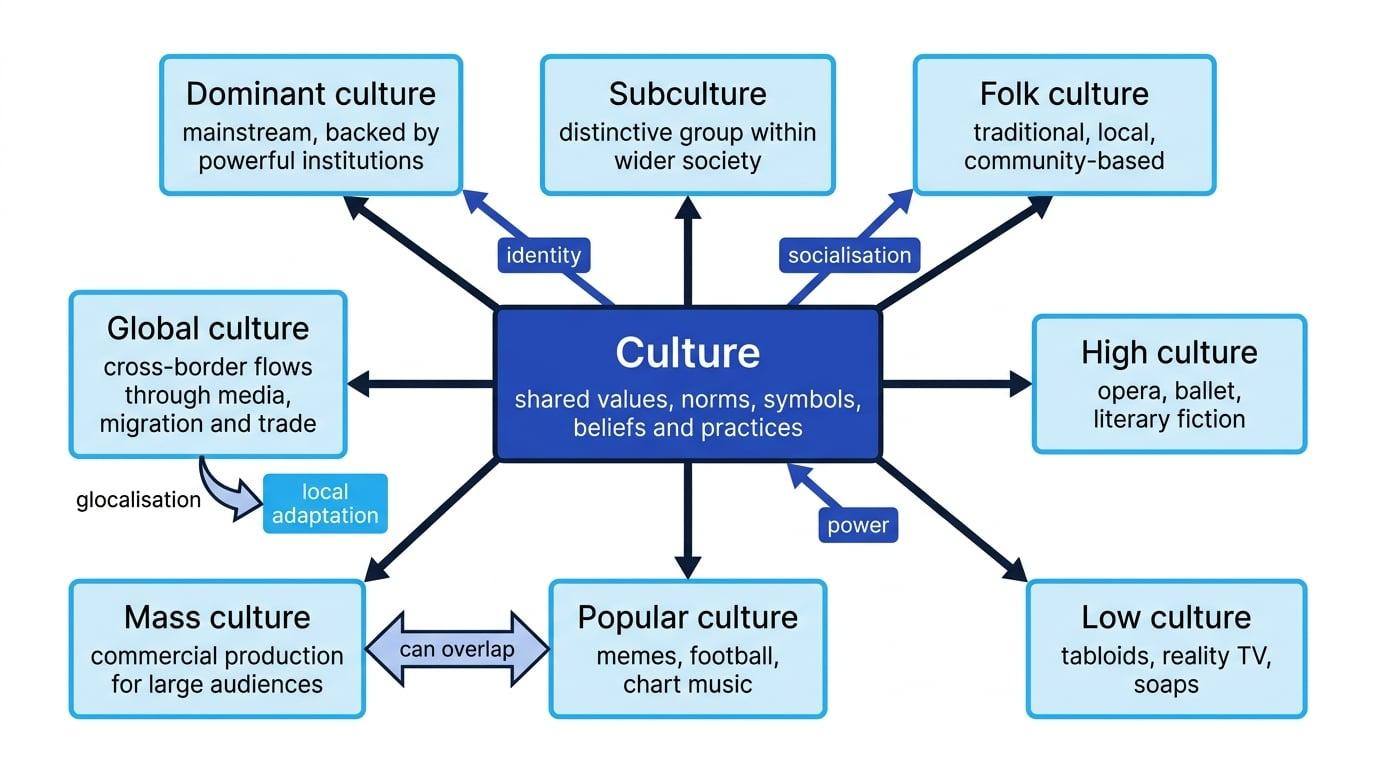
Culture means the shared values — ideas about what is important — norms — expected patterns of behaviour — symbols, language, beliefs, knowledge, customs and practices of a social group.
Culture is learned through socialisation, which means the process by which people learn the norms, values and behaviour expected in their society. This happens through family, education, peer groups, religion, media and work.
Culture is closely linked to identity, meaning your sense of who you are. Your accent, music taste, religious practice, clothing, food, slang and online habits can all help you “perform” or express identity.
The map below shows the main conceptions of culture. Treat them as overlapping categories, not separate boxes.
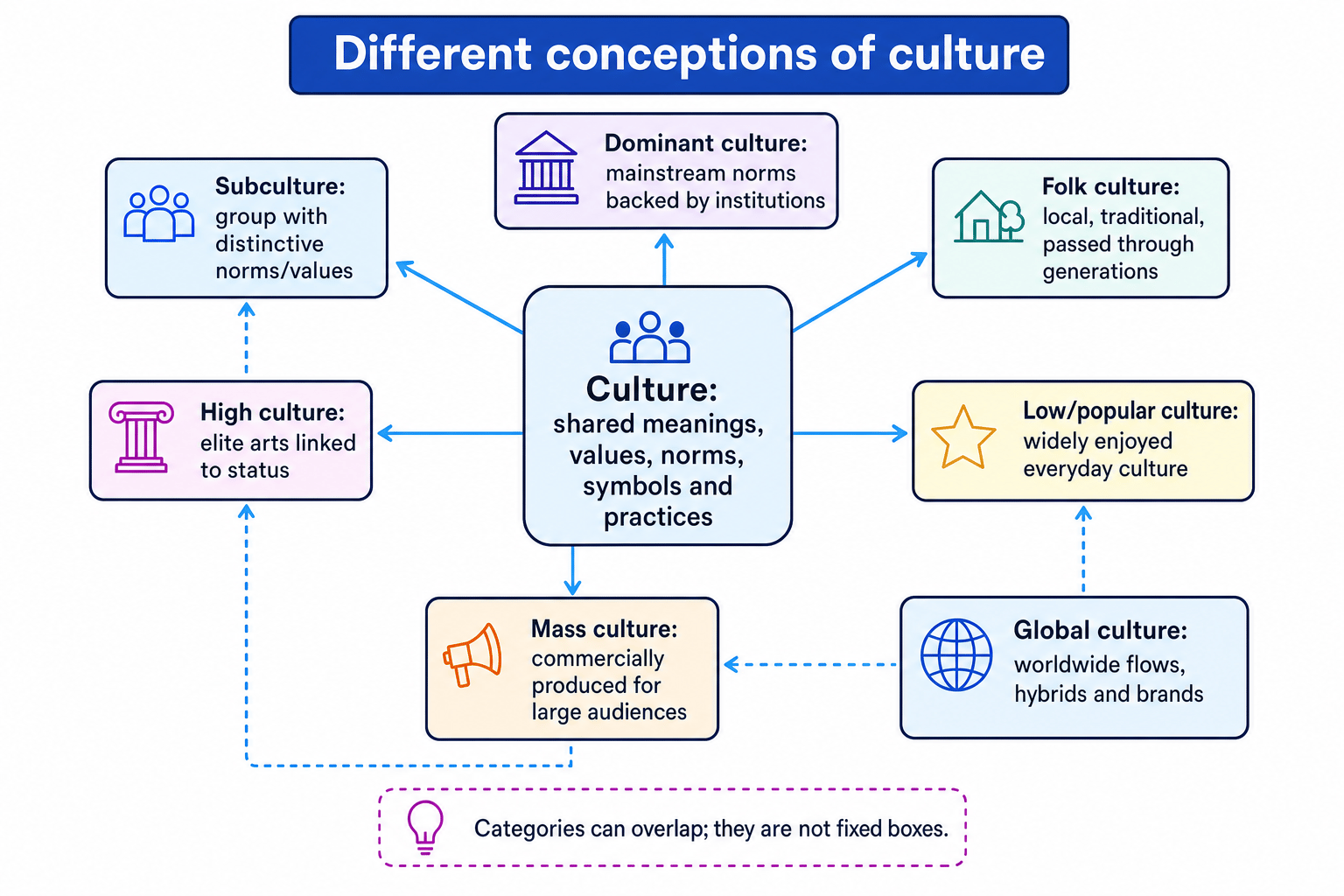
Culture is learned, shared and unequal
Culture is not just “art” or “taste”. It is a whole way of life, but some cultural forms are given more status and power than others.
Dominant culture
Dominant culture
Dominant culture refers to the norms, values and practices that are treated as mainstream or “normal” in a society, often because they are supported by powerful institutions such as schools, the media, the state and the economy.
In the UK, examples might include speaking English in public life, valuing formal education, paid work, individual achievement, consumer choice, punctuality and the idea of a “respectable” family life.
This links directly to social differentiation, power and stratification. Groups with more power are often better able to define their culture as normal, respectable or superior.
Marxists argue that dominant culture can reflect ruling-class interests. Gramsci used the idea of hegemony, meaning leadership through consent, to explain how powerful groups make their worldview seem like common sense.
High culture and low culture
High and low culture
High culture refers to cultural activities seen as refined, serious or elite, such as opera, classical music, ballet, fine art and literary fiction. Low culture refers to cultural forms often labelled as less serious or less prestigious, such as reality TV, tabloids, soap operas or some forms of popular music.
This distinction is not neutral. It often reflects class power. Bourdieu argued that middle-class and upper-class groups possess cultural capital, meaning knowledge, tastes, language and manners that are valued by institutions.
For example, knowing how to discuss Shakespeare, galleries or classical music may help some students appear more “cultured” in school interviews, university applications or professional workplaces.
Treating high culture as genuinely better
Do not write as if high culture is objectively superior. A sociological answer should ask who defines it as superior, why, and whose interests that definition serves.
AO3 evaluation: the boundary between high and low culture changes over time. Shakespeare was once popular entertainment but is now often treated as high culture. Grime, hip-hop and street art have also moved from marginal or “low” status into galleries, universities and award ceremonies.
Subculture
Subculture
A subculture is a group within wider society that has distinctive norms, values, symbols, styles or practices.
Subcultures can be based on class, age, ethnicity, religion, music, sport, locality, sexuality or online interests. Examples include goths, football fan groups, skaters, gamers, religious communities, drag scenes, drill fans or K-pop fandoms.
Subcultures matter because they show that society is culturally diverse. They also show how identity is built through peer groups and media, not just family or school.
Some subcultures challenge dominant norms. The Centre for Contemporary Cultural Studies, associated with Hall and Jefferson, saw some youth subcultures as symbolic resistance to class inequality. Willis’s study of working-class “lads” also showed how peer culture could resist school authority, although it ended up reproducing class inequality.
Identifying a subculture
-
Check whether the group sits within wider society. For example, UK skaters are not a separate society; they exist within wider British culture.
-
Identify distinctive cultural features. Skaters may share styles of clothing, slang, music tastes, places to meet, values around skill and risk, and ways of using urban space.
-
Analyse the relationship with power. If councils design public spaces to discourage skating, this shows that dominant groups can label some subcultural practices as disorderly.
-
Evaluate how fixed the identity is. A postmodernist might argue that many people now move in and out of subcultures flexibly rather than belonging for life.
Subculture vs counterculture
A subculture is simply distinctive. A counterculture is more strongly opposed to dominant norms, such as some radical political, religious or environmental movements.
Folk culture
Folk culture
Folk culture refers to traditional, local, community-based culture, often passed down through generations by custom, storytelling, ritual, music, dance or craft.
Examples might include folk songs, Morris dancing, local dialects, village festivals, regional foods, storytelling traditions, or Welsh Eisteddfod cultural events.
Folk culture is usually contrasted with mass culture because it is seen as small-scale, local and less commercial. However, this contrast can be too simple. Folk traditions may be promoted through tourism, social media, schools and heritage industries.
AO3 evaluation: Hobsbawm used the phrase invented traditions to suggest that some “ancient” traditions are actually more recent creations, often used to build national identity or social unity.
Mass culture
Mass culture
Mass culture is culture that is commercially produced for large audiences, usually through media industries such as television, film, music, advertising, streaming platforms and social media.
The Frankfurt School, especially Adorno and Horkheimer, criticised the culture industry. They argued that mass culture is standardised, profit-driven and encourages passive consumption. In this view, mass entertainment distracts people from inequality and makes capitalism seem normal.
UK examples include reality TV formats, franchise films, fast fashion, chart music, influencer advertising and algorithm-driven streaming recommendations.
AO3 evaluation: this view can be criticised for assuming audiences are passive. Hall’s encoding/decoding model argues that audiences may accept, negotiate or oppose media messages. For example, viewers may enjoy a reality show while also criticising its gender stereotypes or class representations.
Popular culture
Popular culture
Popular culture means cultural products and practices that are widely enjoyed by ordinary people in everyday life.
Popular culture includes football, memes, TikTok trends, chart music, festivals, gaming, fashion, soap operas, podcasts and celebrity culture.
The difference between mass culture and popular culture is subtle but useful:
| Concept | Main focus | Example |
|---|---|---|
| Mass culture | How culture is produced and sold by large industries | A Netflix franchise marketed globally |
| Popular culture | How culture is enjoyed, shared and given meaning by audiences | Fans making memes, edits and discussions around that franchise |
Mass and popular culture overlap
A cultural product can be both mass culture and popular culture: it may be produced by corporations but actively reworked by audiences.
Popular culture can reproduce inequality, for example through sexist beauty standards or racist stereotypes. But it can also give marginalised groups visibility, voice and community.
Global culture
Global culture
Global culture refers to cultural ideas, products, styles and practices that spread across national borders through migration, trade, media, tourism and digital technology.
Examples include global brands, Premier League football audiences, K-pop, Bollywood, anime, TikTok trends, Netflix, McDonald’s, global fashion and international music collaborations.
Sociologists debate what global culture means:
- Cultural homogenisation means cultures become more similar, often through Western or American influence.
- Cultural imperialism means powerful countries dominate weaker countries culturally, for example through media ownership or global brands.
- Hybridisation means cultures mix to create new forms.
- Glocalisation, associated with Robertson, means global products are adapted to local cultures.
For example, a global fast-food chain may sell different menu items in different countries. This shows globalisation does not simply erase local culture.
Applying global culture to a UK example
-
Identify the global flow. K-pop reaches UK audiences through YouTube, TikTok, streaming platforms, tours and fan communities.
-
Apply identity. UK fans may use K-pop to express style, friendship, language learning or online belonging.
-
Apply power. Large entertainment companies and digital platforms shape what becomes visible, profitable and shareable.
-
Evaluate one-way influence. This is not just Western culture spreading outwards; it shows Asian cultural industries influencing UK youth culture too.
Comparing sociological perspectives
Functionalists such as Durkheim and Parsons emphasise shared culture. They argue that culture creates social solidarity by giving people common norms and values. This helps explain national rituals, school assemblies, public ceremonies and shared media events.
Marxists focus on inequality. They argue that culture can support capitalism by promoting consumerism, competition and acceptance of class inequality. However, Marxist approaches can sometimes underplay audience creativity.
Feminists examine how culture can reproduce patriarchy, meaning male dominance. Popular culture may objectify women or normalise unequal caring roles, but feminist media, music and online activism can also challenge sexism.
Postmodernists argue that culture is now more fluid, fragmented and choice-based. People mix styles, identities and influences from different places. However, critics argue that postmodernism can exaggerate freedom and ignore continuing class, gender and ethnic inequalities.
Listing types without comparison
In essays, do not just define each type of culture separately. Compare them using questions like: Who produces it? Who consumes it? Who benefits? Is it local or global? Is it high status or low status?
Pulling it together for essays
A strong answer on culture should combine:
- AO1: accurate definitions and named ideas, such as Bourdieu’s cultural capital, Adorno and Horkheimer’s culture industry, Gramsci’s hegemony, and globalisation concepts.
- AO2: concrete examples from contemporary UK society, such as streaming platforms, music scenes, football culture, TikTok, museums, festivals or youth subcultures.
- AO3: evaluation of whether culture creates shared identity, reflects inequality, resists power, or becomes more global and hybrid.
In the exam
-
Define the cultural form clearly first, then immediately apply it to a real example.
-
Use comparison for AO3: for example, contrast high culture with popular culture, or mass culture with audience creativity.
-
Link culture to power and identity by asking how class, gender, ethnicity, age or globalisation affect whose culture is valued.
Check yourself
- What is the difference between mass culture and popular culture?
- How might high culture be linked to class inequality?
- Why might global culture lead to both homogenisation and hybridisation?