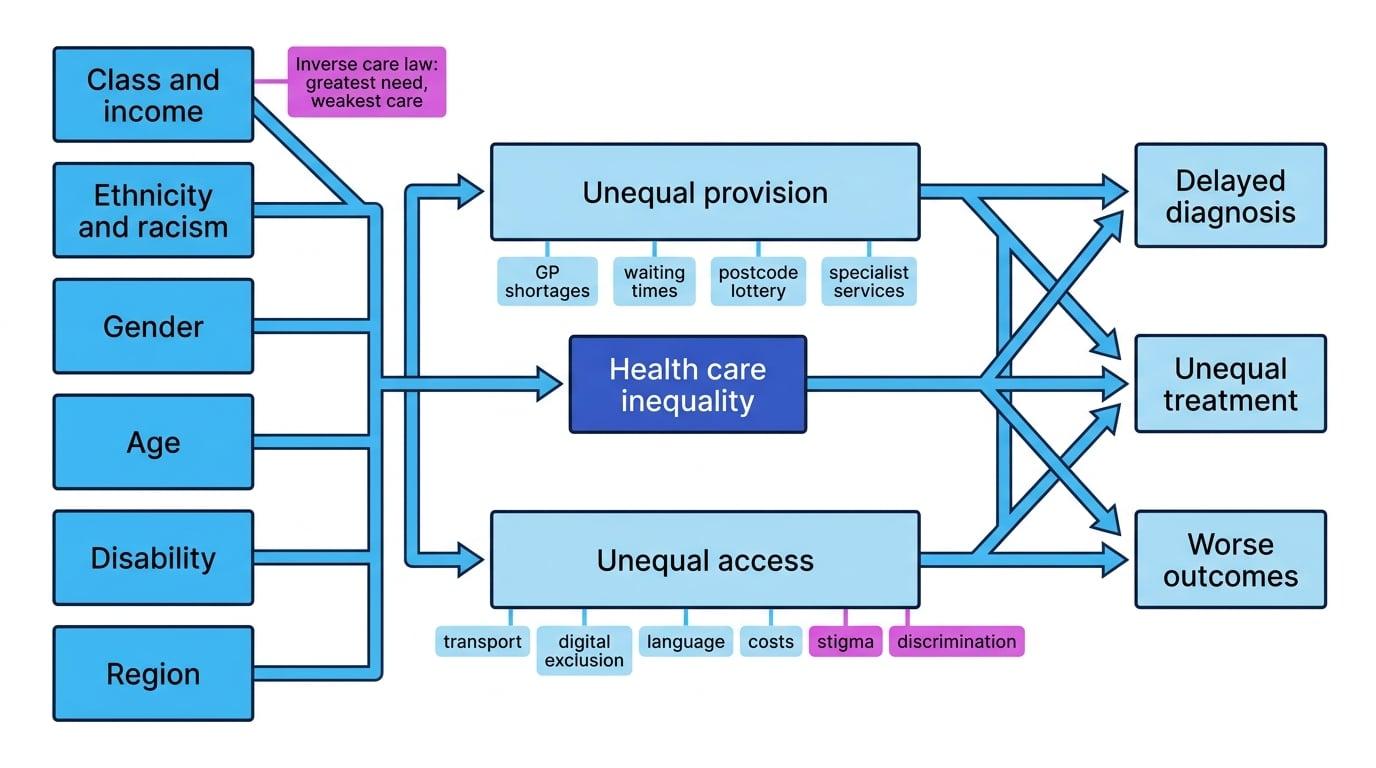
What you'll learn
- How to distinguish provision of health care from access to health care.
- How class, ethnicity, gender, age, disability and region can shape people’s experiences of the NHS and private health care.
- How to use key ideas such as Tudor Hart’s inverse care law, Marmot’s social gradient, and feminist/Marxist explanations.
- How to evaluate evidence and write stronger AO1, AO2 and AO3 points in essays.
The starting point: equal rights do not always mean equal care
The UK NHS is based on universalism: the principle that health care should be available to everyone, mainly funded through taxation, and largely free at the point of use. This is very important sociologically because it means Britain is not simply a market system where only those who can pay receive treatment.
However, sociologists argue that formal equality does not guarantee real equality. People may have the same legal right to use a service, but still face different waiting times, costs, confidence levels, transport barriers, discrimination, or quality of care.
Health care inequality
Health care inequality means patterned differences between social groups in the availability, quality, use or outcome of health services. These patterns are linked to wider inequalities in power, resources and social status.
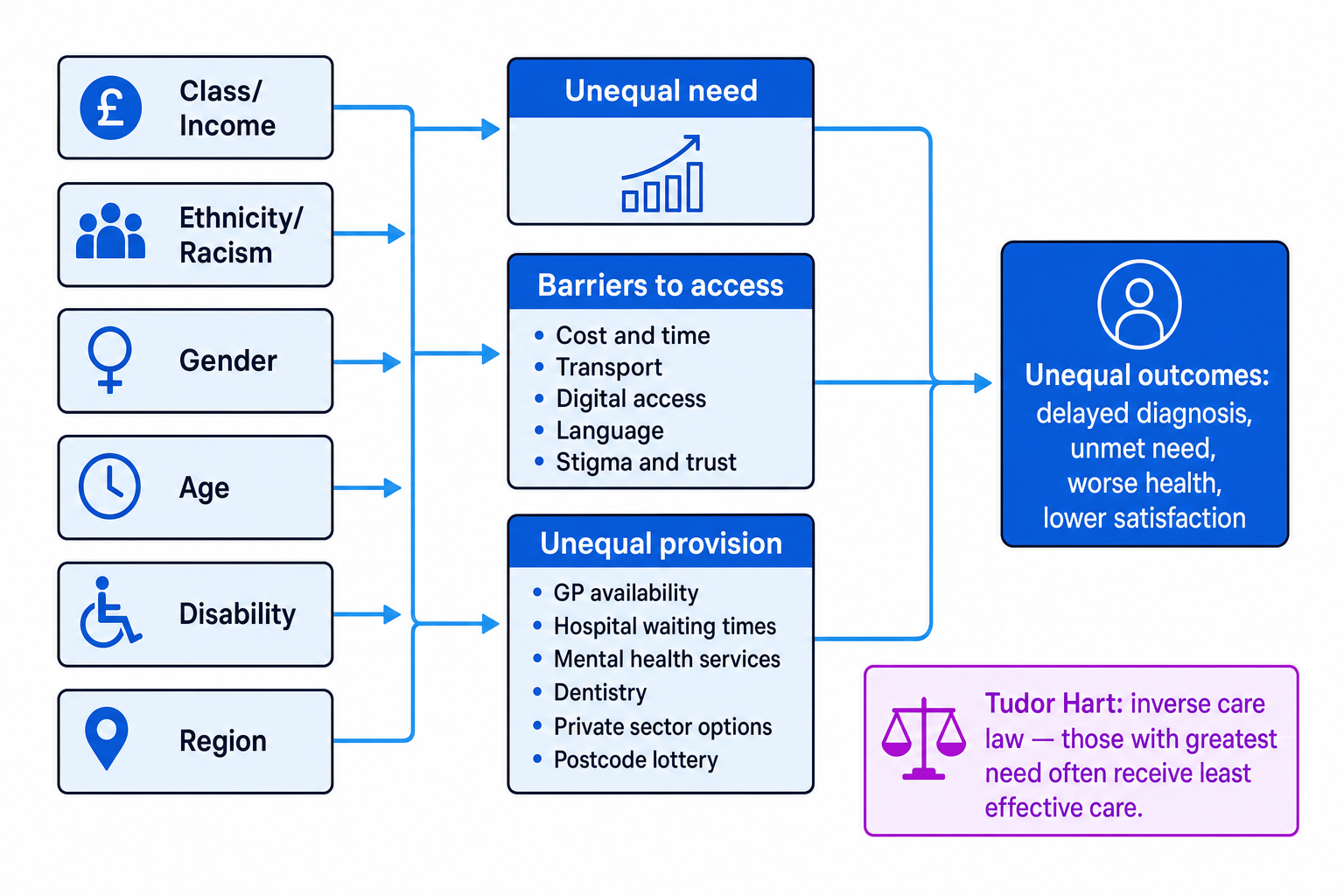
Provision and access: the key distinction
Provision
Provision of health care
Provision means the supply and organisation of health services: for example, how many GP appointments, hospital beds, dentists, mental health services, translators, screening programmes or specialist clinics are available.
Provision can be unequal because services are not distributed evenly. Some areas have more doctors, shorter waiting lists or better-funded services than others. This is sometimes called a postcode lottery, meaning that the care you receive depends partly on where you live.
Access
Access to health care
Access means people’s real ability to use health services when they need them. It includes practical access, financial access, cultural access and emotional access.
For example, a GP surgery may technically exist, but a patient may struggle to use it because they cannot get time off work, cannot afford transport, do not speak English confidently, lack digital skills, or fear being dismissed.
Distinguishing provision from access
A deprived urban area has long waits for GP appointments. Many patients must book through an online form, but some older residents do not use smartphones confidently.
- The shortage of appointments is an issue of provision, because the supply of health care is not enough for the level of need in the area.
- The online booking system is an issue of access, because the service exists but some people cannot use the route into it easily.
- The likely outcome is delayed diagnosis or untreated illness, showing how unequal provision and unequal access can combine.
The main sociological point
Health care inequality is not only about whether services exist. It is about whether different social groups can obtain timely, respectful and effective care in practice.
Social class and income
Social class refers to people’s position in the social structure, often linked to occupation, income, wealth and education. Class affects both health needs and health care access.
People in lower-income groups are more likely to experience poor housing, insecure work, stress, pollution and food poverty. This can increase their need for health services. At the same time, they may face more barriers to using those services: transport costs, inflexible jobs, childcare responsibilities, lower health literacy, or difficulty navigating complex systems.
Tudor Hart (1971) called this the inverse care law.
Inverse care law
The inverse care law is Tudor Hart’s argument that the availability of good medical care tends to vary inversely with the need of the population served: those who need care most may receive the least effective care.
This is especially relevant when health care becomes more marketised. Although the NHS remains universal, private health care can create a two-tier system. Affluent patients may pay for private consultations, scans, dentistry, counselling or physiotherapy, reducing their waiting time. Poorer patients are more dependent on stretched public provision.
Marmot (2010) argued that health follows a social gradient: each step down the social hierarchy is associated with worse health. Marmot’s idea of proportionate universalism means services should be universal but delivered with greater intensity where need is greatest.
Ethnicity, racism and cultural barriers
Ethnicity refers to shared cultural identity, which may include language, religion, nationality, heritage and traditions. Ethnic inequalities in health care are not simply about “culture”; they are also shaped by racism, poverty, migration status and institutional practices.
Some minority ethnic patients may face language barriers, lack of culturally appropriate services, or lower trust in institutions. There is also evidence of unequal treatment. For example, Black women in the UK have faced significantly higher risks around pregnancy and childbirth than White women, raising questions about listening, diagnosis and institutional bias in maternity care.
In mental health services, Black people have been disproportionately represented in compulsory detention under the Mental Health Act. Sociologists link this to racism, stereotyping, policing, crisis pathways and lack of early community support.
Reducing ethnicity to culture
Do not explain ethnic inequalities only by saying “different cultures use services differently”. That ignores racism, poverty, language barriers, migration experiences and unequal treatment by institutions.
Gender and health care
Gender means the social meanings attached to being male, female or another gender identity. Gender affects how people understand symptoms, seek help and are treated by professionals.
Feminists argue that medicine has historically been shaped by male assumptions. Women’s pain may be dismissed as emotional or exaggerated, and conditions affecting women may receive less research attention. At the same time, women are often expected to manage family health: booking appointments, caring for children, supporting elderly relatives and dealing with emotional labour.
Men may also be disadvantaged by gender norms. Connell’s idea of hegemonic masculinity helps explain why some men avoid seeking help, especially for mental health problems, because they have been socialised to appear tough, self-reliant and unemotional.
Trans and non-binary people may face additional barriers, including stigma, lack of professional knowledge, long waiting lists for specialist gender identity services, and fear of disrespectful treatment.
Applying gender socialisation to access
A man delays seeing a GP about depression because he believes he should “cope on his own”.
- Link the behaviour to socialisation, because he has learned masculine norms around toughness and emotional control.
- Connect this to access, because the barrier is not the absence of a GP but reluctance to use the service.
- Analyse the consequence: delayed help-seeking may worsen the condition and increase pressure on crisis services later.
Age, disability and region
Age can affect both need and access. Older people often have greater health needs, but may face digital exclusion, transport problems or ageist assumptions. Younger people may struggle with underfunded mental health services or long waits for specialist support.
Disability can create practical and communicative barriers. A building may be physically inaccessible, appointment letters may not be available in suitable formats, or professionals may engage in diagnostic overshadowing, where symptoms are wrongly attributed to a person’s disability rather than investigated properly.
Region also matters. Rural patients may travel further for hospitals and specialist services. Deprived urban areas may have high need but overstretched primary care. Devolution also means England, Scotland, Wales and Northern Ireland have some differences in charging, organisation and priorities.
Theoretical perspectives
Functionalism
Functionalists such as Parsons see medicine as helping society function. Parsons’ sick role suggests that doctors legitimate illness and help people return to normal social roles. From this view, health care contributes to social order.
The weakness is that functionalism can assume patients have equal access to doctors and equal ability to follow medical advice. It underplays power, poverty and discrimination.
Marxism
Marxists focus on class inequality and capitalism. They argue that health inequalities are produced by the wider economic system: poor housing, dangerous work, low income and underfunded public services. Health care may treat the symptoms of inequality without removing its causes.
A Marxist might also point to private health companies, pharmaceutical profits and the growth of paid alternatives as evidence that health can become a commodity.
However, the NHS is also a challenge to a simple Marxist view because it does redistribute resources and provides care regardless of ability to pay.
Feminism
Feminists focus on patriarchy, meaning male dominance in social institutions and cultural assumptions. They examine how women’s bodies, pain and reproductive health have been controlled or dismissed. They also highlight unpaid care work, which is mainly carried out by women and can affect women’s own health and service use.
Weberian and interactionist approaches
Weberians focus on life chances, meaning the opportunities people have to obtain valued resources such as good health and care. Class, status and power all matter.
Interactionists are useful for studying face-to-face encounters. They ask how labels, stereotypes and communication between doctors and patients can affect diagnosis, trust and treatment.
Evidence and methods
Sociologists use official statistics, surveys, interviews and ethnographic research to study health care inequality.
Official statistics from bodies such as the NHS, ONS and Care Quality Commission can show large-scale patterns in waiting times, outcomes, mortality and service use. These are useful for reliability and representativeness, but they may miss unmet need: people who never reach services may not appear in the data.
Qualitative interviews can reveal how patients experience embarrassment, racism, stigma or confusion. These are often high in validity, but samples may be smaller and harder to generalise.
Strong AO3 evaluation
When evaluating evidence, ask: does the data measure need, use, quality of care, or outcomes? These are related, but they are not the same thing.
Bringing it together in an essay
A strong essay does not just list groups who experience inequality. It explains the mechanisms linking social divisions to health care outcomes.
Building an analytical paragraph
Suppose you want to explain why class affects access to health care.
- Start with the mechanism: lower-income groups may have higher health needs but fewer resources such as flexible work, transport, digital access or private alternatives.
- Apply a concept: this supports Tudor Hart’s inverse care law, because those with greater need may face weaker or slower care.
- Evaluate the argument: the NHS reduces class inequality by providing universal care, but charges for dentistry, prescriptions in England, transport costs and waiting lists mean class advantages still matter.
Contemporary relevance
Health care inequalities remain central in contemporary UK society because of ageing populations, NHS waiting lists, mental health demand, regional inequality, austerity debates, digital booking systems and the growth of private options.
The key sociological insight is that health care is not separate from society. It reflects patterns of social differentiation, power and stratification: class, ethnicity, gender, disability, age and place shape people’s chances of receiving care. It also links to socialisation, culture and identity, because norms around masculinity, trust, language, stigma and family roles affect how people seek and experience care.
In the exam
- Separate provision from access before analysing examples; this makes your answer clearer and more precise.
- Use named evidence such as Tudor Hart (1971), Marmot (2010/2020), the Black Report (1980) or the Acheson Report (1998), then apply it to contemporary UK examples.
- Evaluate by showing complexity: the NHS reduces inequality, but class, ethnicity, gender, disability, age and region still shape real outcomes.
- Include methods evaluation when using evidence: official statistics show broad patterns, while interviews can reveal lived experiences and hidden barriers.
Check yourself
- What is the difference between inequality in provision and inequality in access?
- How does Tudor Hart’s inverse care law help explain class inequalities in health care?
- Why is it important to consider ethnicity, gender, disability and region as well as class?