Mental health is one of the most hotly debated areas within the sociology of health. While doctors often treat mental illness as an objective biological reality, sociologists examine it as a social phenomenon. They argue that what we define as "madness" or "mental illness" is deeply shaped by cultural norms, historical periods, and social power dynamics. Furthermore, mental illness is not randomly distributed across the population; it follows clear, predictable patterns linked to social class, gender, and ethnicity.
What you'll learn
- The fundamental clash between the biomedical model and the social constructionist view of mental illness.
- Key interactionist, Marxist, and feminist theories explaining how mental illness is defined and controlled.
- How and why mental illness is unequally distributed by social class, gender, and ethnicity in the UK.
- How to critically evaluate structural (social causation) versus interactionist (labelling and social selection) explanations.
1. The Nature of Mental Illness: Disease or Social Construct?
To understand how sociologists view mental health, we must first compare the dominant medical model with the sociological approach.
Biomedical Model of Mental Illness
The biomedical model assumes that mental illnesses are physical, organic brain pathologies. It views conditions like depression, schizophrenia, or bipolar disorder as chemical imbalances or genetic abnormalities that can be objectively diagnosed, categorized (e.g., using the DSM-5 manual), and treated primarily with pharmaceutical drugs or medical interventions.
Sociologists do not necessarily deny that people experience profound emotional and mental distress. However, they argue that the biomedical model is limited and fails to see how mental illness is socially constructed.
The Social Constructionist Critique
Social constructionists argue that there is no objective, culture-free definition of "mental illness." Instead, definitions of sanity and madness change over time, vary across cultures, and are constructed by powerful groups to control behavior.
- Thomas Szasz (1961) – The Myth of Mental Illness: Szasz argued that most mental illnesses are not physical diseases at all, but rather "problems in living." By labelling non-conformists or eccentric individuals as "sick," the medical profession pathologizes normal human variation and functions as an agent of social control.
- Michel Foucault (1961) – Madness and Civilization: Foucault traced how society's treatment of the "mad" changed with the Enlightenment. In medieval times, the mad were seen as possessing a different kind of wisdom and integrated into communities. However, as industrial capitalism demanded disciplined, rational workers, madness was constructed as the ultimate opposite of "reason." Asylums were built to lock away and police those who could not or would not conform to capitalist work patterns.
Labelling Theory and Mental Illness
Interactionist sociologists argue that once an individual is given a psychiatric label, it profoundly alters their identity and how society treats them.
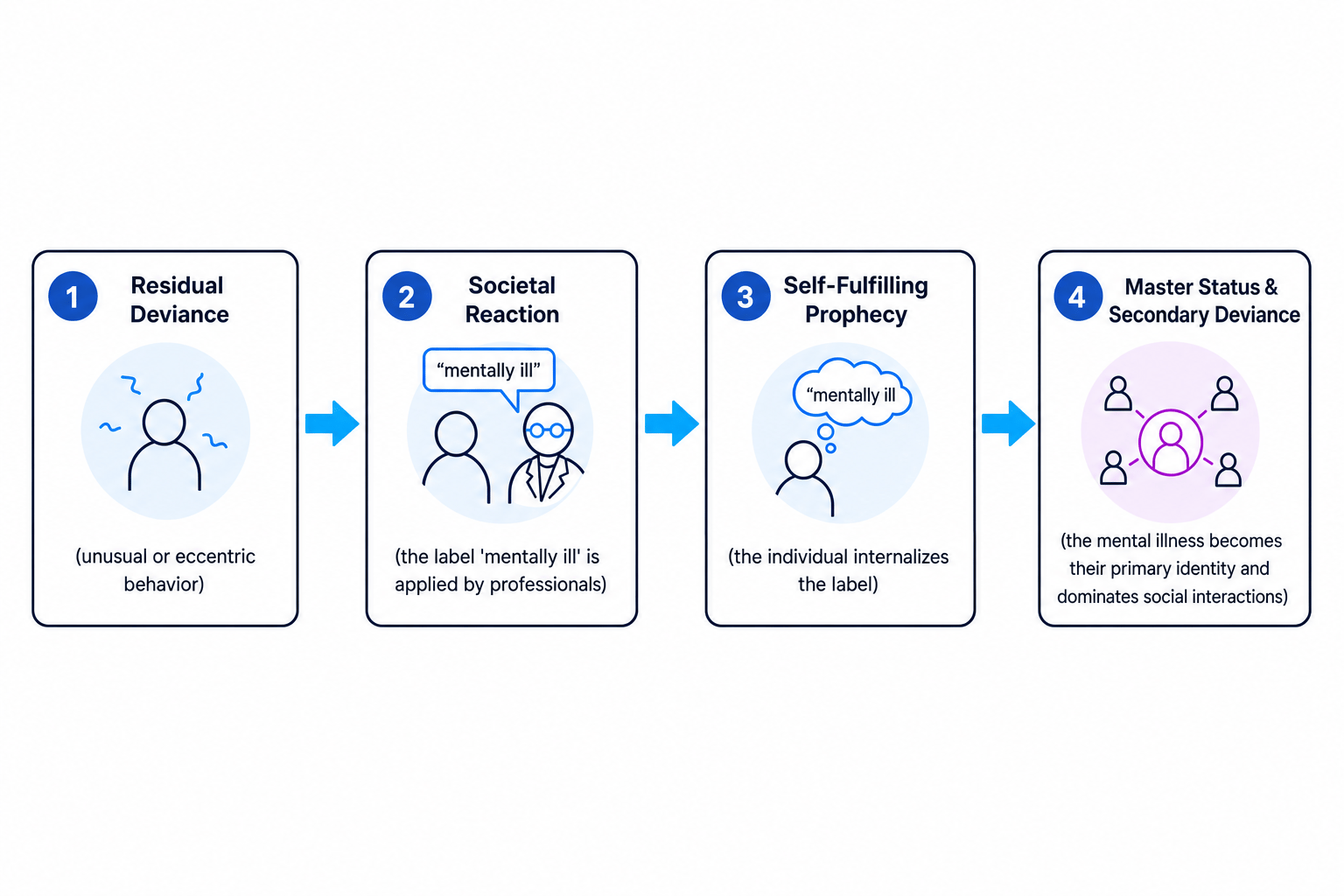
- Thomas Scheff (1966) – Residual Deviance: Scheff argued that most people occasionally commit "residual deviance"—bizarre, rule-breaking, or eccentric behaviors that do not fit into standard criminal categories. Usually, this behavior is ignored. However, if the behavior is highly visible or offensive to powerful people, the individual may be formally labelled "mentally ill."
- The Self-Fulfilling Prophecy: Once the label of "mentally ill" is applied by an expert (like a psychiatrist), it becomes the individual's master status. It overrides all other aspects of their identity. The individual internalizes this label and begins to act in ways that confirm it, leading to a career of chronic mental illness.
The Power of the Label
According to interactionists, psychiatric diagnoses are not objective discoveries; they are social labels that create a self-fulfilling prophecy. Once labelled, an individual is forced into a "sick role" from which it is incredibly difficult to escape.
- David Rosenhan (1973) – "On Being Sane in Insane Places": In this famous study, eight mentally healthy researchers (pseudo-patients) gained admission to psychiatric hospitals by claiming to hear voices saying words like "thud" or "empty." Once admitted, they stopped acting suspiciously and behaved completely normally. Yet, the hospital staff failed to detect their sanity. Their normal behaviors (such as taking notes) were recorded by staff as symptoms of their "schizophrenia in remission." This study demonstrated that psychiatric diagnoses are highly subjective and depend entirely on the context of the institution.
2. The Social Distribution of Mental Illness
Official UK statistics show that mental illness is not distributed equally. Your social class, gender, and ethnic background heavily influence your likelihood of being diagnosed with a psychiatric condition. Sociologists explain these patterns using two main competing frameworks:
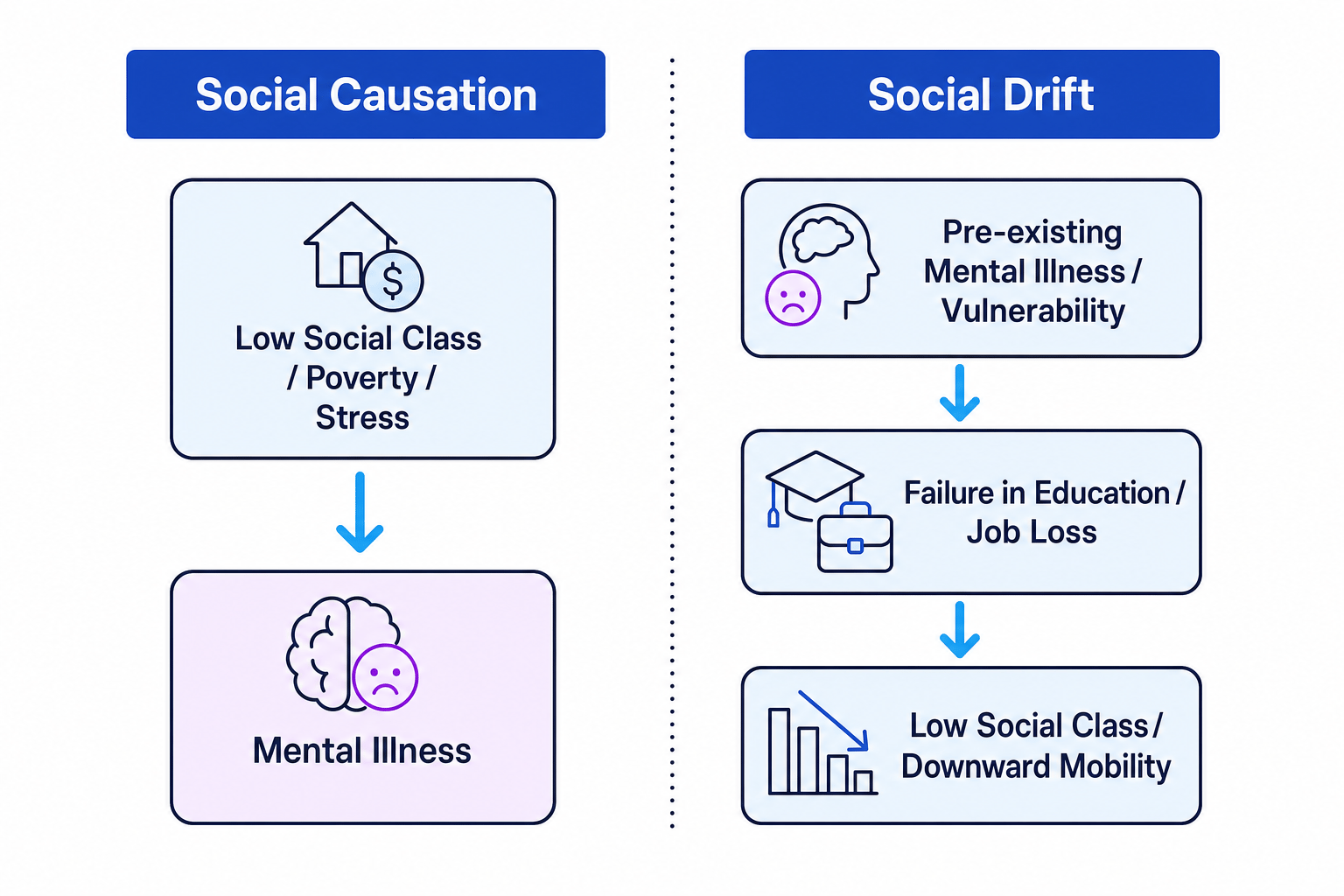
- Social Causation (Structuralist): Social conditions (such as poverty, racism, or sexism) cause genuine mental distress.
- Social Selection / Drift (Individualist/Interactionist): Individuals who suffer from mental illness lose their jobs or fail in school, causing them to drift down into lower social classes.
A. Social Class and Mental Illness
There is a striking, continuous social gradient in UK mental health: working-class individuals are far more likely to suffer from depression, anxiety, and schizophrenia than middle-class individuals.
1. The Social Causation Explanation
This perspective argues that the material realities of working-class life actively damage mental health.
- Material Deprivation and Stress: Poverty, debt, poor-quality housing, and job insecurity create chronic, relentless stress.
- Brown and Harris (1978) – Social Origins of Depression: In their study of working-class mothers in London, they identified vulnerability factors (such as having three or more children under the age of 14, lacking a confiding relationship, or losing their own mother in childhood) which, when combined with provoking agents (life events like an eviction or job loss), highly predicted clinical depression.
2. The Social Selection (Drift) Explanation
This view suggests the correlation is reversed. Mental illness causes lower social class, rather than the other way around.
- An individual with a pre-existing genetic or psychological vulnerability to a condition like schizophrenia will struggle to complete university, secure a high-paying job, or maintain stable housing.
- Consequently, they "drift" down the social class hierarchy into poverty.
Which explanation is stronger?
Most sociologists argue that social causation is the primary driver for common mental disorders like depression and anxiety, while social selection may play a stronger role in highly disabling, severe psychoses like chronic schizophrenia.
B. Gender and Mental Illness
Gender patterns in mental illness reveal a fascinating paradox in UK health statistics:
- Women are significantly more likely to be diagnosed with internalizing disorders (depression, anxiety, eating disorders, and self-harm).
- Men are more likely to be diagnosed with externalizing disorders (alcohol/drug dependency, anti-social personality disorder) and are roughly three times more likely to die by suicide.
1. Social Causation (Feminist & Structuralist Views)
Feminists argue that the structural position of women in patriarchal society causes high rates of mental distress:
- The Triple Shift: Women often perform paid work, domestic labor, and emotional management within families (Duncombe and Marsden), leading to severe burnout and chronic stress.
- Powerlessness and Abuse: Higher rates of domestic violence, sexual harassment, and the "gender pay gap" leave many women feeling trapped and powerless, which are strong psychological triggers for depression.
2. Social Construction & Labelling (Interactionist View)
This view argues that the statistics reflect gender stereotypes and diagnostic bias, rather than actual rates of illness:
- Help-Seeking Behavior: Socialization permits women to express vulnerability and seek medical help. Doctors are more likely to interpret women’s distress as "clinical depression" and prescribe medication.
- The Masculine Hegemonic Ideal: Men are socialized to show emotional strength and self-reliance. Seeking help for mental distress is often viewed as a sign of weakness. Consequently, men do not visit doctors, leaving their distress unrecorded in official statistics. Instead, their distress manifests through anti-social behavior, substance abuse, or sudden, tragic suicide.
C. Ethnicity and Mental Illness
One of the most controversial areas of UK health sociology is the relationship between ethnicity and psychiatric diagnoses.
- Black British people (specifically young men of Caribbean or African descent) are up to three to five times more likely to be diagnosed with schizophrenia than white British men.
- Black British people are also highly over-represented in compulsory admissions (being sectioned under the Mental Health Act) and are more likely to enter the mental health system via the police or criminal justice system.
1. The Diagnostic Bias / Institutional Racism Explanation
Sociologists like Cochrane (1977) and Pilgrim & Rogers (2005) argue that these figures do not represent a genuine epidemic of schizophrenia, but rather racism within the psychiatric system:
- Ethnocentric Criteria: White, middle-class psychiatrists often misunderstand cultural differences in communication, body language, or spiritual beliefs, misinterpreting expressive or emotional behavior as symptoms of mania or aggression.
- The "Big, Bad, and Black" Stereotype: Young Black men are stereotyped by society (including clinicians and police) as dangerous or violent. Consequently, their distress is more likely to be treated as a public security threat, leading to police intervention, forced sedation, and secure psychiatric detention rather than therapeutic counselling.
2. The Social Causation Explanation
Conversely, structural sociologists argue that Black communities in the UK face intense social pressures that cause genuine mental health crises:
- Systemic Racism: Facing daily microaggressions, structural discrimination in employment, housing, and aggressive police profiling (such as "stop and search") generates intense, chronic psychological stress.
- Socio-Economic Disadvantage: Ethnic minority groups are disproportionately concentrated in lower socio-economic classes, making them highly vulnerable to the class-based stresses of poverty and deprivation.
3. Worked Example
Analyzing ethnic disparities in psychiatric diagnoses
Consider a scenario where a sociologist is examining UK hospital data showing that young Black men are over-represented in admissions for acute psychosis in urban psychiatric wards.
- Step 1: Identify the empirical trend and construct a dual-hypothesis framework. The sociologist must avoid accepting the statistics as an unmediated truth. They set up two competing hypotheses to test the data:
- Hypothesis A (Social Causation): The high rate is a real increase in psychosis caused by severe environmental stressors.
- Hypothesis B (Diagnostic Bias): The high rate is an artifact of institutional racism and labelling within the diagnostic process.
-
Step 2: Collect and analyze indicators of environmental stress (Testing Social Causation). The sociologist correlates the zip codes of those admitted with indices of multiple deprivation. They discover that 85%85\%85% of the Black men admitted live in high-poverty, high-unemployment areas and have experienced documented encounters with the criminal justice system. This supports the social causation view, suggesting that racism and material deprivation act as powerful, continuous psychological stressors.
-
Step 3: Analyze clinical decision-making records (Testing Diagnostic Bias). The sociologist reviews clinical intake notes. They find that white patients displaying similar symptoms (such as agitation or talking loudly) are frequently described in notes as "distressed," "anxious," or "unwell," and treated voluntarily. In contrast, Black patients showing the same behaviors are more frequently described as "aggressive," "threatening," or "uncooperative," leading to compulsory sectioning. This provides strong qualitative evidence of diagnostic bias and stereotyping by medical staff.
-
Step 4: Formulate a synthesized sociological conclusion. The researcher concludes that both theories are vital and interdependent. Systemic racism in society creates real, severe psychiatric distress (social causation), while simultaneously, institutional racism within psychiatry ensures that when these individuals seek help, they are met with control and coercive labelling rather than therapeutic care.
Confusing Social Causation with Social Selection
Students frequently mix up these two concepts in essays.
- Remember: Causation means society causes the illness (Social Class →\rightarrow→ Mental Illness).
- Selection/Drift means the illness causes downward social mobility (Mental Illness →\rightarrow→ Social Class).
In the exam
- Deconstruct the statistics: Never accept official statistics on mental illness at face value. Always show the examiner you understand that statistics are socially constructed through help-seeking behaviors, diagnostic tools, and clinical biases.
- Juxtapose structural and interactionist views: For high-grade AO3 (evaluation), contrast structural causation (Marxism, feminism, materialist approaches) with interactionist labelling theories (Scheff, Rosenhan, Szasz). Use terms like "pathologize," "medicalization," "master status," and "structural inequalities."
- Use the "triple threat" of stratification: When writing an essay on the distribution of mental illness, structure your paragraphs systematically around Class, Gender, and Ethnicity.
Check yourself
- Why did David Rosenhan's "On Being Sane in Insane Places" study present a major challenge to the biomedical model of mental health?
- Explain the key difference between the social causation hypothesis and the social selection (drift) hypothesis.
- How can the "hegemonic masculine ideal" explain why men are less likely to be diagnosed with depression but far more likely to commit suicide in the UK?
