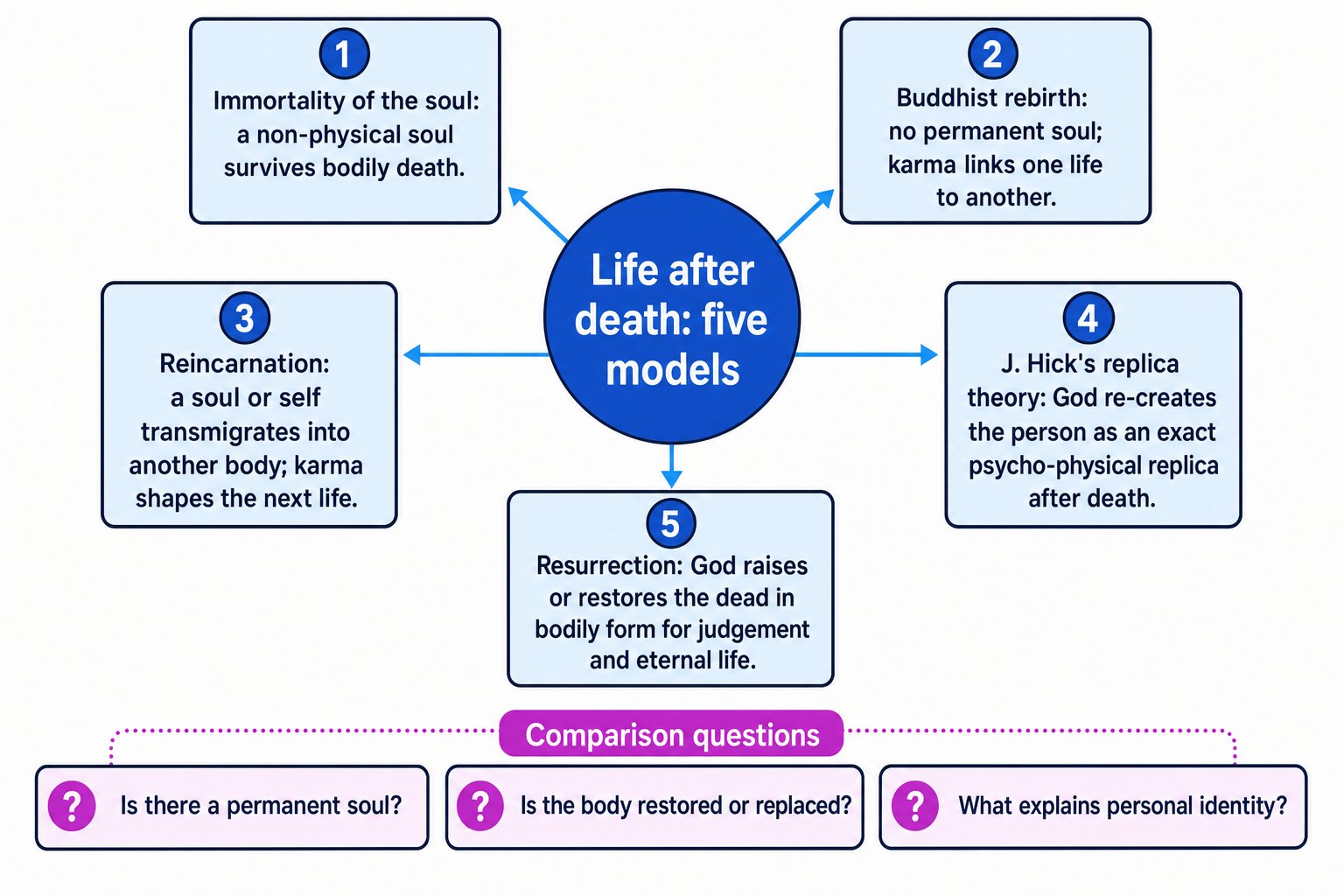
What you'll learn
- The key differences between immortality of the soul, rebirth, reincarnation, replica theory and resurrection.
- How different religious traditions explain what, if anything, continues after death.
- Why personal identity is the central philosophical problem in life-after-death debates.
- How to use J. Hick’s replica theory in evaluation, not just as description.
The big question: what continues after death?
This topic is not just asking, “Do people live after death?” It is asking a sharper question: what exactly survives, continues, is reborn, is recreated, or is restored?
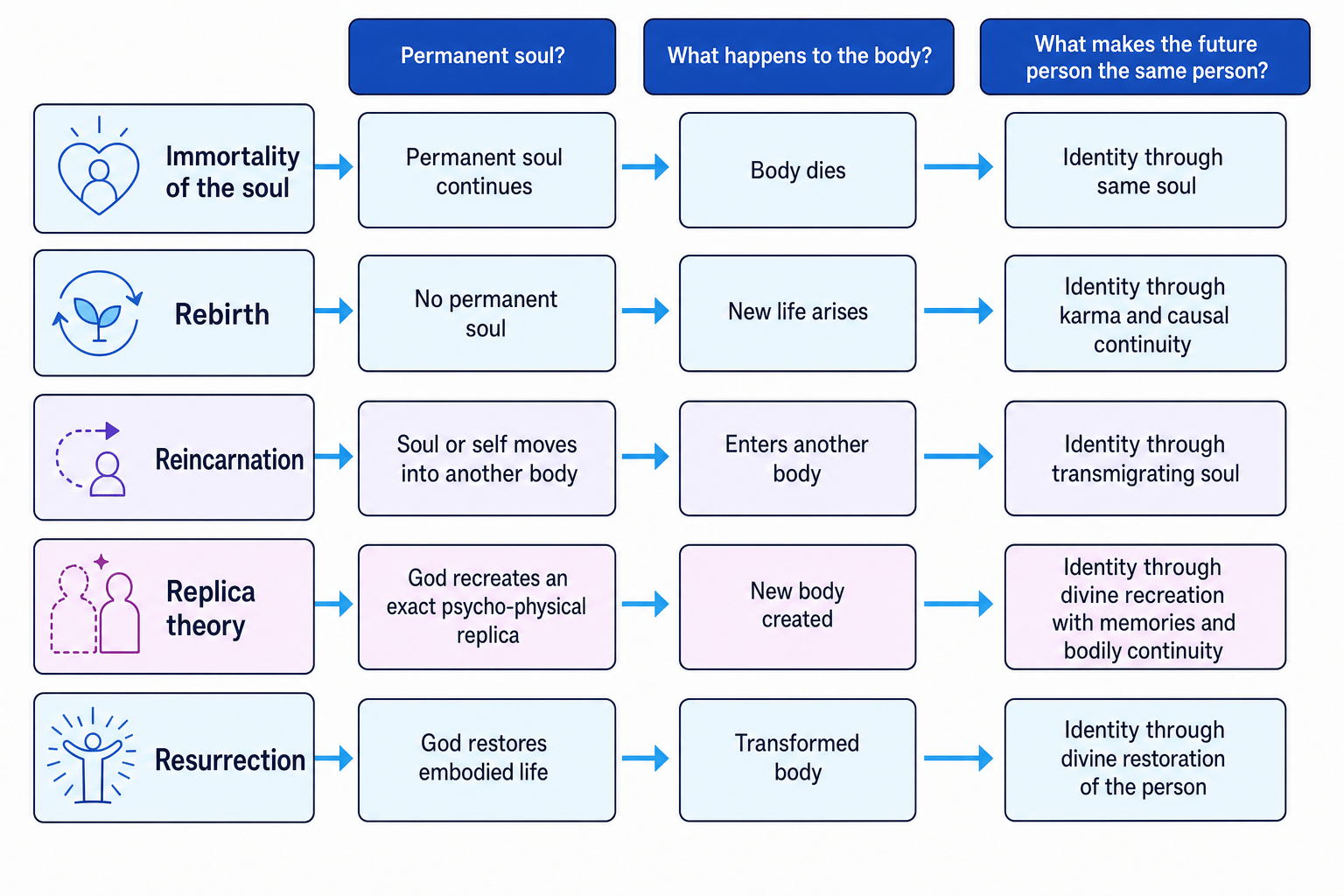
One helpful way to revise the topic is to map each view according to three questions: Is there a permanent soul? What happens to the body? What makes the future person the same person?
Core vocabulary
- Eschatology means beliefs about “last things”, such as death, judgement, heaven, hell, liberation or final destiny.
- A soul is usually understood as the non-physical or spiritual aspect of a person, often linked with consciousness, moral responsibility and identity.
- Personal identity means what makes someone the same person over time.
- Karma means the moral law of cause and effect: actions have consequences that shape future experience or future lives.
The central issue
All five views are trying to answer the same problem: how can “you” continue after bodily death? They disagree over whether the answer is soul, karma, divine recreation, or bodily resurrection.
Personal identity: why it matters
Before comparing traditions, you need the philosophical background.
If someone says, “I will survive death,” you can ask: in what sense will it still be you? There are several possible answers:
- Bodily continuity: the same body, or a restored body, continues.
- Psychological continuity: memory, character and consciousness continue.
- Soul continuity: the same immaterial soul continues.
- Causal or moral continuity: one life leads to another through karma, even without a permanent soul.
Testing a survival claim
- Identify what the view says continues after death: body, soul, memories, karma, or divine recreation.
- Ask whether that is enough for personal identity. For example, memories may show psychological continuity, but they might also be copied.
- Consider what the view still needs to explain. A soul view must explain how soul and body relate; a karma view must explain responsibility without a permanent self; a replica view must explain why the replica is not merely a copy.
Immortality of the soul
Immortality of the soul is the belief that the soul is non-physical, spiritual, and continues to exist after the death of the body.
This is often linked with dualism, the view that human beings are made of two different kinds of reality: body and soul. In Plato’s philosophy, especially in the Phaedo, the soul is superior to the body and naturally belongs to a non-material reality. The body dies, but the soul can continue.
In some religious traditions, soul-language is also used to describe an intermediate state after death. For example, many Christians speak of the soul being with God, although classical Christianity also teaches resurrection of the body. This distinction matters: immortality of the soul is not exactly the same as resurrection.
Strengths and weaknesses
The strength of this view is that it gives a simple answer to personal identity: the same soul continues. It also fits religious beliefs that humans are more than physical organisms.
However, it faces major challenges. If the soul is non-physical, how does it interact with the body? Also, thinkers influenced by materialism — the view that reality is ultimately physical — argue that personality and memory depend on the brain. Aristotle is also a useful contrast with Plato: for Aristotle, the soul is the “form” of the body, not obviously a separable ghost-like substance.
Soul survival is not automatically resurrection
Do not write as if Christianity simply teaches “the soul goes to heaven forever”. Traditional Christian doctrine is centred on resurrection, where God restores or transforms embodied life.
Rebirth: no unchanging soul
Rebirth is especially associated with Buddhism. It is the belief that life continues in a new form, but without an unchanging soul passing from one body to another.
A key Buddhist teaching is anatta, meaning “no permanent self” or “no unchanging soul”. The person is made up of changing physical and mental processes. When one life ends, karma conditions a new life, rather like one flame lighting another flame: there is continuity, but not a single fixed substance travelling across.
Karma is crucial here. It is not usually understood as punishment from God. Instead, it is a moral and causal law: actions motivated by greed, hatred and ignorance produce suffering, while wisdom and compassion help move towards liberation.
Evaluation
Rebirth avoids the problem of explaining a detachable soul. It also fits the Buddhist view that clinging to a permanent self is part of the problem.
The difficulty is moral responsibility. If there is no unchanging self, in what sense is the later life responsible for the earlier life’s karma? A Buddhist response is that responsibility depends on causal continuity, not on a permanent soul.
Reincarnation: transmigration of souls
Reincarnation is the belief that a soul or self is reborn in another body. The technical term transmigration means the movement of the soul from one body to another.
This is strongly associated with Hindu traditions. Many Hindu thinkers distinguish between the temporary body and the atman, the true self or soul. The atman passes through many lives within samsara, the cycle of birth, death and rebirth. Karma shapes the circumstances of future lives. The ultimate goal is moksha, liberation from samsara.
Sikh traditions also include belief in rebirth and liberation, often expressed as mukti, although Sikh teaching places strong emphasis on God’s grace and living in harmony with divine reality.
Rebirth and reincarnation are not the same
Reincarnation usually means a soul or self moves into another body. Buddhist rebirth denies a permanent soul and explains continuity through karma and causal connection.
Distinguishing rebirth from reincarnation
- Suppose a student writes: “Buddhists believe your soul moves into another body because of karma.”
- Compare that claim with Buddhist anatta. If there is no permanent soul, then “your soul moves” is not accurate for Buddhism.
- Correct the claim: Buddhists teach that karma conditions a new life, but not that an unchanging soul transmigrates.
J. Hick’s replica theory
Replica theory is J. Hick’s attempt to show that life after death, especially resurrection, is logically possible. Hick argues that a person could die in one body and continue in another body if God recreated that person as an exact psycho-physical replica. Psycho-physical means involving both mental and bodily features.
Hick was not simply defending a ghostly soul. He treated persons as embodied beings. His theory tries to make sense of resurrection without needing the original atoms of the body to be reassembled.
Replica theory
Hick’s replica theory is the view that God could recreate a person after death as an exact psycho-physical replica, preserving enough bodily and psychological continuity for the person genuinely to continue.
Hick develops the idea through thought experiments. Imagine someone disappears in London and an exact replica appears in New York with the same memories, character and bodily features. Hick then extends this idea to death: if God creates the replica after bodily death, perhaps the person has survived.
This connects with Hick’s idea of eschatological verification: a belief about life after death could be verified after death if true, even though it cannot be verified by the dead person if false.
Evaluation of Hick
Hick’s theory is useful because it supports resurrection while avoiding crude physicalism. It also respects the idea that persons are embodied, not just souls trapped in bodies.
But there is a serious problem: is a replica really the same person, or only a copy? If two replicas were created, both could not be numerically identical with the original person. So psychological similarity alone may not be enough.
Applying Hick’s duplication challenge
- Imagine God creates one replica with your memories, character and bodily appearance. Hick can argue that this preserves psycho-physical continuity.
- Now imagine two identical replicas are created. They cannot both be the one original person, because one individual cannot be identical with two separate individuals.
- Therefore Hick needs more than similarity. He needs a unique divine act of continuation, otherwise replica theory risks becoming replacement rather than survival.
Resurrection: bodily restoration by God
Resurrection is the belief that God will restore the dead in bodily form to eternal life. This is central in Christianity and Islam, and also appears in important strands of Jewish belief.
In Christianity, Jesus’ resurrection is the model and guarantee of future resurrection. Paul describes resurrection life as a transformed “spiritual body” in 1 Corinthians 15, meaning not a ghost, but a body transformed by God. In Islam, belief in the Day of Judgement includes bodily resurrection, accountability, paradise and hell. In Judaism, beliefs vary, but many forms of rabbinic Judaism include hope in resurrection and the world to come.
Resurrection differs from immortality of the soul because it values the body. The final hope is not simply escape from physical existence, but restored embodied life with God.
Evaluation
Resurrection has strong religious power because it connects life after death with divine justice: evil is judged, suffering can be redeemed, and embodied human life is affirmed.
The challenge is coherence. If bodies decay, what body is raised? Hick’s replica theory helps here: God does not need to gather the same particles, but can recreate the person. However, critics may still ask whether this is genuine survival or divine copying.
Comparing the five views
| View | What continues? | Key tradition or thinker | Main strength | Main pressure point |
|---|---|---|---|---|
| Immortality of the soul | Non-physical soul | Plato; some religious soul-beliefs | Clear soul continuity | Soul-body interaction |
| Rebirth | Karmic continuity without permanent soul | Buddhism | Fits anatta | Responsibility without same self |
| Reincarnation | Soul or self in new body | Hinduism; some Sikh beliefs | Explains moral development across lives | Evidence and memory problems |
| Replica theory | God-created psycho-physical replica | J. Hick | Makes resurrection logically possible | Copy or same person? |
| Resurrection | God-restored embodied life | Christianity, Islam, Judaism | Affirms body and divine justice | Identity of restored body |
Building an evaluative judgement
For Edexcel essays, avoid listing views as if they are all the same. A strong answer compares them around a central issue, such as personal identity, justice, or coherence.
A balanced judgement might be:
- Rebirth is internally coherent within Buddhism because it does not require a permanent soul.
- Reincarnation gives a clear moral structure through karma, but may struggle to explain why most people do not remember past lives.
- Immortality of the soul gives a simple continuity claim, but depends on a controversial dualism.
- Resurrection, especially with Hick’s replica theory, may be philosophically defensible if God exists, but is less persuasive to a materialist or atheist.
Best use of Hick
Hick is strongest as a defence of the logical possibility of resurrection. He does not prove that resurrection happens; he argues that the idea of post-mortem personal survival is not meaningless or obviously incoherent.
In the exam
- Start by defining the model you are discussing, especially whether it involves a soul, karma, divine action or bodily restoration.
- Use Hick accurately: replica theory is about God recreating a psycho-physical person, not simply a soul floating away.
- Evaluate through personal identity: ask whether the future being is genuinely the same person, and whether the view depends on assumptions such as God, karma or dualism.
Check yourself
- What is the difference between Buddhist rebirth and Hindu reincarnation?
- Why does Hick’s replica theory face the “copy or same person?” problem?
- How is resurrection different from immortality of the soul?