What you'll learn
- How dualism, monism and Aristotle’s hylomorphism shape beliefs about life after death.
- Why Plato is usually more supportive of an immortal soul than Aristotle.
- How moral reasoning, near-death experiences, evidence and religious language are used in debates about the afterlife.
- How to turn these ideas into balanced Edexcel-style evaluation.
The big question: what has to survive?
Before you can assess “life after death”, you need to ask: what is the person? If a person is mainly an immaterial soul, survival after bodily death may seem possible. If a person is inseparable from the body, then death looks much more final unless God resurrects or re-creates the whole person.
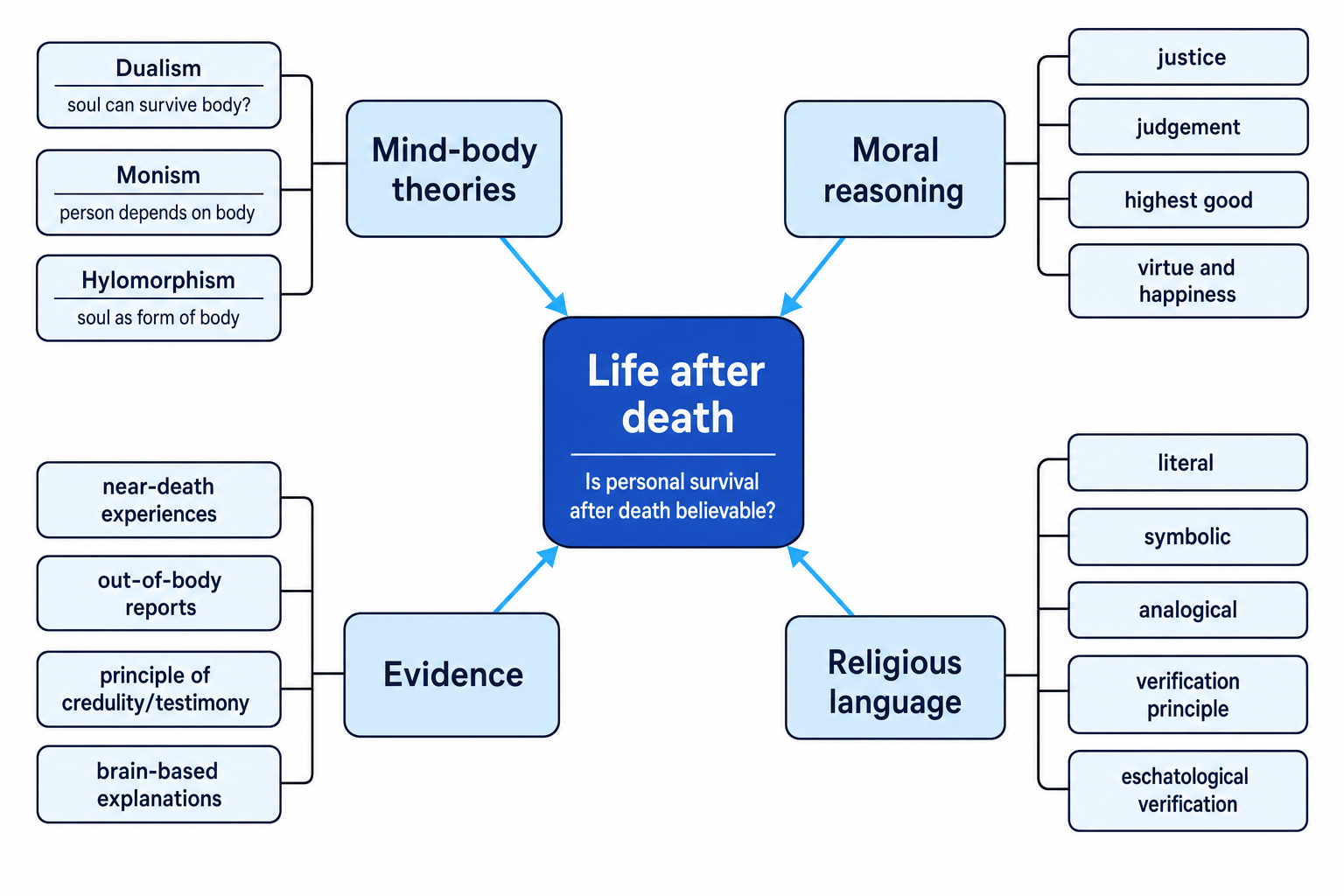
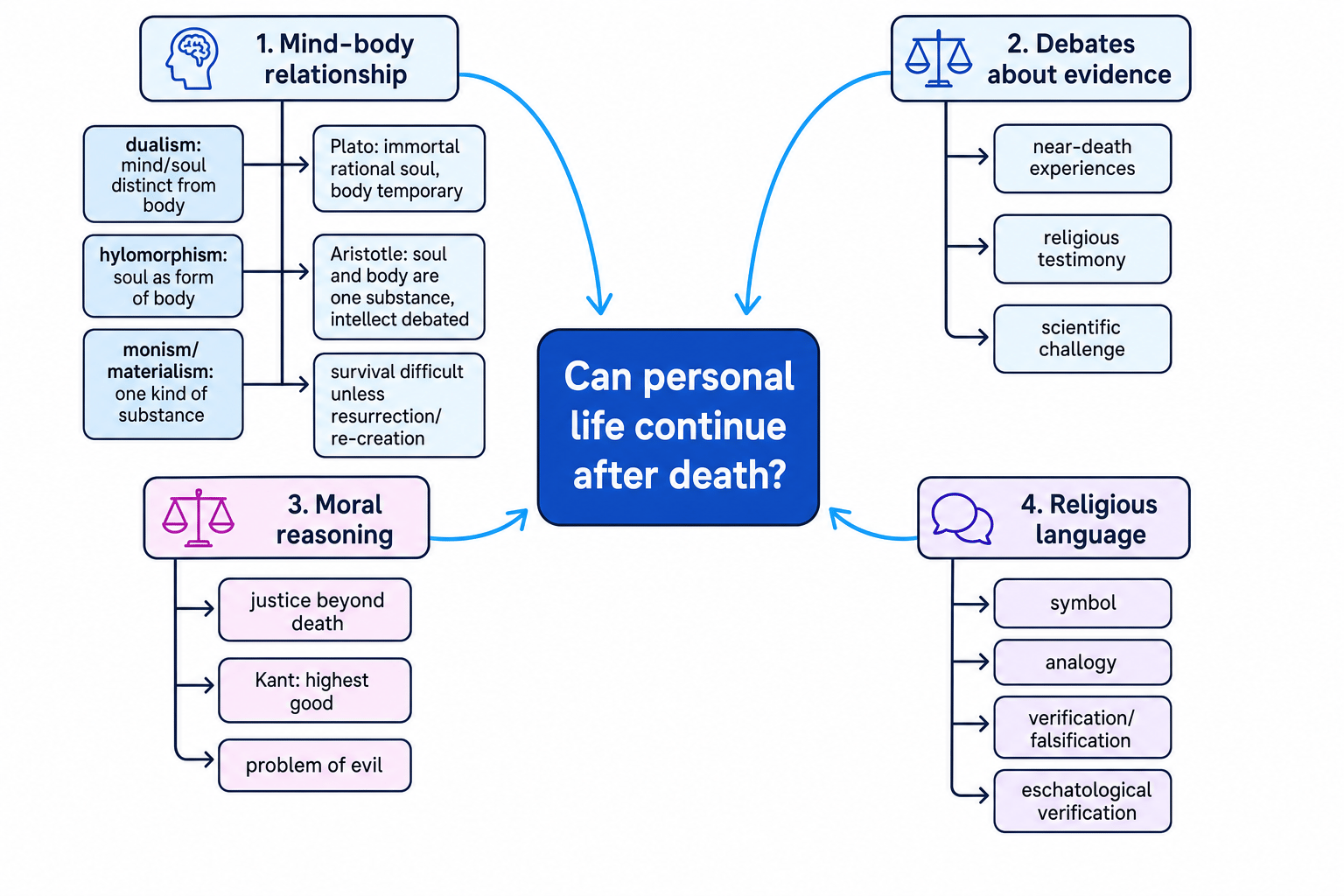
This map shows the main routes through the debate: mind-body theory, moral reasoning, evidence and religious language all feed into whether personal survival after death is believable.
Life after death
Life after death means some form of continued existence after bodily death. This might be understood as the immortality of the soul, resurrection, reincarnation, rebirth, or some other form of continued personal existence.
Mind and body: the starting point
Dualism
Dualism
Dualism is the view that the human person is made up of two distinct aspects: a physical body and a non-physical mind or soul.
In life-after-death debates, dualism is important because it can explain how someone might survive bodily death. If the soul is not identical to the body, it may continue when the body dies.
A strong form is substance dualism, where mind/soul and body are two different kinds of substance. Plato is often read this way: the soul belongs more naturally to the eternal world of truth, while the body belongs to the changing physical world.
A softer form is property dualism, where there is one person or organism, but mental properties such as consciousness cannot be reduced completely to physical brain states. This may support the idea that humans are more than machines, though it does not automatically prove survival after death.
Plato: the soul as immortal
Plato argues that the soul is the true self. In the Phaedo, Socrates presents death as the separation of soul from body. The body distracts us with appetite, pain and illusion, while the rational soul seeks truth.
Plato’s view links to his wider theory of the Forms.
Forms
For Plato, the Forms are eternal, perfect realities such as Beauty, Justice and Goodness. Physical things are imperfect copies of these unchanging truths.
Plato’s argument from recollection claims that learning is really remembering. For example, we can recognise imperfect equality in the world because the soul has prior knowledge of perfect Equality itself. This suggests the soul existed before birth. If it existed before embodiment, Plato thinks it is reasonable to believe it can exist after death too.
He also gives an affinity argument: the soul is more like the invisible, rational and unchanging Forms than like the visible, changing body. Therefore, the soul is naturally fitted for continued existence.
Plato and survival
Plato strongly supports life after death because the rational soul is not dependent on the body for its existence. However, his view raises questions about whether a disembodied rational soul is still recognisably “you”.
Applying Plato to personal survival
-
Identify what Plato thinks the person most truly is: not the changing body, but the rational soul.
-
Link this to his metaphysics: the soul is closer to eternal Forms than to temporary physical objects, so it is less likely to perish with the body.
-
Evaluate the personal identity issue: if emotions, relationships and memories depend partly on embodiment, then Plato may prove survival of a soul without fully proving survival of the whole person.
Aristotle: soul and body as one living substance
Aristotle rejects Plato’s sharp separation between the world of Forms and the physical world. For Aristotle, form is found in things, not in a separate realm.
Hylomorphism
Hylomorphism is Aristotle’s view that every physical substance is a compound of matter and form. In human beings, the body is the matter and the soul is the form of a living body.
For Aristotle, the soul is not a ghost inside the body. It is the organising principle that makes a living body alive. A useful phrase is: the soul is to the body as sight is to the eye. Sight is real, but it cannot float around separately from an eye.
Aristotle distinguishes levels of soul:
- Vegetative soul: nutrition and growth, found in plants.
- Sensitive soul: perception and desire, found in animals.
- Rational soul: reason and intellect, distinctive of humans.
This makes Aristotle less naturally supportive of personal life after death than Plato. If the soul is the form of the body, then when the living body dies, the individual soul seems to cease too.
There is a complication: Aristotle sometimes speaks of intellect as separable, impassible and eternal. Some interpreters see this as allowing survival of rational intellect. However, it is not clearly the survival of an individual person with memories and relationships.
Making Aristotle too Platonic
Do not write as if Aristotle simply believed in an immortal soul like Plato. Aristotle’s soul is normally the form of the body, so his view makes individual personal survival much harder to defend.
Monism: one kind of reality
Monism
Monism is the view that reality is ultimately made of one kind of substance, rather than two separate substances such as body and soul.
The most important form for this topic is materialism or physicalism, the view that everything about a person depends on physical processes. On this view, consciousness is produced by the brain. When the brain dies, the person dies.
Some religious thinkers respond by rejecting a naturally immortal soul and defending resurrection instead. In resurrection belief, God restores or re-creates the whole person. This can fit better with monism because it does not require a soul to escape the body.
Resurrection
Resurrection means being raised to new life after death, usually understood as the restoration or transformation of the whole person rather than the escape of a soul from the body.
Essay contrast
A clear contrast is: Plato supports survival by separating soul from body; Aristotle challenges survival by uniting soul and body; resurrection tries to preserve embodied personhood without Platonic dualism.
Moral reasoning and life after death
Belief in life after death is often connected to moral reasoning. If good people suffer and wicked people prosper, the world can seem morally incomplete. An afterlife may allow justice, judgement, reward or moral growth beyond death.
Plato uses this kind of reasoning in myths such as the Myth of Er in the Republic, where souls are judged and choose future lives. The story supports the idea that justice matters eternally, not just socially.
A later important comparison is Immanuel Kant. Kant does not claim to prove immortality theoretically. Instead, he argues that morality requires us to postulate God and immortality. The highest good means a state where virtue and happiness are properly united. Since this is not achieved in ordinary life, Kant thinks immortality is needed for endless moral progress.
Postulate
A postulate is something assumed as practically necessary for moral reasoning, rather than proven as a scientific or logical fact.
Aristotle offers a useful challenge. His ethics focuses on eudaimonia, meaning human flourishing or living well through virtue. This is mainly this-worldly and embodied. Aristotle does not need heaven or hell to explain why virtue matters.
Using moral reasoning in evaluation
-
Start with the moral problem: in this life, virtue and happiness often do not match, because innocent people suffer and unjust people may flourish.
-
Apply the afterlife claim: judgement, heaven, hell, karma or continued moral progress could make reality morally coherent.
-
Evaluate the weakness: moral desire for justice does not prove that an afterlife exists; it may show what humans hope is true rather than what is actually true.
Near-death experiences and the role of evidence
Near-death experience
A near-death experience is an experience reported by someone close to death or temporarily clinically dead, often involving features such as leaving the body, travelling through a tunnel, encountering light, or meeting deceased relatives.
Near-death experiences, often shortened to NDEs, are used by some as evidence that consciousness can exist apart from the body. Reports of out-of-body experiences are especially significant because some people claim to have seen events they could not have known about normally.
Supporters may appeal to Richard Swinburne’s principle of credulity, the idea that we should generally trust experiences unless we have good reason not to. They may also use the principle of testimony, the idea that we usually trust sincere reports from others.
However, critics argue that NDEs may be explained by brain chemistry, oxygen deprivation, medication, memory reconstruction or cultural expectation. The experiences are also difficult to test publicly. A Christian may interpret a being of light as Christ, while someone from another tradition may interpret it differently.
Assessing an NDE as evidence
-
Ask what kind of evidence is being offered: a private experience, a testimony, or a publicly checkable claim such as accurate perception during an out-of-body experience.
-
Weigh the interpretation: the experience may show that something unusual happened, but it does not automatically prove a specific doctrine such as heaven, reincarnation or resurrection.
-
Reach a balanced judgement: NDEs can challenge strict materialism, especially if independently verified, but they are not strong enough on their own to settle the afterlife debate.
Evidence is not neutral
Evidence always needs interpretation. The same NDE might be taken as proof of heaven, evidence of brain activity under stress, or a symbolic psychological experience.
Religious language and the afterlife
Beliefs about life after death use language that is difficult to verify in ordinary life. Words such as “heaven”, “judgement”, “soul” and “eternity” may not work like everyday factual descriptions.
Religious language
Religious language is language used to speak about God, ultimate reality, religious experience, salvation, death and the afterlife.
Some religious language may be literal, meaning it aims to describe reality directly. For example, “there will be a resurrection” may be treated as a factual claim.
Other language may be analogical, meaning it speaks by comparison. Heaven as “home” may not mean a physical house, but a state of belonging with God.
Other language may be symbolic, meaning it participates in or points towards a deeper reality. Fire in hell, for example, may symbolise alienation from God rather than literal flames.
A key debate is verification.
Verification principle
The verification principle is the claim, associated with A. J. Ayer, that a statement is meaningful only if it is analytic by definition or empirically verifiable in principle.
At first, afterlife claims seem unverifiable because no living person can check them in the normal way. John Hick responds with eschatological verification.
Eschatological verification
Eschatological verification is John Hick’s idea that some religious claims could be verified after death if they are true. “Eschatological” means concerning the last things, such as death, judgement and ultimate destiny.
Hick’s famous parable imagines two travellers on a road. One believes the road leads to a Celestial City; the other does not. If they arrive, the believer is verified. Hick argues that life after death could be like this: not verifiable now, but verifiable at the end.
The weakness is that if there is no afterlife, no one experiences falsification. So critics may say afterlife claims are not genuinely testable in both directions.
Language and meaning
Afterlife language may still be meaningful even if it is not presently provable. The key evaluation issue is whether meaningfulness requires public verification, or whether analogy, symbol and future verification are enough.
Bringing Plato and Aristotle into comparison
| Issue | Plato | Aristotle |
|---|---|---|
| Mind-body view | Strong dualism: soul and body are distinct | Hylomorphism: soul is form of the body |
| Soul | Immortal, rational, closer to Forms | The life-principle of an embodied organism |
| Afterlife | Strongly supported, especially for rational soul | Individual survival is difficult and debated |
| Ethics | Soul should be purified from bodily distraction | Virtue aims at embodied flourishing |
| Main weakness | May undervalue the body and weaken personal identity | May leave little room for personal life after death |
A strong essay does not simply say “Plato is right” or “Aristotle is right”. It asks what each explains well. Plato explains why survival after death is possible if the soul is independent. Aristotle gives a more unified account of human nature and avoids treating the body as a prison, but this makes afterlife belief harder to defend.
Forgetting the personhood question
Do not only ask, “Can a soul survive?” Ask, “Would that surviving soul still be the same person?” Personal identity is central to evaluation.
Overall evaluation
Plato gives the clearest philosophical support for life after death because his dualism makes the soul naturally separable from the body. His arguments from recollection and affinity fit well with immortality, and his moral myths connect afterlife with justice.
However, Aristotle may be more persuasive for many modern thinkers because his account fits ordinary experience: we encounter people as embodied beings, not as souls temporarily trapped in bodies. If memory, character, emotion and relationship are bodily as well as mental, then disembodied survival may seem incomplete.
NDEs and moral reasoning can support belief in life after death, but they do not prove it conclusively. Religious language debates show that afterlife claims may be meaningful even when not currently verifiable, especially if Hick’s eschatological verification is accepted. The strongest judgement might be that life after death is philosophically possible on dualist grounds, morally attractive, and religiously meaningful, but evidentially contested.
In the exam
-
Start with the mind-body issue: explain whether the view you are discussing is dualist, monist or hylomorphic.
-
Use Plato and Aristotle accurately: Plato supports immortality of the rational soul; Aristotle usually makes individual survival more difficult.
-
Evaluate, do not just describe: test afterlife belief through personal identity, moral justice, NDE evidence and religious language.
Check yourself
- Why does Plato’s theory of the soul support life after death more strongly than Aristotle’s hylomorphism?
- How might a near-death experience be used as evidence, and what are two criticisms of that evidence?
- What does Hick mean by eschatological verification, and why might critics still object?