What you'll learn
- How Russell’s and Copleston’s backgrounds shape their views on religion.
- How Copleston uses the argument from contingency to defend belief in God.
- How Russell challenges the need for a final explanation of the universe.
- How their disagreement can be applied to religious experience and essay evaluation.
Why this comparison matters
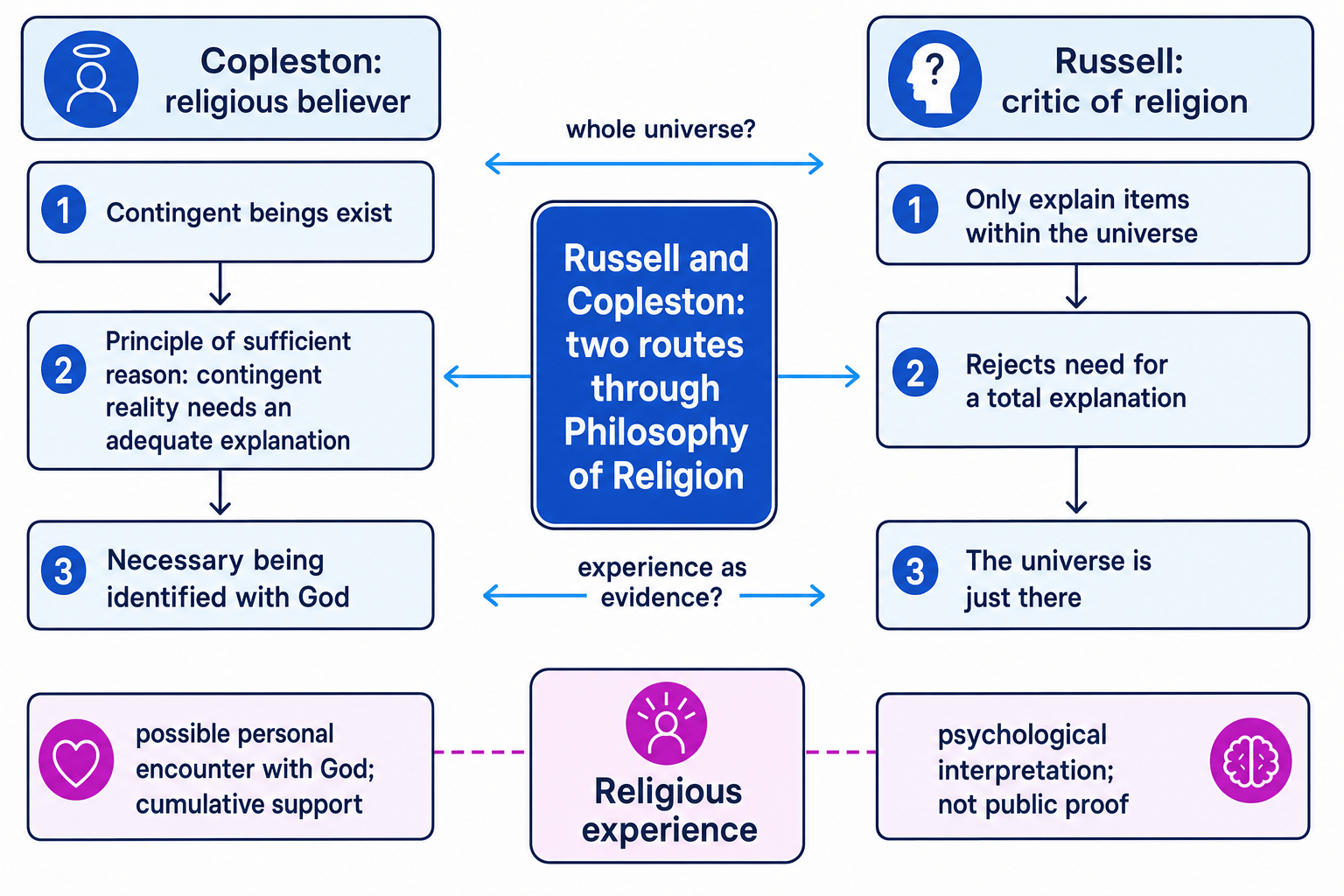
This topic is from Works of scholars, so Edexcel expects you to compare two named thinkers, not just describe “atheism versus theism” in general. Russell and Copleston are especially useful because they directly debated each other about the existence of God in a 1948 BBC radio debate, often known as “The Existence of God”.
Bertrand Russell is the critic of religion. Frederick Copleston is the religious believer. But avoid turning them into cartoon opposites: Russell is not merely “anti-God”, and Copleston is not merely “believe without evidence”. Their debate is about what counts as a good explanation.
The two thinkers in context
Bertrand Russell: critic of religion
Bertrand Russell (1872–1970) was a British philosopher, logician and public intellectual. He helped shape modern analytic philosophy, which values clarity, logical precision and careful use of language.
Russell criticised Christianity in works such as “Why I Am Not a Christian”. He argued that many religious beliefs rest on fear, tradition or emotional need rather than sound reasoning. In the debate with Copleston, Russell does not try to disprove God scientifically. Instead, he questions whether the demand for a total explanation of the universe makes sense.
Critic of religion
A critic of religion is someone who challenges the truth, rationality, morality or social effects of religious belief. In this topic, Russell mainly challenges whether religious belief is rationally justified.
Frederick Copleston: religious believer
Frederick Copleston (1907–1994) was a Jesuit priest and philosopher, best known for his multi-volume A History of Philosophy. He was strongly influenced by the Catholic philosophical tradition, especially thinkers such as Aquinas and Leibniz.
Copleston believes reason can support faith. He does not claim that a philosophical argument gives a full personal knowledge of God, but he thinks it can show that belief in God is intellectually reasonable.
Context shapes method
Russell approaches religion with suspicion towards metaphysical claims that go beyond evidence. Copleston approaches it through classical theism, where God is the ultimate explanation of contingent reality.
Prerequisites: contingency, necessity and explanation
Before comparing them, you need three key terms.
Contingent being
A contingent being is something that exists but does not have to exist. It depends on something else for its existence. You, a tree, a planet and a chair are all contingent.
Necessary being
A necessary being is a being that cannot not exist. In classical theism, God is understood as necessary, self-existent and not dependent on anything else.
Principle of sufficient reason
The principle of sufficient reason is the claim that there must be an adequate explanation for why something exists or is the case, rather than not.
Copleston’s argument is a posteriori, meaning it begins from experience of the world. It starts with the fact that contingent things exist and asks what explains them.
A related term is aseity, meaning God’s self-existence or independence. To say God has aseity is to say God does not receive existence from anything else.
Copleston’s argument from contingency
Copleston’s argument is not simply “everything has a cause, so God caused the universe.” That would be too crude. His point is about dependence and explanation.
He argues roughly like this:
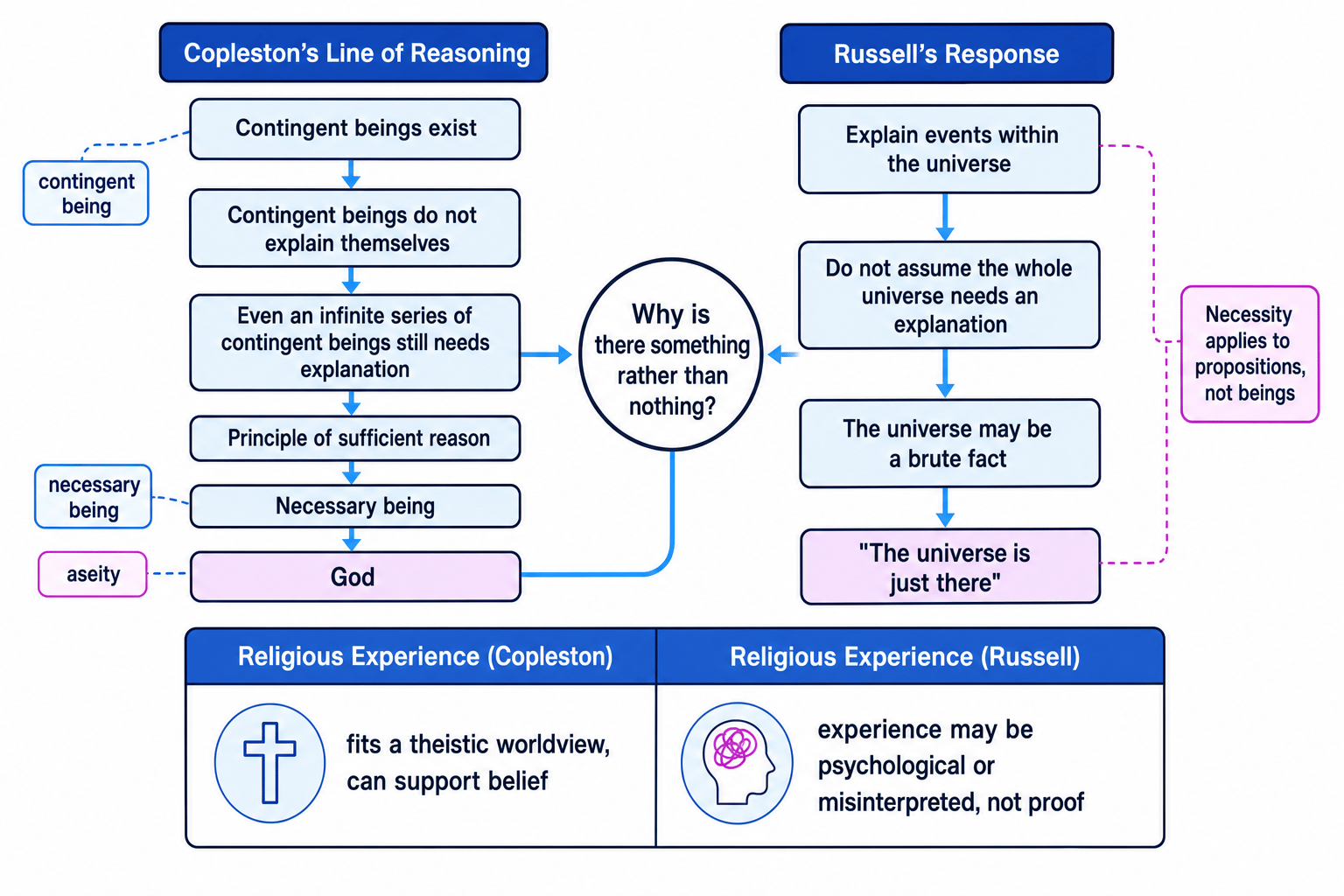
- Contingent things exist.
- Contingent things do not contain the reason for their own existence.
- Even if the universe were an infinite series of contingent things, the whole series would still need an explanation.
- The explanation cannot itself be merely contingent, or the problem continues.
- Therefore, there must be a necessary being.
- This necessary being is what religious believers call God.
Copleston is asking: why is there something rather than nothing?
Tracing the contingency argument
-
Start with an ordinary contingent thing, such as a person. That person exists, but could have failed to exist, so their existence depends on factors beyond themselves.
-
Extend the reasoning to the wider universe. Copleston argues that a collection of dependent things does not become self-explanatory simply by being very large or even infinite.
-
Apply the principle of sufficient reason. If contingent reality exists, there must be an adequate explanation of why it exists at all.
-
Identify the proposed conclusion. Copleston says the final explanation must be necessary rather than contingent, otherwise it would also need a further explanation.
Making Copleston too simplistic
Do not write that Copleston says “everything has a cause, therefore God has no cause.” His argument is more subtle: contingent things need explanation, but a necessary being would not be contingent.
Russell’s critique of Copleston
Russell’s famous reply is that “the universe is just there, and that’s all.” This does not mean he has proved the universe has no explanation. It means he rejects Copleston’s assumption that the universe as a whole must have one.
1. Russell rejects the principle of sufficient reason
Russell does not accept that everything must have a sufficient explanation. For him, some facts may be brute facts.
Brute fact
A brute fact is a fact with no deeper explanation. Russell treats the existence of the universe as something we may simply have to accept rather than explain through God.
This is a major clash. Copleston thinks stopping at the universe is intellectually unsatisfying. Russell thinks moving from the universe to God adds an unnecessary metaphysical claim.
2. Russell questions “necessary being”
Russell argues that necessity properly applies to propositions, not things. For example, a logical truth may be necessary, but Russell doubts whether it makes sense to say a being exists necessarily.
Copleston disagrees. For him, “necessary being” is meaningful because God is not one item inside the universe. God is the ultimate ground of existence itself.
3. Russell challenges explanation of the whole universe
Russell is willing to explain events within the universe. For example, science can explain why a star forms or why a person is born. But he questions whether it makes sense to ask for a cause of the whole universe.
This resembles the fallacy of composition: wrongly assuming that what is true of every part must be true of the whole. Just because every event inside the universe may have an explanation, it does not automatically follow that the universe as a whole has one.
The central disagreement
Copleston thinks contingent reality cries out for a necessary explanation. Russell thinks the demand for a total explanation is optional and perhaps confused.
Evaluating the contingency debate
A strong essay needs more than “Copleston believes; Russell disagrees.” You need to judge which position is more convincing and why.
| Issue | Copleston | Russell | Evaluation |
|---|---|---|---|
| Starting point | Contingent things exist | Agrees ordinary things exist | Copleston’s starting point is strong because it begins with experience |
| Need for explanation | Contingency requires sufficient reason | Not every fact needs deeper explanation | The debate depends heavily on whether the principle of sufficient reason is accepted |
| Universe as a whole | The whole contingent series needs explanation | The universe may be a brute fact | Russell is economical, but Copleston may seem more satisfying |
| God as conclusion | Necessary being explains contingent reality | Necessary existence is questionable | Copleston must still justify why the necessary being is God |
Best evaluation move
Ask whether Russell’s “just there” is a genuine explanation or a refusal to explain. Your judgement can turn on whether brute fact is more reasonable than necessary being.
Applying their ideas to religious experience
Religious experience
A religious experience is an experience interpreted by the person as an encounter with, or awareness of, God or ultimate reality.
Religious experiences are often described using William James’ terms: ineffable means difficult to put into words; noetic means seeming to give knowledge; transient means short-lived; and passive means the person feels the experience happens to them rather than being fully controlled by them.
Copleston is not mainly known for a separate religious-experience argument, but his worldview makes religious experience more plausible. If God is the necessary ground of existence, then it is reasonable to think people might encounter God personally through prayer, worship or mystical awareness.
Russell’s approach is more sceptical. He could accept that someone has had a powerful experience while denying that the experience proves God exists. The experience might be psychological, emotional, culturally shaped or misinterpreted.
Evaluating a claimed religious experience
-
Consider the believer’s interpretation. A person who experiences God in prayer may argue that the experience is noetic because it seems to reveal truth, not just emotion.
-
Apply Copleston’s wider worldview. If God exists as the necessary being, then religious experience fits coherently within a theistic understanding of reality.
-
Apply Russell’s scepticism. A private experience is not automatically public evidence, especially if similar experiences occur in different religions with conflicting beliefs.
-
Reach a balanced judgement. The experience may rationally support belief for the individual, but Russell would deny that it gives a decisive proof for everyone.
Confusing experience with interpretation
Do not say Russell must deny that religious experiences happen. His stronger point is that having an experience does not prove the religious interpretation of it is true.
How to compare them in an essay
The best answers compare throughout. Do not write one long paragraph on Copleston, then one long paragraph on Russell, and only compare in the conclusion.
A useful paragraph pattern is:
- Explain Copleston’s claim.
- Bring in Russell’s direct challenge.
- Analyse which assumption is stronger.
- Link back to religion and belief.
For example, on contingency, the hidden assumption is the principle of sufficient reason. On religious experience, the hidden assumption is whether private experience can count as evidence for a public truth claim.
A possible overall judgement
You could argue that Copleston gives the deeper metaphysical account because he takes seriously the question of why anything exists at all. His argument avoids a crude “first cause” approach and presents belief in God as rational.
However, Russell is powerful because he exposes the cost of Copleston’s reasoning. The move from contingent reality to a necessary being depends on controversial assumptions. Russell’s brute fact view may be less satisfying, but it may also be more cautious.
A strong final judgement might say: Copleston is more persuasive if the principle of sufficient reason is accepted; Russell is more persuasive if we think explanation must remain tied to empirical evidence and logical clarity.
In the exam
-
Compare Russell and Copleston directly in each paragraph, especially on explanation, necessity and evidence.
-
Use accurate key phrases: contingent being, necessary being, principle of sufficient reason, brute fact and religious experience.
-
Make your judgement depend on a clear issue, such as whether the universe needs an explanation or whether private experience can justify public belief.
Check yourself
- Why does Copleston think an infinite series of contingent beings would still need an explanation?
- What does Russell mean by saying the universe is “just there”?
- How would Russell and Copleston interpret the evidential value of a religious experience differently?