What you'll learn
- Why Logical Positivists such as A. J. Ayer argued that religious language is meaningless.
- How verification and falsification test whether statements have factual meaning.
- How thinkers such as R. M. Hare, Basil Mitchell, and John Hick defend religious language.
- How to evaluate these debates using realist, anti-realist, and eschatological approaches.
The big question: can religious language be meaningful?
This topic asks whether claims such as “God exists”, “God loves humanity”, or “prayer is answered” actually say anything factual about reality. The debate is not mainly about whether these claims are true; it is about whether they are meaningful enough to be true or false.
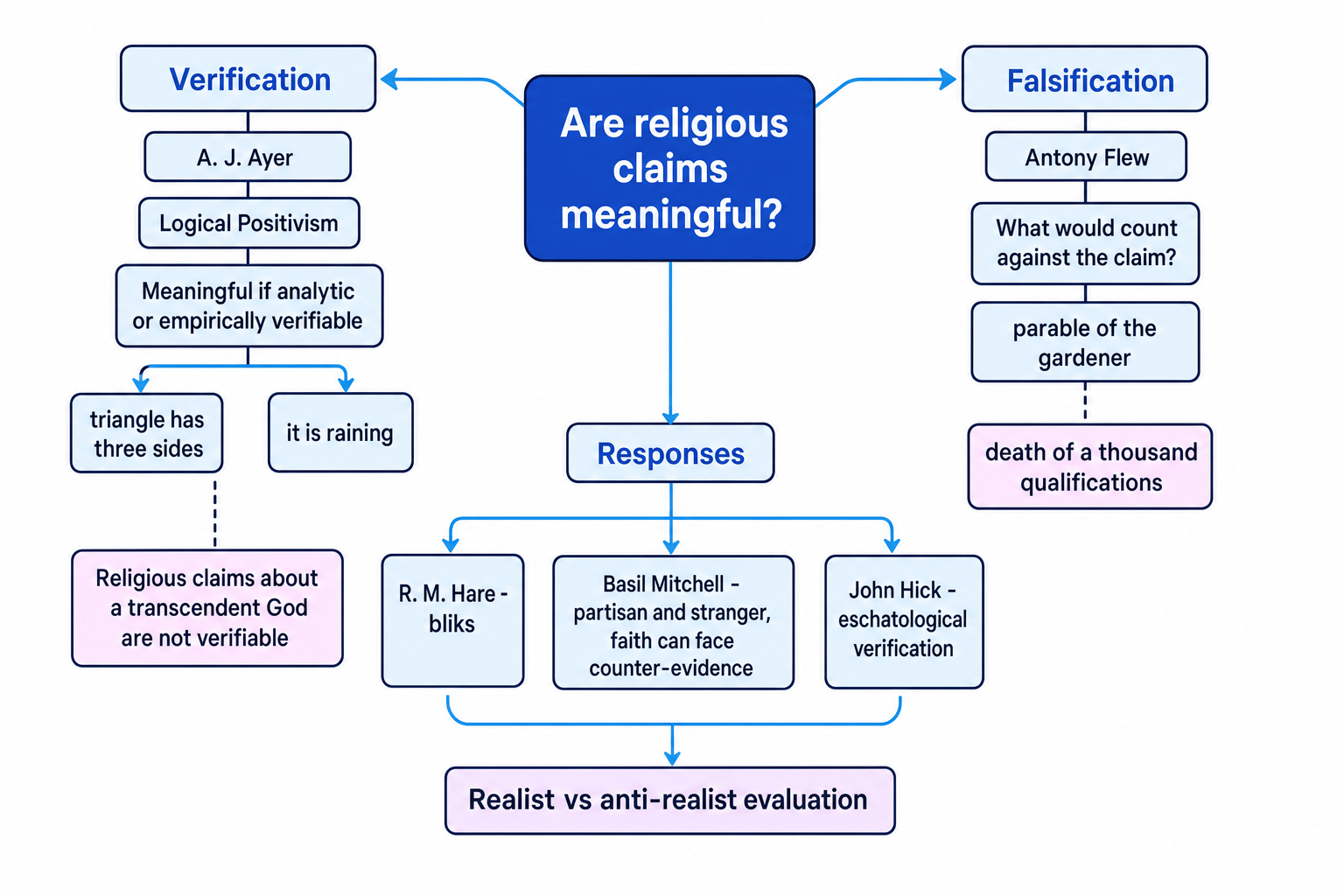
Here is the overall shape of the debate: verification attacks religious language by asking whether it can be empirically confirmed; falsification attacks it by asking whether anything could ever count against it; responses argue that faith may still be meaningful in a different way.
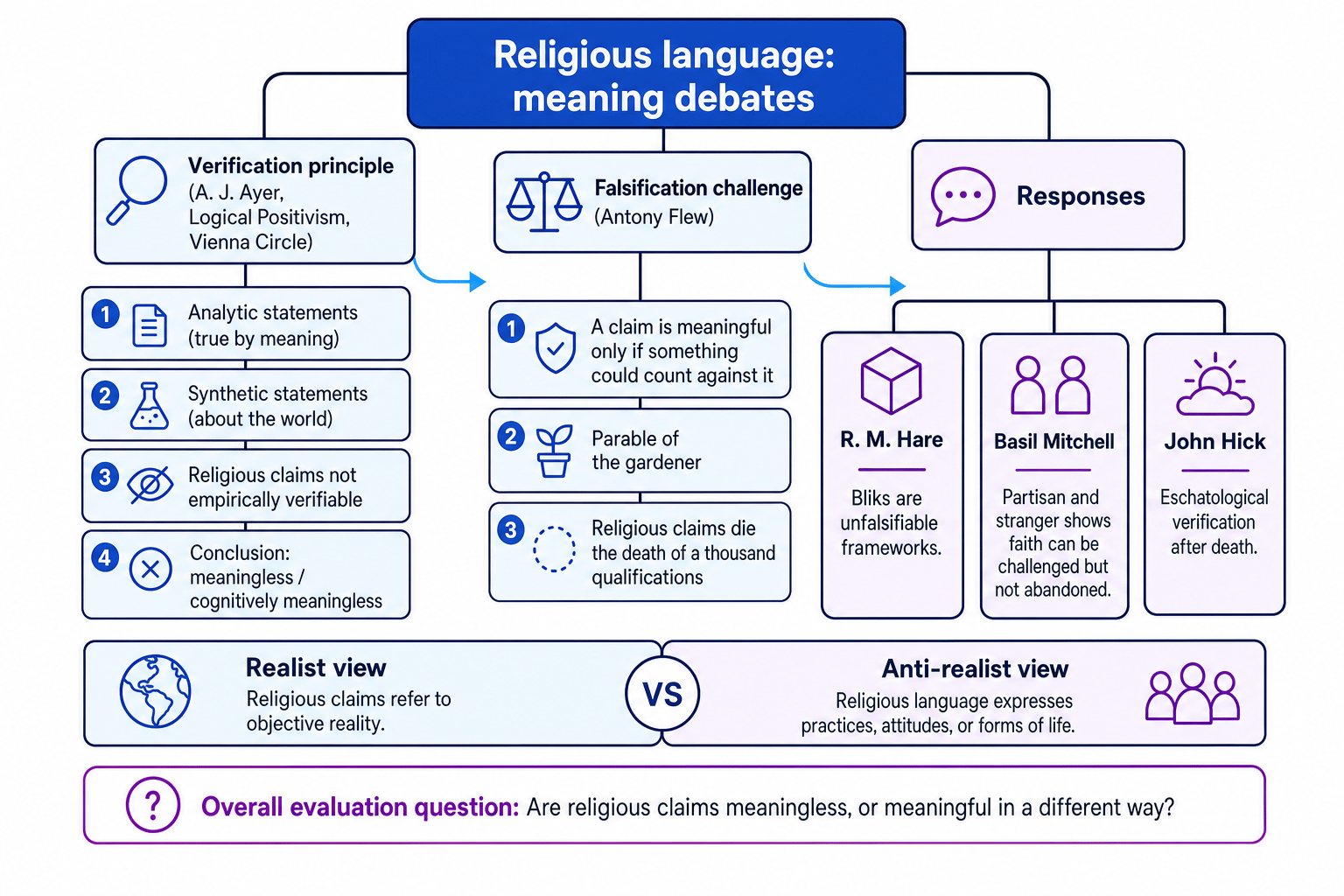
The central issue
Verification asks, “What would show this claim is true?” Falsification asks, “What would show this claim is false?” Religious language is challenged because many religious claims seem to resist both tests.
Logical Positivism and the Vienna Circle
Logical Positivism was a twentieth-century philosophical movement associated with the Vienna Circle, a group of philosophers and scientists who wanted philosophy to be as clear and rigorous as science.
They rejected metaphysics, meaning claims about reality beyond possible experience, such as claims about God, the soul, or ultimate purpose. They thought many traditional philosophical and theological statements looked meaningful but were actually empty because they could not be checked.
Logical Positivism
Logical Positivism is the view that a statement has factual meaning only if it is either true by definition or can be verified by sense experience.
A. J. Ayer popularised Logical Positivism in Language, Truth and Logic. He argued that many religious claims are not false in the ordinary sense; they are cognitively meaningless, meaning they do not express factual propositions that can be true or false.
Analytic and synthetic statements
Logical Positivists distinguished between two main kinds of meaningful statement.
Analytic statement
An analytic statement is true or false by definition. For example, “All bachelors are unmarried” is true because of the meanings of the words.
Synthetic statement
A synthetic statement is true or false because of the way the world is. For example, “There are three chairs in this room” depends on evidence from experience.
For Ayer, a statement is factually meaningful if it is either analytic or empirically verifiable. Religious claims usually seem to be neither. “God loves humanity” is not true by definition, and it is not obviously testable through sense experience.
Classifying statements
- “A triangle has three sides” is analytic because denying it would contradict the meaning of “triangle”.
- “It is raining in London” is synthetic because you would need evidence from the world to check it.
- “God exists beyond space and time” is neither analytic nor straightforwardly synthetic, because it is not true by definition and cannot be verified by ordinary sense experience.
- Ayer therefore concludes that the statement lacks factual meaning, even if it may still express emotion, commitment, or worship.
The verification principle
The verification principle is the test used by Logical Positivists to decide whether a statement has factual meaning.
Verification principle
The verification principle says that a statement is meaningful only if it is analytic or if there is some possible sense experience that could verify it.
Ayer allowed for strong and weak verification. Strong verification would mean proving something conclusively through experience. This is too strict, because many scientific and historical claims cannot be proved with absolute certainty. Weak verification means that some possible evidence could make the statement probable.
Even with weak verification, Ayer thought religious claims fail. If God is defined as transcendent, beyond the empirical world, then there seems to be no possible observation that could confirm God’s existence.
Implications for religious language
For Ayer, saying “God exists” is not like saying “there is no God”. Both claims try to speak about a transcendent being beyond possible verification. So, for Ayer, both are metaphysical and lack literal significance.
This is important: Ayer is not simply saying religious believers are wrong. He is saying their central claims are not genuine factual claims at all.
Saying Ayer proves God does not exist
Ayer does not prove atheism. His argument is that statements about a transcendent God are meaningless as factual statements because they cannot be verified.
Strengths of verification
Verification has a clear strength: it challenges vague or empty language. It asks religious believers to explain what their claims actually mean and what would count as evidence for them.
It also fits well with a scientific worldview. If a claim is about reality, it seems reasonable to ask how reality could confirm it.
Ayer’s approach can be powerful against very vague claims, such as “God’s plan is mysterious” when used to avoid all criticism. It exposes the danger of language that sounds factual but has no clear connection to evidence.
Weaknesses of verification
However, the verification principle faces serious problems.
First, the principle itself does not seem to be analytic or empirically verifiable. The statement “only analytic or empirically verifiable statements are meaningful” is not true by definition, and it cannot be verified by sense experience. So the principle may fail its own test.
Second, it may be too narrow. Ethical, aesthetic, historical, and personal claims often matter deeply but are not easily verified in a laboratory. “Murder is wrong” or “this music is beautiful” may not be empirically verifiable in Ayer’s sense, but many would resist calling them meaningless.
Third, religious believers may argue that religious language is grounded in experience, tradition, worship, and transformation, not just isolated sense observations.
Evaluation shortcut
A strong evaluation of Ayer often says: verification is useful for exposing unclear factual claims, but too restrictive if it dismisses whole areas of human meaning.
Falsification: Flew’s challenge
The falsification debate is linked especially with Antony Flew, although Edexcel requires you to focus on Basil Mitchell’s response.
Falsification
Falsification is the idea that a factual claim is meaningful only if we can say what possible evidence would count against it.
Flew argued that religious believers often refuse to allow anything to count against their claims. If suffering occurs, they say God’s love is mysterious. If prayers are not answered, they say God answered in a different way. If evil exists, they say humans have free will.
Flew illustrated this with the parable of the gardener. Two explorers find a clearing. One believes there is a gardener; the other does not. They set tests: no gardener is seen, no footprints appear, no alarms are triggered. The believer keeps qualifying the claim: the gardener is invisible, intangible, undetectable. Flew argues that the original claim has “died the death of a thousand qualifications”.
The point is that if nothing could count against “God loves us”, then the claim may not assert anything factual.
Applying falsification to a religious claim
- Consider the claim “God answers prayer”.
- Ask what would count against it: unanswered prayers, contradictory outcomes, or cases where sincere prayer seems to make no difference.
- If the believer says every possible outcome still counts as God answering prayer, then the claim becomes unfalsifiable.
- Flew would argue that the claim has lost factual content because it no longer rules anything out.
Hare and bliks
R. M. Hare responded to Flew by introducing the idea of bliks.
Blik
A blik is a basic way of interpreting the world that shapes how someone understands evidence, but is not itself easily falsified by evidence.
Hare tells the story of a paranoid student who believes all university dons want to kill him. Even kind behaviour is interpreted as part of the plot. Hare’s point is that some beliefs function as worldviews rather than ordinary factual hypotheses.
Applied to religion, a believer may see the world through a religious blik: creation, suffering, moral obligation, and hope are interpreted in relation to God.
This helps defend religious language from Flew, but it has a weakness. If religious belief is just a blik, it may become too subjective. A sane blik and an insane blik could both be unfalsifiable, so Hare does not clearly show why religious belief is rational.
Basil Mitchell: faith can be challenged
Basil Mitchell offers a more balanced response than Hare. He accepts that evidence can count against religious belief, especially the problem of evil and suffering. However, he denies that a believer must abandon faith immediately when faced with difficulties.
Mitchell uses the parable of the partisan and the stranger. During a war, a partisan meets a stranger who deeply impresses him and claims to be the leader of the resistance. Later, the stranger is seen helping the enemy as well as the resistance. The partisan does not give up belief, but he is troubled by the evidence and continues to trust the stranger because of their original encounter.
For Mitchell, religious faith is like this. The believer has a prior commitment to God, perhaps based on religious experience, scripture, or the life of Jesus. Evidence such as suffering really does count against belief, but faith is not abandoned at the first challenge.
Mitchell’s middle position
Mitchell agrees with Flew that religious claims must allow evidence against them. But he argues that serious faith can be rationally held through difficulty, rather than instantly dropped.
Mitchell is important because he treats religious belief as a significant article of faith rather than a mere unfalsifiable blik. Faith involves trust, commitment, and struggle. It is not immune to evidence, but neither is it a simple scientific hypothesis.
Realist and anti-realist views
A key evaluation issue is whether religious language is meant realistically or anti-realistically.
Realist view
A realist view says religious claims refer to an objective reality independent of human minds. For example, “God exists” means there really is a God.
Realists are more vulnerable to Ayer and Flew. If religious claims describe reality, then it seems fair to ask how they can be verified or falsified.
Anti-realist view
An anti-realist view says religious language expresses human practices, attitudes, commitments, or forms of life rather than describing an independent supernatural reality in a straightforward factual way.
Anti-realist approaches can avoid some verification and falsification problems because they do not treat religious claims like scientific hypotheses. However, the cost is significant: many believers do think God is real, not merely part of a community’s language or practice.
Assuming anti-realism is just atheism
Anti-realism is not necessarily atheism. It may still value religious language, worship, and commitment, but it interprets them differently from straightforward factual claims about God.
Eschatological verification
John Hick offers another important response: eschatological verification.
Eschatological verification
Eschatological verification is the idea that some religious claims may be verified after death or at the end of time.
Hick uses a parable of two travellers on a road. One believes the road leads to a celestial city; the other does not. During the journey, neither can prove their view. But if they arrive, the believer’s claim is verified.
This suggests that claims about God, judgement, resurrection, or eternal life may not be verifiable now, but could be verified in principle after death.
Its strength is that it challenges Ayer’s claim that religious language is meaningless. If there is a possible future experience that would verify religious claims, then they may be meaningful under weak verification.
Its weakness is that it seems one-sided. If there is no afterlife, the dead person cannot experience the absence of an afterlife. So the claim may be verifiable if true, but not falsifiable if false.
Overall evaluation
Ayer gives a sharp challenge: if religious claims are factual, believers should explain what would count as evidence for them. His argument is especially effective against vague or evasive religious language.
However, the verification principle is arguably self-defeating and too narrow. It risks dismissing meaningful areas of life simply because they are not scientifically testable.
Flew’s falsification challenge is also powerful because it targets the way some believers protect faith from all possible criticism. If “God loves us” is compatible with absolutely any situation, it is fair to ask what the claim actually rules out.
Mitchell’s response is strong because it avoids two extremes. He does not reduce religion to a subjective blik, but he also does not pretend that faith is immune to evidence. He presents faith as a rational commitment that can be tested, strained, and maintained.
A balanced judgement might be: verification and falsification successfully challenge religious language when it is presented as ordinary factual description but protected from evidence. Yet they do not fully show that all religious language is meaningless, especially if religious claims are understood through commitment, cumulative experience, or possible eschatological verification.
In the exam
- Start by defining the issue: this is about whether religious claims are meaningful, not simply whether they are true.
- Use Ayer for verification and Mitchell for the main response, but bring in Flew, Hare, and Hick where they sharpen the debate.
- Evaluate throughout: ask whether each approach is too strict, too subjective, or too far from how believers actually use religious language.
Check yourself
- Why does Ayer think “God exists” is cognitively meaningless rather than simply false?
- How does Mitchell’s partisan parable differ from Hare’s idea of a blik?
- Does eschatological verification successfully answer the verification challenge?