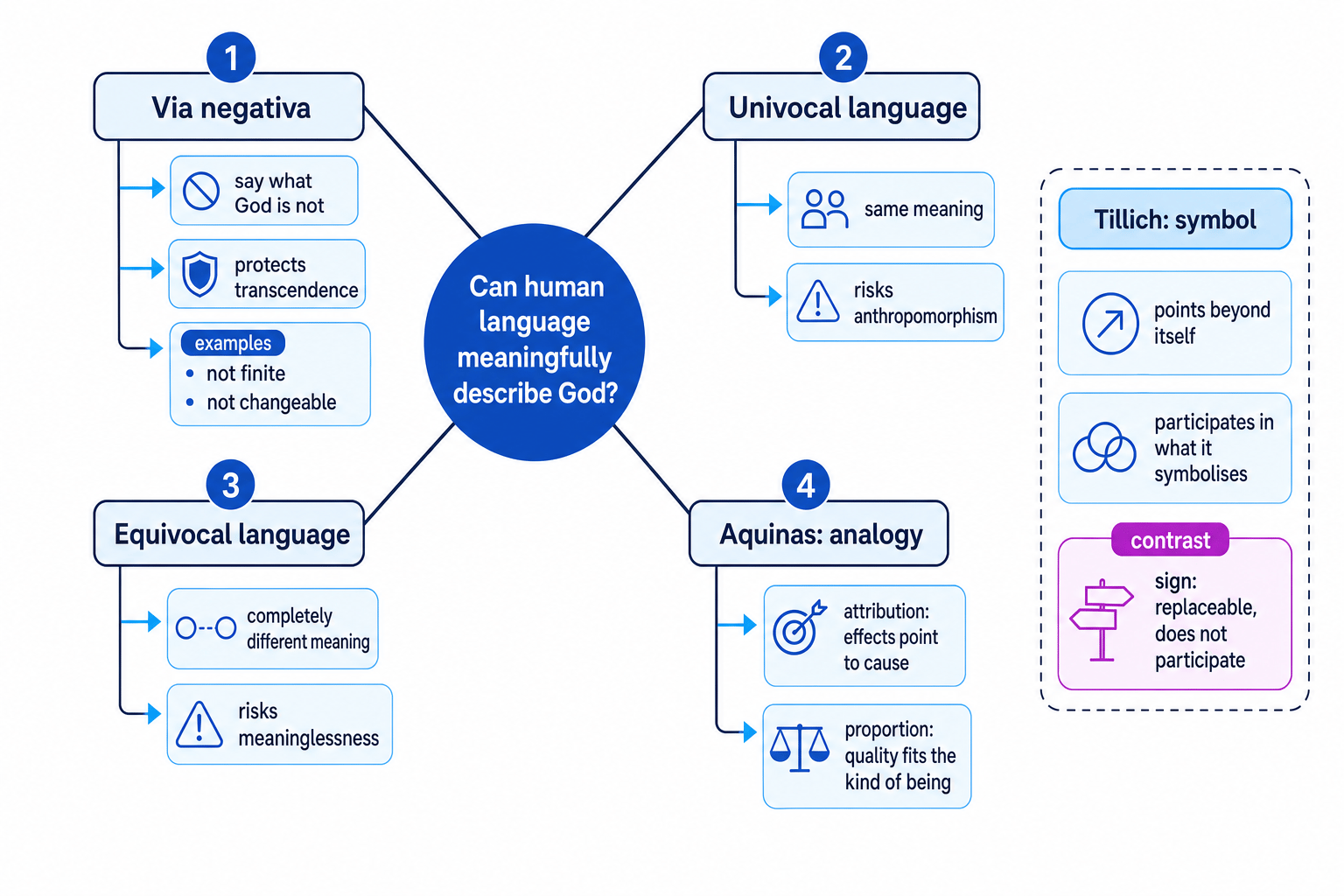
What you'll learn
- Why religious language creates a problem when applied to God.
- How Aquinas uses via negativa and analogy to avoid misleading descriptions of God.
- How Tillich understands religious symbols as more than ordinary signs.
- How to evaluate whether analogy and symbol make religious language meaningful.
Why religious language is difficult
Religious believers often make claims such as “God is good”, “God is Father”, or “God is powerful”. The problem is that God is usually understood as infinite, perfect, transcendent and not part of the ordinary physical world. Human language, however, is shaped by finite human experience.
So the key question is: can ordinary words be meaningfully applied to God?
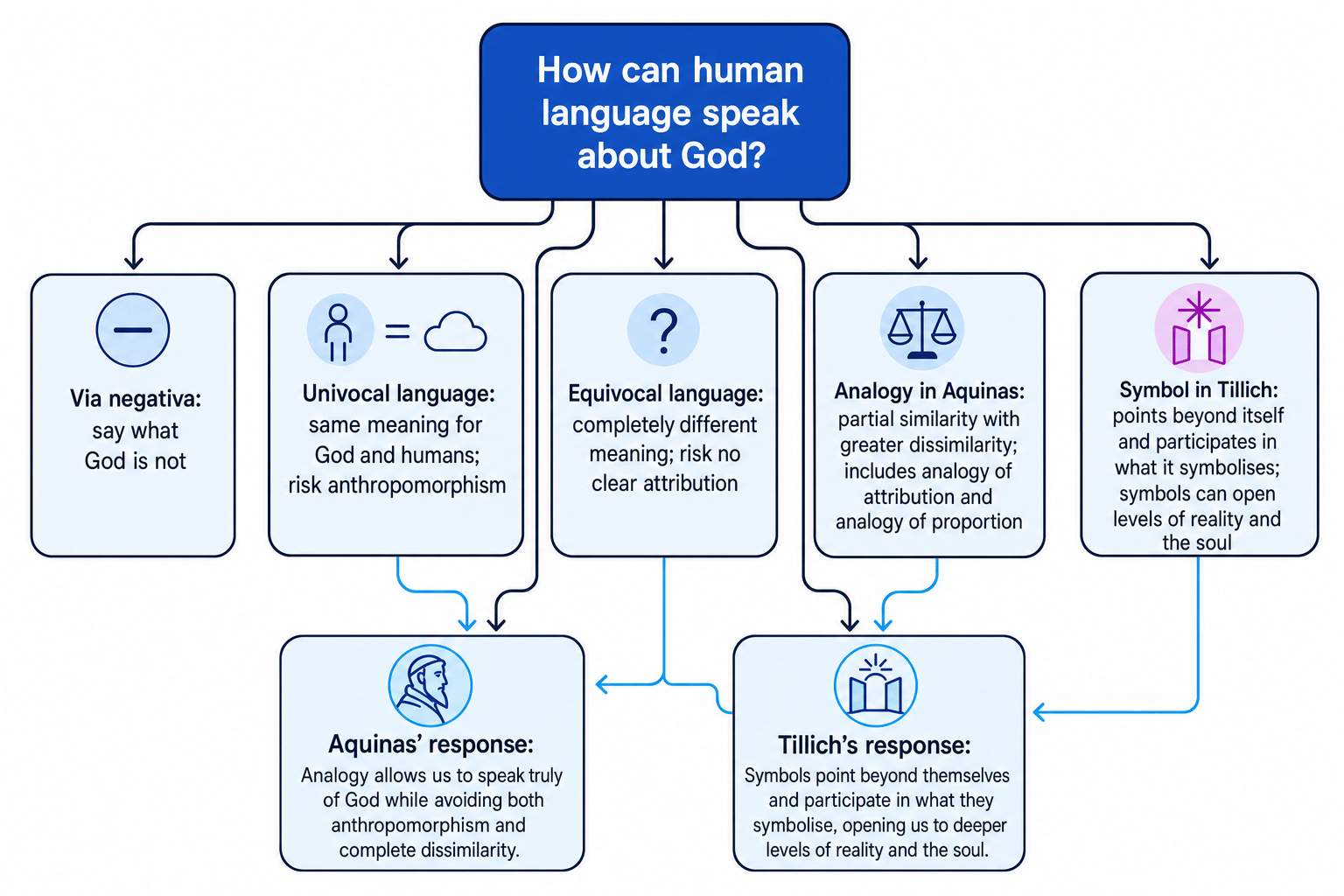
Religious language
Religious language is language used to speak about God, ultimate reality, religious experience, beliefs, practices and worship.
Aquinas and Tillich both try to avoid two extremes: saying too much about God in a crudely human way, and saying so little that religious language becomes empty.
Via negativa: speaking by denial
Via negativa
Via negativa, meaning “the negative way”, is the approach of speaking about God by saying what God is not, rather than claiming directly what God is.
For Aquinas, human beings cannot fully know God’s essence. We do not comprehend what God is in himself. However, we can remove false ideas. For example, we can say that God is not finite, not changeable, not evil, and not dependent.
This protects divine transcendence: God is not simply one object among others.
The negative way
Via negativa gives limited but important knowledge: it does not tell us fully what God is, but it helps us avoid thinking of God as a bigger version of a human being.
Strengths of via negativa
Via negativa is useful because it respects the mystery of God. It fits with classical theism, where God is eternal, simple, perfect and beyond complete human understanding.
It also avoids anthropomorphism.
Anthropomorphism
Anthropomorphism means describing God in overly human terms, as if God had human emotions, body parts or limitations in the same way humans do.
For example, when scripture speaks of “the hand of God”, via negativa reminds us not to imagine God literally having a physical hand.
Limits of via negativa
The weakness is that negative language can seem too thin. If you only say what God is not, it becomes difficult to say what God positively is.
If someone says, “God is not finite, not material, not changeable”, we may still ask: so what is God like?
Treating via negativa as atheism
Via negativa does not deny God’s existence. It denies that human language can fully capture God’s nature.
Univocal and equivocal language
Before Aquinas’ analogy makes sense, you need two contrast terms.
Univocal language
Univocal language uses a word with the same meaning in different contexts.
If “good” meant exactly the same in “Sarah is good” and “God is good”, then we would understand God’s goodness by direct comparison with human goodness.
The problem is that this risks anthropomorphism. God’s goodness would seem like human goodness, only larger. Aquinas thinks this is inadequate because God is not merely a superior human.
Equivocal language
Equivocal language uses a word with completely different meanings in different contexts.
For example, “bat” can mean a flying mammal or a piece of sports equipment. If “good” were equivocal in “Sarah is good” and “God is good”, then God’s goodness would have no clear connection to human goodness.
The problem is that religious language would become unintelligible. If divine goodness has nothing in common with human goodness, then saying “God is good” tells us almost nothing.
Aquinas’ middle route
Aquinas rejects both purely univocal and purely equivocal language about God. He argues that language about God works analogically.
Aquinas and analogy
Analogy
An analogy is a comparison based on partial similarity. Two things are not identical, but they are similar enough for one to help us understand the other.
For Aquinas, words such as “good”, “wise” and “loving” are not used of God in exactly the same way as they are used of humans. But they are not completely unrelated either. They are used analogically.
This means there is a real connection between creaturely goodness and divine goodness, because creatures come from God. However, God’s goodness is greater, fuller and not limited in the way human goodness is.
Analogy of attribution
Analogy of attribution
An analogy of attribution uses a quality found in an effect to say something about its cause.
Aquinas’ basic reasoning is that created things reflect their creator. If there is goodness, wisdom and order in creation, these qualities must in some way be attributed to God as their source.
A traditional example is medicine and health. If we say “healthy urine”, we do not mean urine is healthy in the same way a person is healthy. We mean it indicates the health of the animal or person. The word is connected, but not identical in meaning.
Similarly, when we say “God is good”, we are not saying God is good in exactly the same way as a human person. We are attributing goodness to God as the source of all goodness.
Analogy of proportion
Analogy of proportion
An analogy of proportion says that a quality belongs to different beings in a way appropriate to the kind of thing they are.
A human can be loving in a human way. God is loving in a divine way. The word “loving” is meaningful in both cases, but God’s love is proportionate to God’s infinite nature.
So, the similarity is real, but the dissimilarity is greater. This is why Aquinas’ view avoids reducing God to human categories.
Applying analogy to “God is good”
-
Start with the problem: if “good” is used univocally, God’s goodness becomes too human; if it is used equivocally, the statement loses clear meaning.
-
Apply analogy of attribution: goodness in creation points back to God as the source of goodness, so the word “good” has a real connection to God.
-
Apply analogy of proportion: God’s goodness is not limited human goodness, but goodness appropriate to an infinite and perfect being.
-
Reach the judgement: for Aquinas, “God is good” is meaningful, but it must be understood analogically rather than literally in a human sense.
Proportional similarities and dissimilarities
Aquinas’ view depends on both similarity and difference.
There must be similarity, otherwise religious language becomes equivocal and meaningless. But there must also be dissimilarity, otherwise God is reduced to a creature.
This is sometimes expressed as the idea that between God and creatures there is always a greater dissimilarity within any similarity. In other words, analogy gives genuine knowledge, but not complete comprehension.
Essay phrase
A strong phrase for Aquinas is: analogy preserves meaningful speech about God while respecting divine transcendence.
Evaluating Aquinas
A strength of Aquinas’ approach is that it reflects how religious believers often speak. They do not usually mean that God is literally a human father, ruler or craftsman. They mean that these words partially disclose something about God.
Analogy also fits Aquinas’ wider natural theology. Since God is creator, effects in the world can tell us something about their cause.
However, critics may argue that analogy is vague. How much similarity is enough? If we do not know God directly, how can we check whether our analogies are accurate?
Another weakness is that analogy may depend on already accepting a theistic worldview. If you do not believe the world is created by God, then created qualities may not obviously point back to divine qualities.
Signs and symbols
Tillich approaches religious language differently. He focuses on symbols.
Sign
A sign points to something beyond itself but does not participate in what it points to. Its meaning is usually conventional and replaceable.
For example, a road sign points you towards a place, but it does not share in the reality of that place. It could be replaced by another sign if people agreed on the new meaning.
Symbol
A symbol points beyond itself and also participates in the reality or meaning it symbolises.
Tillich argues that religious language is symbolic because God is not one being among others. God is “being-itself” and the object of “ultimate concern”. Therefore, literal language cannot capture God.
Tillich’s theory of symbol
Paul Tillich argues that symbols do several important things.
First, symbols point beyond themselves. A cross is not merely two pieces of wood or metal; in Christianity it points to Jesus’ crucifixion, sacrifice, salvation and hope.
Second, symbols participate in what they symbolise. For believers, the cross is not a random label. It shares in the sacred meaning of the Christian story.
Third, symbols can open up levels of reality. They disclose dimensions of meaning that ordinary descriptive language may not reach.
Fourth, symbols can open up levels of the soul. They affect people existentially, emotionally and spiritually.
Tillich on religious symbols
For Tillich, religious symbols are powerful because they do not just describe religious truth; they help believers encounter and participate in it.
Types of symbol across religious traditions
Religious traditions use many kinds of symbol:
- Objects: the cross in Christianity, the Khanda in Sikhism, prayer beads in several traditions.
- Sounds and words: Om/Aum in Hindu traditions, sacred names of God, liturgical phrases.
- Actions: baptism, salah, Eucharist, pilgrimage, bowing, prostration.
- Places: Jerusalem, Makkah, the Ganges, Bodh Gaya.
- Stories and images: parables, mandalas, icons, scriptural narratives.
These symbols often identify a community. They show belonging, express shared memory and shape worship.
Interpreting the cross as a Tillichian symbol
-
Distinguish sign from symbol: the cross is not merely a signpost meaning “Christianity is here”; it carries deeper religious meaning for Christians.
-
Identify what it points to: it points to Jesus’ death, suffering, forgiveness, salvation and, in many traditions, victory over sin and death.
-
Explain participation: for believers, the cross participates in Christian faith because it is used in worship, prayer, sacraments, identity and devotion.
-
Evaluate its scope: the cross may be deeply meaningful inside Christian faith, but someone outside that context may interpret it historically, politically or aesthetically instead.
Problems with symbols
Symbols are powerful, but they can also be difficult to interpret.
One problem is ambiguity. The same symbol can mean different things to different people. Water may symbolise cleansing, danger, chaos, life, death or rebirth depending on context.
Another problem is faith-context dependence. A symbol may have limited application outside the tradition that gives it meaning. For example, the Eucharist has profound significance within Christianity, but that significance depends on Christian beliefs about Jesus, salvation, remembrance and presence.
A third problem is that symbols can change or “die”. Tillich argues that symbols are not artificially invented at will. They grow out of a community’s life, and they can lose power if the community no longer experiences them as meaningful.
Saying symbols are just metaphors
For Tillich, symbols are not merely decorative comparisons. They participate in what they symbolise and can transform the believer’s understanding of reality.
Evaluating Tillich
Tillich’s theory is strong because it explains why religious language is not just factual description. It helps account for worship, ritual, art and experience. Many believers would agree that symbols can communicate what plain literal statements cannot.
It also avoids crude literalism. Tillich does not need to claim that every religious phrase works like a scientific statement. Religious symbols express ultimate concern and point beyond ordinary objects.
However, critics may argue that symbolic language is too subjective. If symbols need interpretation, how do we decide which interpretation is correct?
There is also a danger that religious claims become unclear. If “God is Father” is symbolic, does it make any definite claim about God, or only about human attitudes towards God?
A further issue is exclusivity. Symbols may be meaningful within one faith but confusing or even offensive in another. This limits their usefulness as universal religious language.
Comparing Aquinas and Tillich
Aquinas and Tillich both reject crude literalism. Neither thinks language about God is simply univocal.
Aquinas focuses on analogy: words about God are meaningful because creatures reflect their creator. His approach is more connected to natural theology and metaphysics.
Tillich focuses on symbol: religious language points beyond itself and participates in ultimate reality. His approach is more connected to worship, faith and existential meaning.
A balanced judgement could be that Aquinas gives a stronger account of how religious statements can make truth-claims about God, while Tillich gives a stronger account of how religious language actually functions in lived religion.
In the exam
-
For Aquinas, always explain the problem first: univocal language risks anthropomorphism, while equivocal language risks meaninglessness.
-
Use the key terms precisely: via negativa, analogy of attribution, analogy of proportion, sign, symbol and participation.
-
For evaluation, do not just say “analogy works” or “symbols are vague”; judge whether each theory makes religious language meaningful while still protecting God’s transcendence.
Check yourself
- Why does Aquinas reject both univocal and equivocal language about God?
- How does Tillich’s symbol differ from an ordinary sign?
- What is one strength and one weakness of using symbols in a particular faith context?