What you'll learn
- How Wittgenstein moves from picture theory to meaning as use.
- What language-games and forms of life are.
- How D. Z. Phillips applies this to religious language.
- How to evaluate the charge of fideism: is faith protected, or insulated from criticism?
The big issue: what makes language meaningful?
In the religious language topic, the background worry is this: if statements such as “God loves me”, “God forgives”, or “prayer works” cannot be verified like ordinary empirical claims, are they meaningless?
The language-games approach says: slow down. Before judging a sentence, ask what the words are doing in the life of the people using them. Religious language may not work like scientific language, but that does not automatically make it meaningless.
The whole topic is a shift from “Does this sentence picture a fact?” to “How is this sentence used within a form of life?”
Prerequisite: cognitive and non-cognitive language
Cognitive and non-cognitive language
Cognitive language aims to state facts and is usually treated as true or false. Non-cognitive language does not primarily state facts; it may express commitment, trust, emotion, worship, moral attitude, or a way of seeing the world.
For example, “The church has a tower” is cognitive: it describes something that could be checked. But “I promise”, “I forgive you”, or “Lord, have mercy” do not mainly work by describing an object. They do something within a relationship or practice.
Non-cognitive does not mean meaningless
Do not write as if Wittgenstein or Phillips simply think religious language is “nonsense”. Their point is that religious language may be meaningful in a different way from scientific description.
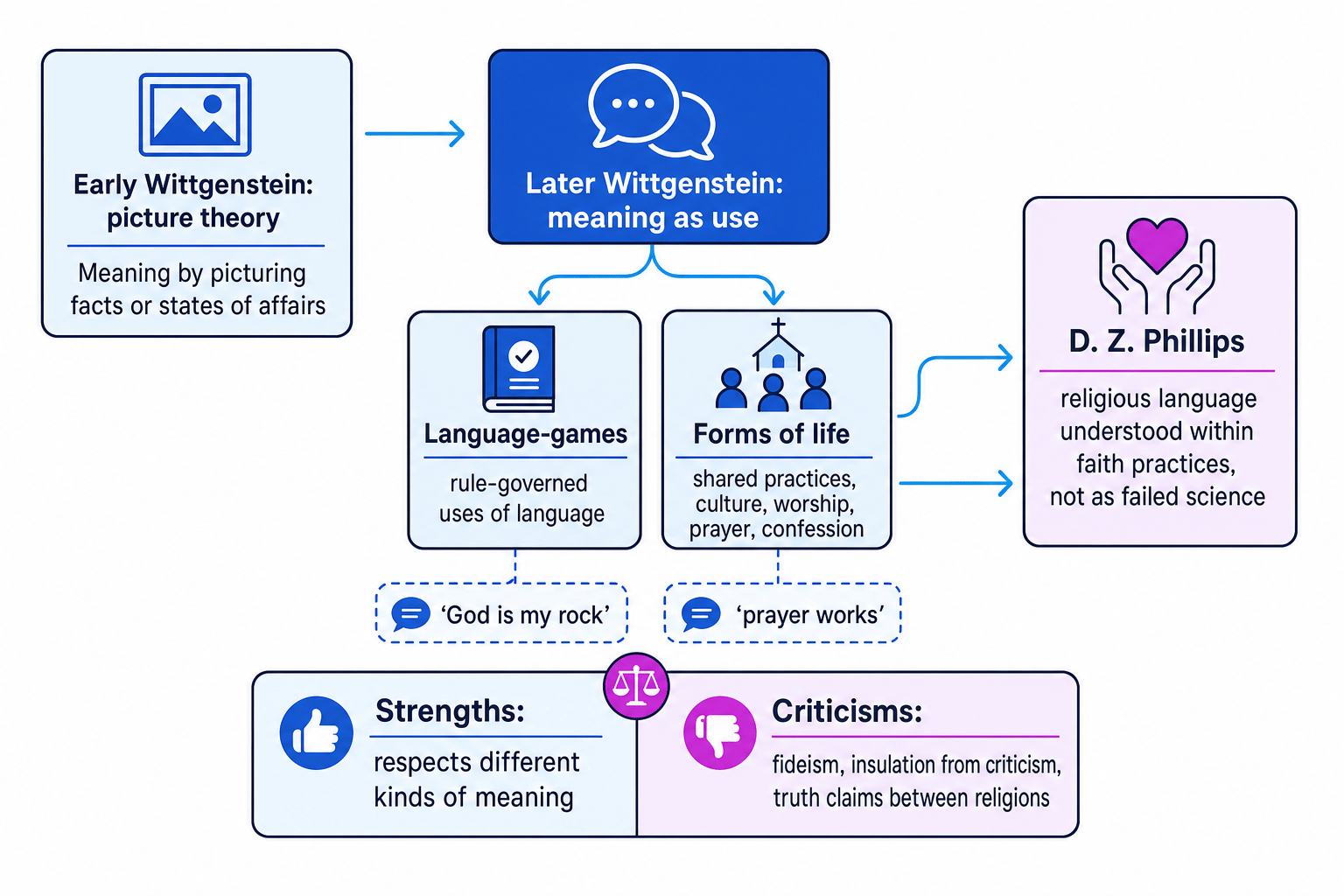
Early Wittgenstein: picture theory
Ludwig Wittgenstein’s early work, especially the Tractatus Logico-Philosophicus, is associated with the picture theory of meaning.
Picture theory
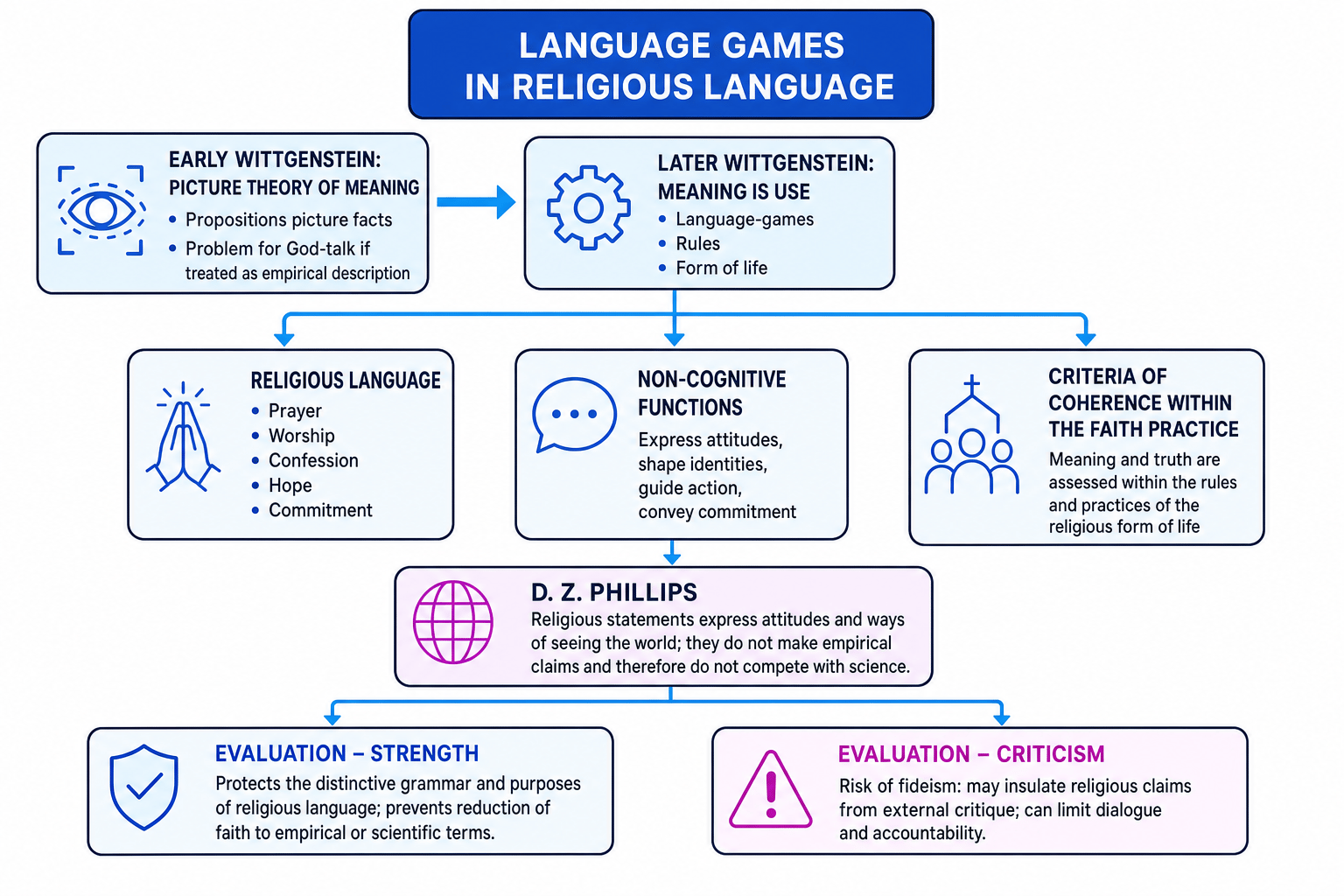
The picture theory of meaning is the view that meaningful propositions work by picturing possible states of affairs in the world. Language has meaning when its logical structure corresponds to how reality could be.
On this view, a sentence such as “The cup is on the table” is meaningful because it represents a possible arrangement of objects. It can be compared with reality.
This creates pressure for religious language. If “God is loving” is treated as if it pictures God in the same way “the cup is on the table” pictures a physical situation, then we face a problem: God is not an observable object within the world.
Testing God-talk with picture theory
- Treat “God loves me” as a cognitive proposition that must picture a state of affairs.
- Ask what worldly arrangement would correspond to it in the way “the cup is on the table” corresponds to a visible arrangement.
- Notice the difficulty: God’s love is not an object or event that can be directly mapped like a physical scene.
- So, under a strict picture-theory model, religious language looks problematic unless it is reinterpreted or placed outside ordinary factual speech.
This is not the end of Wittgenstein’s thought. His later work radically changes direction.
Later Wittgenstein: meaning is use
In Philosophical Investigations, Wittgenstein rejects the idea that all language has one essence or one job. Language does not only describe facts. It can command, joke, pray, confess, thank, promise, bless, lament, and worship.
His famous idea is that the meaning of a word is found in its use.
Language-game
A language-game is a rule-governed way of using language within a particular human activity, practice, or context.
The word “game” matters because language has rules, but different activities have different rules. The rules for chess are not the rules for football. Likewise, the rules for scientific testing are not the same as the rules for prayer, worship, or moral confession.
Form of life
A form of life is the wider pattern of human activity, culture, practice, behaviour, and shared assumptions within which language makes sense.
So, religious language belongs within a religious form of life: prayer, worship, scripture, community, ritual, repentance, hope, and commitment.
Meaning depends on use
For later Wittgenstein, you understand religious language by looking at how it functions in the life of believers, not by forcing it to behave like laboratory science.
Interpreting God is my rock
- If you read “God is my rock” using a literal picture model, it seems absurd: God is not a lump of stone.
- If you read it within the religious language-game, the phrase expresses trust, stability, dependence, and refuge.
- The sentence is coherent because it fits the practices of prayer, worship, and testimony; it is not trying to classify God as a mineral object.
Religious language as a distinctive language-game
Religious language has its own grammar. Here, “grammar” does not just mean punctuation or sentence structure. It means the rules for how words are meaningfully used.
For Wittgensteinian thinkers, religious statements are often not best understood as scientific hypotheses. “God forgives” is not like “there is a planet beyond Neptune”. It functions within confession, repentance, grace, worship, and transformation.
This gives religious language a distinctive character. It is not meaningless because it fails scientific verification. It belongs to a different kind of practice.
Criteria of coherence
Criteria of coherence are the standards within a language-game that show whether a statement makes sense and fits the rules of that practice.
For example, within Christianity, “God forgives” coheres with ideas such as sin, repentance, grace, reconciliation, and worship. It would be incoherent to treat forgiveness as a mechanical process that can be controlled like a machine.
Assessing prayer works
- In a scientific language-game, “prayer works” might be tested as a causal claim: does prayer produce measurable outcomes?
- In a Wittgensteinian religious language-game, the phrase may function differently: prayer expresses dependence on God, trust, surrender, gratitude, or hope.
- So the coherence of “prayer works” depends on whether it fits the religious practice of prayer, not whether prayer behaves like a guaranteed technique for controlling events.
D. Z. Phillips: applying Wittgenstein to religion
D. Z. Phillips was strongly influenced by Wittgenstein. He argues that philosophers should not distort religious belief by forcing it into the shape of science, metaphysics, or prediction.
For Phillips, religious language is not mainly about positing God as one more object in the universe. God is not a hidden item alongside other items. Religious belief is a way of seeing and responding to the world.
So, when believers speak of God, prayer, sin, or eternal life, Phillips thinks we should examine the role those words play in religious life. The philosopher’s job is to clarify the grammar of belief, not to replace it with an external test.
Phillips on religious meaning
Phillips sees religious language as meaningful within the practices and commitments of faith. It should not be judged as though it were failed science.
This is why Phillips is often called a Wittgensteinian fideist, though that label can be debated.
Fideism: faith as the context for understanding
Fideism
Fideism is the view that religious belief depends primarily on faith, and that faith cannot be fully judged by external standards such as empirical proof or detached reason.
In this topic, fideism means that religious language can only be properly understood within the context of faith. To understand prayer, you must see how it belongs to a life of prayer. To understand worship, you must see how worship shapes the believer’s world.
A weaker version says outsiders can understand the grammar of religious language by careful observation. A stronger version says only believers can truly understand it from the inside.
Nuance the fideism point
Do not simply say “Wittgenstein believed only believers understand religion.” A better answer says that language-games stress context, practice, and form of life, but this raises the worry that religion becomes insulated from outside criticism.
Evaluation: strengths of language-games
A major strength is that this approach respects the variety of language. It avoids the mistake of assuming that all meaningful language must work like scientific description.
It also explains why religious language is often powerful even when it is not literal. Hymns, prayers, confessions, and blessings shape identity and action. The language-games approach takes this lived reality seriously.
It can also defend religion against crude verificationist attacks. If someone says “God forgives” is meaningless because forgiveness cannot be placed in a test tube, Wittgenstein and Phillips can reply that the critic is using the wrong language-game.
Evaluation: criticisms of language-games
The biggest criticism is that language-games may protect religious belief too much. If every religious claim is judged only by internal rules, it becomes difficult to criticise harmful, false, or incoherent beliefs from the outside.
There is also a worry about truth. Many believers do not think “God exists” merely expresses a way of life. They think it is really true. If Phillips makes religious language too non-cognitive, he may fail to represent what believers actually claim.
A further problem is disagreement between religions. If Christianity, Islam, Hinduism, Buddhism, and atheism all have different language-games, how do we judge between them? The theory may explain internal meaning, but it may struggle with public truth-claims.
The insulation problem
If religious language can only be assessed by its own internal rules, critics may argue that it becomes immune to evidence, reason, and moral challenge.
Overall judgement
Language-games are very useful for showing that religious language has a distinctive role. Wittgenstein helps you see that meaning is not limited to factual description. Phillips develops this into a defence of religious language as coherent within faith.
However, the approach is less convincing if it implies that religious claims never need external evaluation. A balanced judgement is that language-games explain how religious language functions, but they do not fully settle whether religious claims are true.
In the exam
- Start with the shift from early Wittgenstein’s picture theory to later Wittgenstein’s meaning as use.
- Use the technical pair language-game and form of life, then apply them directly to prayer, worship, confession, or God-talk.
- Evaluate Phillips carefully: he protects the distinctive grammar of faith, but may be criticised for fideism, insulation from critique, and reducing truth-claims to expressions of commitment.
Check yourself
- Why does picture theory create a problem for religious language?
- How does a form of life help explain the meaning of prayer or worship?
- Is fideism a strength or a weakness of the language-games approach?