

What you'll learn
- How utility, pleasure, hedonism and happiness fit together.
- Why Bentham and J. S. Mill developed utilitarianism in different ways.
- The difference between Act, Rule, Preference, Negative and Ideal utilitarianism.
- How to evaluate utilitarianism in relation to law, social reform, relativism and religion.
The basic idea: consequences matter
Utilitarianism is a consequentialist ethical theory. That means it judges whether an action is right or wrong by looking at its consequences — what happens as a result.
For utilitarians, the best action is the one that produces the greatest amount of overall good. Classical utilitarians usually define that good as happiness or pleasure.
Utilitarianism
Utilitarianism is the ethical theory that an action, rule or policy is right if it produces the greatest overall utility — often expressed as “the greatest happiness for the greatest number.”
Utility
Utility means usefulness in producing good consequences. In classical utilitarianism, this usually means producing pleasure, happiness or wellbeing and reducing pain or suffering.
Pleasure, hedonism and happiness
Utilitarianism begins with a simple thought: people generally seek pleasure and avoid pain.
Hedonism
Hedonism is the view that pleasure is the highest good, or that happiness is mainly understood in terms of pleasure and the absence of pain.
Jeremy Bentham’s version of utilitarianism is strongly hedonistic: pleasure is good, pain is bad, and moral decisions should maximise pleasure and minimise pain.
However, not all utilitarians mean the same thing by “happiness”. Mill argues that happiness includes richer human fulfilment, such as education, friendship, freedom and moral development.
The core test
A utilitarian asks: Which option produces the best overall consequences for everyone affected?
Why utilitarianism emerged
Utilitarianism developed during the Enlightenment, a period that emphasised reason, evidence, human progress and reform. It was also shaped by major social and political changes: industrialisation, urban poverty, debates about democracy, prison reform, education and legal reform.
In Britain, the law was often harsh, unequal and influenced by tradition rather than by careful assessment of human welfare. Bentham wanted ethics and law to become more rational, practical and publicly useful.
Culturally, utilitarianism also reflects a move away from purely religious or aristocratic authority. It asks not, “What has tradition commanded?” but, “What actually benefits people?”
Bentham: quantity of pleasure
Jeremy Bentham set out his theory in An Introduction to the Principles of Morals and Legislation (1789). He famously wrote that nature has placed humanity under “two sovereign masters, pain and pleasure”.
Bentham argued that everyone’s pleasure counts equally. His approach is democratic: no person’s happiness is automatically more important than another’s.
Principle of utility
Bentham’s principle of utility says that actions are right if they tend to promote pleasure or happiness, and wrong if they tend to produce pain or unhappiness.
Bentham also developed the hedonic calculus, a method for comparing pleasures and pains. It considers factors such as intensity, duration, certainty, nearness, fruitfulness, purity and extent.
Using the hedonic calculus
Imagine a government deciding whether to fund free school meals for more children.
-
Consider intensity and duration: the benefit is significant because hunger strongly affects health, learning and concentration, and the effects may last across a child’s education.
-
Consider certainty and extent: the outcome is fairly certain and affects many children, families and schools, so the policy has wide social impact.
-
Consider fruitfulness and purity: the policy may lead to further benefits such as better attendance and attainment, though it may also involve costs through taxation.
-
Make the utilitarian judgement: if the overall welfare gained by children and society outweighs the financial cost, Bentham’s approach would support the reform.
Bentham is not selfish
Bentham’s theory is not “do whatever gives me pleasure”. It is impartial: everyone affected must be included in the calculation.
Mill: quality of happiness
John Stuart Mill developed utilitarianism in Utilitarianism (1861). He agreed that morality aims at happiness, but he thought Bentham’s view was too crude if it treated all pleasures as equal.
Mill distinguishes between higher pleasures and lower pleasures.
Higher and lower pleasures
Higher pleasures are intellectual, moral and aesthetic pleasures, such as learning, friendship, art and freedom. Lower pleasures are bodily pleasures, such as eating, drinking and physical comfort.
Mill argues that higher pleasures are better in kind, not just greater in amount. His famous phrase is: “It is better to be a human being dissatisfied than a pig satisfied; better to be Socrates dissatisfied than a fool satisfied.”
To decide which pleasures are higher, Mill appeals to competent judges: people who have experienced both kinds of pleasure and are therefore able to compare them.
Bentham vs Mill
Bentham focuses mainly on the quantity of pleasure. Mill adds that the quality of happiness matters too.
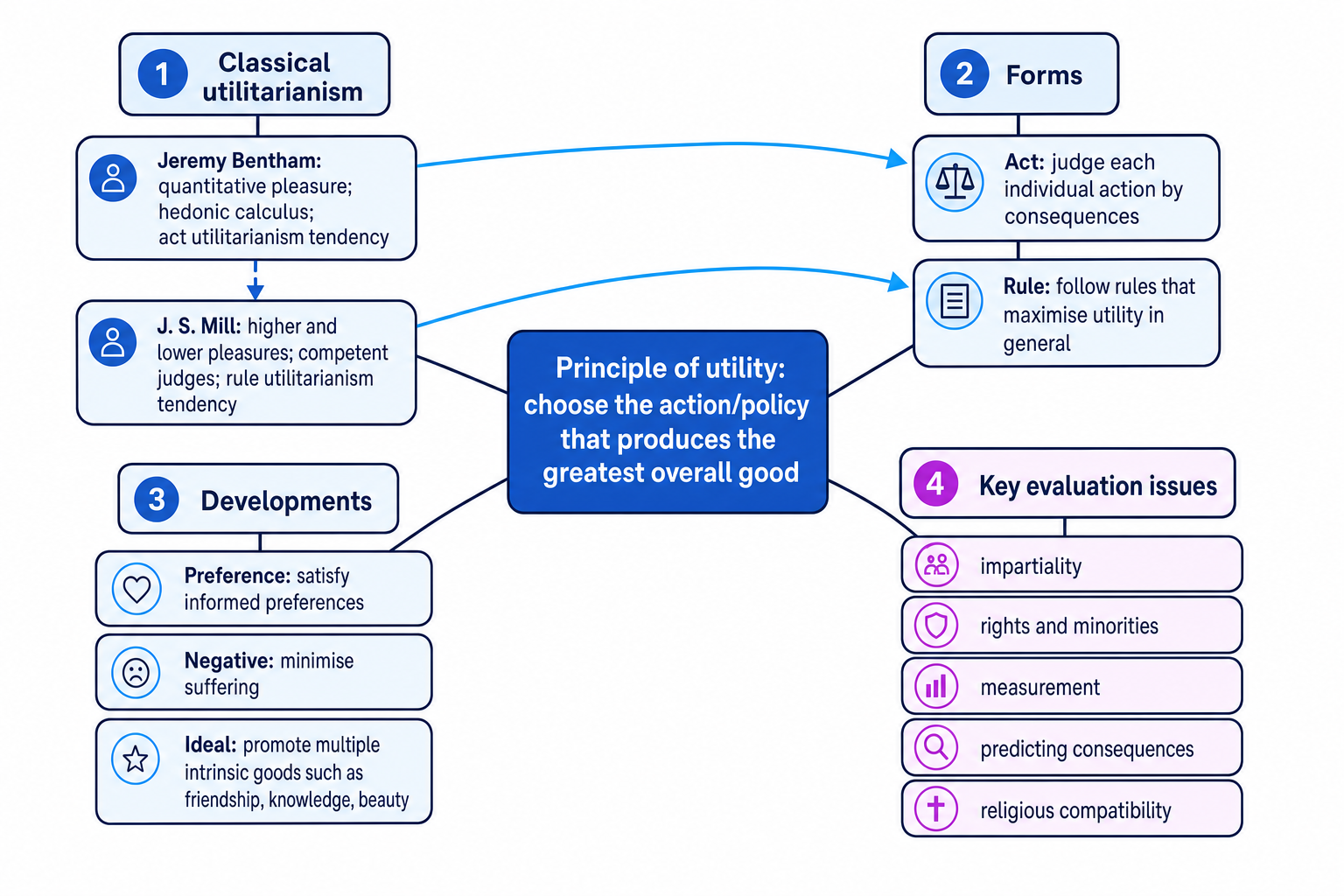
This map shows the main forms of utilitarianism and how Bentham and Mill connect to later developments.
Act and Rule Utilitarianism
Act Utilitarianism
Act Utilitarianism
Act Utilitarianism judges each individual action by whether it produces the greatest utility in that specific situation.
This fits Bentham’s practical approach. If lying in one situation produces better consequences than telling the truth, an act utilitarian may say lying is right in that case.
Rule Utilitarianism
Rule Utilitarianism
Rule Utilitarianism says we should follow rules that, if generally accepted, would maximise utility overall.
This is often linked to Mill because he valued stable social rules, liberty and justice. A rule utilitarian might say: “Even if one lie seems useful, a general rule permitting lies would damage trust and reduce happiness overall.”
Choosing between Act and Rule Utilitarianism
Suppose a doctor could lie to a patient to make them feel calmer before treatment.
-
An act utilitarian asks whether this particular lie will produce more happiness than truth-telling in this situation.
-
A rule utilitarian asks what would happen if doctors generally followed a rule allowing deception when convenient.
-
If the wider rule would damage trust in medicine, Rule Utilitarianism may reject the lie even if it seems useful short-term.
Later developments
Preference Utilitarianism
Preference Utilitarianism
Preference Utilitarianism says the right action is the one that best satisfies the preferences or interests of those affected.
This shifts the focus from pleasure to what people actually want. It can be useful in medical ethics, where respecting a patient’s informed choice may matter more than simply maximising pleasure.
Negative Utilitarianism
Negative Utilitarianism
Negative Utilitarianism gives priority to reducing suffering rather than increasing happiness.
This can seem compassionate, especially in cases involving severe pain, poverty or war. However, critics argue it can become too extreme if the only aim is to eliminate suffering at any cost.
Ideal Utilitarianism
Ideal Utilitarianism
Ideal Utilitarianism argues that more than one thing has intrinsic value, such as beauty, friendship, knowledge, justice and pleasure.
This answers the criticism that classical utilitarianism is too narrow. It moves closer to Mill’s view that human flourishing involves more than bodily pleasure.
Utilitarianism, law and social reform
Utilitarianism has had major influence on political and social reform. Bentham supported reforms to the legal system, prisons, education and welfare. He argued that laws should be assessed by whether they improve human wellbeing.
Mill applied utilitarian thinking to liberty, democracy and women’s rights. In On Liberty (1859), he argues for the harm principle: society should only restrict individual freedom to prevent harm to others. This supports freedom of speech, personal autonomy and social progress.
Utilitarian reasoning can also be seen in changing social attitudes and laws. For example, arguments for abolishing slavery, expanding education, improving workers’ rights, decriminalising homosexuality and reforming punishment often appeal to the reduction of suffering and the increase of wellbeing.
Use reform examples
In essays, link utilitarianism to public policy. It is especially strong when discussing laws that affect many people, such as healthcare, punishment, education or poverty.
Relativism and utilitarianism
Ethical relativism
Ethical relativism is the view that moral judgements depend on circumstances, cultures or situations rather than fixed universal rules.
Utilitarianism is not fully relativist, because it has one universal principle: maximise utility. However, it can lead to different answers in different situations because consequences vary.
For example, telling the truth may usually maximise happiness, but in a dangerous situation lying might prevent harm. This makes utilitarianism flexible, but critics say it risks becoming unpredictable.
Strengths of utilitarianism
One major strength is that utilitarianism is practical. It gives a clear decision-making method: consider consequences and choose the option that benefits the most people.
It is also impartial. Bentham’s view that “each counts for one and none for more than one” challenges selfishness, privilege and discrimination.
A further strength is its usefulness in law and politics. Governments often must make decisions about limited resources. Utilitarianism helps explain why policies should aim at public welfare rather than private interest or tradition.
Mill’s version is especially strong because it protects human dignity better than Bentham’s. By valuing higher pleasures and liberty, Mill avoids reducing human beings to mere pleasure-machines.
Weaknesses of utilitarianism
A key weakness is the problem of measurement. It is difficult to calculate happiness, compare different people’s experiences, or predict long-term consequences.
Utilitarianism may also threaten rights and justice. If punishing an innocent person would calm a riot and make many people happy, Act Utilitarianism seems to allow it. This is a serious challenge.
Mill tries to answer this by arguing that justice and rights are deeply connected to long-term utility. Societies are happier when they protect liberty, security and fair treatment. However, critics may say this makes rights dependent on usefulness rather than genuinely inviolable.
Forgetting the minority problem
Do not only say “it helps the majority”. A top answer asks whether utilitarianism can protect vulnerable minorities from being sacrificed for social benefit.
Compatibility with religious ethics
Utilitarianism can be compatible with religious ethics when it promotes compassion, welfare and concern for others. Many religious traditions value reducing suffering and helping the vulnerable, so utilitarianism can support charitable action and social justice.
However, there are tensions. Religious ethics may be based on divine commands, natural law, sanctity of life or absolute duties. Utilitarianism may permit actions that some religions reject, such as lying, euthanasia or embryo research, if the consequences seem beneficial.
For example, a Christian natural law approach may say some acts are intrinsically wrong, regardless of consequences. A utilitarian would judge the same act by its outcomes.
Religious compatibility
Utilitarianism often agrees with religion about caring for human welfare, but disagrees when religion insists on absolute moral rules.
Overall judgement
Utilitarianism remains important because it is flexible, public and focused on real-world outcomes. Bentham gives it clarity and reforming energy; Mill gives it depth by defending higher pleasures, liberty and human dignity.
Its weakness is that consequences are hard to measure and may conflict with justice or rights. The strongest version for modern ethics is often Rule Utilitarianism, especially in Mill’s form, because it keeps the concern for happiness while offering better protection for trust, liberty and minorities.
In the exam
-
Explain Bentham and Mill accurately: Bentham is quantitative and linked to the hedonic calculus; Mill is qualitative and linked to higher pleasures and liberty.
-
Evaluate with examples: use law, punishment, healthcare, social reform or minority rights to show how the theory works in practice.
-
Reach a justified judgement: do not just list strengths and weaknesses; decide whether Bentham’s, Mill’s or a later form is most convincing.
Check yourself
- What is the difference between Act and Rule Utilitarianism?
- Why does Mill think some pleasures are “higher” than others?
- Can utilitarianism protect individual rights, or does it risk sacrificing minorities?
