Human equality is one of the most significant moral and political challenges of the modern era. While modern legal frameworks take the concept of human rights for granted, the philosophical and theological foundations of why humans are equal remain highly contested.
In this topic, you will explore how religious and secular traditions justify equality, examine how these principles have been put into practice by key advocates, and evaluate whether religious language still has a valid place in public ethical debates.
What you'll learn
- The core religious and secular ethical frameworks used to justify human equality.
- How Martin Luther King Jr. applied Christian theology to dismantle racial segregation.
- How Joni Eareckson Tada advocates for disability rights using a theological model of suffering and intrinsic worth.
- The strengths and weaknesses of integrating religious perspectives into secular legal and social debates.
1. Foundations of Equality: Religious vs. Secular
To evaluate debates about equality, you must first understand where the concept of "equal worth" comes from. Does it stem from a divine creator, or can it be established purely through human reason?
Equality
The state of being equal, especially in status, rights, and opportunities. In ethics, it refers to the belief that all human beings possess equal intrinsic value and deserve equal moral consideration.
The Religious Foundation: Imago Dei
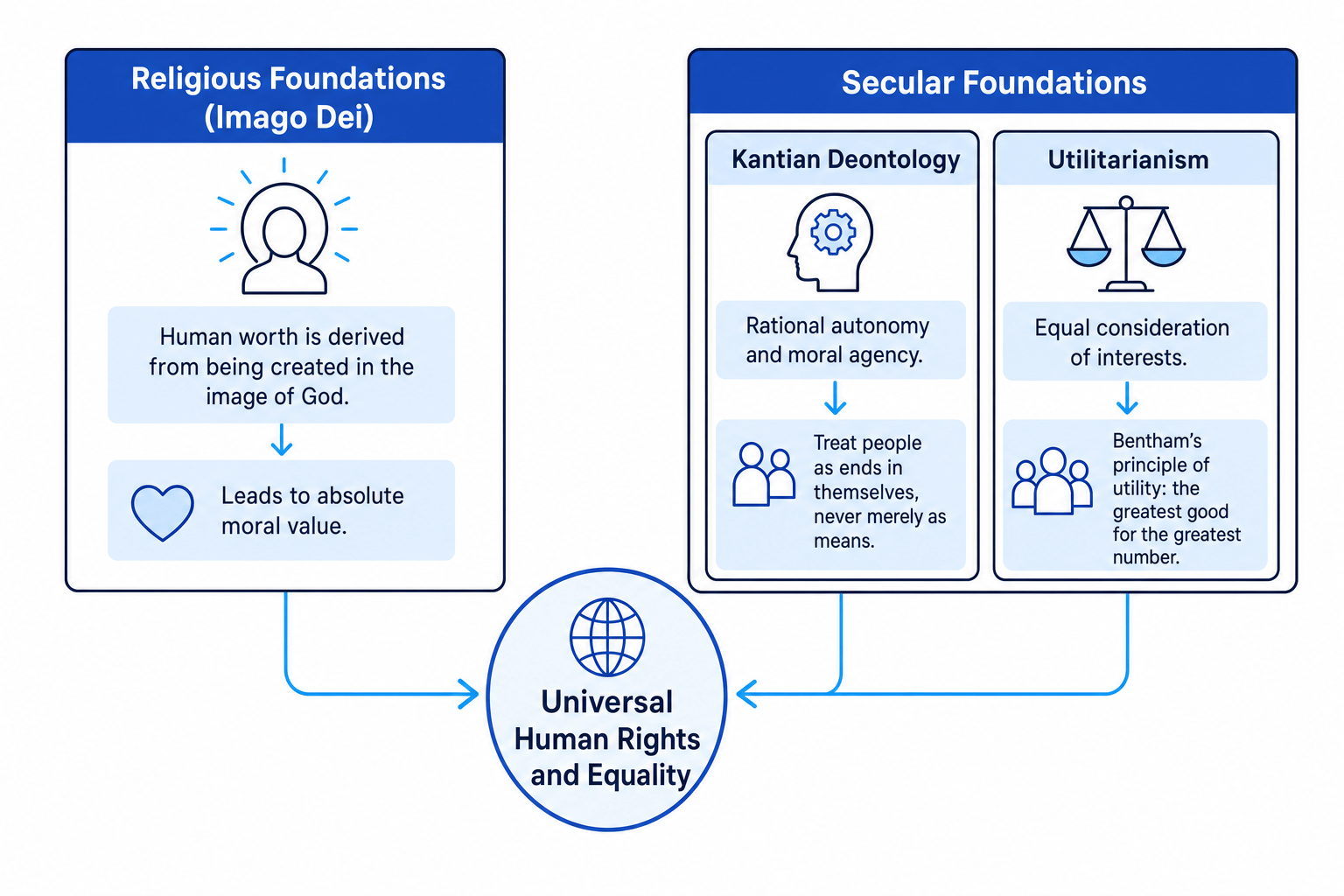
In Christian theology, equality is not something humans earn; it is an ontological (essential) reality given by God.
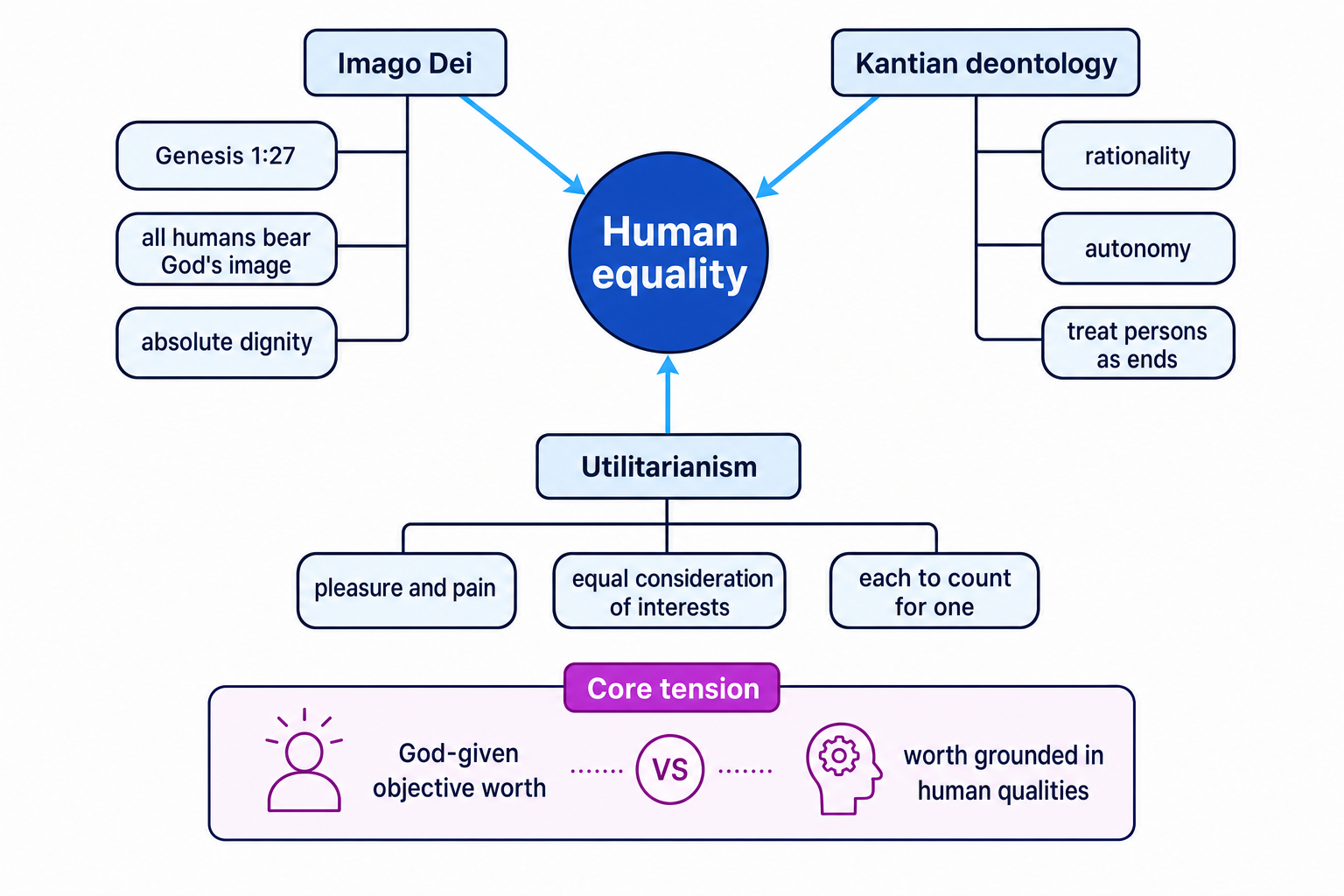
- The Image of God (Imago Dei): Genesis 1:27 states, "God created mankind in his own image." Because every human being carries this divine imprint, all individuals possess an absolute, non-negotiable dignity that cannot be stripped away by state laws or social attitudes.
- Universalism in the New Testament: Traditional boundaries of social status, race, and gender are declared irrelevant before God. In Galatians 3:28, the Apostle Paul writes: "There is neither Jew nor Gentile, neither slave nor free, nor is there male and female, for you are all one in Christ Jesus."
Secular Ethical Foundations
Secular philosophers argue that we do not need a God to justify equality. They offer alternative foundations:
- Kantian Deontology: Immanuel Kant argued that equality is grounded in human rationality. Because humans are rational agents, they possess autonomy and "dignity" rather than a "price." Under his Formula of Humanity (the Categorical Imperative), we must always treat human beings as ends in themselves, never merely as a means to an end. This forbids exploitation and establishes universal moral rights.
- Utilitarianism: Jeremy Bentham rejected "natural rights" as nonsense, grounding equality instead in our shared capacity to experience pleasure and pain. His fundamental axiom was: "Each to count for one, and none for more than one." For utilitarians, equality means the equal consideration of interests—everyone’s suffering or happiness weighs equally in the moral calculus.
The Core Tension
Religious equality is grounded in a transcendent source (God's creation), making human dignity absolute and objective. Secular equality is grounded in immanent human qualities (reason or sentience), which critics argue can fluctuate or exclude certain groups (such as those with severe cognitive impairments).
2. Racial Equality: Martin Luther King Jr.
During the mid-20th century, the American South was governed by Jim Crow laws—state and local laws that enforced racial segregation. Martin Luther King Jr. (1929–1968), a Baptist minister, became the intellectual and spiritual leader of the Civil Rights Movement, arguing that segregation was not just politically unwise, but a sin against God.
Theological and Philosophical Framework
King's philosophy of non-violent resistance (Satyagraha, influenced by Mahatma Gandhi) was built on deeply Christian foundations:
- Agape Love: King distinguished between eros (romantic love), philia (friendship), and agape (disinterested, selfless Christian love). He argued that civil rights activists must love their oppressors with agape, seeking to redeem the relationship rather than defeat the enemy.
- Natural Law and Unjust Laws: In his famous Letter from Birmingham Jail (1963), King addressed moderate white clergy who criticized his civil disobedience. He justified breaking segregation laws by appealing to Augustine and Thomas Aquinas:
- An unjust law is a human law that is not rooted in eternal law and natural law.
- Aquinas argued that any law that uplifts human personality is just; any law that degrades human personality is unjust.
- Because segregation distorts the soul and damages the personality of both the segregated and the segregator, it is a moral outrage that Christians have a duty to disobey.
Light Bulbs and Electricity
Think of the Imago Dei like electricity flowing through different-colored light bulbs. The bulbs (our outer racial, gender, or physical differences) look distinct on the outside. However, the light glowing within them is the exact same electrical current (the divine image). To treat one bulb as worthless is to insult the power source that illuminates them all.
3. Disability Equality: Joni Eareckson Tada
Disability theology challenges the historical marginalization of disabled people, who have often been treated as "broken" or secondary citizens.
Social Model of Disability
A conceptual framework which argues that people are disabled by systemic barriers, derogatory attitudes, and social exclusion, rather than by their physical or mental impairments.
Joni Eareckson Tada (born 1949) became a quadriplegic following a diving accident in 1967. Through her global ministry, Joni and Friends, she has spent decades advocating for the rights and spiritual inclusion of disabled individuals.
Theological Advocacy for Disability Rights
Eareckson Tada’s work challenges both secular utilitarian values and toxic theological assumptions:
- Rejection of the "Karmic" or Punitive View of Disability: Historically, some religious communities viewed disability as a punishment for sin. Tada reframes disability using the New Testament, notably 2 Corinthians 12:9 ("My grace is sufficient for you, for my power is made perfect in weakness"). She argues that disability reveals the interdependence of humanity and exposes the illusion of self-sufficiency.
- The Intrinsic Value of Vulnerability: Secular society often measures human worth by economic productivity or cognitive ability. Tada argues that because disabled individuals bear the Imago Dei, their worth is absolute.
- Opposition to Euthanasia and Selective Abortion: Tada is a vocal critic of assisted dying and selective termination of fetuses with genetic abnormalities. She warns that these practices stem from a utilitarian view of human worth, where a life with suffering is deemed "not worth living." Instead, she advocates for robust social support and spiritual communities that embrace the vulnerable.
Confusing Tada's View on Suffering
Do not write that Joni Eareckson Tada believes physical suffering is a good thing in itself. She acknowledges that suffering is painful and a consequence of a fallen world. However, she argues that God uses suffering as a tool to cultivate empathy, dismantle human pride, and foster genuine, equal community.
4. Evaluating Religious Voices in Secular Debates
A key A-Level RS requirement (AO2) is to evaluate whether it is appropriate or valuable to employ religious perspectives in modern debates about equality.
Arguments for Using Religious Perspectives
- A Secure Foundation for Dignity: Secular ethics struggles to find an objective anchor for human rights. If human worth is based on rational capability (Kant), then infants, people with late-stage dementia, or those with severe intellectual disabilities may lose their status as "persons." The theological concept of the Imago Dei protects everyone unconditionally.
- Historical Success: The most successful equality campaigns in history—such as the abolition of the slave trade (led by William Wilberforce) and the Civil Rights Movement (led by MLK)—were fueled by religious rhetoric. Religious narratives possess a unique motivational power to inspire self-sacrifice for the common good.
Arguments Against Using Religious Perspectives
- Exclusionary in Pluralistic Societies: In multicultural, secular democracies, appealing to scripture or divine revelation (e.g., "because God said so") carries no authority for non-believers. Ethical debates must be conducted in the "common currency" of shared human reason.
- Historical Abuse of Scripture: Critics like Richard Dawkins point out that religious texts have been used to justify extreme inequality. For centuries, Christian slave owners used the Bible to justify slavery, and churches used scripture to oppose women's suffrage and LGBTQ+ rights.
Watch Your Tone in AO2
Avoid sweeping generalizations such as "Religion always causes inequality" or "Without religion, there is no morality." Successful essays balance both sides, recognizing that while religious institutions have historically perpetuated inequality, religious principles have also been the primary catalysts for dismantling it.
5. Structured Essay Technique: AO2 Evaluation
Here is how you can build a high-scoring evaluation paragraph analyzing whether Martin Luther King Jr.'s theological approach to equality is superior to a secular utilitarian approach.
Evaluating MLK's theological framework against utilitarianism
- State your thesis clearly: King's theological grounding of equality on the Imago Dei offers a more stable and resilient foundation for human rights than secular utilitarianism.
- Explain the religious perspective (AO1): King argued in his Letter from Birmingham Jail that segregation laws are unjust because they degrade human personality, violating the natural law of God. This means human rights are metaphysical and absolute; they cannot be overridden by democratic consensus or social utility.
- Introduce the secular counter-perspective: By contrast, a utilitarian like Jeremy Bentham might argue that equality is justified because it maximizes the happiness of the greatest number. In this view, rights are social constructs designed to minimize suffering.
- Critique the secular perspective (AO2): However, utilitarianism contains a fatal flaw: if a highly prejudiced majority derived immense pleasure from segregating a minority, a strict utilitarian calculation could theoretically justify this oppression. Utilitarianism lacks a mechanism to protect minority rights when social utility swings against them.
- Formulate a justified conclusion: Therefore, King's theological framework is superior because it establishes human dignity as an inalienable right, protecting the minority from the fluctuating preferences of the majority.
In the exam
- Directly compare your scholars: Look for opportunities to compare Martin Luther King Jr. and Joni Eareckson Tada. Both use the Imago Dei to advocate for marginalized groups, but King focused on structural, legal segregation (race), whereas Tada focuses on existential value and protection from utilitarian medical ethics (disability).
- Reference key legislation: Ground your essays in actual historical progress. Mention the Civil Rights Act (1964) in the USA and the Equality Act (2010) in the UK to show how ethical theory translates into concrete legal changes.
- Utilize precise terminology: Use terms like Imago Dei, agape, Satyagraha, Deontology, utilitarian calculus, and the social model of disability to demonstrate academic rigor.
Check yourself
- How does Thomas Aquinas's definition of a "just law" support Martin Luther King Jr.’s campaign of civil disobedience?
- Why does Joni Eareckson Tada object to secular utilitarian views on assisted dying and selective abortion?
- What is the primary philosophical weakness of grounding human equality on Immanuel Kant's concept of "rationality"?