

What you'll learn
- What a theodicy is and how it responds to evil and suffering.
- How Augustine explains evil through the Fall, privation and free will.
- How Irenaeus explains suffering through soul-making, epistemic distance and final fulfilment.
- How process theodicy changes the idea of God’s power, and how to evaluate all three approaches.
1. The starting point: why theodicies are needed
The problem of evil asks how belief in God can be reasonable if there is real evil and suffering in the world. It becomes especially sharp for classical theism, the belief that God is all-powerful, all-loving, all-knowing and creator of everything.
A theodicy does not usually deny that suffering is terrible. It tries to show that belief in God can still be coherent despite suffering.
Theodicy
A theodicy is an attempt to justify God’s goodness and power in the face of evil and suffering.
Two kinds of evil are useful to distinguish:
- Moral evil: suffering caused by human choices, such as murder, cruelty, exploitation or war.
- Natural evil: suffering caused by natural processes, such as disease, earthquakes, genetic disorders or animal pain.
The map below shows the three main approaches in this topic: Augustine, Irenaeus and process theodicy.
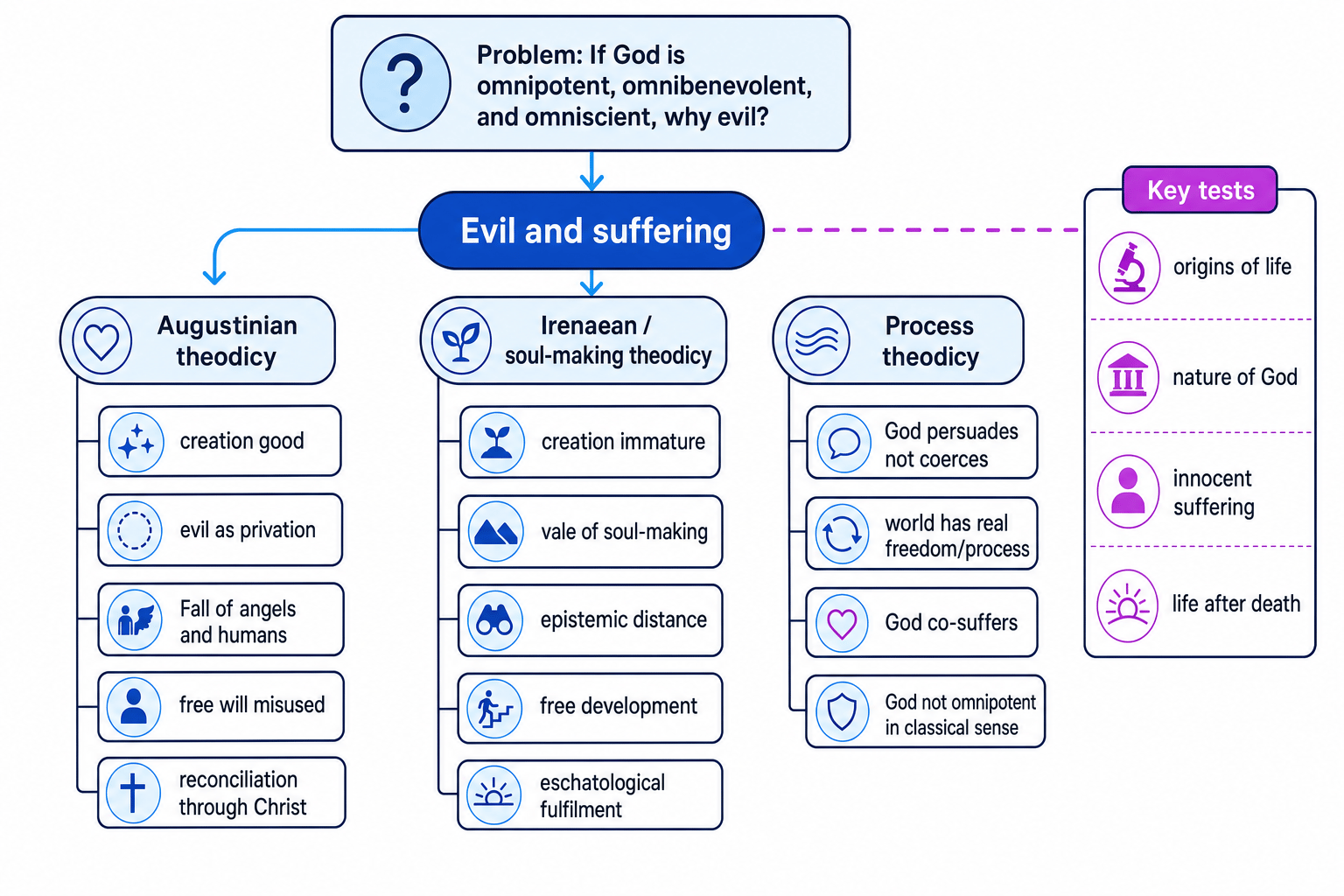
The big question
Theodicies are not just asking “why is there pain?” They are asking whether suffering is compatible with a God who is good, powerful and worthy of worship.
2. Augustine: creation was good, evil is a privation
Augustine’s theodicy begins with the Christian belief that God created the world good. In Genesis, creation is repeatedly described as “good”, so Augustine argues that evil cannot be a thing God created.
Instead, evil is a privation: a lack, corruption or absence of goodness.
Privation
A privation is the absence of a good that should be there. For Augustine, evil is not a substance; it is a corruption of something originally good.
A classic example is blindness. Blindness is not a separate “thing” in the same way an eye is a thing. It is the lack of sight where sight should exist. Augustine applies this idea to evil: evil depends on good, but twists or damages it.
The Fall of angels and humans
Augustine links evil to the misuse of free will, meaning the genuine ability to choose between alternatives. He argues that God created free beings good, but some angels turned away from God through pride. Then human beings also fell through the disobedience of Adam and Eve.
This is known as the Fall: the traditional Christian belief that human nature and the created order became damaged through the first human sin.
For Augustine, moral evil is therefore caused by creatures, not by God. God gave freedom because a world of freely loving creatures is better than a world of robots. But free will can be misused.
Soul-deciding and reconciliation
Augustine’s approach is sometimes described as soul-deciding because earthly life becomes a serious moral and spiritual arena. Human beings either turn towards God or away from God.
However, Augustine does not think fallen humans can simply repair themselves by trying harder. They need grace, God’s undeserved help. The Christian solution is reconciliation, meaning the restoration of the broken relationship between humanity and God, achieved through Christ.
Reconciliation
Reconciliation means being brought back into right relationship with God after sin. In Christian theology, this happens through Christ’s saving work and God’s grace.
Applying Augustine to suffering
A student is asked how Augustine might explain a world containing both murder and disease.
-
Separate the types of evil. Murder is moral evil because it comes from human choice. Disease is natural evil because it comes through the natural order.
-
Apply Augustine’s cause of evil. Augustine explains moral evil through the misuse of free will after the Fall. Human beings turn away from God and choose lesser goods selfishly.
-
Extend the Fall to natural evil. Traditional Augustinian thought sees natural disorder as linked to the cosmic consequences of the Fall: creation is no longer harmoniously ordered as it was intended to be.
-
Evaluate the explanation. This protects God from directly creating evil, but it struggles if natural suffering existed before humans, as modern evolutionary science suggests.
Turning evil into a substance
Do not say Augustine thinks God created evil “for a reason”. Augustine’s whole point is that evil is not a created thing at all; it is the privation or corruption of created goodness.
Strengths of Augustine
Augustine’s theodicy is powerful because it preserves key Christian beliefs:
- God remains wholly good.
- Evil is blamed on created free will, not on God.
- Human moral responsibility is taken seriously.
- The need for salvation through Christ makes sense.
It also gives a strong account of moral evil. Cruelty, betrayal and injustice often do seem connected to disordered human desire.
Weaknesses of Augustine
The biggest difficulty is modern science. If life developed through evolution, then death, predation, disease and extinction existed long before human beings. That makes it hard to say natural evil entered the world through a historical human Fall.
Augustine also faces a logical challenge: if God made free creatures perfectly good, why did they choose evil? J. L. Mackie famously argued that an omnipotent God could have created free beings who always freely choose the good.
There is also a moral concern. Is it fair for all humans to inherit guilt or punishment from Adam and Eve? And why should animals or infants suffer because of human sin?
3. Irenaeus: creation as a vale of soul-making
Irenaeus offers a very different approach. Instead of saying creation began perfect and then fell, Irenaeus sees human beings as created immature and incomplete. We are made in the image of God, but must grow into the likeness of God.
This means the world is not meant to be a paradise of comfort. It is a challenging environment in which humans can develop virtues such as courage, compassion, patience and trust.
Vale of soul-making
The vale of soul-making is the idea that earthly life is a place of moral and spiritual development, where challenges help persons grow towards maturity.
The phrase “vale of soul-making” is associated especially with John Hick’s later development of Irenaean ideas, but the roots are in Irenaeus’ belief that humans grow towards divine likeness.
Free will defence
The free will defence argues that genuine freedom is a great good. If God constantly prevented wrong choices, humans would not be morally responsible agents.
For Irenaeus, free will is not only about explaining why evil happens. It is necessary for growth. You cannot develop courage without danger, forgiveness without wrongdoing, or compassion without need.
Best of all possible worlds
The phrase best of all possible worlds is most closely associated with Leibniz, but it is useful here. A soul-making theodicy does not claim this is the most comfortable world possible. It claims this may be the best kind of world for producing mature persons.
A world with predictable natural laws, real risks and real consequences may be better for soul-making than a world where God constantly intervenes to remove pain.
Epistemic distance
Irenaean theodicy also uses the idea of epistemic distance. This means God is not so overwhelmingly obvious that belief becomes forced.
Epistemic distance
Epistemic distance is the gap between humans and God that allows people to respond freely to God rather than being compelled by undeniable divine presence.
If God appeared unmistakably every time someone considered doing wrong, obedience might be based on fear or self-interest, not genuine love.
Eschatological justification
The Irenaean approach needs an afterlife. This is called eschatological justification, from eschatology, meaning beliefs about the final destiny of humans and the world.
The idea is that suffering can only be fully justified if God ultimately completes the soul-making process beyond death. Hick develops this in a strongly hopeful direction, arguing that all persons will eventually be brought to perfection.
Using soul-making to analyse suffering
A student is evaluating whether Irenaeus can explain the suffering of someone who becomes seriously ill.
-
Identify the developmental claim. Irenaeus can argue that a difficult world allows virtues such as courage, patience, empathy and dependence on God to develop.
-
Notice the unequal distribution. Some people suffer far more than others, and some suffering seems to destroy rather than develop a person.
-
Bring in eschatological justification. The theodicy therefore needs life after death, where God can heal, complete and fulfil what earthly life leaves broken.
-
Make the judgement. The argument is stronger if life after death is accepted, but much weaker if the afterlife is seen as speculative or if suffering seems too extreme to be justified by future growth.
Saying suffering is automatically good
Irenaean theodicy does not mean every painful event is obviously good. It argues that a world containing challenge may be necessary for soul-making, but this still leaves difficult cases of apparently pointless suffering.
Strengths of Irenaeus
Irenaeus fits modern views about development better than Augustine. Evolution already presents life as a long process of growth, struggle and adaptation. So Irenaeus does not need a literal perfect world at the beginning.
It also gives suffering a positive purpose. Instead of seeing pain only as punishment or corruption, it can be part of moral and spiritual formation.
Weaknesses of Irenaeus
The main weakness is innocent suffering. Babies, animals and victims of extreme cruelty may not seem to gain meaningful soul-making benefits. Some suffering crushes character rather than builds it.
There is also a serious challenge to the nature of God. If God deliberately uses suffering to develop people, does that make God loving, or does it make God manipulative?
The theodicy also depends heavily on life after death. Without a future fulfilment, the amount and unfair distribution of suffering look much harder to justify.
4. Process theodicy: God persuades but does not coerce
Process theodicy is associated with thinkers such as Alfred North Whitehead, Charles Hartshorne and David Griffin. It is not the same as Augustine or Irenaeus, because it changes the classical idea of omnipotence.
In process thought, reality is dynamic and developing. God works within the process of the world by persuasion, not by coercion.
Process theodicy
Process theodicy argues that God is not responsible for evil because God cannot unilaterally control the world. God lovingly persuades creatures towards good but cannot force their free responses.
This means God is not omnipotent in the classical sense. God cannot simply prevent every earthquake, disease or violent act. Instead, God is the co-sufferer who experiences the pain of creation and works to bring good out of it. Whitehead famously described God as “the fellow-sufferer who understands”.
This view also challenges aseity, the classical belief that God is self-existent and independent. In process theology, God is genuinely affected by the world.
Evaluating process theodicy against classical theism
A student is asked whether process theodicy solves the problem of evil.
-
Identify the solution. Process thought removes direct blame from God by denying that God has coercive control over every event.
-
Test it against innocent suffering. This helps with cases such as childhood cancer or natural disasters, because process theodicy does not say God planned them for a hidden purpose.
-
Test it against the nature of God. The cost is that God is no longer omnipotent in the classical sense. Some believers may think this is too far from traditional Christianity.
-
Reach a balanced judgement. Process theodicy may make God seem more compassionate, but it may also make God seem less able to guarantee final victory over evil.
A high cost solution
Process theodicy solves part of the problem of evil by limiting God’s power. That is effective logically, but it may no longer defend the God of classical theism.
5. Comparing Augustine and Irenaeus
| Issue | Augustine | Irenaeus |
|---|---|---|
| Starting point | Creation was originally good and ordered. | Creation is good but immature and incomplete. |
| Source of evil | Evil comes from the Fall of angels and humans through misuse of free will. | Evil and suffering are part of the environment in which souls develop. |
| Key idea | Evil is a privation of good. | The world is a vale of soul-making. |
| Human problem | Humans are fallen and need grace. | Humans are immature and need growth. |
| Solution | Reconciliation through Christ. | Growth into divine likeness, completed eschatologically. |
| Main strength | Strong on moral evil and Christian doctrine of sin. | Strong on development, freedom and modern evolutionary thinking. |
| Main weakness | Struggles with evolution and inherited guilt. | Struggles with excessive and innocent suffering. |
Best comparison point
Augustine mainly explains evil by looking backwards to the Fall; Irenaeus mainly explains suffering by looking forwards to spiritual development and final fulfilment.
6. The four big evaluation tests
Modern views about origins of life
Augustine is weakest here if read literally. Evolution suggests death and suffering existed before human beings, so natural evil cannot easily be blamed on the human Fall.
Irenaeus is stronger because he sees creation as developmental. Process theodicy is also compatible with evolution because it presents the world as genuinely open and dynamic.
The nature of God
Augustine protects God’s goodness by saying God did not create evil. But he still must explain why an omniscient God created beings he knew would fall.
Irenaeus presents God as a loving educator. But if the world is full of extreme suffering for educational purposes, God may seem harsh.
Process theodicy makes God compassionate and involved, but weakens classical omnipotence and aseity.
Innocent suffering
This is the hardest test for all theodicies. Augustine may seem unfair because the innocent suffer due to inherited sin. Irenaeus may seem inadequate because not all suffering develops the sufferer. Process thought avoids saying innocent suffering is divinely planned, but it leaves open why God is worthy of worship if unable to prevent it.
Life after death
Augustine uses reconciliation and salvation through Christ to answer the problem of sin and judgement. Irenaeus needs eschatological fulfilment even more strongly, because soul-making may be incomplete in earthly life.
If life after death is rejected, Irenaean theodicy becomes much weaker. If it is accepted, it can argue that present suffering is not the final word.
In the exam
-
Anchor your answer in Augustine and Irenaeus. Edexcel can reward other scholars, but these two must be central for this topic.
-
Evaluate as you go. After explaining a claim, test it against modern origins of life, the nature of God, innocent suffering or life after death.
-
Compare directly. Use phrases such as “unlike Augustine…” or “Irenaeus is stronger here because…” rather than writing two separate mini-essays.
-
Reach a justified judgement. A strong conclusion should say which theodicy is most successful, for which kind of believer, and at what cost.
Check yourself
- Why does Augustine say evil is a privation rather than a substance?
- How does epistemic distance support the Irenaean soul-making theodicy?
- Does process theodicy solve the problem of evil, or simply redefine God?
