

Welcome to one of the most intellectually stimulating and emotionally profound topics in your A-Level Religious Studies course. The problem of evil and suffering is not just a theoretical puzzle; it is a direct challenge to the rationality of classical religious belief.
In this topic, you will explore how the existence of pain, cruelty, and disaster in our world is used by secular and atheist philosophers to argue that the God of classical theism cannot possibly exist.
What you'll learn
- The crucial distinction between moral and non-moral (natural) evil.
- How the "Inconsistent Triad" exposes the logical problem of evil.
- The distinct challenges posed by David Hume and J.L. Mackie to classical theism.
1. What is the Problem of Evil?
Before we dive into the complex philosophical arguments, we need to clarify our terms. In everyday language, "evil" is often used to describe exceptionally wicked people or acts. In philosophy of religion, however, the term has a much broader definition.
Evil and Suffering
Evil is defined philosophically as any pain, suffering, or deprivation of good. Suffering is the subjective, conscious experience of physical pain or mental distress caused by these conditions.
Philosophers split evil into two primary categories. Understanding this distinction is vital for your AO1 explanation marks.
Moral Evil
This refers to any suffering caused by the deliberate actions, choices, or omissions of free, rational agents (humans).
- Examples: Murder, theft, war, cruelty, and systemic oppression.
- Key feature: It stems directly from human agency and choice.
Non-Moral (Natural) Evil
This refers to suffering that arises from the natural operation of the physical universe, entirely independent of human action or choice.
- Examples: Earthquakes, tsunamis, cancer, droughts, and volcanic eruptions.
- Key feature: It is built into the fabric of nature and happens due to physical laws, not human choices.
Confusing Natural and Moral Evil
Students often misclassify environmental crises as natural evil. While climate change leads to natural disasters (such as floods), the human choices driving it make it a form of moral evil (or at least a hybrid). To keep your exam essays clean, always use unambiguous examples: a volcanic eruption or a genetic disease for natural evil, and acts of violence or theft for moral evil.
2. The Nature of the Challenge: Classical Theism under Fire
The problem of evil does not challenge every concept of God. For instance, a belief in multiple, competing gods (polytheism) or a god who is indifferent to human affairs (deism) is unaffected by the existence of suffering.
Instead, the problem is directed specifically at the God of classical theism, who is defined by three supreme attributes:
- Omnipotent: All-powerful. God can do anything that is logically possible.
- Omnibenevolent: All-loving/wholly good. God desires to prevent all suffering and promote perfect goodness.
- Omniscient: All-knowing. God knows everything that has happened, is happening, and will happen.
If God has these three attributes, then why is there suffering? This tension forms the basis of the two main types of the problem of evil: the logical problem and the evidential problem.
3. The Logical Problem of Evil
The logical problem of evil is an a priori argument. It claims that the existence of evil and the existence of the classical God are logically incompatible. It is not a matter of "how much" evil there is; rather, the argument states that even a single microscopic pinch of suffering is enough to prove that the classical God cannot exist.
David Hume and the Epicurean Paradox
Although the ancient Greek philosopher Epicurus is credited with first formulating this dilemma, David Hume (1711–1776) famously revitalised it in his Dialogues Concerning Natural Religion (1779).
Hume summarised Epicurus' questions clearly:
- Is God willing to prevent evil, but not able? Then he is impotent (not omnipotent).
- Is he able, but not willing? Then he is malevolent (not omnibenevolent).
- Is he both able and willing? Whence then is evil? (Where does evil come from?)
Hume argued that because evil is an undeniable fact of our world, we must logically conclude that God lacks either the power or the love required to stop it. Therefore, the traditional God of classical theism does not exist.
J.L. Mackie and the Inconsistent Triad
In his influential 1955 paper "Evil and Omnipotence", modern philosopher J.L. Mackie formalized this argument into what we call the Inconsistent Triad.
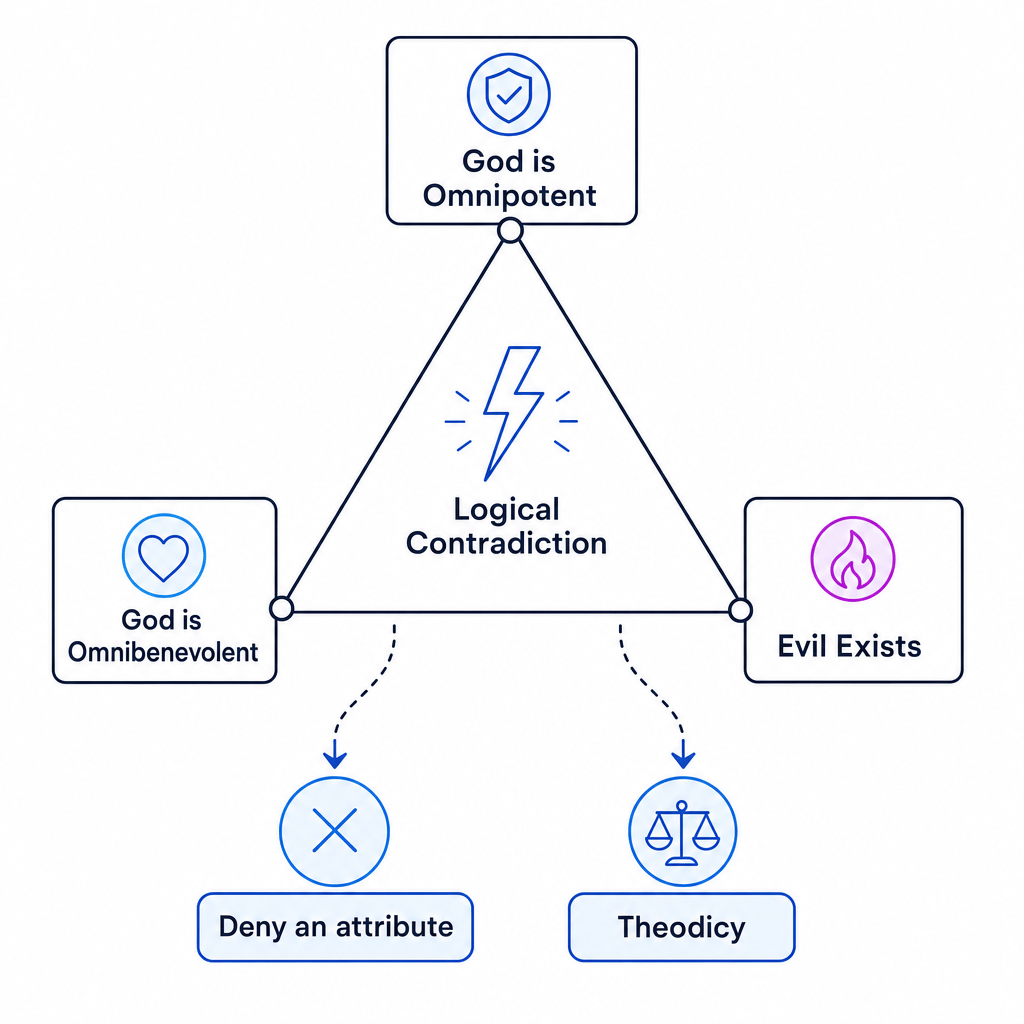
Mackie pointed out that a logical contradiction occurs because the three propositions in the triad cannot all be true at the same time:
- God is omnipotent.
- God is wholly good (omnibenevolent).
- Evil exists.
Mackie's Logical Rule
Mackie argued that for the contradiction to work, we must accept two simple rules of logic:
- A good thing always eliminates evil as far as it can.
- There are no limits to what an omnipotent being can do.
If these rules hold, then an omnipotent, wholly good God would eliminate all evil. Since evil exists, such a God cannot.
If we wish to resolve this contradiction logically, we are forced to deny at least one corner of the triangle. For the traditional believer, however, denying any of these attributes is unacceptable because it compromises the very nature of God.
The Broken Triangle
Think of the Inconsistent Triad like a three-legged stool. If you saw off any one of the legs (e.g., deny that evil is real, or deny that God is all-powerful), the stool will stand differently, but it is no longer the classical Christian "stool." If you keep all three legs, the stool collapses under the weight of logical contradiction.
4. Deconstructing the Logical Challenge
To succeed in your AO2 evaluation, you must understand exactly how the logical problem of evil operates. Let's look at how you can deconstruct Mackie's Inconsistent Triad step-by-step to evaluate its logical validity.
Deconstructing the Inconsistent Triad
How does a philosopher show that the Inconsistent Triad represents a formal logical contradiction?
-
Identify the core premises: State the three classical propositions clearly:
- P1P_1P1: God is omnipotent.
- P2P_2P2: God is omnibenevolent.
- P3P_3P3: Evil exists.
-
Introduce the hidden premises of definition: Add the logical definitions that connect these premises:
- D1D_1D1: An omnipotent being has the power to prevent any evil.
- D2D_2D2: An omnibenevolent being has the desire to eliminate all evil.
-
Derive the logical consequence of God's existence: Combine the attributes of God (P1P_1P1 and P2P_2P2) with their definitions (D1D_1D1 and D2D_2D2):
- If an omnipotent, omnibenevolent being exists, it has both the power (D1D_1D1) and the desire (D2D_2D2) to eliminate all evil.
- Therefore, if God exists, evil cannot exist.
-
Identify the contradiction with reality: Compare the derived logical consequence with the factual premise (P3P_3P3):
- Fact: Evil exists (P3P_3P3).
- Deduction: Therefore, an omnipotent, omnibenevolent God does not exist.
-
Evaluate the outcome: Conclude that the theist must either reject one of the core premises (P1P_1P1 or P2P_2P2) or find a flaw in the hidden definitions (D1D_1D1 or D2D_2D2) to resolve the logical contradiction.
5. Mackie's Critique of Theodicies
In "Evil and Omnipotence", Mackie anticipated that religious believers would try to resolve this triad using theodicies (arguments that justify God in the face of evil). He categorized these attempts into "adequate solutions" and "fallacious solutions."
Adequate Solutions
An adequate solution is one that avoids the contradiction by giving up one of the corners of the triad. For example:
- Denying God's omnipotence (as in Process Theology).
- Claiming that evil is merely an illusion (as in Christian Science).
While these are logically consistent, Mackie points out that most traditional believers reject them because they ruin the orthodox concept of God.
Fallacious Solutions
These are solutions that try to keep all three corners of the triad but, according to Mackie, fail logically because they secretly change the meaning of the terms or break down under scrutiny. Let's look at two major fallacies Mackie identifies:
1. "Good cannot exist without evil" (or "Evil is a necessary counterpart to good")
- The Believer's View: You cannot have the concept of "light" without "darkness." Likewise, you cannot have "good" without "evil" to define it.
- Mackie's Critique: This limits God's power. It suggests God is bound by a law of nature or logic that prevents him from creating good without its opposite. If God must create evil in order to create good, he is not truly omnipotent.
2. "The universe is better with some evil in it" (Aesthetic/Soul-making solutions)
- The Believer's View: Certain high-level virtues, like courage, compassion, and forgiveness (Second-Order Goods), can only develop in a world containing real dangers and suffering (First-Order Evils).
- Mackie's Critique: This leads to an infinite regress. If we need "First-Order Evil" (pain) to have "Second-Order Good" (sympathy), what about "Second-Order Evil" (cruelty)? To overcome cruelty, we would need a "Third-Order Good" (benevolent justice). Mackie argues this game of levels never stops, and it still fails to explain why an omnipotent God could not simply create humans who always freely choose the good.
Focus on Mackie's Free Will Critique
Mackie’s most powerful attack is on the Free Will Defence. He asks: If God is omnipotent, why couldn't he have made humans who are genuinely free, yet always choose to do the right thing? Since this is a logically possible state of affairs, an omnipotent God's failure to create such a world proves he is either not omnipotent or not wholly good. This is a brilliant point to use in your AO2 essays!
In the exam
- Define your terms immediately: In an essay on the problem of evil, make sure your first paragraph clearly distinguishes between moral and non-moral (natural) evil.
- Quote the key scholars accurately: Use Hume’s classic "Is he willing..." formulation or Mackie’s "Inconsistent Triad" explicitly. This shows the examiner you are grounded in the specific academic texts.
- Keep AO2 at the heart of your writing: Do not just explain the triad (AO1). Critically evaluate whether Mackie is correct to reject the Free Will Defence, or whether his definition of omnipotence is too rigid.
Check yourself
- Can you explain why a natural disaster like an earthquake is classified as "non-moral evil," while a human-caused disaster is classified as "moral evil"?
- What are the three propositions that make up J.L. Mackie's "Inconsistent Triad"?
- Why does Mackie argue that saying "good cannot exist without evil" limits God's omnipotence?
