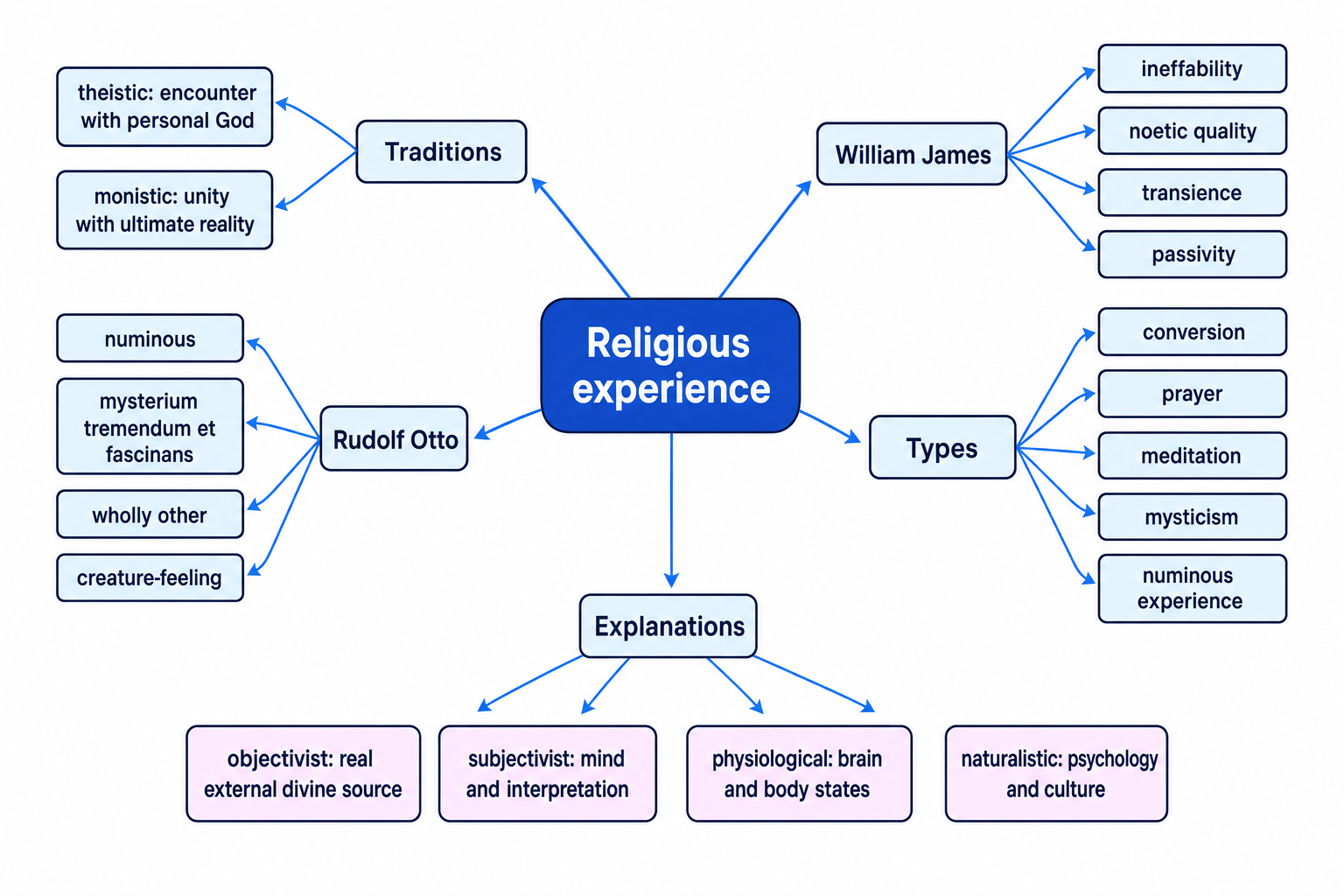
What you'll learn
- How religious experience can be understood across theistic and monistic traditions.
- William James’ four marks of mystical experience: ineffability, noetic quality, transience and passivity.
- Rudolf Otto’s idea of the numinous as mysterium tremendum et fascinans.
- How to compare objectivist, subjectivist, physiological and naturalistic explanations.
1. Starting point: what is a religious experience?
A religious experience is usually understood as an experience that the person interprets as involving God, gods, the divine, the sacred, or ultimate reality. “Ultimate reality” means the deepest reality or truth that a religious tradition believes everything depends on.
This matters because not all religious traditions describe reality in the same way. Some are theistic, meaning they centre on belief in a personal God or gods. Others may be monistic, meaning they see reality as ultimately one unified reality rather than many separate things.
Religious experience
A religious experience is an experience interpreted as an encounter with, awareness of, or response to God, gods, the sacred, or ultimate reality.
For example, a Christian might describe a religious experience as a personal encounter with God through prayer. A Hindu Advaita Vedanta thinker might describe spiritual insight as realising the unity of Atman and Brahman. A Buddhist may speak less about God and more about awakening, enlightenment, or insight into reality.
So, in Edexcel essays, avoid writing as if religious experience only means “seeing God”. The topic includes a wide range of experiences across traditions.
The main ideas in this topic fit together like this:
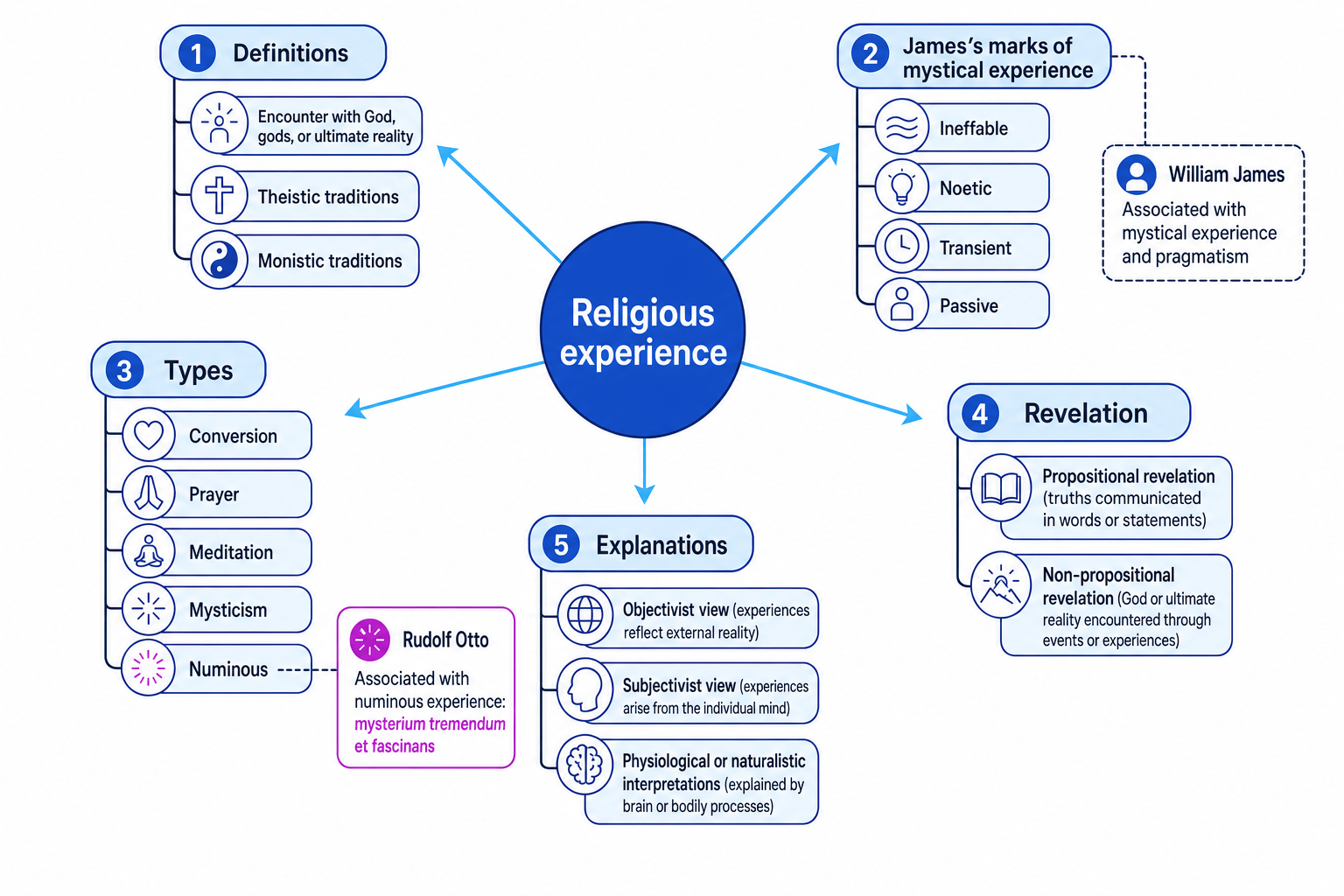
The big picture
Religious experience is not one single thing: it includes personal encounters, mystical union, conversion, prayer, meditation and awe before the holy, and these can be interpreted in objectivist, subjectivist or naturalistic ways.
2. William James: mystical experience
William James was an American psychologist and philosopher. His key work is The Varieties of Religious Experience (1902). James focused on first-hand religious experience, especially the experiences of individual people rather than official doctrines or institutions.
James is especially useful because he offers four famous features of mystical experience.
James’ four marks
James’ four marks of mystical experience
- Ineffability means the experience cannot be fully expressed in ordinary language.
- Noetic quality means the experience gives the person a sense of knowledge, insight or truth.
- Transience means the experience does not last long.
- Passivity means the person feels acted upon rather than fully in control.
James does not claim that every religious experience proves God exists. His view is more careful. He argues that religious experiences can be authoritative for the person who has them, but they do not automatically compel outsiders to believe.
James also uses a pragmatic approach. Pragmatism means judging beliefs partly by their practical effects or “fruits”. If an experience produces lasting moral transformation, courage, compassion or holiness, James thinks it should be taken seriously.
Evaluating James
James’ approach is strong because it takes personal testimony seriously and recognises the real impact religious experiences can have. It also works across traditions because it focuses on features of experience, not just one doctrine.
However, there are weaknesses. A life-changing experience is not necessarily true. A false belief could still have positive effects. Also, James’ focus on individual experience may underplay the role of religious community, scripture and tradition in shaping how people interpret experiences.
Treating James as a simple proof of God
James does not simply say “religious experiences happen, therefore God exists”. His argument is more modest: experiences can be meaningful and authoritative for the experiencer, especially when their effects are positive.
3. Rudolf Otto: the numinous
Rudolf Otto was a German theologian best known for The Idea of the Holy (1917). Otto argued that at the heart of religion is the experience of the numinous.
The numinous
The numinous is an experience of the holy as mysterious, overwhelming and attractive. Otto describes it as mysterium tremendum et fascinans: a mystery that causes awe or dread, yet also fascinates and draws the person in.
Otto says the numinous involves the sense of the wholly other: something radically beyond ordinary human life. He also describes creature-feeling, where the person feels small, dependent or humbled before the sacred.
Importantly, Otto calls the numinous non-rational, not irrational. He means that it goes beyond ordinary reasoning and language; he is not saying it is nonsense.
Evaluating Otto
Otto is helpful because he captures an important feature of many religious experiences: awe. His account fits experiences such as Isaiah’s vision in the Temple, Moses before the burning bush, or a worshipper overwhelmed by the holiness of God.
However, Otto may be too narrow if he treats awe before a holy “other” as the core of all religion. Some traditions emphasise unity, calm insight or liberation rather than fear and fascination before a personal divine being. A naturalist might also argue that awe can be explained psychologically: humans can feel overwhelmed by nature, music, ritual or architecture without encountering God.
4. Types of religious experience
Religious experiences can be grouped into several types. These categories overlap, so do not treat them as completely separate boxes.
| Type | What it means | Example of how it might appear |
|---|---|---|
| Conversion | A major change in belief, identity or way of life | Saul/Paul changing from persecutor of Christians to apostle |
| Prayer | Communication with God or the divine | A believer feels guided, comforted or answered |
| Meditation | Disciplined attention or contemplation to gain spiritual insight | Buddhist meditation leading to insight into impermanence |
| Mysticism | Direct experience of union with God or ultimate reality | A mystic claims oneness with the divine |
| Numinous experience | Awe-filled encounter with the holy | A person feels overwhelmed by the “wholly other” |
Conversion is particularly important for James. He discusses people who move from inner conflict to peace, sometimes suddenly and sometimes gradually. For James, the significance of conversion is seen in its “fruits”: the transformed life that follows.
Prayer and meditation can be quieter forms of experience. They may not involve visions or voices, but they can still be religiously significant if the person interprets them as contact with God or ultimate reality.
Classifying an experience
A student writes: “During silent meditation, a person felt the boundaries between themselves and the universe disappear. They said the experience lasted only a few minutes, could not be described properly, and gave them deep insight into reality.”
-
The reference to silent meditation and the loss of boundaries suggests mysticism, because the person reports a direct awareness of unity with ultimate reality.
-
The claim that it “could not be described properly” matches James’ mark of ineffability, while “deep insight into reality” matches noetic quality.
-
The fact that it lasted only a few minutes matches transience, and the person’s sense that the experience happened to them rather than being fully controlled may suggest passivity.
-
This would be less clearly Otto’s numinous unless the account also stressed awe, dread, fascination or the “wholly other”.
5. Religious experience and revelation
Revelation means God, the divine or ultimate reality being disclosed or made known. Religious experience is often linked with revelation because the person may claim that something previously hidden has been shown to them.
Propositional and non-propositional revelation
Propositional revelation means truths are revealed in statements, teachings or words. Non-propositional revelation means God or ultimate reality is revealed through an event, person or experience rather than through a set of verbal statements.
A prophetic message such as “God commands this” is closer to propositional revelation because it can be expressed as a claim. A mystical experience of unity may be non-propositional because it reveals reality through direct awareness rather than through sentences.
Many experiences contain both. Paul’s conversion on the road to Damascus includes an encounter with Christ and also words addressed to him. In an essay, it is often best to show this complexity rather than forcing every example into only one category.
6. Objectivist, subjectivist and naturalistic explanations
When evaluating religious experience, a key question is: what causes it?
Objectivist and subjectivist views
An objectivist view says religious experiences are caused by a real external divine or sacred reality. A subjectivist view says the experience arises from the person’s mind, emotions, culture or interpretation.
A believer may take an objectivist view: the experience really is an encounter with God or ultimate reality. Otto’s language often sounds objectivist because the numinous is experienced as the “wholly other”, not as something the person invents.
A subjectivist may argue that religious experiences are real experiences, but their source is internal. The person genuinely feels awe, peace or insight, but this does not prove an external God.
Physiological and naturalistic interpretations
A physiological explanation explains religious experience through the body or brain. Examples include temporal lobe activity, epilepsy, fasting, sleep deprivation, drugs, sensory deprivation or unusual neurological states.
A naturalistic explanation is broader. It explains religious experience without appealing to God or the supernatural. It may include psychology, social conditioning, wish-fulfilment, ritual, trauma, or the human need for meaning.
These explanations are powerful because they show how religious experiences might arise naturally. However, they do not automatically disprove religious interpretations. A believer could argue that brain processes are the means through which God is experienced, just as seeing a tree involves brain activity but the tree may still be real.
A balanced evaluation move
Do not write “science explains the brain, so God is disproved.” A stronger point is: physiological explanations weaken religious experience as public proof, but they may not remove its personal or theological significance.
7. Comparing James and Otto
James and Otto are both important, but they approach the topic differently.
James begins with individual cases and asks what features and effects religious experiences have. He is especially interested in mysticism, conversion and practical transformation. Otto begins with the holy itself and argues that the numinous is a distinctive religious category that cannot be reduced to ordinary emotions.
James is broader and more psychological. Otto is more theological and focused on awe before the sacred. James is useful for analysing many different experiences; Otto is especially useful for experiences of overwhelming holiness.
For evaluation, you can argue that James is more flexible across traditions, while Otto gives a richer account of the distinctive “otherness” many believers report. But both face the problem that private experience is difficult to verify publicly.
Judgement for essays
Religious experiences may be convincing for those who have them, especially when they transform lives, but their private and interpreted nature means they are less convincing as universal proof of God or ultimate reality.
In the exam
-
Define the type of experience clearly before evaluating it: conversion, prayer, meditation, mysticism or numinous.
-
Use James for mystical features and practical effects; use Otto for awe, holiness and mysterium tremendum et fascinans.
-
Balance objectivist claims with subjectivist, physiological and naturalistic explanations, then reach a justified judgement rather than just listing views.
Check yourself
- What is the difference between a theistic and a monistic understanding of religious experience?
- How do James’ four marks help identify mystical experience?
- Why might a physiological explanation weaken, but not completely disprove, a religious interpretation?