What you'll learn
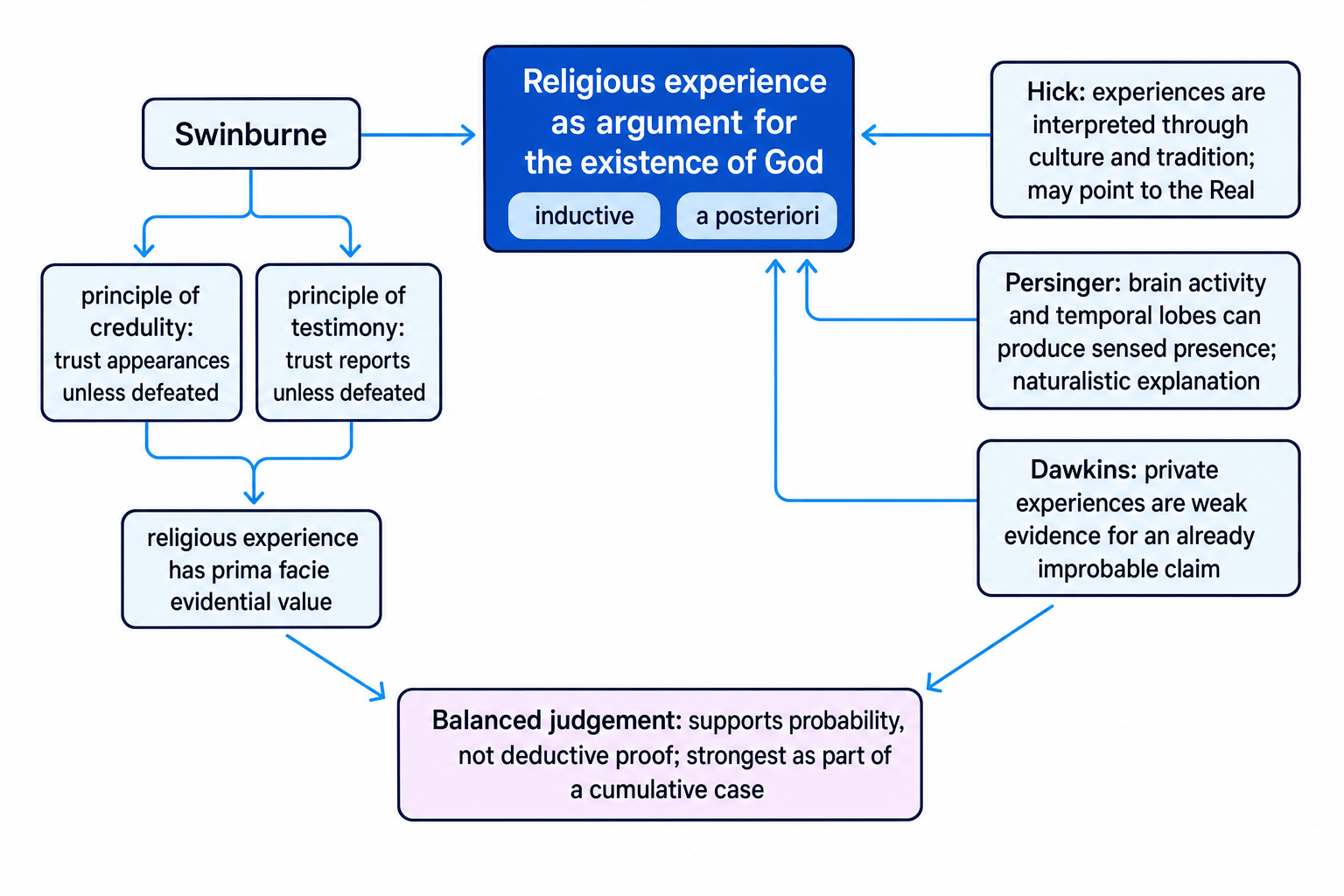
- How religious experience can be used as an inductive argument for God’s existence.
- How Swinburne’s principles of credulity and testimony support the argument.
- How Hick, Persinger and Dawkins challenge or refine the evidential value of religious experience.
- How to evaluate this topic in a balanced A-Level essay.
Starting point: what kind of argument is this?
A religious experience argument begins with human experience: people report that they have encountered God, the divine, the numinous, or a reality beyond the ordinary world. The argument then asks whether these experiences are evidence that God exists.
This is not usually presented as a deductive proof. It is an inductive argument.
Inductive argument
An inductive argument reasons from evidence to a probable conclusion. The conclusion may be strong or weak depending on how good the evidence is, but it is not guaranteed with absolute certainty.
Religious experience is also an a posteriori argument, because it begins with experience rather than pure logic.
A posteriori
An a posteriori argument is based on experience or evidence from the world. In this topic, the relevant evidence is people’s reported experience of God or the divine.
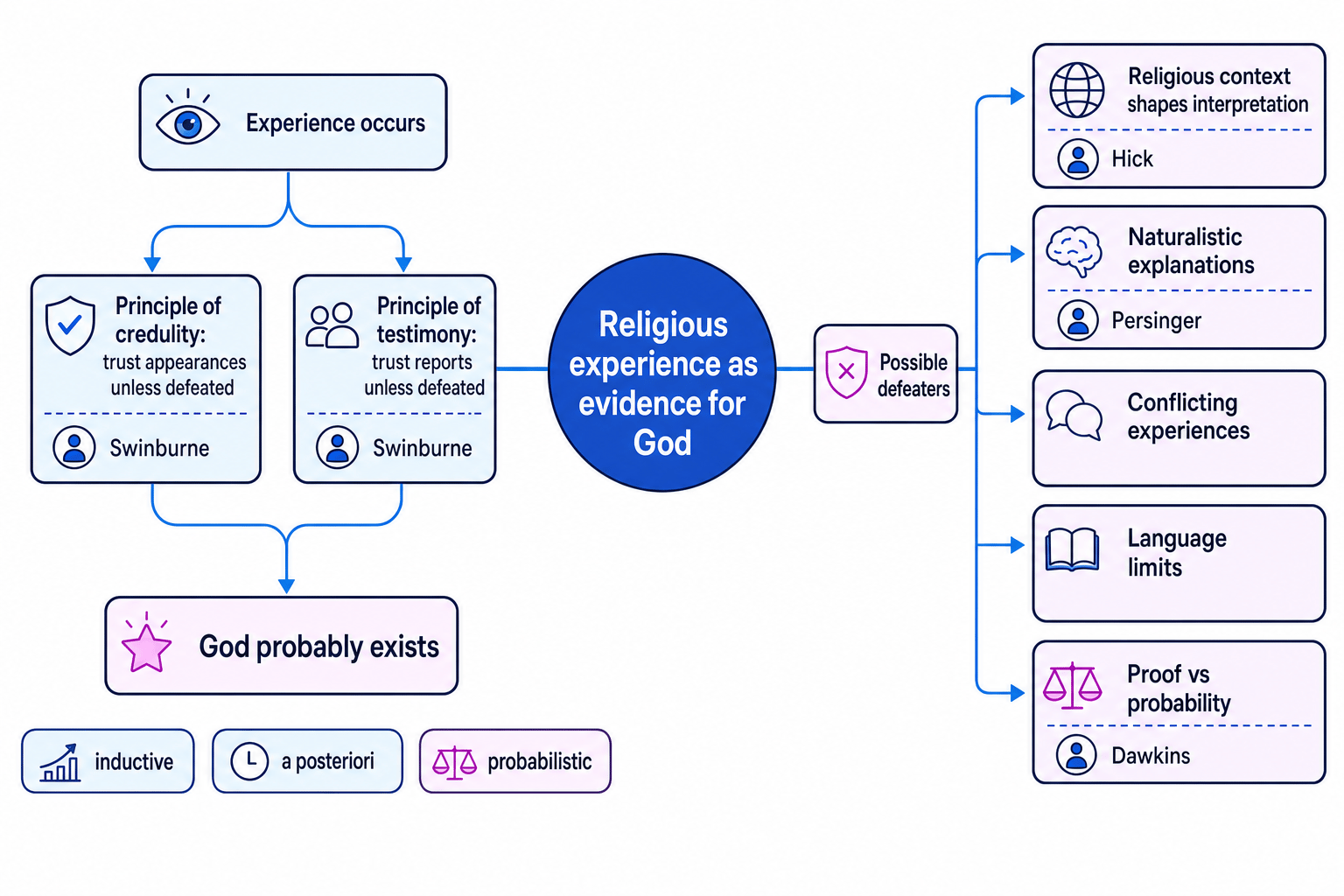
So the basic structure is:
- Many people claim to have experienced God or a divine reality.
- We normally treat experience as a source of knowledge unless there is a good reason not to.
- Therefore, religious experience gives at least some evidence that God exists.
The core issue
The argument does not normally claim “religious experiences prove God with certainty.” It claims that religious experiences may make belief in God more reasonable or probable.
Appearances: how things seem and how things really are
A major issue is the link between appearance and reality. If it seems to you that you see a tree, you usually believe there is a tree. But appearances can mislead: you might be dreaming, hallucinating, or misinterpreting what you see.
Religious experience raises the same question: if it seems to someone that God is present, should we believe God really is present?
Swinburne argues that we should normally trust appearances unless there are special reasons not to.
Principle of credulity
Richard Swinburne’s principle of credulity says that if it seems to a person that something is present or happening, then it is probably the case, unless there is a good reason to doubt it.
This matters because religious experience often feels direct to the person having it. The believer may not infer God’s presence from evidence; they may feel that God is immediately encountered.
Swinburne’s principle of testimony
Swinburne also argues that we usually trust what other people tell us.
Principle of testimony
The principle of testimony says that we should normally accept other people’s reports as truthful unless we have good reason to think they are lying, mistaken, confused, or unreliable.
This is important because most of us have not had dramatic religious experiences ourselves. The argument often depends on the testimony of mystics, converts, worshippers, or ordinary believers.
Swinburne’s point is that everyday life would become impossible if we refused to trust experience and testimony in general. We trust witnesses in courts, friends describing their holidays, and scientists reporting observations. He thinks religious testimony should not be dismissed simply because it is religious.
Applying credulity and testimony
-
A person says they experienced God’s presence during prayer. Swinburne’s principle of credulity gives the person an initial reason to trust how the experience seemed to them.
-
Another person hears this report. Swinburne’s principle of testimony gives the listener an initial reason to take the report seriously rather than automatically dismissing it.
-
The listener then checks for possible defeaters: Was the person intoxicated? Mentally unwell? Known to lie? Reporting something impossible or contradictory?
-
If no strong defeater is found, Swinburne would say the testimony provides some evidence for God, though not a deductive proof.
Treating Swinburne as claiming certainty
Swinburne is not saying every religious claim must be accepted blindly. He is saying that religious experience has prima facie evidential value: it counts as evidence unless there are good reasons to reject it.
Hick: experience is always interpreted
John Hick gives a more cautious and interpretive account. He argues that religious experience is shaped by the believer’s wider worldview, culture and tradition.
Interpretation
An interpretation is the meaning someone gives to an experience. The same event may be understood differently depending on a person’s beliefs, expectations and background.
For Hick, people do not experience reality in a completely neutral way. We experience things “as” something. For example, a sound in the night might be experienced as the wind, an intruder, or a sign from God depending on context.
Hick develops a broadly Kantian idea: there may be a divine reality, which he calls the Real, but human beings experience it through the concepts and symbols of their own religious traditions. A Christian may interpret the Real through Christ, a Hindu through Brahman, and a Muslim through Allah.
This can support religious experience because it shows that interpretation is not unique to religion. All experience involves interpretation. However, it also weakens simple claims such as “this experience proves Christianity is true,” because different traditions report different experiences.
Hick’s refinement
Hick does not treat religious experience as a simple photograph of God. He sees it as a culturally shaped response to the divine reality.
Strength: religious experience can be treated like ordinary perception
One strength of the argument is fairness. If we trust ordinary sensory experiences unless we have reason not to, perhaps we should treat religious experiences in the same way.
Sensory experience
A sensory experience is an experience involving perception, such as seeing, hearing or feeling something. Some religious experiences are described in sensory terms, such as hearing God’s voice or seeing a vision.
Swinburne’s argument gains force here. We do not usually demand absolute proof before accepting perception. If someone says they saw a dog in the street, we do not normally require scientific testing. So why demand impossible standards only for religious experience?
However, critics reply that religious experiences are not exactly like ordinary perception. Ordinary perception is often public, repeatable and checkable. If you claim there is a dog in the street, others can look. If you claim God spoke privately to you, the evidence is harder to verify.
Weakness: religious context may shape the experience
A key challenge is that religious experiences often match the believer’s prior faith. Christians tend to experience Jesus or the Holy Spirit; Hindus may experience Krishna or Shiva; Muslims may experience Allah’s guidance.
This could suggest that people are encountering a real divine reality through different traditions, as Hick argues. But it could also suggest that the mind produces experiences based on expectation, upbringing and religious language.
Using Hick to assess religious diversity
-
A Christian reports experiencing Jesus, while a Hindu reports experiencing Krishna. The experiences appear to support different religious claims.
-
A strict exclusivist interpretation may say one experience is true and the other is false, but this creates the problem of explaining why sincere people in other traditions have powerful experiences.
-
Hick’s pluralist interpretation says both may be culturally shaped responses to the Real, so diversity does not automatically disprove religious experience.
-
The weakness is that Hick’s view may no longer prove the existence of the specific God of classical theism; it supports a more general divine reality.
Weakness: Persinger and naturalistic explanation
Michael Persinger offers a scientific challenge. He argued that some religious experiences may be linked to activity in the brain, especially the temporal lobes. His famous “God helmet” experiments used weak magnetic stimulation and were claimed to induce experiences such as a sensed presence.
Naturalistic explanation
A naturalistic explanation explains an experience using ordinary natural causes, such as brain activity, psychology, culture or environment, rather than direct divine action.
Persinger’s work challenges the argument because if religious experiences can be produced by brain processes, perhaps they do not point to God at all.
But this challenge has limits. Showing that an experience has a brain correlate does not prove the experience is false. Every experience has brain activity associated with it. If you see a real tree, your brain is active; that does not mean the tree is unreal.
So Persinger is strongest when used as a defeater for some experiences, especially unusual or isolated ones. He is weaker if used to dismiss all religious experience automatically.
Good evaluation phrase
A strong essay can say: Persinger may explain the mechanism of an experience, but that does not by itself settle the object of the experience.
Weakness: Dawkins, probability and proof
Richard Dawkins is highly sceptical of religious experience as evidence for God. In The God Delusion, he treats personal religious experiences as psychologically interesting but evidentially weak. He argues that the brain is capable of illusion, hallucination and misinterpretation.
Dawkins also thinks the God hypothesis is already improbable because God would be an extremely complex explanation. Therefore, private experiences are not enough to make belief rational.
This raises an important exam issue: proof and probability are not the same.
Proof and probability
Proof means establishing something conclusively. Probability means showing that something is more or less likely. Religious experience arguments usually aim at probability, not absolute proof.
Swinburne can reply that Dawkins demands too much. Many rational beliefs depend on experience and testimony, not proof. Dawkins can respond that extraordinary claims need stronger evidence than ordinary claims, especially when the experiences are private and diverse.
God’s nature: transcendent and immanent
The argument also depends on the nature of God.
Transcendent and immanent
A transcendent God is beyond the physical world and ordinary human categories. An immanent God is present and active within the world and human life.
Religious experience fits well with divine immanence: if God is present in human life, it makes sense that people might encounter God in prayer, worship, conversion or mystical experience.
But divine transcendence creates difficulty. If God is beyond ordinary experience and language, then how can a human experience accurately identify God? This leads to the problem of language.
Limitations of language
Many religious experiences are described as ineffable, meaning they cannot be fully expressed in words. This can make testimony powerful but also problematic.
If someone says, “I cannot describe it, but I knew God was there,” that may be meaningful to them. Yet as public evidence, it is limited. An argument needs claims that can be understood, tested and compared.
Still, the limitation may fit the subject matter. If God is transcendent, perhaps ordinary language will always struggle. The weakness is not necessarily that the experience is false, but that it is difficult to use as evidence in an essay argument.
Lack of uniformity
Religious experiences are not uniform. Some are visions; others are voices, mystical union, conversion, awe before nature, or a sense of forgiveness. They also point to different religious beliefs.
This lack of uniformity weakens the argument if it is used to prove one specific religion. Conflicting testimonies cannot all be literally correct if they make incompatible claims.
However, lack of uniformity does not destroy the argument completely. Swinburne could argue that many varied experiences may still point towards a general divine reality. Hick could argue that different traditions interpret the Real differently.
Overclaiming from religious experience
Do not jump from “some people have religious experiences” to “therefore the Christian God definitely exists.” The argument usually supports a more modest conclusion unless carefully developed.
Overall judgement
Religious experience is influential because it begins with something immediate and personal. Swinburne gives it philosophical force by arguing that experience and testimony should be trusted unless defeated. Hick strengthens the discussion by explaining why religious experiences may be genuinely significant even though they are interpreted through culture.
However, the argument faces serious challenges. Persinger offers naturalistic explanations, Dawkins questions probability and evidential standards, and religious diversity makes interpretation complex. The strongest conclusion is probably not that religious experience proves God, but that it can contribute to a cumulative case for belief, especially when combined with other arguments.
In the exam
-
Start by identifying the argument as inductive, a posteriori and probabilistic, not a deductive proof.
-
Use Swinburne for the positive case: principle of credulity, principle of testimony, and the idea of defeaters.
-
Evaluate with Hick, Persinger and Dawkins: interpretation, cultural context, naturalistic explanation, probability, and lack of uniformity.
Check yourself
-
Why does Swinburne think religious experience should have prima facie evidential value?
-
How does Hick’s view both support and weaken the religious experience argument?
-
Does Persinger’s brain-based explanation disprove religious experience, or only challenge its interpretation?