What you'll learn
- Why the Ontological Argument is a priori, deductive, and not based on evidence.
- How Anselm argues that God’s existence follows from the definition of God.
- Why necessary existence and aseity matter in classical theism.
- How Bertrand Russell challenges the argument through logic, language, and the claim that existence is not a predicate.
The basic idea
The Ontological Argument is an argument for God’s existence based on the concept or definition of God. Unlike arguments from design or causation, it does not begin with the world. It begins with the idea of God and asks whether existence is built into that idea.
Ontological Argument
An ontological argument is an argument that tries to prove God’s existence from the meaning of the word “God” or from the concept of God as the greatest or most perfect being.
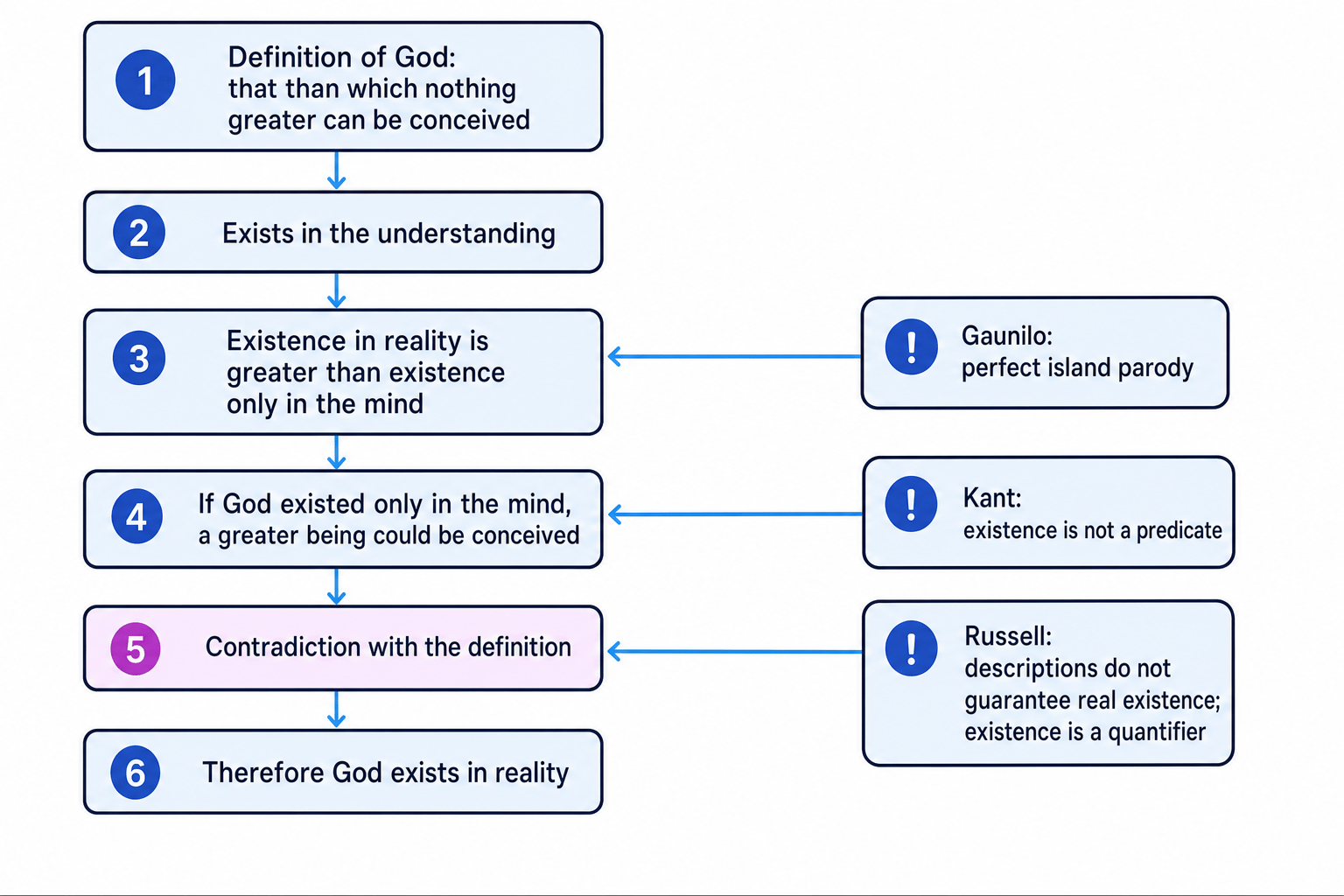
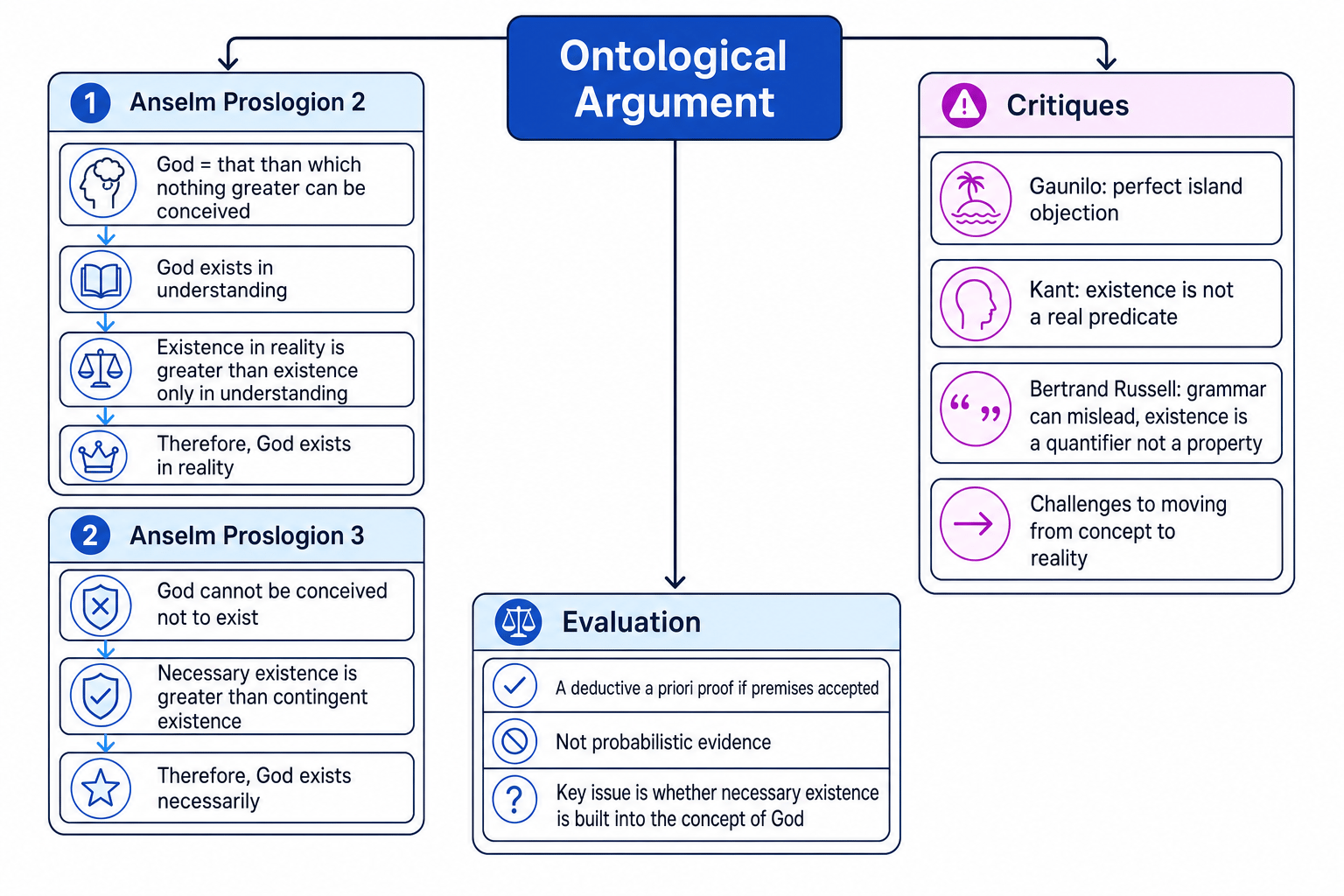
The whole argument can be mapped as premises leading to a conclusion, with key criticisms focusing on whether we can move from an idea in the mind to existence in reality.
A priori and a posteriori arguments
A priori and a posteriori
An a priori argument is known through reason alone, independently of sense experience. An a posteriori argument depends on evidence from experience or observation.
The Ontological Argument is a priori because it does not use empirical evidence such as order in the universe, religious experience, or the existence of motion. Instead, it analyses the concept “God”.
This makes it different from the Design Argument, which is a posteriori because it begins with observations of apparent order and purpose in the world.
Deductive reasoning
Deductive reasoning
A deductive argument is one where, if the premises are true and the reasoning is valid, the conclusion must be true.
The Ontological Argument aims to be deductive. It is not trying to say “God probably exists”. It is trying to say “God necessarily exists”.
That is why the argument is ambitious: if it works, it gives certainty. But if even one premise fails, the whole proof may collapse.
Classifying the Ontological Argument
-
The argument begins with the definition of God, not with an observation about the universe, so it is a priori rather than a posteriori.
-
It claims that the conclusion follows necessarily from the concept of God, so it is deductive rather than inductive.
-
Because it aims at certainty, it should be assessed in terms of validity and soundness, not merely probability.
Proof, not probability
The Ontological Argument is not an evidence-based argument for God being likely. It is an attempted logical proof that God’s non-existence is impossible.
Analytic propositions
Analytic proposition
An analytic proposition is a statement that is true by definition because the predicate is contained within the subject, such as “a triangle has three sides”.
Some defenders of the Ontological Argument treat “God exists” as analytic. The claim is not merely that God happens to exist, but that existence belongs to the concept of God in the same way that having three sides belongs to the concept of a triangle.
This is highly controversial. Critics argue that existence is not like an ordinary defining feature.
Defining God
Anselm defines God as:
“that than which nothing greater can be conceived.”
This means God is the greatest conceivable being. If you could think of something greater than God, then that greater thing would really be God.
Necessary existence and aseity
Necessary existence means existing in such a way that non-existence is impossible. Aseity means God exists “from himself”: God is independent, self-existent, and not dependent on anything else.
A being with contingent existence depends on something else and could have failed to exist. You, a tree, or a planet are contingent. Classical theism says God is not like that: God exists necessarily and has aseity.
Anselm’s first argument: Proslogion 2
Anselm’s first form of the argument appears in Proslogion 2.
His reasoning is roughly:
- God is “that than which nothing greater can be conceived”.
- Even the fool who denies God understands the idea of God.
- So God exists at least in the understanding.
- But a being that exists in reality is greater than one that exists only in the mind.
- If God existed only in the mind, a greater being could be conceived: one existing in reality.
- That contradicts the definition of God.
- Therefore, God exists in reality.
Reconstructing Anselm’s first argument
-
Start with Anselm’s definition: God is the greatest conceivable being.
-
Compare two possible cases: God existing only as an idea, and God existing both as an idea and in reality.
-
Anselm claims the second is greater, because real existence is greater than merely mental existence.
-
If God existed only in the mind, God would not be the greatest conceivable being.
-
Therefore, Anselm concludes that God must exist in reality.
Treating Anselm as using evidence
Do not write that Anselm proves God by looking at the world. His argument is not based on nature, causation, morality, or experience. It is based on the concept of God.
Anselm’s second argument: Proslogion 3
Anselm’s second version strengthens the argument by focusing on necessary existence.
He argues that a being that cannot be thought not to exist is greater than a being that can be thought not to exist. Since God is the greatest conceivable being, God must have necessary existence.
This avoids a simple version of the criticism that Anselm only proves a very great being exists. For Anselm, God is not just very impressive. God is the kind of being whose non-existence is impossible.
Anselm’s strongest move
Anselm’s most important move is not just “God exists”, but “God exists necessarily”. God is not one more object in the universe; God is the self-existent source of all being.
Strengths of the argument
It is not vulnerable to changing evidence
Because the argument is a priori, it does not depend on scientific discoveries or disputed observations. A design argument might be challenged by evolution or natural explanations, but Anselm’s argument operates at the level of logic and definition.
It fits classical theism
The argument suits the traditional idea of God as perfect, necessary, and self-existent. If God is truly ultimate, then God cannot depend on anything else for existence.
It aims for certainty
Unlike inductive arguments, which only support probability, the Ontological Argument aims at proof. If Anselm’s premises are accepted, the conclusion is meant to follow necessarily.
A useful comparison
For evaluation, compare the Ontological Argument with the Design or Cosmological Arguments: those begin with experience and aim for probability; Anselm begins with the concept of God and aims for certainty.
Gaunilo’s challenge: the perfect island
Gaunilo, a monk contemporary with Anselm, objected that the same reasoning could prove absurd things.
He imagined the greatest possible island. If existing in reality is greater than existing only in the mind, then the greatest possible island must exist. But that is obviously ridiculous.
This is called a reductio ad absurdum, where an argument is criticised by showing that its logic leads to an absurd conclusion.
Anselm’s likely reply is that islands are not like God. An island is contingent and has no intrinsic maximum greatness. You can always imagine more beaches, better fruit, or clearer water. But God, as the greatest conceivable being, is unique and necessarily existent.
Kant’s challenge: existence is not a predicate
Predicate
A predicate is a property or quality attributed to a subject, such as “is powerful”, “is wise”, or “is red”.
Immanuel Kant argued that existence is not a real predicate. Saying something exists does not add a new property to the concept of it.
His famous example is that one hundred real coins do not contain any more conceptual features than one hundred imaginary coins. The real coins are more useful, but the concept is not made greater by adding existence.
This directly challenges Anselm’s claim that existence in reality is greater than existence in the understanding.
Bertrand Russell: language and logic
Bertrand Russell is especially important for Edexcel because the spec names him alongside Anselm.
Russell rejected the Ontological Argument partly because he thought ordinary grammar can mislead us. A sentence like “God exists” looks as if “God” names an object and “exists” describes it. But Russell’s logical analysis suggests that existence does not work like that.
For Russell, existence is better understood as a quantifier. To say “X exists” is not to add a property to X. It is to say that there is at least one thing satisfying a description.
For example, “unicorns do not exist” does not mean there are mysterious objects called unicorns that possess the property of non-existence. It means nothing in reality satisfies the description “unicorn”.
Applied to God, Russell would say that defining God as necessarily existent does not show that anything actually satisfies that description.
Applying Russell to Anselm
-
Anselm treats “God” as the greatest conceivable being and argues that existence belongs to that concept.
-
Russell challenges the grammar behind this move: the word “God” may function as a description, but that does not prove there is an object corresponding to it.
-
On Russell’s view, “God exists” means something like “there is one being that satisfies the description ‘God’”.
-
The definition alone cannot establish that anything satisfies the description, so the argument does not successfully move from concept to reality.
Russell’s core objection
Russell’s challenge is that you cannot define something into existence. Logical grammar matters: “existence” is not an ordinary property possessed by a named object.
The central debate: can existence be part of God’s definition?
The whole argument turns on whether necessary existence can be included in the definition of God.
Anselm says yes: if God is the greatest conceivable being, God must exist necessarily. A God who could fail to exist would not be ultimate.
Russell says no: this confuses definitions with reality. A description can include “necessary existence”, but that does not prove the description is fulfilled.
This is where AO2 evaluation becomes important. You should not just list criticisms. You need to judge whether they defeat Anselm.
A balanced judgement might be:
- Anselm is strongest when he argues that God, if real, must be necessary rather than contingent.
- Russell is strongest when he shows that language can make existence look like a property.
- The argument may clarify what believers mean by “God”, but it is less successful as a proof that forces non-believers to accept God’s existence.
Anselm and Russell compared
Anselm and Russell disagree about the relationship between thought, language, and reality.
Anselm believes the concept of God is unique. Since God is the greatest conceivable being, and necessary existence is greater than contingent existence, God must exist.
Russell thinks this makes a logical mistake. The fact that a concept includes existence does not mean reality contains something matching that concept.
Saying Russell only repeats Kant
Russell is similar to Kant because both reject existence as an ordinary predicate. But Russell’s distinctive contribution is his logical analysis of language: descriptions do not automatically refer to real things.
Overall evaluation
The Ontological Argument is powerful because it is elegant and ambitious. It does not offer a probability but a claimed proof. It also captures something central to classical theism: God is not a contingent object but the necessary, self-existent reality on which all else depends.
However, its weakness is the move from definition to existence. Gaunilo challenges the structure by parody. Kant challenges the idea that existence adds greatness. Russell challenges the logic of treating existence as a property and warns that grammar can mislead philosophical thought.
Your final judgement can be nuanced: Anselm may succeed in showing that the concept of God involves necessary existence, but Russell gives strong reasons to doubt that this proves God exists outside the mind.
In the exam
-
Define the argument type precisely: a priori, deductive, and based on an analytic understanding of God rather than evidence.
-
Use Anselm accurately: include both the “greatest conceivable being” argument and the stronger claim about necessary existence.
-
Evaluate with Russell directly: explain that existence is not a predicate and that logical grammar prevents us from defining God into existence.
Check yourself
- Why is the Ontological Argument a priori rather than a posteriori?
- How does Anselm move from “God exists in the understanding” to “God exists in reality”?
- Why does Russell think ordinary language can mislead us about existence?