

What you'll learn
- How scientific methodology differs from, and overlaps with, religious ways of forming belief.
- Why miracles create a pressure point between natural law and divine action.
- How Big Bang cosmology, steady state theory, evolution, intelligent design, creationism, the cosmological constant and the Gaia hypothesis affect philosophy of religion.
- How to use Darwin and Dawkins accurately in extended evaluation.
1. Why religion and science matter for philosophy of religion
This topic is not simply “science versus religion”. It asks a subtler question: when science explains the natural world, what happens to religious belief and arguments for God?
Science can challenge religious claims when those claims are about public, observable reality: the age of the universe, the development of life, or whether a miracle occurred. But science can also be used by religious thinkers to support belief, especially through arguments about cosmic origins, order, fine-tuning and purpose.
The key skill is to avoid simplistic conclusions. “Science disproves God” is too quick. So is “science proves God”. You need to explain which religious claim is being discussed, which scientific theory is relevant, and what philosophical conclusion can reasonably follow.
2. Scientific methodology
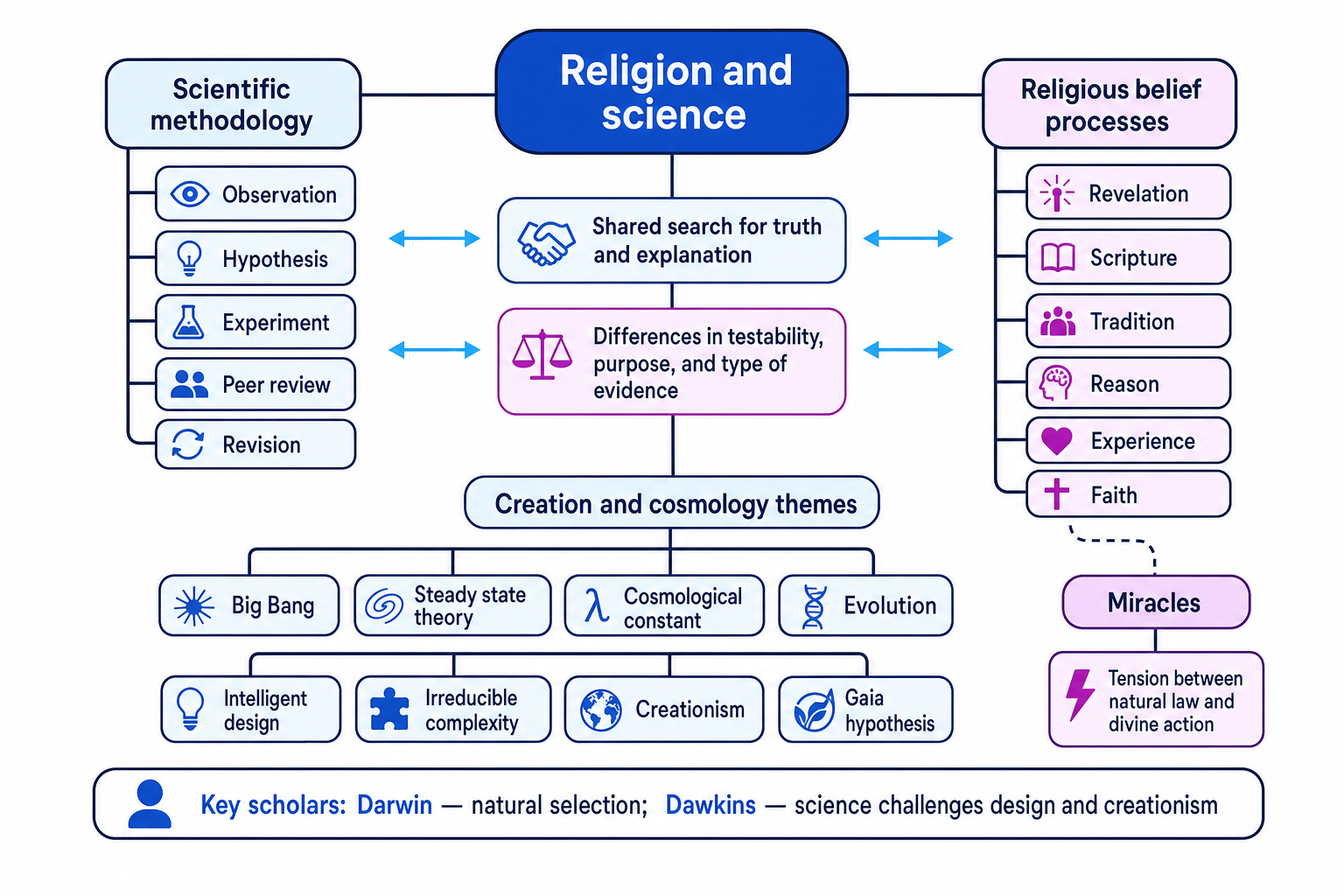
A methodology is a structured way of finding out truth. Scientific methodology normally begins with observation, moves to a hypothesis, and tests that hypothesis through experiment.
Empirical and a posteriori
An empirical method uses evidence from observation or experience. An a posteriori claim is known “after experience”, unlike an a priori claim, which is argued independently of experience.
Science usually works through:
- Observation: noticing patterns in the natural world.
- Hypothesis: a testable proposed explanation.
- Experiment: a controlled way of checking whether the hypothesis fits the evidence.
- Revision: changing or abandoning a theory when evidence requires it.
This makes science public, repeatable and open to correction. A scientific claim should be testable in principle, even if the test is difficult.
Methodological naturalism
Science normally uses methodological naturalism: it looks for explanations within the natural order. This does not automatically mean metaphysical naturalism, the stronger belief that only the natural world exists.
Religious belief can also use reason and evidence, but it often draws on additional sources: revelation means God disclosing truth; scripture means sacred writings; tradition means inherited teaching and practice; religious experience means an experience interpreted as encounter with the divine; and faith often means trust or commitment, not merely believing without evidence.
This comparison matters because some religious claims are not scientific hypotheses. For example, “God gives life ultimate meaning” is not tested like a laboratory claim. But “the universe was created in six twenty-four-hour days” is a claim about the physical world, so it is vulnerable to scientific evidence.
This map gives you the big picture before we unpack the key debates.
3. Miracles: natural law and divine action
A miracle is usually understood as an extraordinary event caused by God, often interpreted as a sign of divine purpose. Some define it as a violation of natural law; others prefer to say it is a rare event in which God acts through or beyond the normal order.
The problem is that science depends on regularity. If events constantly broke natural patterns, experiment would become impossible. So miracle claims create a philosophical tension: should we explain unusual events naturally, or can it ever be rational to infer divine action?
David Hume is useful background here: he argued that evidence for regular natural law will normally outweigh testimony to a miracle. However, religious thinkers may reply that if God exists, then divine action is not impossible; the real issue is whether the evidence for a particular miracle is strong enough.
Testing a claim about prayer and healing
- Turn the broad religious claim into a testable hypothesis: for example, “patients prayed for by others recover faster than comparable patients not prayed for.”
- Compare groups while controlling relevant factors such as severity of illness and medical treatment, because without controls you cannot tell whether prayer made the difference.
- Interpret the result carefully: a positive result might suggest an unusual effect, but it would not by itself prove “God intervened”; a negative result would not disprove every possible miracle, because miracles are usually claimed to be free divine acts rather than repeatable mechanisms.
Turning method into metaphysics
Do not say “science only studies natural causes, therefore only natural causes exist.” That moves from a scientific method to a philosophical worldview, and it needs argument.
4. Creation themes and scientific cosmologies
A scientific cosmology is a theory about the origin, structure and development of the universe. A religious doctrine of creation is the belief that the universe depends on God for its existence.
Creation and creationism
Creation is the broad religious belief that God is the source and sustainer of reality. Creationism is a narrower view, often involving a literal reading of scripture about how and when the world was made.
Big Bang theory
The Big Bang theory holds that the universe expanded from an extremely hot, dense early state. It is supported by evidence such as cosmic expansion and cosmic microwave background radiation.
For philosophy of religion, this can support a cosmological line of thought: if the universe had a beginning, perhaps it needs a cause beyond itself. However, the Big Bang does not automatically prove God. It is a scientific model of cosmic development, not a theological conclusion.
Aquinas is helpful by contrast: his cosmological arguments do not depend simply on the universe having a first moment in time. They focus on dependence here and now. So even an eternal universe could, for Aquinas, still depend on God.
Steady state theory
Steady state theory, associated with thinkers such as Fred Hoyle, proposed that the universe has no beginning and remains broadly the same over time, with matter continuously appearing as the universe expands.
This theory is now largely rejected by mainstream cosmology because evidence favours Big Bang theory. Its philosophical importance is that it once seemed to weaken arguments based on a beginning of the universe. But it would not necessarily defeat all belief in God, because religious arguments can focus on why there is any universe at all, not only when it began.
The cosmological constant and fine-tuning
The cosmological constant is a feature in cosmological models linked with the expansion of the universe. In religious debate, it is often discussed as part of fine-tuning: the idea that certain physical conditions appear to fall within an extremely narrow life-permitting range.
Theists may argue that fine-tuning points towards design. Non-theists may reply using the anthropic principle, which says that we should not be surprised to observe life-permitting conditions, because only a life-permitting universe could contain observers like us. Some also appeal to a possible multiverse.
The philosophical question is whether fine-tuning is better explained by God, chance, necessity, or a wider cosmological theory.
5. Evolution: Darwin and Dawkins
Evolution is the change in inherited characteristics of populations over generations. Natural selection, developed by Charles Darwin, is the process by which heritable variations that aid survival and reproduction become more common.
Darwin’s On the Origin of Species challenged older design arguments, especially Paley’s watch analogy. Paley argued that complex living things resemble designed machines and therefore point to an intelligent designer. Darwin showed how complex adaptations could arise gradually without direct design of each organism.
Darwin did not simply set out to “disprove God”. His theory explained biological diversity by natural processes. His personal religious position moved away from orthodox Christianity, and he is often described as agnostic later in life. This distinction matters: Darwin’s science challenges some forms of design argument, but Darwinism is not identical with atheism.
Richard Dawkins takes Darwin’s theory in a more explicitly atheist direction. In The Blind Watchmaker, he argues that natural selection explains the appearance of design without a designer. His famous claim is that “Darwin made it possible to be an intellectually fulfilled atheist.” In The God Delusion, Dawkins also argues that God is a poor explanation because a designer complex enough to create the universe would itself require explanation.
Judging whether evolution refutes design
- Identify the target: Darwin most directly challenges biological design arguments, such as Paley’s claim that complex organisms require an intelligent designer.
- Apply natural selection: if adaptations can arise through inherited variation and differential survival, then biological complexity does not require direct divine manufacture.
- Limit the conclusion: this weakens one version of the design argument, but it does not by itself settle arguments from cosmic fine-tuning, the existence of natural laws, or ultimate purpose.
Individuals do not evolve
In Darwinian evolution, populations evolve over generations. Individual organisms may survive or reproduce, but they do not personally evolve into new species.
6. Intelligent design, irreducible complexity and creationism
Intelligent design is the view that some features of life or the universe are best explained by intelligence rather than undirected processes. It tries to present itself as an inference from evidence, not simply as biblical literalism.
Irreducible complexity, associated with Michael Behe, is the claim that some biological systems need all their parts working together, so they could not have evolved gradually. Critics respond that evolution can repurpose existing structures, and that “not yet fully explained” does not mean “designed by God”.
God of the gaps
A God of the gaps argument uses God to fill gaps in current scientific knowledge. This is risky because if science later explains the gap, the argument for God shrinks.
Creationism usually rejects some or all mainstream evolutionary science in favour of a literal reading of sacred texts. Young-earth creationism, for example, claims that the earth is only thousands of years old. This is in direct conflict with geology, cosmology and evolutionary biology.
Many religious believers instead accept theistic evolution: the view that God creates through evolutionary processes. This allows Darwinian science and religious belief in creation to be compatible, though Dawkins would argue that evolution removes the need for God as an explanation.
7. The Gaia hypothesis
The Gaia hypothesis, developed by James Lovelock with Lynn Margulis, suggests that life and the physical environment interact as a self-regulating system that helps maintain conditions suitable for life.
Scientifically, Gaia is not the claim that Earth is literally a conscious goddess. Philosophically and religiously, however, it can support ideas of interdependence, stewardship and ecological responsibility. It may appeal to traditions that emphasise the sacredness of nature, but it is not straightforward evidence for a personal creator God.
8. Overall significance for philosophy of religion
Religion and science debates reshape several major areas of philosophy of religion:
- Design arguments: Darwin weakens biological design arguments; fine-tuning may offer a newer version.
- Cosmological arguments: Big Bang cosmology may support arguments from a beginning, but steady state theory shows why stronger arguments focus on dependence rather than merely temporal origin.
- Miracles: scientific regularity makes miracle claims difficult, but not automatically impossible if God exists.
- Religious belief and scripture: scientific discoveries push religious believers to decide whether sacred texts should be read literally, symbolically, or theologically.
- Faith and reason: Dawkins presents faith as opposed to evidence, while many religious thinkers see faith as trust that can work alongside reason.
A balanced judgement might say: science powerfully challenges literalist creationism and simple biological design arguments, especially through Darwin. Dawkins is right that natural selection reduces the need to explain living complexity by direct design. However, whether this defeats belief in God depends on further philosophical questions about why there is a law-governed universe, whether fine-tuning is significant, and whether religious claims are always meant as scientific explanations.
In the exam
- Start by defining the exact issue: methodology, miracles, cosmology, evolution, intelligent design or creationism.
- Use Darwin and Dawkins accurately: Darwin explains natural selection; Dawkins uses Darwinian evolution to argue against design and theism.
- Avoid sweeping claims. Evaluate the scope: does the science challenge all religion, or only a particular argument or literal interpretation?
Check yourself
- Why does methodological naturalism not automatically prove metaphysical naturalism?
- How does Darwin’s theory challenge Paley’s design argument?
- What is the difference between creation, creationism and theistic evolution?

