What you'll learn
- How stewardship, conservation and sustainability shape religious environmental ethics.
- How secular approaches, especially Lovelock’s Gaia hypothesis and Næss’s deep ecology, challenge human-centred thinking.
- How to evaluate debates about animal welfare, waste management, climate change, legal changes and social attitudes.
Environmental issues are not just “science topics” in Religious Studies. They are ethical questions about value, responsibility, harm, future generations and whether humans have a special role within nature.
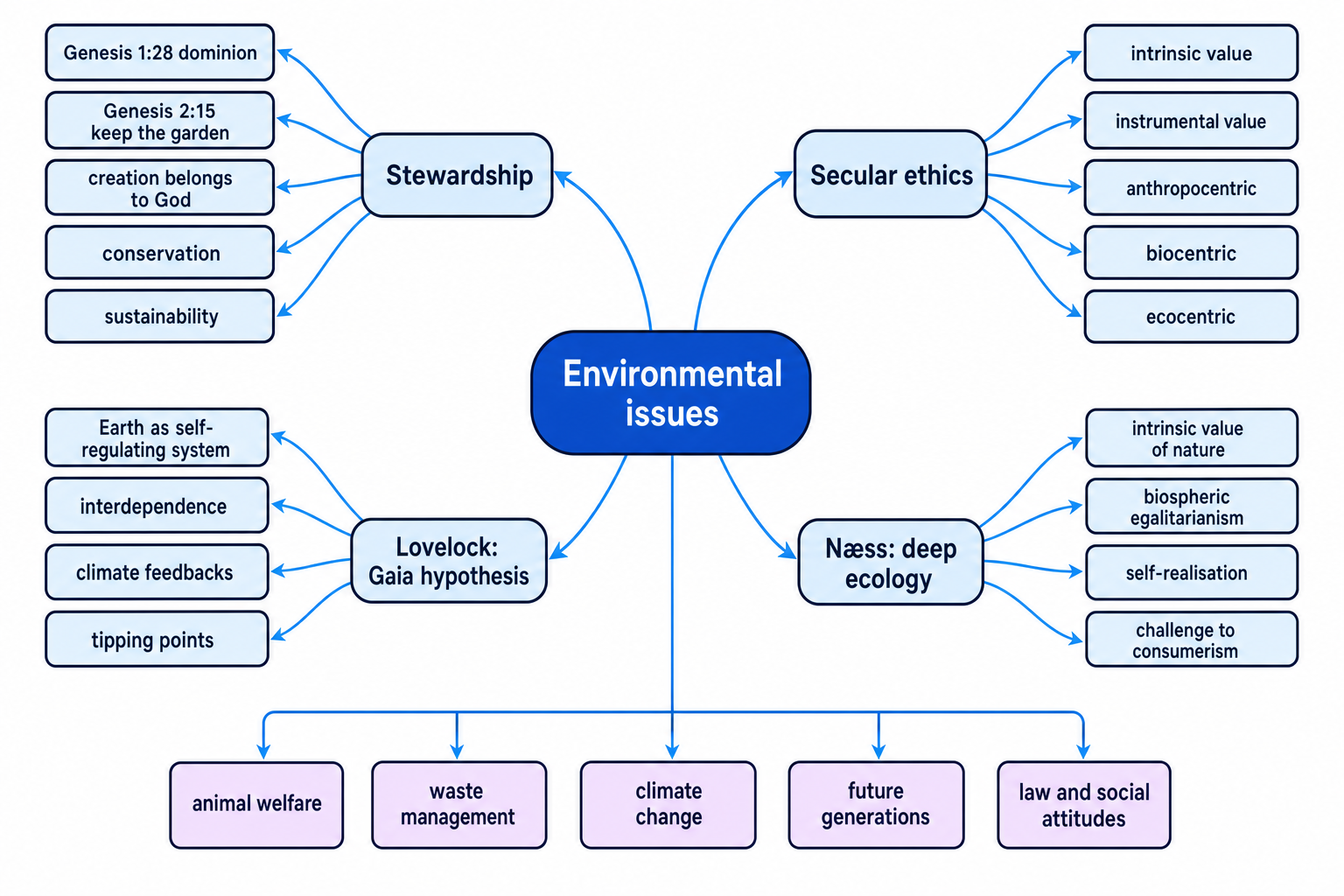
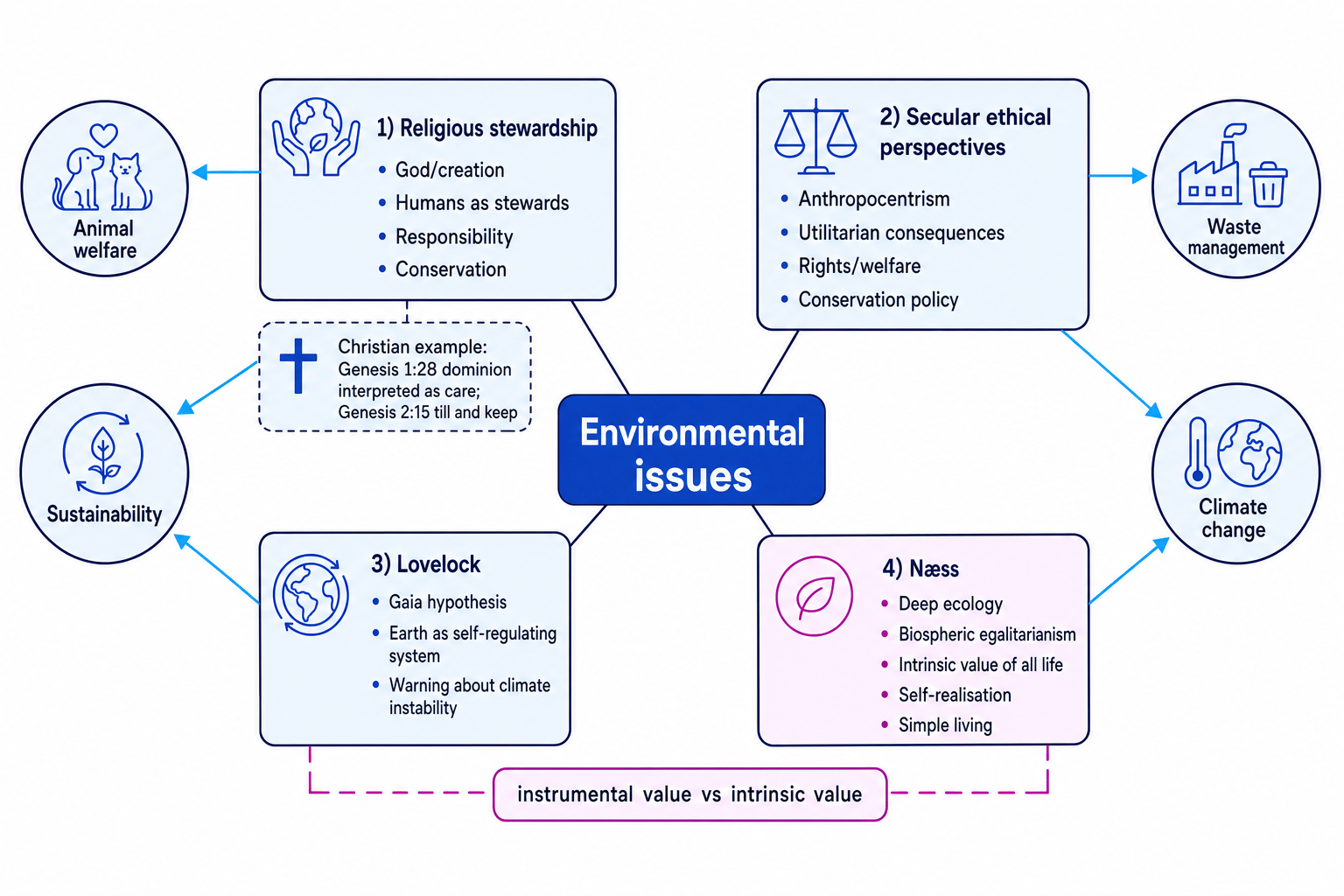
The map below shows the main routes through this topic: religious stewardship, secular ethical reasoning, Lovelock’s Gaia theory and Næss’s deep ecology.
1. Stewardship: humans as responsible caretakers
Stewardship
Stewardship is the belief that humans have been entrusted with responsibility for the natural world and must care for it rather than exploit it selfishly. In Christian ethics, this is often linked to God as creator and humans as accountable managers of creation.
A key Christian starting point is Genesis. Genesis 1:28 says humans have “dominion” over the earth, while Genesis 2:15 says Adam is placed in the garden “to till it and keep it”. These can be read together: human power over nature should be exercised as care, not domination.
Psalm 24:1 also matters: “The earth is the Lord’s.” This means the world does not belong absolutely to humans. Humans may use creation, but not as if it were disposable property.
Conservation
Conservation means protecting and responsibly managing natural resources, species and habitats so that they are not destroyed or exhausted. It is slightly different from preservation, which often means leaving nature untouched as far as possible.
Christian stewardship can support conservation because it sees the natural world as good, God-given and morally significant. It can also connect with concern for the poor, because environmental damage often harms vulnerable people first.
Applying stewardship to climate policy
- Start with the Christian premise that creation belongs to God, not absolutely to human beings.
- Interpret “dominion” through Genesis 2:15: power over the earth should mean serving, guarding and maintaining it.
- Apply this to climate change: reducing emissions, protecting forests and supporting renewable energy can be seen as duties of stewardship.
- Evaluate the argument: it is powerful for believers, but in a plural society it may need translating into shared ideas such as responsibility, justice and protection of future generations.
Dominion does not have one fixed meaning
Do not assume “dominion” automatically means exploitation. Some critics read it that way, but many Christian ethicists argue that biblical dominion is accountable rule under God, not unlimited permission to damage nature.
2. Secular environmental ethics: value without God
A secular ethical perspective is an approach to moral questions that does not depend on belief in God or revelation. It may use reason, consequences, rights, welfare, human flourishing or the intrinsic value of nature.
Instrumental and intrinsic value
Instrumental value means something is valuable because it is useful for something else. Intrinsic value means something is valuable in itself, not merely because it benefits humans.
This distinction is central. A forest might have instrumental value because it provides timber, medicines, carbon storage and recreation. But it might also have intrinsic value if it is worth protecting even when no human benefits directly.
Anthropocentric, biocentric and ecocentric views
Three environmental viewpoints
- Anthropocentrism is human-centred ethics: nature matters mainly because it affects human beings.
- Biocentrism gives moral importance to living things, not only humans.
- Ecocentrism gives moral importance to whole ecosystems, species, habitats and ecological relationships.
A secular utilitarian might support environmental protection because pollution, species loss and climate change produce suffering and reduce wellbeing. This can be very practical in policy-making, because it weighs consequences. However, it may still treat nature mainly as useful to humans.
Evaluating a plastic waste policy
- Identify the harm: single-use plastics can damage wildlife, pollute oceans and create long-term waste.
- Consider the policy: a charge or ban on some plastics may reduce consumption and encourage reusable alternatives.
- Weigh the consequences: benefits include less pollution and changed habits; costs may include inconvenience or financial pressure on consumers and businesses.
- Make a judgement: a secular consequentialist can support the policy if the environmental and welfare benefits outweigh the costs.
3. Lovelock and the Gaia hypothesis
Gaia hypothesis
James Lovelock’s Gaia hypothesis, developed with Lynn Margulis, is the idea that the Earth’s living organisms, atmosphere, oceans and soils form a complex self-regulating system that helps maintain conditions suitable for life.
Lovelock does not simply mean that the Earth is a conscious goddess. His point is scientific and systemic: life and the physical environment interact. For example, living organisms can affect atmospheric gases, temperature and chemical balances.
In ethical debate, Gaia theory encourages holistic thinking. Climate change is not just one isolated problem; it can disturb interconnected systems. Lovelock later warned that human activity could push the Earth into a less stable and less hospitable state.
Strengths of Lovelock
- He helps move ethics beyond short-term human convenience.
- He supports the idea that climate change is urgent because Earth systems can have feedback loops and tipping points.
- His theory challenges the assumption that humans stand outside nature.
Weaknesses of Lovelock
- Gaia theory describes how Earth systems work, but it does not by itself prove what humans morally ought to do.
- Some critics argue that “Gaia” language can sound too teleological, as if the Earth intentionally plans outcomes.
- Lovelock’s support for nuclear power as a response to climate change is controversial, especially among environmentalists.
Gaia is not automatically an ethical theory
Lovelock gives a powerful way of understanding Earth as an interconnected system, but you still need a moral argument to move from “the system is at risk” to “therefore humans ought to act”.
4. Næss and deep ecology
Deep ecology
Arne Næss’s deep ecology is a secular environmental philosophy that argues nature has intrinsic value and that humans must radically rethink their relationship with the natural world.
Næss contrasts shallow ecology with deep ecology. Shallow ecology fights pollution and resource depletion mainly because they harm human health and prosperity. Deep ecology asks deeper questions: Why assume humans are more important? Why organise society around consumption? Why value nature only when it is useful?
Næss supports biospheric egalitarianism, the view that all living things have value “in principle”. This does not mean humans can never eat plants or protect themselves. It means humans should not assume they have an automatic right to reduce the richness and diversity of life except for vital needs.
He also uses the idea of self-realisation. As people mature morally, they should widen their sense of self beyond the individual ego and recognise their connection with the wider natural world.
Næss’s challenge
Deep ecology says the environmental crisis is not only a technical problem. It is a crisis in human values: consumerism, human superiority and endless economic growth must be questioned.
Evaluating Næss
Næss is strong because he gives environmental ethics real depth. He explains why small lifestyle adjustments may not be enough if the deeper problem is a human-centred worldview.
However, deep ecology can be difficult to apply in law and politics. Governments need concrete policies: emissions targets, waste rules, farming standards and transport plans. Næss gives a radical vision, but not always detailed policy solutions. Critics also worry that deep ecology can sound as if it values ecosystems more than vulnerable human communities, although Næss himself did not intend it as anti-human.
5. Key issues: animals, sustainability, waste and climate
Animal welfare and protection
Animal welfare
Animal welfare concerns the wellbeing of animals, especially avoiding unnecessary suffering and ensuring appropriate living conditions. Animal rights goes further, arguing that animals have moral entitlements that should not be overridden merely for human convenience.
A Christian stewardship view may allow humans to use animals for food, work or research, but should condemn cruelty because animals are part of God’s creation. A secular utilitarian view, such as Peter Singer’s, focuses on sentience: if animals can suffer, their suffering must count morally.
Relevant UK legal changes include the Animal Welfare Act 2006, which places a duty of care on those responsible for animals, and the Animal Welfare (Sentience) Act 2022, which recognises animals as sentient beings in policy-making. Social attitudes have also shifted, with greater concern about factory farming, animal testing, veganism and cruelty-free products.
Sustainability
Sustainability
Sustainability means meeting present needs without preventing future generations from meeting their own needs. It requires long-term thinking about resources, climate, biodiversity and economic life.
Religious stewardship supports sustainability because humans are accountable for how they treat creation. Secular ethics may defend sustainability through intergenerational justice, meaning fairness between present and future people.
The debate is often about cost and responsibility. Should individuals change lifestyles, or should governments and corporations carry the main burden? A strong answer usually says both matter, but law and industry are essential because individual choices alone cannot solve systemic problems.
Waste management
Waste management includes reducing waste, reusing materials, recycling, safe disposal and designing products that last longer. The UK plastic bag charge, first introduced in England in 2015 and later increased, is a useful example of law shaping behaviour. It shows how a small legal change can shift social attitudes and normalise reuse.
Pope Francis’ Laudato si’ criticises a “throwaway culture”, which fits well with stewardship and sustainability. A secular view may make the same point through consequences: waste damages ecosystems, animals and human health.
Climate change
Climate change
Climate change refers to long-term shifts in climate patterns. In current ethical debate, it usually means human-caused global warming driven largely by greenhouse gas emissions.
Climate change is ethically significant because its effects are unequal. Those who contribute least often suffer most: poorer communities, future generations, low-lying nations and non-human species.
The Climate Change Act 2008 made the UK the first country to set legally binding national emissions reduction targets, later amended to include a net zero target for 2050. This is a strong example of environmental concern becoming law, not merely personal preference.
Useful essay contrast
Lovelock helps you explain why climate change is dangerous at the level of Earth systems. Næss helps you argue that the deeper cause is a human-centred and consumerist worldview.
6. Should religious perspectives be used in environmental debates?
Religious perspectives can be very valuable. They motivate communities, give moral language to responsibility, and connect environmental care with virtues such as humility, gratitude and restraint. Religious groups also have global networks, which can influence behaviour and political pressure.
However, there are weaknesses. In a plural society, not everyone accepts scripture or belief in God. Religious texts can also be interpreted differently: “dominion” may be used to support stewardship, but critics such as Lynn White argued that Christianity helped create an exploitative attitude towards nature.
A balanced judgement is that religious perspectives are appropriate when they contribute to public ethical reasoning rather than replacing scientific evidence or democratic law. They are strongest when combined with secular arguments about welfare, justice, sustainability and ecological interdependence.
Best overall judgement
Environmental ethics is strongest when it combines motivation, science and moral reasoning: stewardship can motivate care, Lovelock shows interdependence, and Næss challenges the human-centred values driving ecological damage.
In the exam
- Define the key concept early: stewardship, conservation, sustainability, Gaia or deep ecology.
- Use Lovelock and Næss directly, not as name-drops: explain what each actually contributes to the debate.
- Reach a judgement about whether religious perspectives are useful today, weighing them against secular law, science and changing social attitudes.
Check yourself
- How is Christian stewardship different from a purely anthropocentric use of nature?
- Why does Lovelock’s Gaia hypothesis need an additional moral argument?
- What is the difference between Næss’s deep ecology and “shallow” environmentalism?