What you'll learn
- Why the cosmological argument is usually treated as an a posteriori and inductive argument.
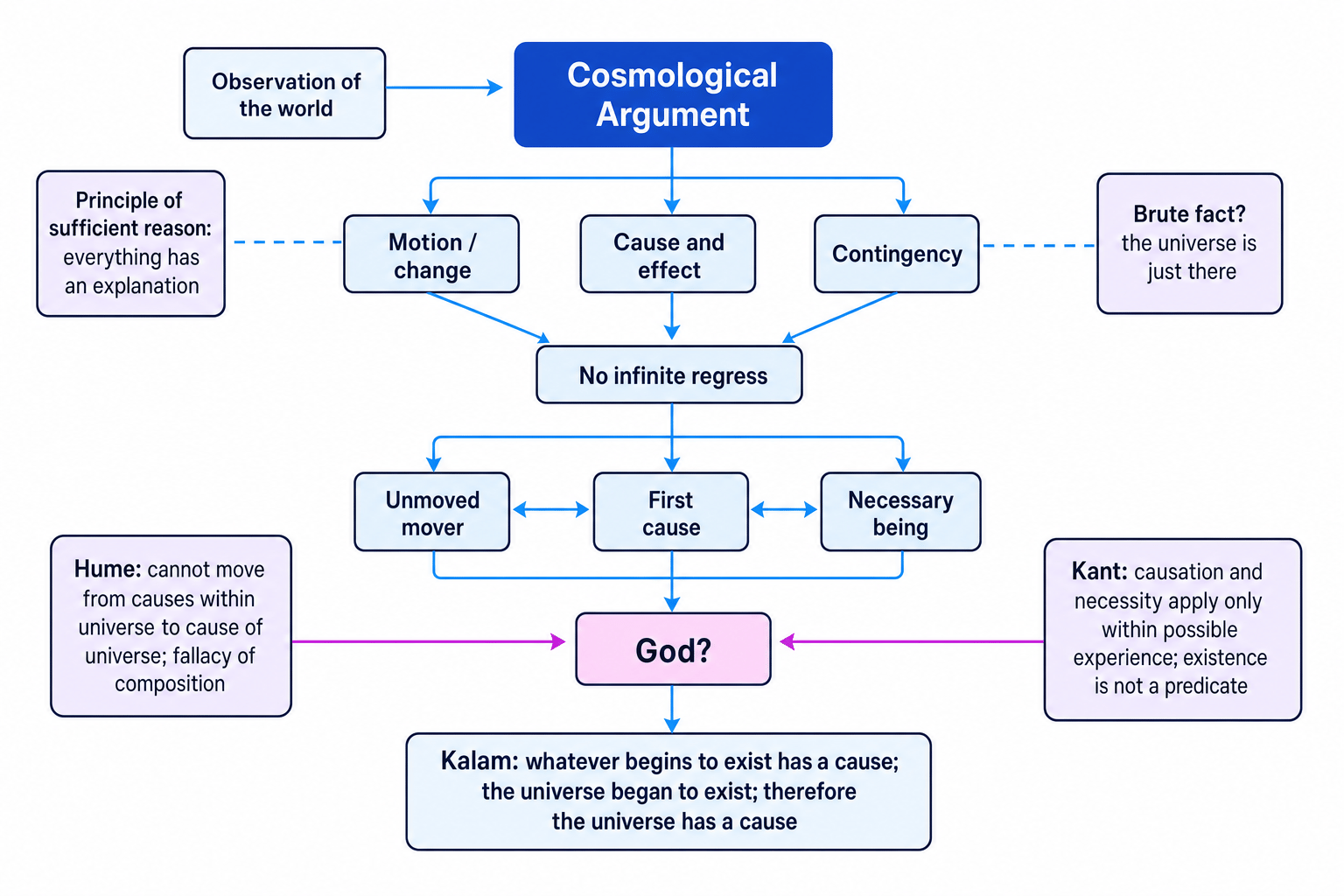
- How Aquinas argues from motion, cause and effect, and contingency to God.
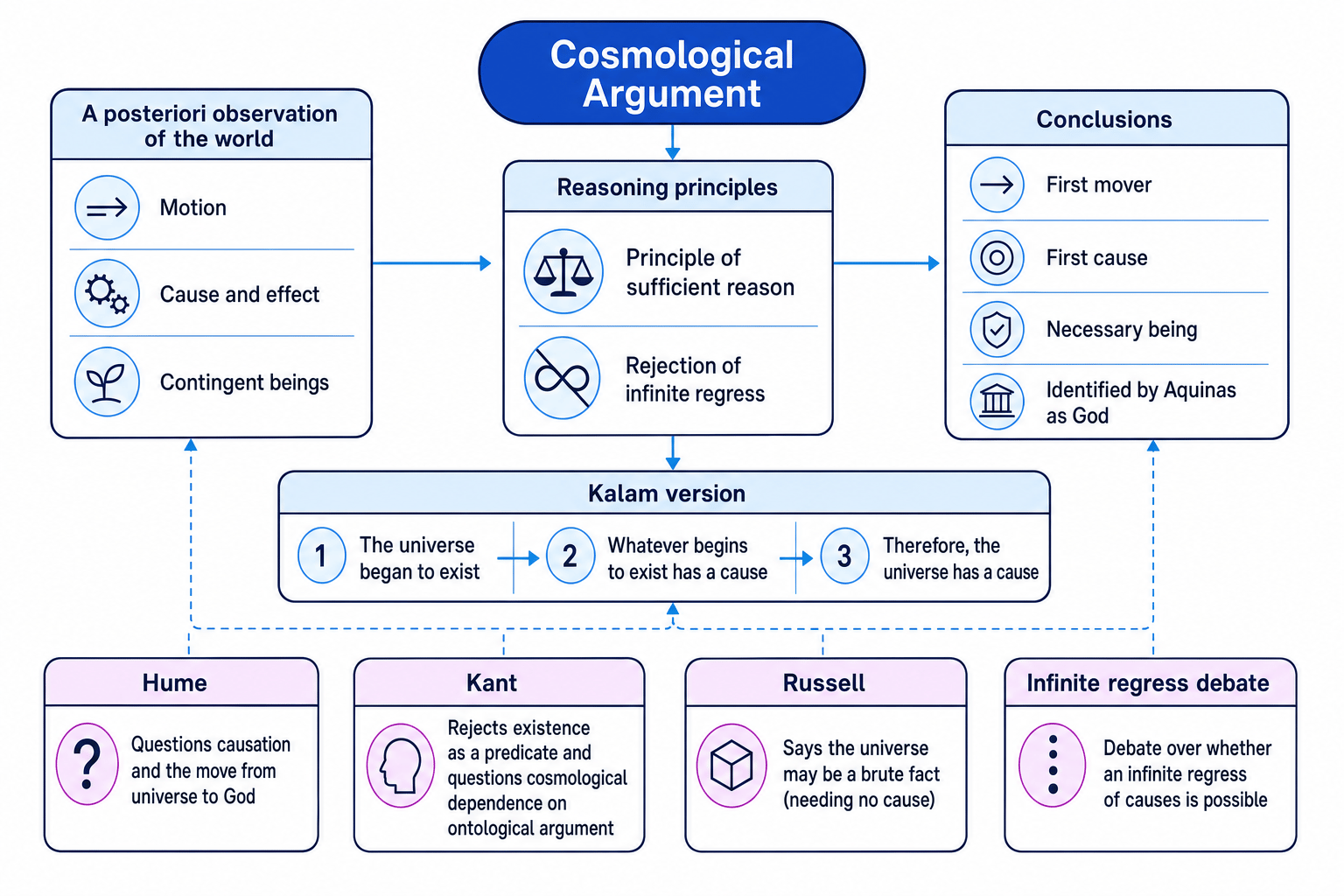
- How ideas like the principle of sufficient reason, infinite regress, first cause, necessary existence, and the Kalam argument fit together.
- How David Hume and Immanuel Kant challenge the argument, and how to evaluate those challenges in essays.
The big picture
The cosmological argument asks a huge question: why is there something rather than nothing? It reasons from features of the world — change, causation, dependency, or the beginning of the universe — to an ultimate explanation, often identified as God.
Cosmological argument
The cosmological argument is an argument for God’s existence which begins with the existence or features of the cosmos — the universe — and argues that there must be an ultimate explanation, such as a first cause, first mover, or necessary being.
It is important to distinguish this from the teleological argument, which focuses on design, order and purpose. The cosmological argument focuses more basically on existence, causation, change and dependency.
A posteriori and inductive reasoning
A posteriori and inductive
An a posteriori argument depends on experience or observation. Inductive reasoning draws a conclusion that is probable if the premises are strong, rather than absolutely guaranteed.
The cosmological argument starts from ordinary experience: things change, things are caused, and things depend on other things. From there, it argues that the universe as a whole needs an explanation.
Strictly, some versions are written in a deductive-looking form: if the premises are true, the conclusion appears to follow. However, for A-Level evaluation, it is usually assessed as giving probability rather than proof, because its key premises are debatable.
Classifying the reasoning
Suppose someone argues: “Everything we experience has a cause, so the universe must have a cause.”
-
The starting point is observation of the world: we experience caused events, such as fires causing smoke or parents causing children to exist. This makes the argument a posteriori.
-
The conclusion goes beyond the direct observation: we have not observed the universe itself being caused. The argument therefore involves an inference from what we experience to what must explain that experience.
-
The strength of the argument depends on whether that inference is justified. Hume can challenge it by asking whether we are allowed to move from causes within the universe to a cause of the universe.
Probability rather than proof
The cosmological argument is strongest when presented as rational support for belief in God, not as a mathematical proof that no reasonable person could reject.
The principle of sufficient reason
The principle of sufficient reason, often shortened to PSR, is the claim that everything must have a sufficient explanation for why it exists or why it is the way it is.
Principle of sufficient reason
The principle of sufficient reason is the view that every fact, event or existing thing must have an adequate explanation, either in itself or in something else.
This matters because the cosmological argument is not just asking, “What happened before the universe?” It is asking whether reality as a whole has an explanation.
A brute fact is something with no deeper explanation: it is “just there”. Bertrand Russell famously used this kind of response in debate with F. C. Copleston, saying, “The universe is just there, and that’s all.”
Applying the principle of sufficient reason
Imagine explaining why a particular person exists.
-
You might explain that person through their parents. This gives a real explanation, but the parents are also dependent beings who need explaining.
-
You might then explain the parents through grandparents, biology, society and the conditions of the universe. The explanation becomes wider, but it still consists of contingent factors.
-
The PSR then asks whether the whole chain of dependent explanations needs a sufficient explanation. The cosmological argument says yes; Russell’s brute fact response says no.
Aquinas: motion, causation and contingency
Thomas Aquinas presents several versions of the cosmological argument in his Summa Theologica. The most relevant are the first three of his “Five Ways”.
The First Way: motion or change
For Aquinas, motion does not only mean movement from one place to another. It means change: the movement from potentiality to actuality. For example, cold water has the potential to become hot; when heated, that potential becomes actual.
Aquinas argues that things are changed by something already actual. But there cannot be an infinite regress of changers here and now. Therefore, there must be an unmoved mover, which Aquinas identifies as God.
The Second Way: cause and effect
An efficient cause is that which brings something about. For example, a builder is an efficient cause of a house.
Aquinas argues that nothing can be the efficient cause of itself, because it would have to exist before itself, which is impossible. If every cause depended on a previous cause, and there were no first cause, there would be no later causes. Therefore, there must be a first cause, identified as God.
The Third Way: contingency and necessity
A contingent being is something that could have failed to exist. You, trees, planets and stars are contingent because they depend on other things.
A necessary being is something that cannot fail to exist and does not depend on anything else. In theology, God’s self-existence is sometimes called aseity, meaning that God exists from himself and not from another cause.
Contingent and necessary existence
A contingent being depends on something else for its existence. A necessary being exists by its own nature and cannot fail to exist.
Aquinas argues that if everything were contingent, then at some point there could have been nothing. But if there had ever been absolutely nothing, nothing would exist now, because nothing comes from nothing. Since things do exist, there must be a necessary being grounding all contingent beings.
Reconstructing Aquinas’ Third Way
-
Begin with the observation that contingent things exist: people, animals, planets and stars come into existence and pass away.
-
Aquinas reasons that if everything were contingent, then it is possible for everything not to exist. If at one time nothing existed, nothing could begin to exist without a cause.
-
Since something exists now, Aquinas concludes that not everything can be contingent. There must be a necessary being which explains why contingent beings exist.
-
The evaluative question is whether Aquinas has shown that this necessary being is the God of classical theism, rather than simply some unknown necessary reality.
Aquinas is not mainly doing Big Bang cosmology
Aquinas is not simply asking what happened at the first moment of time. His main concern is dependence here and now: why changing, caused and contingent things require an ultimate sustaining explanation.
Infinite regress and first cause
An infinite regress is a chain that goes backwards forever with no first member. In this topic, it usually means an endless chain of causes, movers or explanations.
Aquinas rejects an infinite regress in an essentially ordered series: a series where later members depend here and now on earlier members. For example, a hand moves a stick which moves a stone. If the hand stops, the stick and stone stop being moved.
The cosmological argument often claims that without a first cause, the whole chain would never get going. Critics reply that an infinite chain may not be impossible, or that each member of the chain can be explained by the previous member without needing an extra explanation of the whole.
Treating first cause as a first event
Do not assume Aquinas’ “first cause” simply means the earliest event in time. For Aquinas, “first” often means most fundamental: the cause on which everything else depends.
The Kalam cosmological argument
The Kalam cosmological argument comes from Islamic philosophical theology, especially medieval kalām thought, and has been defended in modern philosophy by thinkers such as William Lane Craig.
Its basic form is:
- Whatever begins to exist has a cause.
- The universe began to exist.
- Therefore, the universe has a cause.
This version focuses more directly on whether the universe had a beginning. Its defenders argue that an actual infinite past is impossible, so the universe cannot have existed forever.
Kalam argument
The Kalam cosmological argument argues that because the universe began to exist, it must have a cause beyond itself.
Testing the Kalam inference
-
Assess the first premise: if things begin to exist within the universe, they normally have causes. The issue is whether this causal rule can be applied to the universe as a whole.
-
Assess the second premise: if the universe began to exist, then it seems to need an explanation beyond itself. If the universe did not begin, this version becomes much weaker.
-
Assess the conclusion: even if the universe has a cause, further argument is needed to show that the cause is personal, omnipotent, omniscient and worthy of worship.
Hume’s challenges
David Hume, especially through the character Philo in Dialogues Concerning Natural Religion, offers several major criticisms.
First, Hume questions whether we can apply cause and effect beyond experience. We know causation through repeated observation within the universe. But we have not observed universes being created.
Second, Hume challenges the move from parts to whole. This is sometimes called the fallacy of composition: assuming that what is true of each part must be true of the whole. Even if every thing within the universe has a cause, it does not automatically follow that the universe as a whole has a cause.
Third, Hume argues that even if the universe has a cause, the cause need not be the God of classical theism. It could be finite, imperfect, multiple, or unlike anything religious believers mean by God.
Using Hume against the first cause argument
-
Aquinas argues from caused things in the world to a first cause of all things. Hume asks whether our experience of caused things gives us enough evidence to talk about the cause of the whole universe.
-
If causation is known only from patterns within experience, then applying it beyond the universe may be an unsupported leap.
-
Therefore, Hume does not merely deny Aquinas’ conclusion; he weakens the route to it by questioning whether the key causal principle can be extended that far.
Kant’s challenges
Immanuel Kant criticises cosmological reasoning in Critique of Pure Reason. His objection is different from Hume’s.
Kant argues that the cosmological argument depends on the ontological argument. It moves from the world to a necessary being, but then tries to define that necessary being into existence as the supremely real being. For Kant, existence is not a predicate: existence is not a property that adds to the concept of a thing.
A predicate is something said of a subject, such as “powerful” or “wise”. Kant’s point is that saying “God exists” does not add a normal descriptive property to the idea of God; it claims that such a being is instantiated in reality.
Kant also argues that causation is one of the categories by which the human mind structures experience. We can use causation within possible experience, but we cannot confidently apply it beyond experience to a transcendent creator.
Kant’s main point
Kant does not simply say “there is no God”. He argues that theoretical reason cannot prove God’s existence by stretching concepts like cause and necessity beyond possible experience.
Strengths of the cosmological argument
The argument has several important strengths.
First, it begins from universal features of experience. Everyone encounters change, dependency and cause and effect. This gives it wide appeal across religious traditions.
Second, it addresses a deep philosophical question. Even if science explains events within the universe, the cosmological argument asks why there is a universe with laws and conditions at all.
Third, Aquinas’ contingency argument can be seen as stronger than a simple “first event” argument. It is not destroyed simply by saying the universe is very old, or even eternal, because it asks why contingent reality exists at all.
Fourth, it fits well with classical theism. A necessary being with aseity seems close to the traditional idea of God as eternal, uncaused and the source of all existence.
Weaknesses and evaluation
The main weakness is that the argument may not get all the way to God. A first cause is not automatically loving, personal, omniscient or morally perfect.
Another weakness is the challenge of brute fact. If Russell is right that the universe simply exists without further explanation, then the PSR is false or at least not universally applicable.
There is also the debate over infinite regress. Aquinas thinks an infinite regress of dependent causes is impossible, but Hume and later critics argue that this is not clearly proven. If an infinite chain of explanations is possible, a first cause may not be needed.
Finally, Kant’s criticism is serious because it challenges the whole ambition of the argument. If causation and necessity cannot be applied beyond possible experience, then the cosmological argument may go beyond what human reason can legitimately claim.
A balanced judgement
A strong essay can argue that the cosmological argument succeeds as a powerful pointer towards God if you accept the PSR, but fails as a proof if you accept Hume’s limits on causal inference or Kant’s limits on theoretical reason.
Comparing the key thinkers
Aquinas defends the argument by reasoning from motion, causation and contingency to God as first mover, first cause and necessary being.
Hume challenges the argument empirically. He questions whether our experience of causes inside the universe justifies claims about the cause of the universe itself.
Kant challenges the argument more deeply at the level of reason. He argues that the cosmological argument illegitimately applies concepts such as causation and necessity beyond possible experience, and secretly relies on the ontological argument.
For Edexcel essays, the best comparisons do not just list these views. You should show how they clash: Aquinas trusts metaphysical reasoning from experience to God; Hume doubts the causal inference; Kant doubts whether reason can make that kind of transcendent claim at all.
In the exam
-
Define the argument type early: it is a posteriori and usually evaluated as probabilistic, even when written in a formal structure.
-
Use Aquinas accurately: explain motion as change, efficient causation, and contingency; do not reduce him to a simple Big Bang argument.
-
Compare scholars directly: set Aquinas against Hume on causation and against Kant on necessary existence and the limits of reason.
-
Evaluate the key hinge issue: whether reality needs a sufficient explanation, or whether the universe can be accepted as a brute fact.
Check yourself
- Why does Aquinas’ word “motion” mean more than movement from place to place?
- How does the principle of sufficient reason support the cosmological argument?
- What is the difference between Hume’s criticism and Kant’s criticism?