What you'll learn
- How to explain the strengths and weaknesses of religious belief fairly.
- How alternative explanations challenge religion without automatically disproving it.
- How probability, evidence and burden of proof matter in critiques of belief.
- How to compare Richard Dawkins and Merold Westphal on atheism, suspicion and religion.
1. Why this topic matters
This section is a “toolkit” topic. You are not learning one single argument; you are learning the background ideas that help you discuss critiques of religious belief in extended essays.
A strong Edexcel answer will not simply say “religion is true” or “religion is false”. It will show that different critics challenge religion in different ways: through science, psychology, sociology, probability, morality, language, power and interpretation.
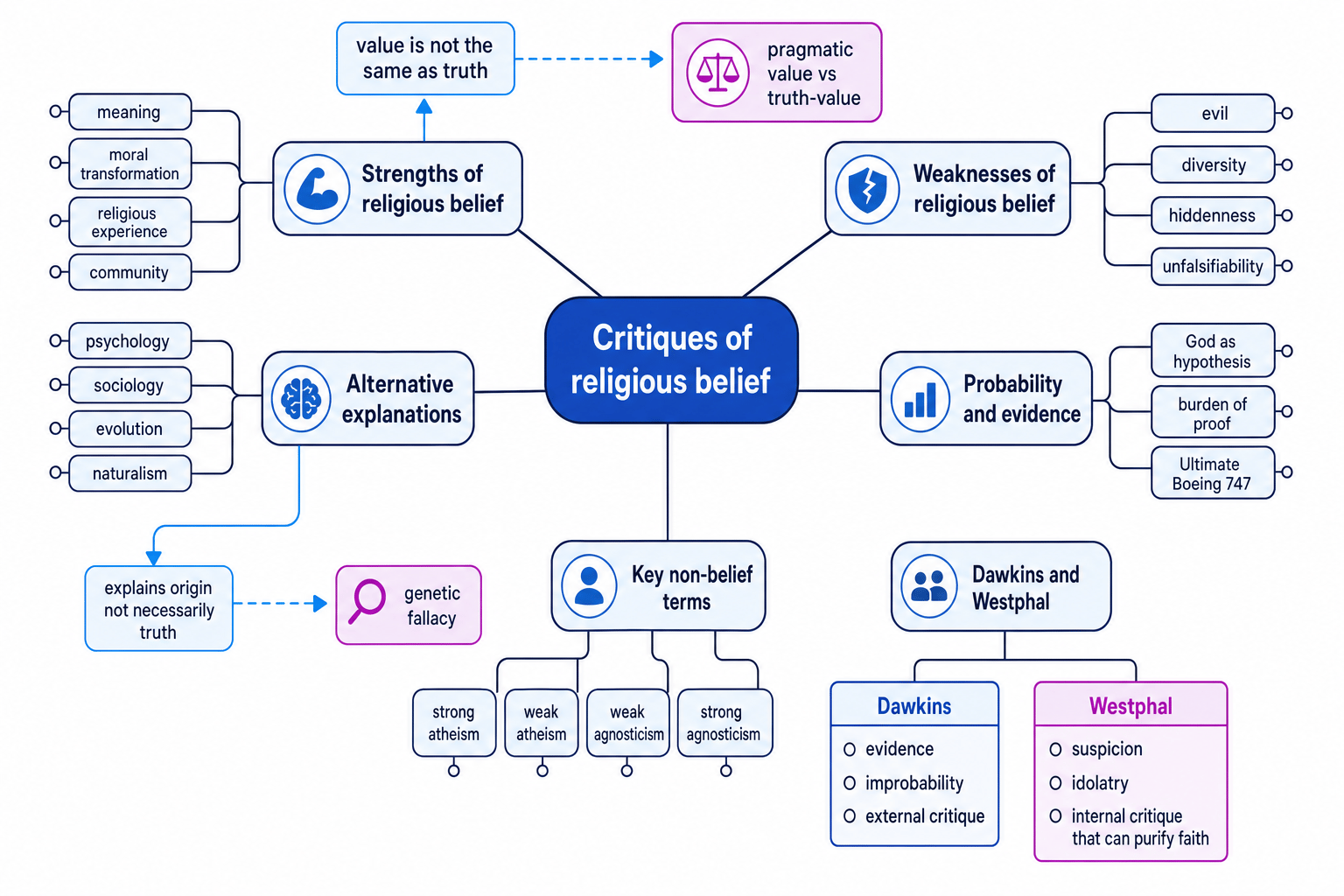
The map below shows the main areas you need to connect.
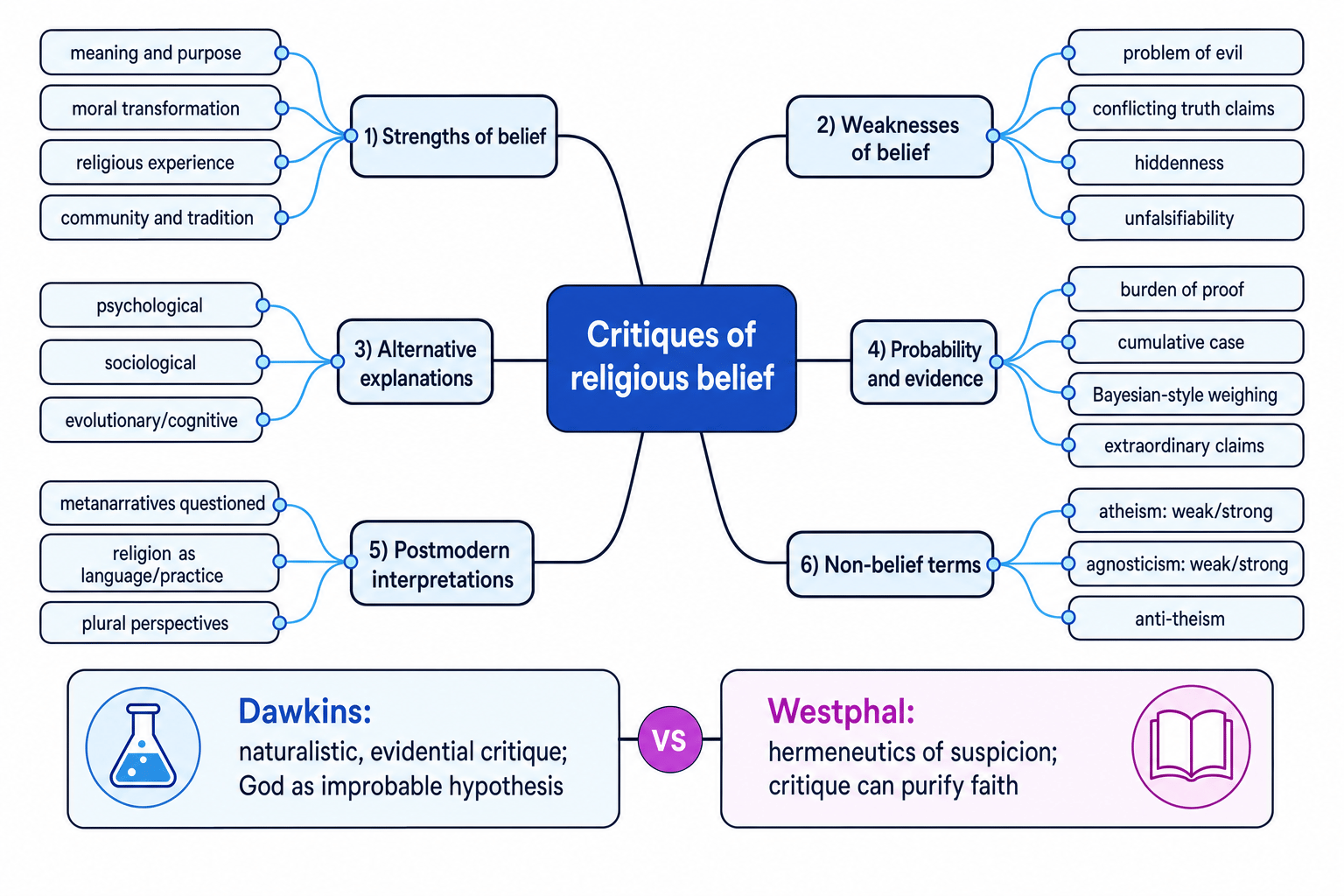
Religious belief
Religious belief can mean belief in propositions, such as “God exists”, but it can also mean trust, worship, practice, belonging to a tradition, and a way of interpreting life.
The key distinction
Dawkins mainly treats religion as a set of factual claims that should be tested against evidence. Westphal treats religion as something that must also be interpreted, because belief may be shaped by motives, power, desire and self-deception.
2. Key terms: atheism, agnosticism and theism
Before you evaluate critiques, you need precise vocabulary.
Theism
Theism is belief in a personal God who creates, sustains and may act within the universe. In Philosophy of Religion, this usually refers to the God of classical monotheism: omnipotent, omniscient and morally perfect.
Atheism
Atheism is either the rejection of belief in God or the absence of belief in God. The exact meaning depends on whether it is used in a strong or weak sense.
Types of atheism
Strong atheism, also called positive atheism, claims that God does not exist.
Weak atheism, also called negative atheism, means lacking belief in God without necessarily claiming to prove that God does not exist.
Anti-theism goes further: it is opposition to belief in God, often because religion is judged to be harmful.
Dawkins is best described as a de facto atheist: he does not claim absolute certainty, but he thinks God’s existence is extremely improbable. In The God Delusion, he famously places himself very close to the atheist end of a scale of belief.
Agnosticism
Agnosticism is the view that God’s existence is unknown, or perhaps unknowable.
Types of agnosticism
Weak agnosticism says, “I do not currently know whether God exists.”
Strong agnosticism says, “Human beings cannot know whether God exists.”
Classifying non-belief positions
-
If someone says, “There is definitely no God,” classify this as strong atheism, because it makes a positive truth-claim against God’s existence.
-
If someone says, “I lack belief because I have not seen enough evidence,” classify this as weak atheism, because the focus is absence of belief rather than certainty that God is impossible.
-
If someone says, “The question of God is beyond human knowledge,” classify this as strong agnosticism, because it claims the issue cannot be known, not merely that it is currently undecided.
Atheism is not always certainty
Do not assume every atheist claims to have proved that God does not exist. Dawkins’ position is probabilistic: he thinks God is overwhelmingly unlikely, not logically impossible.
3. Strengths of religious belief
Religious belief has several possible strengths.
First, it can offer meaning and purpose. Religion can place individual suffering, moral responsibility and death within a larger story.
Second, it can support moral transformation. Believers may argue that faith produces virtues such as forgiveness, compassion and self-sacrifice.
Third, it can appeal to religious experience. Experiences of prayer, conversion, awe, miracle or encounter with the divine may be treated as evidence by those who have them.
Fourth, religious belief often forms part of a community and tradition. This gives people identity, ritual, memory and shared moral practices.
Strength is not the same as proof
A belief may be meaningful, morally powerful and life-changing, but critics can still ask whether it is true. In essays, separate pragmatic value from truth-value.
Evaluating these strengths
The strongest defence of religious belief is often cumulative: no single point proves God, but religious experience, moral transformation, order in the universe and existential meaning may together form a reasonable case.
However, Dawkins would challenge this. He argues that comfort and meaning do not make a belief true. A belief may be psychologically useful and still false.
Westphal would add a different concern: religious belief may genuinely transform lives, but believers must also ask whether their religion is being used to serve pride, power or self-interest.
Balancing a strength of religious belief
-
Start with the claim: religious belief gives people meaning in suffering, so it has existential strength.
-
Test what kind of strength this is. It supports the value of religion, but it does not by itself establish the truth of religious claims.
-
Add comparison: Dawkins would say usefulness is not evidence, while Westphal would ask whether the meaning offered by religion is spiritually honest or a form of self-protection.
4. Weaknesses of religious belief
Religious belief also faces serious weaknesses.
The problem of evil asks how an omnipotent and perfectly good God can allow suffering. This remains one of the strongest philosophical challenges to theism.
Religious diversity creates another issue. Different traditions make conflicting claims about God, salvation, revelation and ultimate reality. Critics ask why one tradition should be privileged.
Divine hiddenness questions why God is not more obvious, especially to sincere seekers.
Finally, some religious claims may seem unfalsifiable, meaning that no possible evidence is allowed to count against them. Critics argue that this protects belief from rational testing.
Unfalsifiable
A claim is unfalsifiable if there is no possible observation or experience that could show it to be false.
Dawkins sees these weaknesses as reasons to reject religious belief. For him, religion often makes claims about reality while avoiding the standards of evidence used elsewhere.
Westphal is more nuanced. He does not treat critiques as simply destructive. He thinks criticism can expose false religion: religion used as ideology, wish-fulfilment or self-justification.
Good evaluation language
Instead of writing “religion is weak because evil exists”, write: “The problem of evil weakens classical theism if the believer cannot give a coherent account of why an omnipotent and benevolent God permits suffering.”
5. Alternative explanations of religion
An alternative explanation explains why people believe in religion without assuming that religious beliefs are true.
Reductionism
Reductionism explains religion by reducing it to something non-religious, such as psychology, society, biology or politics.
Psychological explanations
Psychological critiques suggest that religion arises from human needs, fears or desires. For example, religion may comfort people in the face of death or give a sense of control in an uncertain world.
Sociological explanations
Sociological critiques focus on society and power. Religion may preserve social order, justify authority or give oppressed people consolation.
Evolutionary and cognitive explanations
Dawkins favours naturalistic explanations. He argues that religious belief may spread like a meme, a cultural unit passed from mind to mind. Religion may also be a by-product of useful human tendencies, such as detecting agency or trusting authority figures in childhood.
Naturalism
Naturalism is the view that reality should be explained through natural causes rather than supernatural causes.
The genetic fallacy
The danger is the genetic fallacy: assuming that explaining where a belief came from proves it false.
For example, if someone explains why a person believes in justice, that does not automatically show justice is unreal. Likewise, explaining why someone believes in God does not by itself disprove God.
Testing a reductionist explanation
-
Identify the explanation: “Religion exists because humans fear death.” This is a psychological account.
-
Ask what it successfully explains. It may explain why belief is attractive and why ideas of heaven or salvation are widespread.
-
Ask what it does not prove. It does not logically show that God is unreal; it only challenges whether belief is motivated by truth rather than desire.
Explaining belief does not automatically disprove belief
A Dawkins-style naturalistic explanation can weaken the rational basis of belief, but it must still be argued carefully. Origin and truth are connected, but they are not identical.
6. Probability and evidence
Dawkins frames God as a hypothesis: a proposed explanation for features of the universe, such as design, complexity and religious experience. He argues that this hypothesis is very improbable.
His famous “Ultimate Boeing 747” argument responds to design arguments. If complexity needs explanation, then a divine designer would be even more complex and therefore even less probable. Dawkins argues that natural selection gives a better explanation of apparent design in living things.
Burden of proof
The burden of proof is the responsibility to give reasons or evidence for a claim. Critics often argue that the burden lies with the person claiming that God exists.
Why probability is difficult
Probability depends on background assumptions. Dawkins assumes that explanations should be naturalistic and that complex explanations are less likely. A theist may reply that God is not a complex object within the universe, but a simple necessary reality or personal explanation.
This is why probability debates often become debates about what counts as a good explanation.
Weighing Dawkins’ probability claim
-
State Dawkins’ claim: God is an improbable explanation because a designer capable of creating the universe would require explanation.
-
Test the assumption: this works strongly against a physical designer within the universe, but the classical theist does not usually define God as a physical object.
-
Reach a balanced judgement: Dawkins is powerful against crude design arguments, but less decisive against more philosophical accounts of God as necessary, simple or non-physical.
7. Postmodern interpretations of religion
Postmodernism
Postmodernism is a broad intellectual movement that questions universal “grand stories”, absolute neutrality and the idea that human reason can view reality from nowhere.
A metanarrative is a large-scale story that claims to explain reality as a whole. Some postmodern thinkers are suspicious of metanarratives because they can hide power interests.
Westphal is especially important here. He uses the hermeneutics of suspicion, an approach associated with Marx, Nietzsche and Freud. It asks what hidden motives, interests or desires may lie behind belief.
Hermeneutics of suspicion
The hermeneutics of suspicion is an interpretive approach that looks beneath surface meanings to uncover hidden motives, power structures or self-deceptions.
Westphal does not simply say, “Atheists are right and religion is false.” Instead, he argues that atheistic critiques can be useful for believers. They can expose idolatry, hypocrisy and religion used to protect privilege.
This makes Westphal very different from Dawkins. Dawkins uses critique to make belief look irrational. Westphal uses critique to purify belief.
Using suspicion without reductionism
-
Take the claim: “A wealthy society says God wants the poor to accept their place.”
-
Apply suspicion: ask whether this religious claim serves the interests of the powerful rather than the will of God.
-
Avoid overclaiming: this may expose a corrupt use of religion, but it does not prove that all religious belief is false.
8. Dawkins and Westphal compared
| Issue | Richard Dawkins | Merold Westphal |
|---|---|---|
| Main approach | Naturalistic and evidential | Interpretive and self-critical |
| View of religion | Usually irrational and improbable | Often distorted, but potentially spiritually meaningful |
| Key concern | God is a bad explanation | Religion may hide self-interest and idolatry |
| Type of critique | External critique from atheism | Internal critique useful for believers |
| Best exam use | Probability, science, alternative explanations | Postmodern suspicion, ideology, purification of faith |
Dawkins is strongest when challenging simplistic claims that God is needed to explain biological design. His critique is clear, accessible and evidence-focused.
However, he can be criticised for treating all religion as if it were a scientific hypothesis. Some religious believers argue that faith is not a rival scientific theory but a metaphysical, moral and existential worldview.
Westphal is strongest because he takes critique seriously without becoming simplistic. He shows that religious people should not dismiss atheism too quickly.
However, Westphal may be less useful for someone seeking a direct answer to whether God exists. His approach exposes distortions in belief, but it does not settle the truth of theism.
In the exam
-
Define your terms precisely: distinguish strong atheism, weak atheism, agnosticism, naturalism and reductionism.
-
Compare Dawkins and Westphal directly: Dawkins critiques religion as improbable and evidentially weak; Westphal uses suspicion to expose distorted religion.
-
Reach a justified judgement: decide whether critiques disprove religion, weaken only some forms of religion, or help purify religious belief.
Check yourself
-
Why is Dawkins better described as a probabilistic atheist than someone claiming absolute proof?
-
What is the genetic fallacy, and why does it matter for alternative explanations of religion?
-
How does Westphal’s use of atheistic critique differ from Dawkins’ critique?