What you'll learn
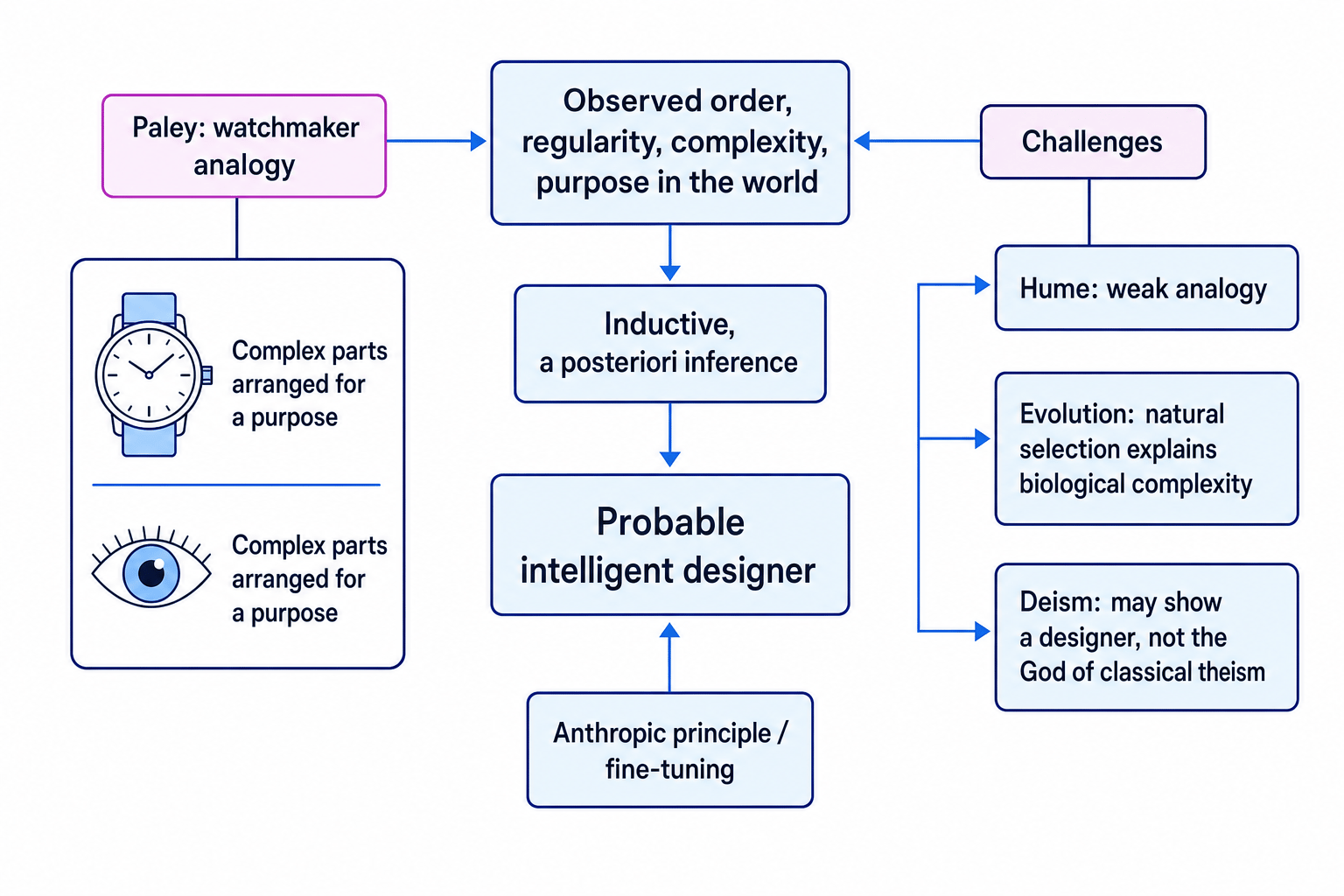
- How the Design Argument moves from observed order in the world to belief in a designer.
- The key concepts: inductive, a posteriori, analogy, regularity, cumulative evidence, and the anthropic principle.
- How William Paley defends the argument using the watchmaker analogy.
- How David Hume challenges the argument and why evolution and deism matter in evaluation.
The basic idea: order suggests design
The Design Argument is also called the teleological argument. “Teleological” comes from the Greek word telos, meaning end, goal, or purpose. The argument claims that the order, regularity, complexity, and apparent purpose in the universe are best explained by an intelligent designer, usually identified as God.
Design Argument
The Design Argument is an argument for God’s existence which says that features of the world — such as order, regularity, complexity, and purpose — provide evidence of an intelligent designer.
It is not usually presented as a strict proof. It is more like an inference: “Given what we observe, the most reasonable explanation is design.”
Inductive reasoning and a posteriori argument
An inductive argument is an argument where the conclusion is made probable by the evidence, rather than guaranteed. For example, if the sun has risen every day in your experience, you may infer that it will probably rise tomorrow. That is strong, but not logically certain.
Inductive reasoning
Inductive reasoning moves from observed evidence to a probable conclusion. If the evidence is strong, the conclusion may be reasonable, but it is not deductively certain.
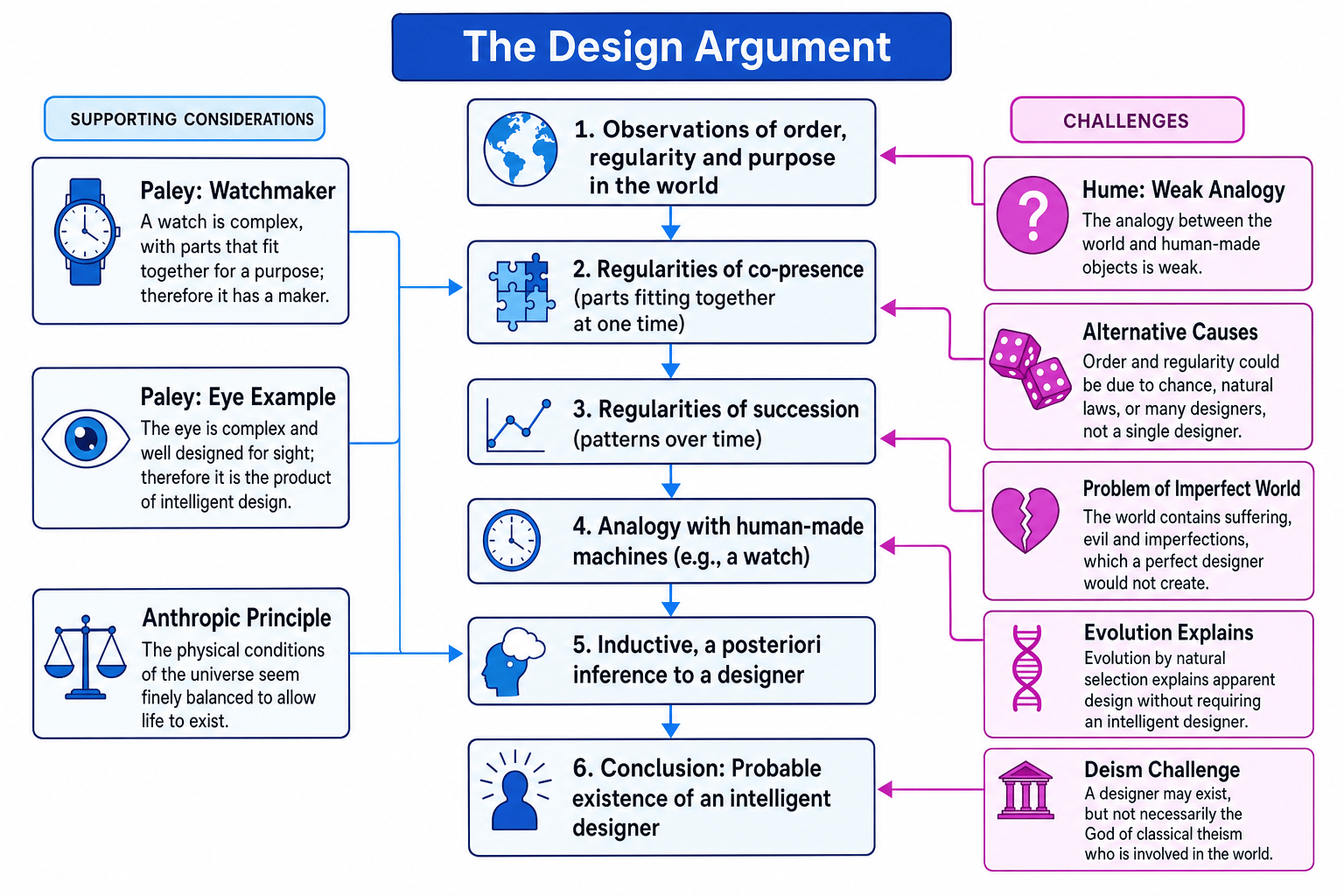
The Design Argument is also a posteriori, meaning it is based on experience or observation. It starts with what we notice about the world: living organisms seem adapted to their environments; natural laws seem regular; the universe seems capable of supporting life.
A posteriori
An a posteriori argument is based on experience, observation, or evidence from the world.
This matters because the argument depends on how we interpret experience. The same facts can be interpreted differently: a theist may see order as evidence of God, while an atheist may see it as the result of natural processes.
Classifying the Design Argument
- The argument begins with observations of the world, such as the structure of the eye or the regularity of natural laws.
- Because it starts from experience, it is a posteriori rather than a priori.
- It then reasons from evidence to a likely explanation, so it is inductive rather than deductive.
- Therefore, its conclusion is best expressed as “God probably exists” rather than “God must exist.”
Probability, not proof
The Design Argument aims to make belief in a designer reasonable or probable. It does not prove God’s existence with logical certainty.
Order, regularity, and purpose
Supporters of the Design Argument point to different kinds of order in the world.
Regularities of co-presence
A regularity of co-presence is order found in the way parts exist together at the same time. For example, the parts of the eye — lens, retina, optic nerve — work together to produce sight. The parts seem coordinated.
Regularity of co-presence
A regularity of co-presence is an ordered relationship between parts existing together, where the parts appear arranged to function as a whole.
Regularities of succession
A regularity of succession is order found in patterns over time. For example, seasons follow one another, planets move according to regular patterns, and causes are followed by effects.
Regularity of succession
A regularity of succession is an ordered sequence or pattern over time, such as repeated natural cycles or predictable causal processes.
These two kinds of regularity are important because the Design Argument does not only focus on living things. It can also point to the wider order of the universe.
Distinguishing types of regularity
- If you are discussing the eye, focus on how its parts work together at the same time: lens, retina, and optic nerve cooperate to enable sight.
- That makes it a regularity of co-presence, because the emphasis is on coordinated parts.
- If you are discussing the predictable movement of planets or seasonal cycles, focus on repeated patterns over time.
- That makes it a regularity of succession, because the emphasis is on sequence and predictability.
Paley’s watchmaker argument
William Paley is the key supporter you need for Edexcel. In Natural Theology (1802), Paley uses the famous watchmaker analogy.
An analogy is a comparison between two things. Paley asks us to imagine finding a watch on a heath. If you inspected it, you would notice that its parts are arranged for a purpose: telling the time. You would not think it had formed by chance. You would infer that it had a designer.
Analogy
An analogy is a comparison between two things, used to argue that because they are similar in one respect, they may be similar in another respect too.
Paley then applies this to nature. Living organisms are much more complex than watches, and their parts seem arranged for purposes. For example, the eye seems designed for seeing. Therefore, Paley argues, nature also points to an intelligent designer.
His reasoning is roughly:
- A watch has complex parts arranged for a purpose.
- We infer that the watch has a designer.
- Natural organisms also have complex parts arranged for a purpose.
- Therefore, we should infer that natural organisms have a designer.
- That designer is God.
Applying Paley’s analogy
- Identify the feature Paley wants to explain: the eye has many parts that cooperate to produce sight.
- Compare it with a human-made object: a watch has many parts that cooperate to tell the time.
- Infer from the similarity: if purposeful arrangement in a watch suggests a designer, purposeful arrangement in the eye may also suggest a designer.
- Evaluate the strength of the move: the conclusion is probable only if the analogy between organisms and machines is strong.
Treating analogy as proof
Do not write as if Paley’s analogy proves God exists. An analogy can support an inference, but it can also be challenged if the two things being compared are not similar enough.
Cumulative evidence and the anthropic principle
The Design Argument can be presented as a cumulative argument. This means it does not depend on one piece of evidence alone. Instead, many features together may increase the probability of design: biological complexity, regular natural laws, cosmic order, and the conditions needed for life.
Cumulative argument
A cumulative argument builds strength from several pieces of evidence taken together, rather than relying on one single point.
The anthropic principle is often used in modern versions of the Design Argument. It points out that the universe appears finely balanced for intelligent life. If certain physical conditions were different, life as we know it might not exist.
Anthropic principle
The anthropic principle, in design arguments, is the claim that the universe’s conditions appear finely tuned for life, and this may suggest intelligent design.
This can strengthen the argument because it widens the evidence beyond biology. Even if evolution explains organisms, a defender may still ask why the universe has laws and conditions that make evolution and life possible at all.
Useful essay move
A strong essay can say that evolution weakens Paley’s biological examples, but it does not automatically defeat every design argument, especially versions based on cosmic order or fine-tuning.
Hume’s criticisms
David Hume’s key criticisms appear in Dialogues Concerning Natural Religion (1779), especially through the character Philo. Hume wrote before Paley, but his criticisms are highly relevant to Paley’s style of argument.
The weak analogy objection
Hume argues that the analogy between the world and a machine is weak. We have experience of watches being made, but we do not have experience of universes being made. The world is also more like an organism than a machine, because it grows and changes.
If the analogy is weak, the conclusion is weak.
Alternative explanations
Hume also argues that even if the universe shows order, it does not follow that it was designed by the God of classical theism. The cause might be:
- many designers rather than one designer;
- a limited or imperfect designer;
- a designer who is no longer involved;
- natural processes rather than intelligence;
- chance over vast periods of time.
The problem of imperfection
Hume points out that the world contains suffering, disorder, and apparent flaws. If we infer the nature of the cause from the nature of the effect, then an imperfect world may suggest an imperfect designer.
Using Hume to challenge Paley
- Paley claims that the eye is like a watch because both have complex parts arranged for a purpose.
- Hume challenges whether this comparison is strong enough: watches are human-made machines, while eyes are living biological organs.
- Hume then asks whether the conclusion goes too far: even if there is design, it may not prove one perfect, omnipotent, benevolent God.
- Therefore, Hume weakens both the analogy and the theological conclusion drawn from it.
Hume’s main pressure point
Hume does not simply say “there is no order.” He argues that order can be interpreted in different ways and does not necessarily justify belief in the God of classical theism.
Evolution as an alternative interpretation
Charles Darwin’s theory of evolution by natural selection gives a powerful alternative explanation for apparent biological design. Organisms are not designed in one act; rather, small variations that help survival are preserved over long periods.
This directly challenges Paley’s examples, especially the eye. The eye may look designed, but evolutionary theory explains how complex organs can develop gradually through natural processes.
However, this does not completely end the debate. A theist may respond that evolution could be the method God uses to create. Another response is to move from biological design to cosmic fine-tuning: evolution explains living things, but does not explain why there is a law-governed universe capable of producing life.
Saying Darwin disproves God
Evolution challenges Paley’s biological design argument, but it does not logically disprove God. Some religious believers accept evolution and see it as compatible with divine creation.
Deism and the limits of the conclusion
Deism is the belief that God created or designed the universe but does not intervene in it. This matters because the Design Argument may only support a designer, not necessarily the personal, loving, miracle-working God of Christianity or another revealed religion.
Deism
Deism is the belief that God created or designed the universe but does not actively intervene in its ongoing events.
This is a major evaluative point. Even if Paley succeeds, he may only establish an intelligent cause of order. He has not automatically proven a God who answers prayers, performs miracles, or has moral concern for human beings.
Evaluating the argument
The strengths of the Design Argument are clear. It starts from ordinary experience, so it feels accessible. It explains why the world appears ordered and purposeful. Paley’s examples are memorable, and cumulative versions can draw on a wide range of evidence.
Its weaknesses are also serious. Because it is inductive, it gives probability rather than certainty. Its evidence can be interpreted in different ways. Hume attacks the analogy and the move from “order” to “one perfect God.” Evolution gives a strong natural explanation of biological complexity. Deism shows that even a successful design argument may not prove the God religious believers actually worship.
A balanced judgement might be: Paley’s argument is strong as an intuitive argument from apparent purpose, but Hume shows that it is much weaker as a proof of classical theism. Modern fine-tuning versions may be harder to dismiss than Paley’s biological examples, but they still face the problem of alternative explanations.
In the exam
- Define the argument precisely: it is an a posteriori, inductive, teleological argument from order and purpose to a probable designer.
- Use Paley accurately: explain the watchmaker analogy and apply it to biological complexity, especially the eye.
- Evaluate with Hume throughout: weak analogy, alternative explanations, imperfect world, and the gap between “designer” and “God.”
- Include alternative interpretations such as evolution and deism to show balanced AO2 judgement.
- End with a clear judgement about how far the argument succeeds, not just a list of strengths and weaknesses.
Check yourself
- Why is the Design Argument inductive rather than deductive?
- What is the difference between regularities of co-presence and regularities of succession?
- Does Paley’s argument prove the God of classical theism, or only suggest some kind of designer?