What you'll learn
- How juries may be influenced by witness and defendant characteristics.
- How cognitive ideas such as schemas, stereotypes and credibility judgements explain courtroom bias.
- The key research: Dixon et al. (2002), The Role of Accent and Context in Perceptions of Guilt.
- How to apply strategies that may influence, or improve, jury decision making.
Why is the courtroom a cognitive topic?
A jury is a group of members of the public who listen to evidence in court and decide whether a defendant is guilty or not guilty. In an ideal legal system, jurors should base their decision only on the evidence.
However, jurors are human. They interpret evidence through memory, attention, expectations and beliefs. That makes this a cognitive topic: it focuses on how people process information and make decisions.
Extra-legal factors
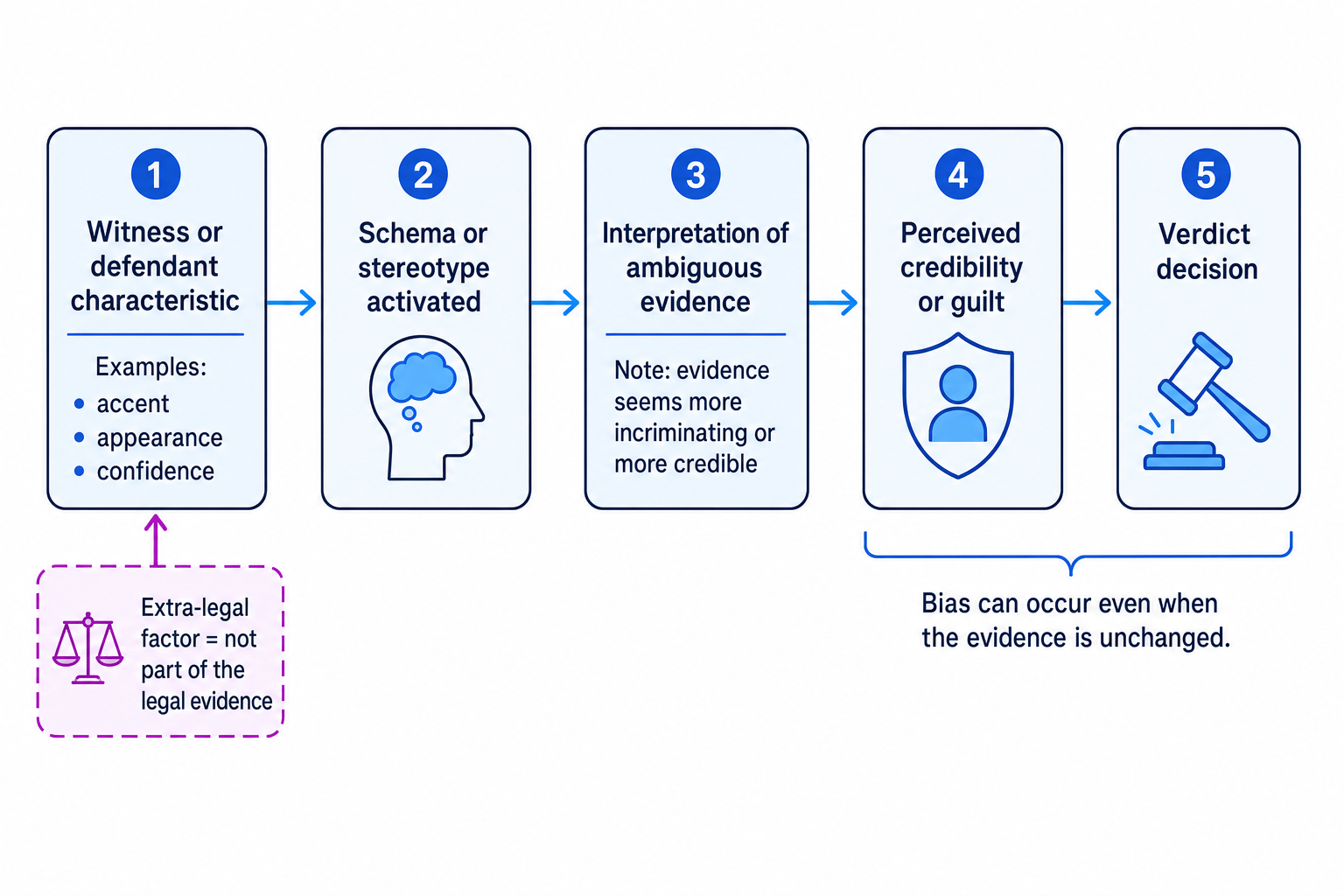
Extra-legal factors are influences on a jury that are not part of the legal evidence, such as a defendant’s accent, appearance, ethnicity, confidence, age or style of speech.
The basic cognitive pathway is: a juror notices a characteristic, links it to a stereotype, interprets the evidence through that stereotype, and then forms a judgement about credibility or guilt.
Background: how juries can be persuaded
Schemas and stereotypes
A schema is a mental framework that helps us organise information. For example, you may have a schema for “courtroom”, “police officer” or “credible witness”.
A stereotype is a simplified belief about a group of people. Stereotypes can be based on accent, gender, age, class, ethnicity or appearance. They can be inaccurate and unfair, but they may still affect judgement.
Credibility
Credibility means how believable or trustworthy someone appears. In court, jurors may judge the credibility of witnesses, victims, experts and defendants.
This matters because jurors do not simply “receive” evidence. They interpret it. A confident witness may seem more accurate. A defendant who speaks with a stigmatised accent may be judged as more suspicious, even if the evidence is identical.
Witness characteristics
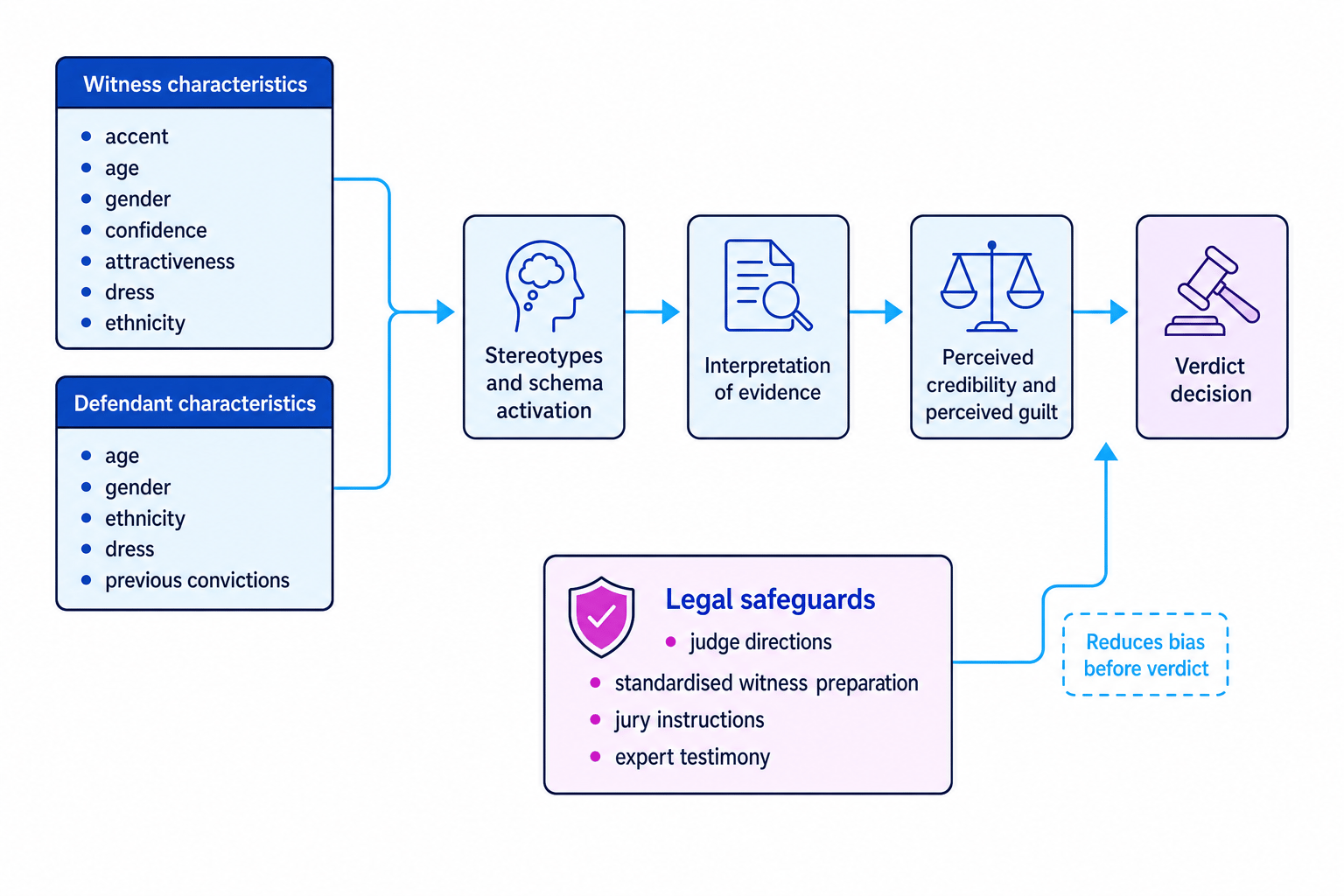
A witness is someone who gives evidence in court. Witnesses can influence juries through:
- Confidence — confident witnesses are often seen as more accurate, even though confidence does not always equal accuracy.
- Consistency — a witness whose account stays the same may seem more reliable.
- Status or expertise — professional witnesses may be seen as more believable.
- Age — children or older adults may be judged unfairly as less reliable.
- Accent and speech style — some accents may be associated with intelligence, honesty or criminality.
- Emotional expression — a distressed witness may seem sincere, but too much or too little emotion can also be judged negatively.
Defendant characteristics
A defendant is the person accused of a crime. Jurors may be influenced by:
- Accent
- Ethnicity
- Clothing and general appearance
- Attractiveness
- Gender
- Similarity to the jurors
- Previous convictions, if the jury is aware of them
A well-known idea here is the halo effect, where one positive characteristic, such as attractiveness or confidence, leads people to assume other positive qualities, such as honesty.
The key courtroom bias
Jurors may mistake a feeling of “this person seems guilty” for a rational judgement based on evidence, when that feeling may actually come from stereotypes or schemas.
Applying schemas to a courtroom scenario
A defendant in a robbery trial speaks with a regional accent that some jurors associate with being “rough” or “uneducated”. The evidence is mixed.
- The non-legal cue is the defendant’s accent, because accent is not evidence that they committed the robbery.
- The accent may activate a stereotype, such as “people with this accent are more likely to be criminal”.
- The juror may then interpret ambiguous evidence as more incriminating, because it fits the activated stereotype.
- A fairer decision would involve separating the legal evidence from the extra-legal cue and asking whether the prosecution evidence proves guilt.
Key research: Dixon et al. (2002)
Aim
Dixon et al. (2002) investigated whether a suspect’s accent and the context of the crime affected people’s perceptions of guilt.
The study is especially useful for this topic because it shows that juror-like decisions can be affected by social information that should not logically determine guilt.
Method
Dixon et al. used a laboratory experiment with mock-juror participants. A mock juror is a research participant asked to make a judgement similar to a real juror, usually using a written, audio or video case.
The study used an opportunity sample of 119 university students in Britain. Participants listened to an audio recording of a police interview with a suspect.
The main independent variables were:
- Accent: a Birmingham accent or a standard English accent.
- Context: the type of crime scenario, often described as a more “blue-collar” or “white-collar” context.
The dependent variable was the participants’ judgement of the suspect, including perceptions of guilt.
A useful feature was the use of a matched-guise technique. This means the same speaker can present different accents, helping researchers control for other voice differences.
Matched-guise technique
A matched-guise technique is when the same speaker uses different accents or speech styles, so researchers can test the effect of the accent while keeping the actual speaker constant.
Results
The key finding was that accent and context affected perceptions of guilt. A suspect with a Birmingham accent was judged more negatively in some contexts, especially where the accent fitted existing social stereotypes about the type of crime.
This suggests an interaction effect: the effect of accent was not completely separate from the crime context. Instead, the meaning of the accent depended on the situation.
Conclusions
Dixon et al. concluded that judgements of guilt can be influenced by accent-based stereotypes. This supports the idea that courtroom decision making is not purely rational or evidence-based.
It also suggests that juries may be persuaded by subtle characteristics of defendants, even when those characteristics are irrelevant to the legal facts.
Dixon et al. in one sentence
Dixon et al. (2002) showed that a suspect’s accent can affect perceived guilt, especially when the crime context makes accent stereotypes seem relevant.
Evaluating Dixon et al. (AO3)
Strengths
The study had good control. Because it was a laboratory experiment, the researchers could standardise the audio material and manipulate accent and context systematically. This improves internal validity because differences in guilt ratings are more likely to be linked to the manipulated variables.
The matched-guise technique is also a strength. If the same speaker produced both accents, then differences in judgement are less likely to be due to the speaker’s pitch, pace or personality.
The study is useful because it has clear real-world implications. If accent can bias perceptions of guilt, courts need strategies to reduce this bias.
Weaknesses
The study has limited ecological validity. Real juries hear much more evidence, deliberate as a group, receive judge directions and know their decision has serious consequences. A student listening to an audio recording is not the same as a real juror deciding a real case.
The sample may also be biased. University students may not represent the wider jury-eligible population. Their age, education and social background may affect how they respond to accent.
There is also a possible issue of ethnocentrism. The meaning of a Birmingham accent is culturally specific to Britain. The findings may not generalise to countries or regions where accents carry different stereotypes.
Overclaiming the findings
Do not write that Dixon et al. proved Birmingham-accented defendants are more likely to be convicted in real courts. The study measured perceptions of guilt in a mock setting, not actual jury verdicts.
Ethics and social sensitivity
Dixon et al. was relatively low-risk, but there are still ethical issues. Participants should have given informed consent, had the right to withdraw, been protected from distress, and been debriefed afterwards.
The research is also socially sensitive because it deals with prejudice linked to accent and social class. According to the spirit of the BPS Code of Human Research Ethics, researchers should maximise social benefit while avoiding harm, such as reinforcing stereotypes about particular regions or groups.
Application: strategies to influence jury decision making
In this topic, “influence” can mean improving jury decisions so they are more evidence-based and less biased. A strong application answer should name a strategy, explain the cognitive mechanism, and apply it to the courtroom situation.
Strategy 1: judicial instructions and decision checklists
A judicial instruction is guidance given by the judge to the jury about how to apply the law and what evidence they may or may not consider.
A practical strategy is for the judge to give jurors clear instructions that they must ignore irrelevant characteristics such as accent, appearance or emotional style. This can be strengthened with a written decision checklist that asks jurors to focus on each piece of evidence separately.
This works cognitively because it encourages systematic processing rather than quick heuristic judgement. A heuristic is a mental shortcut. Heuristics are useful in everyday life, but in court they may lead to unfair decisions.
Reducing accent bias in a robbery trial
A defendant with a Birmingham accent is accused of robbery. The defence is worried that jurors may see the accent as fitting a “criminal” stereotype.
- The risk is identified as accent-based stereotyping, because the accent may influence perceived guilt without being legal evidence.
- The judge gives a clear instruction that accent, class assumptions and speech style must not be used as evidence of guilt.
- Jurors use a written checklist that separates the prosecution evidence, defence evidence and witness reliability, so they have to justify decisions using case facts.
- The expected effect is that jurors rely less on the stereotype and more on the strength of the evidence.
Strategy 2: expert testimony about bias
An expert witness is someone with specialist knowledge who helps the court understand an issue. In some cases, an expert could explain how stereotypes, memory errors or confidence can affect judgement.
For example, an expert might explain that witness confidence does not always equal accuracy, or that accent stereotypes can affect perceived credibility. This may help jurors become more aware of their own assumptions.
Strategy 3: standardising witness and defendant presentation
Courts can also reduce bias by making presentation more standardised. For example, defendants may be advised to dress appropriately and speak clearly. Witnesses may receive familiarisation with the courtroom process so they are less anxious.
However, there is an ethical boundary: preparation should not become coaching. It is acceptable to help a witness understand the process, but not to tell them what to say or how to manipulate the jury.
AO2 application shortcut
For any courtroom scenario, use this chain: characteristic → stereotype/schema → interpretation of evidence → perceived credibility or guilt → strategy to reduce bias.
Overall evaluation of applications
Strategies such as judicial instructions are useful because they are practical and inexpensive. They also fit the legal aim of making verdicts evidence-based.
However, they may not fully remove bias. Some stereotypes operate automatically, meaning jurors may be influenced without realising it. Also, a warning about bias could sometimes make a characteristic more noticeable.
Expert testimony may be more powerful because it explains the psychology behind bias, but it can be expensive and may confuse jurors if it is too technical.
Instructions are not magic
Telling jurors to ignore a bias does not guarantee that they can. A strong answer should say the strategy may reduce bias, not completely eliminate it.
Linking to the cognitive area
This topic fits the cognitive area because it studies internal mental processes such as attention, perception, memory, schemas and decision making.
It also links to debates:
- Freewill/determinism: jurors may feel they choose freely, but their decisions can be influenced by unconscious stereotypes.
- Reductionism/holism: focusing only on accent is reductionist; real verdicts involve many interacting factors.
- Usefulness: the research can improve fairness in court.
- Validity: mock-jury studies are controlled but may lack realism.
- Ethics: research can expose prejudice but must avoid reinforcing it.
In the exam
- For AO1, describe the background, Dixon et al.’s aim, method, results and conclusions clearly before evaluating.
- For AO2, apply the cognitive chain: characteristic → stereotype/schema → evidence interpretation → perceived guilt or credibility.
- For AO3, balance strengths and weaknesses: control and usefulness versus low ecological validity, sample bias, ethnocentrism and ethical/social sensitivity issues.
Check yourself
- How can a defendant’s accent affect perceived guilt even when the evidence stays the same?
- What did Dixon et al. (2002) manipulate, and what did they measure?
- Why might judicial instructions reduce bias, but not remove it completely?