What you'll learn
- Why evidence from witnesses and suspects depends on memory, attention, and language.
- How the cognitive interview helps people retrieve more information.
- What Memon and Higham (1999) concluded in their review of the cognitive interview.
- How to apply and evaluate police interview strategies for AO1, AO2, and AO3 answers.
Why this topic is cognitive
Cognitive psychology is the area of psychology that studies internal mental processes, such as memory, attention, perception, and thinking. In criminal psychology, this matters because police often rely on what people remember and report.
Evidence can come from physical traces, CCTV, documents, witnesses, victims, and suspects. This topic focuses on the collection and use of verbal evidence: what people say happened, who was involved, and how events unfolded.
Eyewitness testimony
Eyewitness testimony is information given by someone who has seen or experienced an event, such as a crime, accident, or suspicious incident.
A witness account is not simply “played back” from memory. It is affected by how the event was noticed, how it was stored, and how it is retrieved during questioning.
Background: memory and evidence
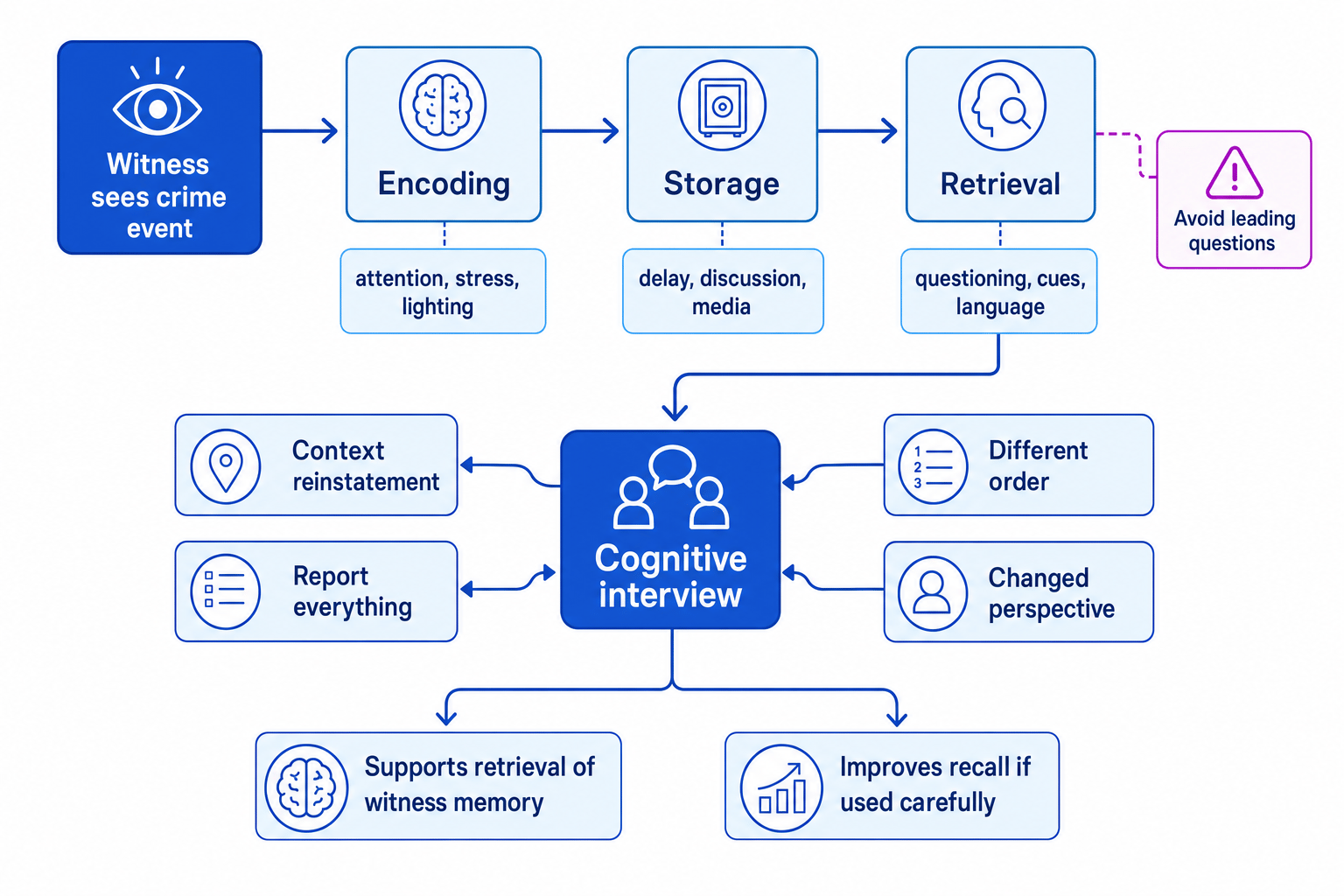
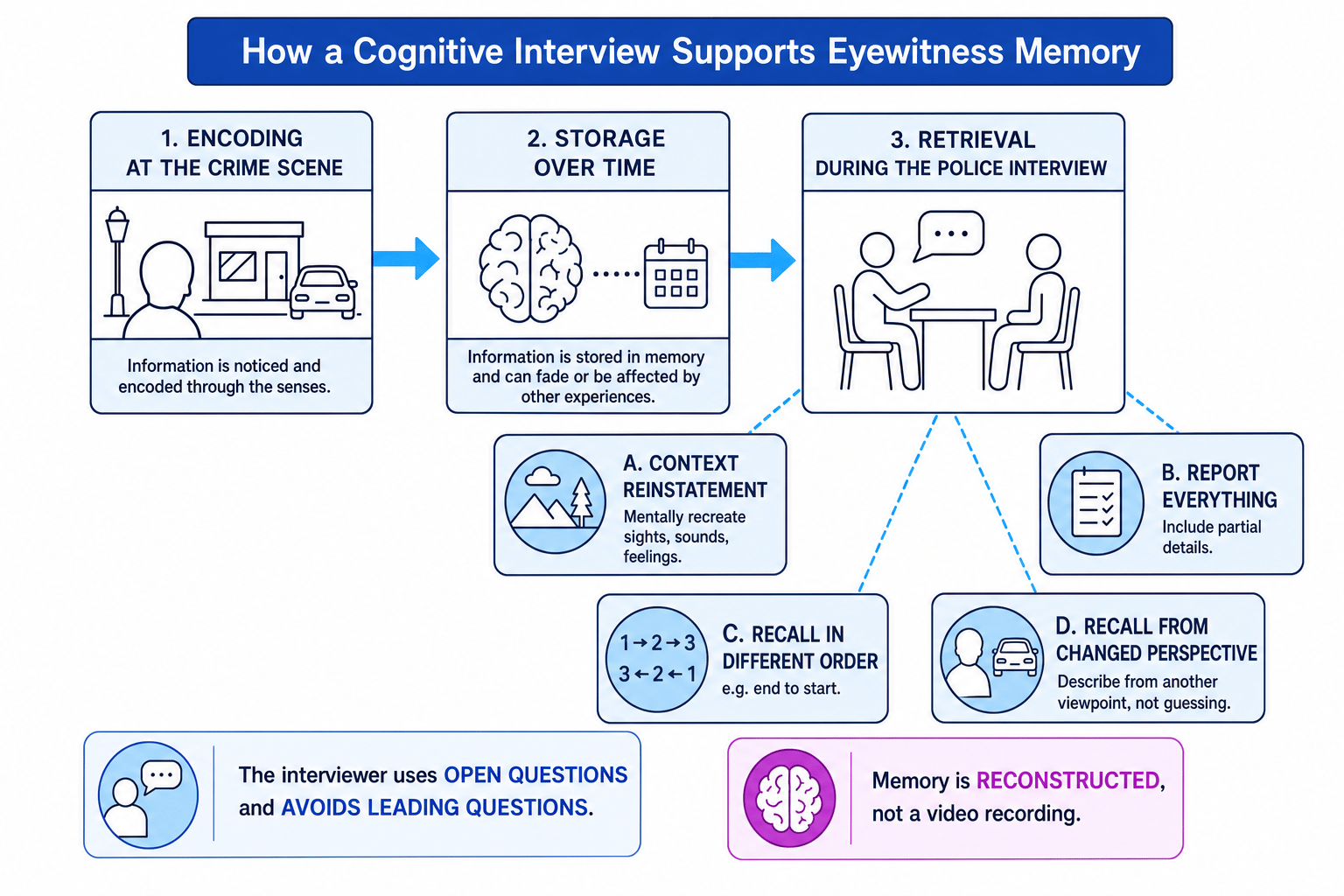
Memory is usually described in three stages:
- Encoding: information is taken in through the senses.
- Storage: information is retained over time.
- Retrieval: information is accessed and reported later.
In a crime situation, encoding may be poor because the event is fast, stressful, unexpected, or frightening. Storage may be affected by delay, discussion with other people, media coverage, or later questioning. Retrieval may be helped or harmed by the interview technique.
Memory is reconstructed
Witnesses do not retrieve a perfect recording of the crime. They reconstruct memories using stored details, retrieval cues, expectations, and sometimes information encountered after the event.
This links closely to Loftus and Palmer (1974), a Component 02 core study. They showed that leading questions can alter eyewitness estimates and possibly memory itself. For example, asking how fast cars were going when they “smashed” into each other produced higher speed estimates than asking when they “hit” each other.
So, police interviewers need to ask questions in a way that helps retrieval without contaminating the memory.
Retrieval cues and the cognitive approach
A retrieval cue is a reminder that helps someone access stored information. For example, thinking about the weather, sounds, location, emotions, or sequence of events may help a witness remember more.
The encoding specificity principle suggests that memory is better when the cues present at retrieval match the cues present at encoding. In simple terms: recreating the original context can help recall.
This is one reason why the cognitive interview was developed.
Using retrieval cues with a witness
A witness saw a robbery outside a bus stop but says, “I can’t remember much.”
-
The interviewer avoids a leading question such as, “Was the robber wearing a black hoodie?” because that could insert false information into the witness’s account.
-
The interviewer asks the witness to mentally return to the scene: the bus stop, traffic noise, weather, lighting, and how they felt. These cues may overlap with the original encoding context.
-
The witness then gives a free recall account. Because the retrieval conditions are closer to the original event, extra details may become accessible, such as the direction the robber ran or a distinctive voice.
The cognitive interview
Cognitive interview
The cognitive interview is a police interview technique designed to improve eyewitness recall by using psychological principles about memory retrieval.
The original cognitive interview is usually described as having four main techniques.
1. Context reinstatement
The witness is encouraged to mentally recreate the physical and emotional context of the event. They may be asked to think about the location, weather, sounds, lighting, smells, and their feelings at the time.
This uses the idea that matching the retrieval context to the encoding context can improve recall.
2. Report everything
The witness is encouraged to report all details, even if they seem trivial, partial, or uncertain. A small detail may later become important or act as a cue for further recall.
For example, a witness may not remember a full number plate but may remember “it started with an M” or “there was a sticker on the back window”.
3. Recall in a different order
The witness may be asked to recall the event backwards, from the middle, or from a different starting point. This can reduce reliance on a fixed story or schema.
A schema is a mental framework based on past experience. Schemas help us interpret events, but they can also lead us to fill gaps with what we expect, rather than what actually happened.
4. Recall from a changed perspective
The witness may be asked to describe the scene from another viewpoint, such as where another person was standing. This may cue extra spatial details.
Changed perspective does not mean guessing
The witness should not invent what another person saw. The aim is to trigger memory from a different angle, not to encourage speculation.
The enhanced cognitive interview
Later versions developed into the enhanced cognitive interview. This keeps the memory techniques but adds better communication and social features, such as:
- building rapport;
- reducing anxiety;
- letting the witness control the pace;
- using open questions;
- avoiding interruptions;
- listening actively;
- adapting the interview for children, older adults, or vulnerable witnesses.
This matters because an interview is not just a memory task. It is also a social interaction involving power, trust, confidence, and stress.
AO1 shortcut
For a basic description, remember the four original techniques as: context, everything, order, perspective.
Key research: Memon and Higham (1999)
The key research for this topic is Memon, A. and Higham, P. A. (1999), “A review of the cognitive interview”, published in Psychology, Crime and Law.
This was a review article, not a single laboratory experiment. Memon and Higham examined research evidence on the cognitive interview, including its theoretical basis, effectiveness, and practical problems.
Aim
The aim was to review how effective the cognitive interview is and whether it should be used in real police work.
Main findings
Memon and Higham reported that the cognitive interview often increases the amount of correct information recalled by witnesses compared with standard interview methods.
However, they also noted important limitations:
- Some versions of the cognitive interview may increase incorrect details as well as correct details.
- The technique needs proper interviewer training.
- It can be time-consuming.
- Some components may be more useful than others.
- The changed-perspective instruction can be risky if it encourages guessing.
- Effectiveness may vary depending on the witness, the crime, the delay, and the interviewer.
Conclusions
Memon and Higham concluded that the cognitive interview is useful, but it is not a magic solution. It should be used carefully, with attention to accuracy, interviewer skill, and the needs of the witness.
Memon and Higham’s core conclusion
The cognitive interview can improve witness recall, but its success depends on careful use, good training, and avoiding techniques that increase error or pressure.
Application: police interview strategy
A clear application is using the enhanced cognitive interview with witnesses or victims after a crime.
In the UK, this can fit with the wider PEACE model of investigative interviewing:
- Preparation and planning
- Engage and explain
- Account
- Closure
- Evaluation
The cognitive interview is especially relevant to the Account stage, where the interviewer helps the person give their version of events.
Applying it to witnesses
A police interviewer should begin by building rapport and explaining that the witness should say if they do not know or cannot remember something. This reduces pressure to please the interviewer.
They should then invite a free recall account using open questions, such as “Tell me everything you remember about what happened.” After that, they can use context reinstatement, ask for all details, and only later ask clarifying questions.
Applying it to suspects
With suspects, the situation is more complicated. A suspect may be anxious, defensive, or deliberately deceptive. The cognitive interview assumes cooperation and genuine memory retrieval, so it is usually more suitable for witnesses than suspects.
However, cognitive principles still matter. Interviewers should avoid coercive questioning, avoid leading questions, allow a full account, and check inconsistencies carefully rather than forcing a confession.
Planning an interview after a shop robbery
A shop assistant witnessed a robbery and is distressed.
-
The interviewer first chooses an enhanced cognitive interview because the person is a witness who may have useful memory details but may also be anxious.
-
The interviewer builds rapport and explains that it is acceptable to say “I don’t know”. This reduces demand characteristics, where the witness might try to give the answer they think police want.
-
The interviewer uses context reinstatement by asking the witness to picture the shop layout, lighting, sounds, customers, and their own position behind the counter.
-
The interviewer asks for a free account and encourages the witness to report everything, including partial details such as fragments of speech, clothing, movement, or the direction of escape.
-
The interviewer may later ask for recall in a different order, but uses changed perspective cautiously to avoid encouraging the witness to guess what another person saw.
AO3 evaluation
Strength: useful in real investigations
The cognitive interview has practical value because it can increase the amount of information gained from witnesses. Even small details may help police identify suspects, check CCTV, or build a timeline.
This makes the approach high in usefulness, one of the key debates in applied psychology.
Strength: based on cognitive theory
The technique is grounded in psychological principles such as retrieval cues, context-dependent memory, and encoding specificity. This gives it scientific credibility because it is not just common sense; it is based on research into how memory works.
Weakness: more detail does not always mean more accuracy
A major issue is whether the technique increases only correct details, or whether it also increases errors. “Report everything” may encourage useful recall, but it may also produce irrelevant or inaccurate information.
Quantity is not the same as quality
Do not evaluate the cognitive interview by saying only that it “gets more information”. Good AO3 also asks whether that extra information is accurate, reliable, and useful.
Weakness: training and time
The enhanced cognitive interview requires skill. Poorly trained interviewers may interrupt, ask leading questions, rush the witness, or misuse the changed-perspective technique.
It is also longer than a standard interview. In busy police settings, time pressure may reduce how well it is applied.
Validity and ecological issues
Some evidence for the cognitive interview comes from laboratory studies where participants watch staged events or videos. These studies can control variables, which helps reliability, but they may lack ecological validity because real crimes involve more fear, surprise, and personal involvement.
Field research may be more realistic, but it is harder to control. Real witnesses vary in age, stress, motivation, delay, and relationship to the crime.
Ethics and the BPS Code
The British Psychological Society Code of Ethics and Conduct highlights respect, competence, responsibility, and integrity. These principles are relevant because police interviews can affect victims, witnesses, suspects, and court outcomes.
Ethically, interviewers should avoid leading questions, intimidation, and pressure. Vulnerable witnesses may need breaks, support, appropriate adults, or adapted language. Suspects must not be pushed into false confessions.
Debates
The cognitive interview sits mainly on the situational side of the individual/situational debate because it shows that the interview environment can affect recall. However, individual differences still matter: age, trauma, confidence, language ability, and anxiety can all influence memory.
It can also be seen as more holistic than a simple memory test because the enhanced version considers communication, rapport, social pressure, and emotion, not just retrieval cues.
How to shape an essay answer
For AO1, describe the background, the four cognitive interview techniques, and Memon and Higham’s review.
For AO2, apply the technique to a scenario. Ask yourself: is the person a witness, victim, or suspect? Are they distressed? Is there a delay? What interview strategy would reduce contamination?
For AO3, evaluate usefulness, accuracy, training, ethics, ecological validity, and whether the technique works equally well for all people.
In the exam
-
Define the cognitive interview clearly before evaluating it: context reinstatement, report everything, different order, and changed perspective.
-
When applying to a scenario, choose interview prompts that are open and non-leading; avoid wording that inserts details.
-
For evaluation, balance usefulness with caution: it can increase recall, but poor training or pressure can increase errors.
Check yourself
- Why might context reinstatement improve eyewitness recall?
- What did Memon and Higham (1999) conclude about the cognitive interview?
- Why is the cognitive interview usually more suitable for witnesses than for deceptive suspects?