What you'll learn
- How neighbourhood features can influence crime through social signals and informal control.
- Wilson and Kelling’s (1982) broken windows theory.
- How zero tolerance policing can be used as a crime-prevention strategy.
- How to evaluate this topic using AO1, AO2 and AO3.
The starting point: social crime prevention
A social approach to crime prevention focuses on the environment around the offender, rather than only looking at biology, personality or individual thinking patterns.
It asks: what is it about a neighbourhood, community or social setting that makes crime more or less likely?
Social crime prevention
Social crime prevention means reducing crime by changing social and environmental conditions, such as policing, community involvement, neighbourhood maintenance and public order.
This topic is part of Criminal Psychology because it applies psychological ideas about behaviour, perception, fear and social influence to real-world crime control.
Social explanations look outside the individual
In this topic, crime is not explained mainly by “bad people”. It is explained by the signals and opportunities created by neighbourhood conditions.
Neighbourhood features and crime
A neighbourhood can communicate powerful social messages. If an area looks cared for, people may feel watched, protected and connected. If it looks neglected, people may assume nobody is in control.
Physical disorder
Physical disorder
Physical disorder means visible signs that an area is neglected, such as broken windows, graffiti, litter, abandoned buildings, vandalism or poor lighting.
Physical disorder matters because it may signal that rules are not being enforced. This can make residents feel unsafe and make offenders think they are unlikely to be challenged.
Social disorder
Social disorder
Social disorder means visible antisocial behaviour in public spaces, such as public drinking, drug dealing, aggressive groups, harassment or noisy conflict.
Social disorder can increase fear. If residents avoid the area, there are fewer ordinary people around to notice, challenge or report crime.
Informal social control
Informal social control
Informal social control is the way ordinary people help maintain order without using formal punishment, for example by watching out for neighbours, challenging antisocial behaviour or reporting problems.
When people trust each other and feel responsible for their area, informal social control is stronger. When people are frightened or disconnected, it weakens.
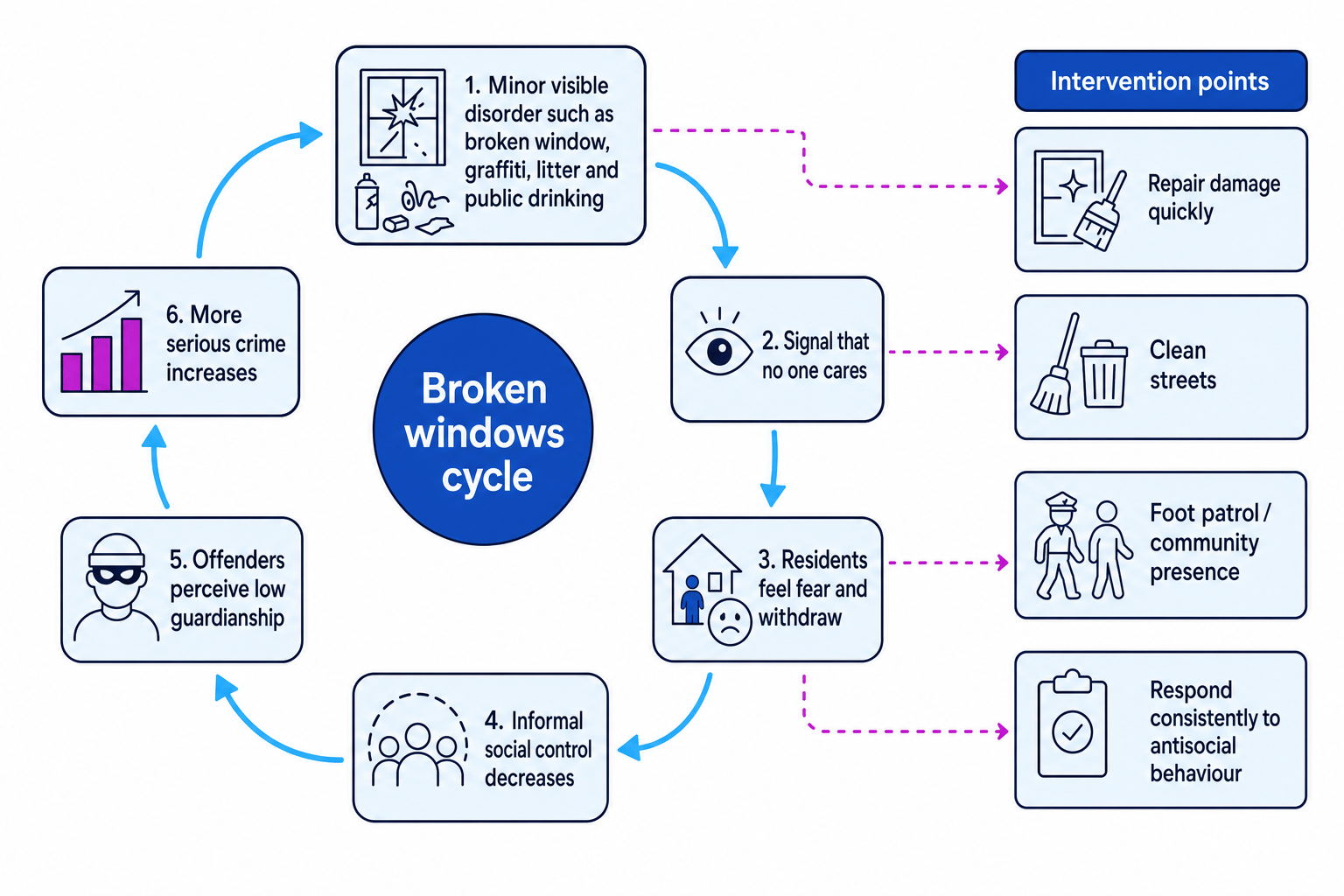
Applying neighbourhood features
A council is concerned about a shopping parade where several windows are smashed, graffiti is left for weeks, groups drink outside shops, and residents say they avoid going out after dark.
- Classify the signs of disorder: smashed windows and graffiti are physical disorder, while public drinking and intimidating groups are social disorder.
- Apply the social mechanism: these features may signal that nobody is maintaining the area, so offenders may perceive a lower risk of being challenged.
- Predict the community effect: residents avoiding the area reduces informal social control, because fewer people are present to supervise public space.
- Suggest a prevention link: repairing windows quickly, removing graffiti and increasing visible community or police presence could interrupt the cycle before more serious crime develops.
Key research: Wilson and Kelling (1982)
The key research for this topic is Wilson and Kelling (1982), “The police and neighbourhood safety: Broken windows.”
This was not a traditional laboratory experiment. It was a theoretical article using observations, examples and policing evidence to argue that disorder can lead to more serious crime.
Background to the theory
Wilson and Kelling were interested in why people feel safe or unsafe in neighbourhoods. They argued that fear of crime is not only caused by serious crime itself. It can also be caused by visible disorder.
Their famous idea was that if one broken window is left unrepaired, people may assume nobody cares. More windows may then be broken, and the area may decline further.
Broken windows theory
Broken windows theory is the idea that visible signs of disorder, if left unchallenged, can encourage further disorder and eventually more serious crime by signalling weak social control.
Evidence and examples used
Wilson and Kelling discussed evidence from policing and social observation.
One important example was Zimbardo’s car study. A car was left in a deprived area of New York and was vandalised quickly. A similar car left in Palo Alto, a more affluent area, was initially left alone. However, once the car was visibly damaged, people also began to vandalise it. This supported the idea that visible damage can invite further damage.
They also discussed foot patrol policing. In some areas, foot patrols did not necessarily reduce recorded crime, but residents felt safer and had more positive attitudes towards the police. Wilson and Kelling argued that visible policing can help maintain public order and reassure communities.
The main argument
Wilson and Kelling argued that minor disorder should not be ignored. They suggested a possible sequence:
- A minor problem appears, such as a broken window or graffiti.
- If it is not dealt with, it signals that nobody is in charge.
- Residents become fearful and withdraw from public spaces.
- Informal social control decreases.
- More serious offenders move in because the area appears poorly guarded.
- Crime increases further.
The broken windows message
Small signs of disorder can have big social effects because they change what residents and offenders believe about control, safety and risk.
Calling it a controlled experiment
Do not describe Wilson and Kelling (1982) as a controlled experiment with independent and dependent variables. It is better described as a theoretical article based on observations, examples and policing evidence.
Zero tolerance policing
Zero tolerance policing
Zero tolerance policing is a crime-prevention strategy where police respond firmly and consistently to minor offences and antisocial behaviour, rather than ignoring them.
This strategy is closely linked to broken windows theory. If minor disorder is dealt with quickly, the neighbourhood does not send the message that nobody cares.
Zero tolerance may target behaviours such as vandalism, fare dodging, graffiti, public drinking, drug dealing or aggressive begging, depending on the context.
How zero tolerance may reduce crime
Zero tolerance could work through several social mechanisms:
- Deterrence: potential offenders may avoid crime if they believe they will be caught or challenged.
- Visible order: quick responses to minor offences signal that rules are enforced.
- Reassurance: residents may feel safer and return to public spaces.
- Informal control: when residents feel confident, they may be more willing to report problems or challenge disorder.
- Reduced opportunities: visible police or community presence can make offending harder.
Zero tolerance does not mean maximum punishment
In exam answers, describe zero tolerance as consistent enforcement of minor offences. Do not imply it always means extreme punishment or aggressive policing.
Using zero tolerance in a transport hub
A train station has increasing reports of graffiti, fare dodging, intimidation and theft. The local authority wants a social crime-prevention plan.
- Link the problem to broken windows theory: graffiti and fare dodging are minor disorders that may signal weak control, encouraging further offending.
- Choose a zero tolerance response: staff and police could consistently challenge fare dodging, remove graffiti rapidly and respond to antisocial behaviour near entrances.
- Add a social mechanism: visible enforcement may reassure passengers, increasing legitimate use of the station and strengthening informal social control.
- Evaluate the risk: if enforcement targets particular groups unfairly, the strategy could become unethical and damage trust in the police.
Application: a social crime-prevention strategy
A strong applied answer should not just say “use zero tolerance”. You should explain what would be done, why it should work, and what problems it might create.
Strategy: rapid repair plus visible order maintenance
A practical strategy could include:
- repairing vandalism and broken windows quickly
- removing graffiti and litter
- improving lighting in poorly supervised areas
- increasing foot patrols
- responding consistently to antisocial behaviour
- encouraging residents to report problems
- working with local shops, schools and community groups
This combines environmental maintenance with zero tolerance principles. The aim is to stop disorder becoming normal.
Applying it to a new scenario
If an exam source describes a housing estate with vandalism, abandoned cars and residents afraid to leave home, you can apply broken windows theory directly.
You could say that visible disorder may signal low guardianship. Residents may withdraw, reducing informal social control. A prevention strategy could involve quick repairs, removal of abandoned cars, police foot patrols and community reporting systems.
Good AO2 is specific
For application marks, always use details from the scenario. If the source mentions graffiti, abandoned shops or groups intimidating residents, name those details and link them to physical disorder, social disorder or informal social control.
Evaluation of the social approach
Strengths
One strength is usefulness. Broken windows theory has clear real-world applications, such as rapid repair, neighbourhood clean-ups and foot patrol policing. This makes the research valuable for governments, councils and police forces.
Another strength is that the theory explains why minor disorder matters psychologically. It focuses on perception, fear and social signals, not just official crime rates.
It also supports a situational explanation of crime. This is useful because it shows that changing an environment may reduce offending without needing to change an offender’s personality.
Weaknesses
A major weakness is that the evidence is often correlational. Disordered neighbourhoods may have more crime, but this does not prove disorder causes crime. Poverty, unemployment, poor housing and lack of services may be deeper causes.
Another weakness is that zero tolerance may create ethical problems. It can lead to over-policing of already disadvantaged communities, especially if certain age groups, ethnic groups or social classes are targeted more heavily.
This links to the BPS Code of Ethics and Conduct, especially respect, responsibility and avoiding harm. Even if a policy aims to reduce crime, it should not stigmatise communities or treat people unfairly.
There are also validity issues. Recorded crime statistics may not accurately show real crime levels because some crimes are not reported, and increased policing can increase recorded crime simply because more offences are detected.
Finally, the theory may be ethnocentric. Wilson and Kelling developed their ideas mainly from American urban policing, so the conclusions may not apply equally to all UK communities, rural areas or different cultural contexts.
Do not overclaim causation
It is safer to write that disorder may contribute to crime, rather than saying it definitely causes crime. Many social and economic factors can affect offending.
Linking to debates
Individual versus situational
This topic strongly supports the situational side of the debate. It suggests that crime can be influenced by neighbourhood conditions and social signals.
Reductionism versus holism
Broken windows theory can be seen as reductionist if it reduces crime to visible disorder. A more holistic answer would include poverty, education, policing style, community trust and opportunity.
Usefulness
This is one of the most useful parts of Criminal Psychology because it directly informs crime-prevention strategies. However, usefulness depends on ethical and fair application.
In the exam
- For AO1, describe broken windows theory clearly: disorder signals low control, residents withdraw, informal social control falls, and crime may increase.
- For AO2, apply the exact scenario details to physical disorder, social disorder, zero tolerance or community control.
- For AO3, evaluate with balance: mention usefulness and real-world application, but also discuss causation, ethics, bias and alternative explanations.
Check yourself
- How does an unrepaired broken window potentially lead to more serious crime according to Wilson and Kelling?
- What is the difference between physical disorder and social disorder?
- Why might zero tolerance policing be useful but also ethically problematic?
