What you'll learn
- How Freud used the case of Little Hans to explain a childhood phobia.
- The method, results and conclusions of the study for AO1.
- How to evaluate the study using validity, reliability, sampling and ethics.
- How Freud (1909) compares with the paired contemporary study, Baron-Cohen et al. (1997).
1. The background: why Freud studied Little Hans
Freud (1909) is a classic core study in the Individual differences area, within the theme Understanding disorders. This area looks at how and why people differ in behaviour, thoughts and emotions, especially when behaviour is considered atypical or disordered.
Freud was working within the psychodynamic approach, which explains behaviour in terms of unconscious motives, childhood experiences and inner conflicts.
Psychoanalysis
Psychoanalysis is Freud’s theory and therapy method based on the idea that unconscious conflicts can cause psychological symptoms, and that bringing these conflicts into awareness can reduce distress.
Freud was interested in phobias, which are intense, irrational fears of an object or situation. Little Hans was a five-year-old boy who developed a fear of horses. Freud argued that this was not simply a fear of animals, but a symbolic expression of a deeper unconscious conflict.
Key Freudian ideas you need first
The unconscious means thoughts, wishes and fears outside conscious awareness but still influencing behaviour.
The Oedipus complex is Freud’s claim that during the phallic stage of psychosexual development, roughly ages 3–6, a boy unconsciously desires his mother and sees his father as a rival. Freud also suggested boys experience castration anxiety, a fear that the father will punish them for these wishes.
A defence mechanism is an unconscious strategy used to reduce anxiety. In this study, the key defence mechanism is displacement: anxiety is shifted from a threatening target onto a safer substitute.
Freud's core explanation
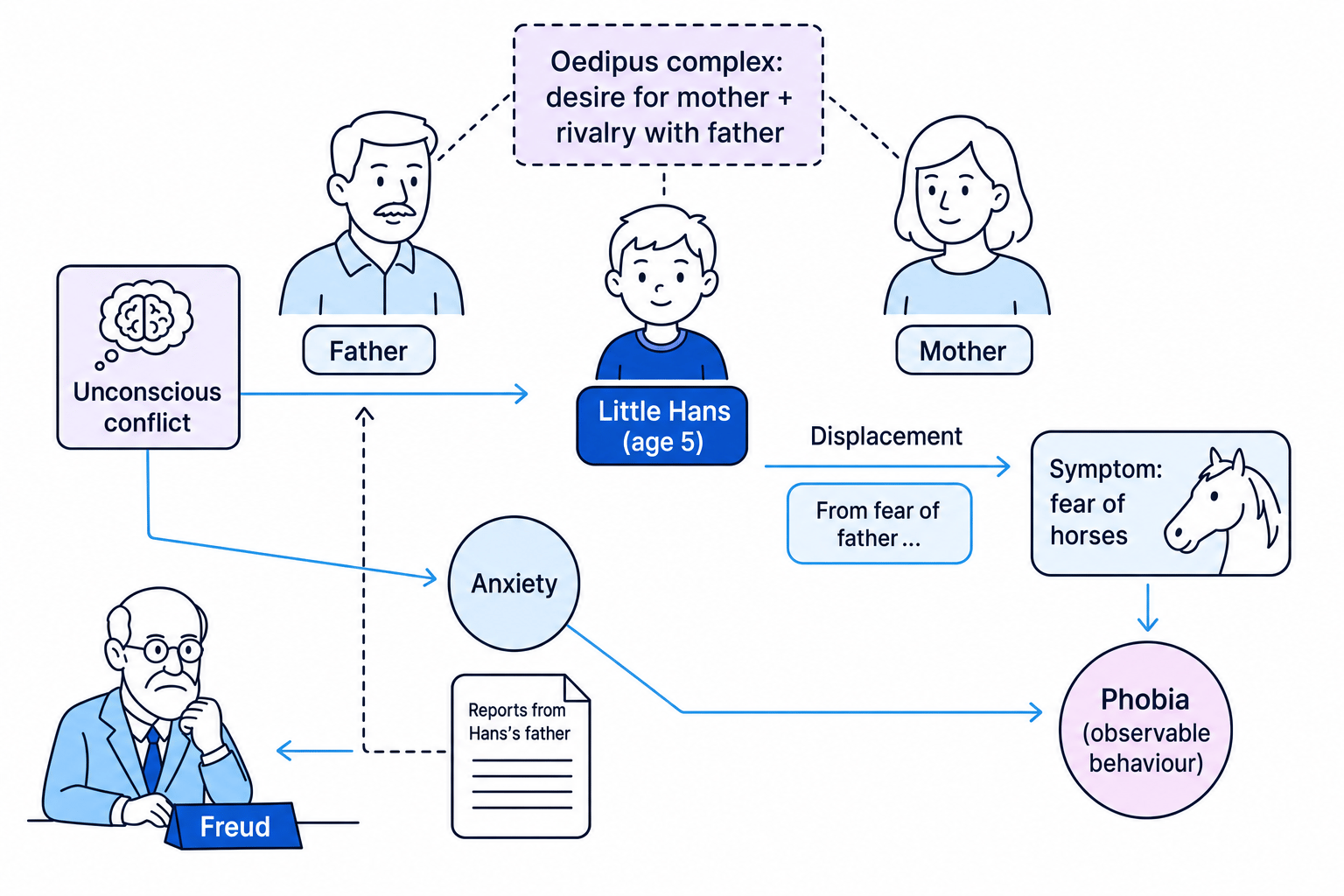
Freud argued that Hans’s fear of horses was a displaced fear of his father, caused by unconscious Oedipal conflict and castration anxiety.
The diagram below shows Freud’s interpretation: Hans’s observable symptom was a horse phobia, but Freud claimed the deeper cause was unconscious conflict within the family situation.
Applying displacement to a new phobia
- A child refuses to go near dogs and says, “They might bite me.” The observable symptom is a phobia, because the fear is intense and leads to avoidance.
- A Freudian interpretation would look beyond the dog itself and ask whether the child is experiencing a threatening relationship conflict, such as jealousy after a new sibling or fear of a strict parent.
- If the feared dog shares features with the threatening person, Freud might suggest displacement: the child cannot safely express fear or hostility toward the person, so the anxiety is redirected onto the dog.
- A balanced answer would add that this is only one interpretation. A behavioural explanation, such as learning through a frightening dog encounter, may be more testable.
2. Aim of the study
Freud aimed to show that a childhood phobia could be explained using psychoanalytic theory. More specifically, he wanted to support his ideas about infantile sexuality, the Oedipus complex, castration anxiety and the symbolic meaning of symptoms.
This was not an experiment testing a hypothesis with numbers. It was a detailed clinical case study.
3. Method: how the study was carried out
Design
Freud (1909) used a case study, meaning an in-depth investigation of one person or a small group.
Case study
A case study is a detailed investigation of an individual, often using qualitative data such as observations, interviews, letters and personal reports.
This study was longitudinal, because Hans was studied over time rather than on one occasion. It was also mainly qualitative, because the data were words, conversations, fantasies and observations rather than numerical scores.
Sample
The sample was one boy, known by the pseudonym Little Hans, who was about five years old and living in Vienna. His father was interested in Freud’s theories and reported Hans’s behaviour to Freud.
This is an opportunity sample, because Hans was available through Freud’s personal and professional network.
Materials and apparatus
There was no laboratory apparatus. The main materials were:
- Hans’s father’s written notes and letters to Freud.
- Conversations between Hans and his father.
- Reports of Hans’s dreams, fantasies and everyday comments.
- Freud’s psychoanalytic interpretations.
Procedure
Hans’s father observed and questioned Hans, then sent reports to Freud. Freud mostly analysed these reports rather than observing Hans directly. Freud met Hans only briefly, so the father acted almost like a co-researcher and therapist.
Hans showed curiosity about “widdlers”, Freud’s term in the case for penises, and asked questions about who had one. His mother reportedly threatened to call a doctor to cut off his “widdler” when he touched it, which Freud later linked to castration anxiety.
Hans later developed a fear that horses would bite him. He avoided going outside because horses were common in the streets. He was especially frightened by horses with black around the mouth and by horses pulling heavy carts or falling down.
4. Results: what Freud found
The findings were not statistical results. They were patterns Freud identified in Hans’s speech, behaviour and fantasies.
Fear of horses
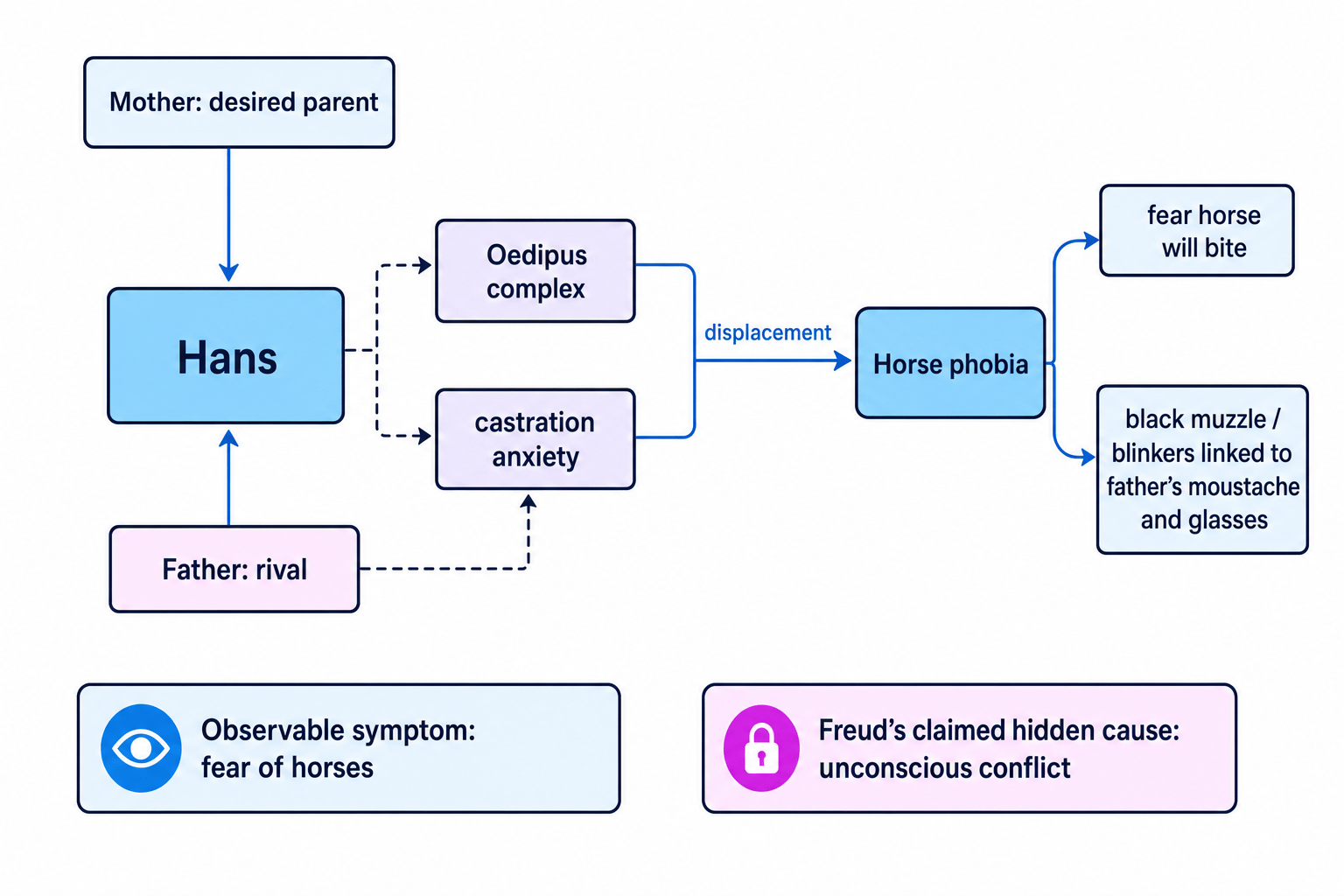
Hans feared horses biting him and became reluctant to leave the house. Freud interpreted the horse as a symbol for Hans’s father. The horse’s black muzzle and blinkers were linked to the father’s moustache and glasses.
Hans had also seen a horse fall down in the street. Freud interpreted this as connected to Hans’s unconscious wish that his father would “fall” or disappear, because the father was a rival for the mother’s attention.
Giraffe fantasy
Hans described a fantasy involving a large giraffe and a crumpled giraffe. Freud interpreted the large giraffe as the father and the crumpled giraffe as the mother. Hans sitting on the crumpled giraffe was interpreted as a symbolic wish to possess his mother, while the large giraffe protested.
Jealousy and family relationships
Hans had a younger sister, Hanna. Freud interpreted some of Hans’s comments as signs of jealousy and hostility towards her, because she took some of his mother’s attention.
Improvement
Over time, after Hans discussed his fears and received interpretations through his father, his phobia reduced. Freud viewed this as evidence that uncovering unconscious conflict could help relieve symptoms.
Do not say Freud proved the Oedipus complex
Freud claimed the case supported his theory, but a single case study cannot prove a universal theory. In AO3, use phrases like “Freud interpreted this as…” rather than “this shows…”
5. Conclusions
Freud concluded that Hans’s phobia was a symbolic symptom of unconscious conflict. The horse represented the father, and the fear of being bitten represented castration anxiety. Hans’s love for his mother and rivalry with his father were, according to Freud, expressed indirectly through the horse phobia.
Freud also concluded that psychoanalysis could be used with children, even indirectly through a parent.
6. Evaluation: AO3
Strengths
One strength is the rich qualitative detail. Freud collected detailed information about Hans’s everyday life, conversations and fantasies. This gives depth and helps psychologists understand the personal meaning of symptoms.
Another strength is ecological validity, which means the extent to which findings reflect real-life behaviour. Hans was studied in his normal home context rather than in an artificial laboratory.
The study was also useful. It helped develop later forms of talking therapy and encouraged psychologists to take childhood experiences seriously when explaining disorders.
Weaknesses
A major weakness is low generalisability, meaning the findings may not apply beyond this case. Hans was one boy from a particular middle-class Viennese family in the early 1900s.
There are also serious problems with validity, meaning whether the study measured or explained what it claimed to. Freud’s interpretation may not have been the true cause of Hans’s fear. A simpler behavioural explanation is that Hans learned to fear horses after seeing a horse fall down.
Reliability is also weak. Reliability means consistency. Another researcher might interpret the same conversations differently, and the study cannot be replicated in a controlled way.
Freud may also have shown confirmation bias, where a researcher notices evidence that supports their theory and overlooks evidence that challenges it. Hans’s father also knew Freud’s ideas, so he may have asked leading questions.
Ethics
Judged by modern BPS ethical guidelines, the study raises concerns. Hans was a young child and could not give fully informed consent. His father consented, but Hans may not have understood the purpose of the questioning.
There are also concerns about protection from psychological harm, because Hans was questioned about frightening and sensitive topics. Confidentiality was partly protected through the pseudonym “Little Hans”, although the case later became identifiable.
However, Freud and Hans’s father appeared to believe they were helping Hans, and his phobia did improve.
AO3 balance
For Freud, balance is easy: the study is rich, detailed and useful, but it is subjective, hard to replicate and based on one culturally specific child.
7. Link to the theme and area
This study fits the theme Understanding disorders because it tries to explain the cause of a phobia. It suggests disorders may come from unconscious conflict, not just from biology or learning.
It fits the Individual differences area because it focuses on one person’s unusual experience in depth. It is idiographic, meaning it aims to understand the individual, rather than nomothetic, which means trying to establish general laws about groups.
8. Comparison with Baron-Cohen et al. (1997)
The paired contemporary study for this theme is Baron-Cohen et al. (1997), which studied adults with autism or Asperger syndrome using the Eyes Task. The Eyes Task required participants to infer mental states from photographs of the eye region. This tested Theory of Mind, the ability to understand other people’s thoughts and feelings.
Both studies are about understanding disorders, but they do this in very different ways.
| Feature | Freud (1909) | Baron-Cohen et al. (1997) |
|---|---|---|
| Approach | Psychodynamic | Cognitive |
| Method | Case study | Quasi-experiment |
| Data | Qualitative | Quantitative and more standardised |
| Sample | One child | Groups of adults |
| Main explanation | Unconscious conflict | Theory of Mind deficit |
| Replicability | Low | Higher, because procedure is standardised |
| Usefulness | Influenced therapy and ideas about childhood | Influenced understanding and assessment of autism |
Freud is more detailed and personal, while Baron-Cohen et al. is more scientific in the sense of being controlled, measurable and easier to replicate. However, Baron-Cohen et al. may still be criticised for artificial tasks and for the socially sensitive nature of researching autism.
9. Wider debates
Freud’s study is strongly deterministic, because it suggests Hans’s behaviour was caused by unconscious forces outside his control.
It also raises the nature/nurture debate. Freud believed some drives were part of human nature, but Hans’s symptoms were shaped by his family experiences, especially his relationship with his parents.
The study can be seen as reductionist, because it reduces a complex phobia to one main explanation: Oedipal conflict. A more holistic explanation might include learning, parenting style, temperament and the real experience of seeing a horse fall.
It is also potentially ethnocentric, because Freud generalised from a specific European cultural context. Family roles, parenting and attitudes toward sexuality may differ across cultures.
In the exam
- For AO1, tell the story in order: background, aim, method, results and conclusions. Use key details such as Hans’s horse phobia, the father’s reports, the giraffe fantasy and displacement.
- For AO2, apply Freud carefully to the scenario: identify the symptom, suggest the unconscious conflict, then explain the defence mechanism.
- For AO3, avoid vague criticism. Use precise terms: validity, reliability, generalisability, ethics, confirmation bias, sampling bias and comparison with Baron-Cohen et al. (1997).
Check yourself
- Why did Freud interpret Hans’s fear of horses as a displaced fear of his father?
- What are two strengths and two weaknesses of using a case study in this research?
- How does Freud (1909) differ from Baron-Cohen et al. (1997) in method and explanation?