What you'll learn
- Why Baron-Cohen et al. developed the Eyes Task as an advanced test of theory of mind.
- How the study was designed, including its participant groups, materials, procedure, results and conclusions.
- How to evaluate the study for AO3: validity, reliability, sampling, ethics and usefulness.
- How to compare it with its paired classic study, Freud (1909) Little Hans.
Why this study matters
Baron-Cohen et al. (1997) is the contemporary core study for the OCR H567 key theme Understanding disorders in the Individual differences area.
It investigates whether adults with high-functioning autism or Asperger syndrome have difficulty interpreting subtle social cues from the eye region of the face.
Today, Asperger syndrome is usually understood within Autism Spectrum Disorder, but the original study used the labels “autism” and “Asperger syndrome”, so you should use those terms when describing the study.
Autism Spectrum Disorder
Autism Spectrum Disorder is a neurodevelopmental condition involving differences in social communication, restricted or repetitive behaviours, and sensory or routine-related differences. “Spectrum” means people vary widely in strengths, needs and difficulties.
Background: theory of mind
A key idea behind the study is theory of mind.
Theory of mind
Theory of mind is the ability to understand that other people have mental states — such as beliefs, intentions, emotions and desires — which may be different from your own.
Earlier theory-of-mind research often used false-belief tasks, such as the Sally-Anne task. In these tasks, a child has to understand that another person can hold a belief that is false. Many autistic children struggled with these tasks, supporting Baron-Cohen’s mindblindness theory: the idea that autism involves difficulty representing other people’s mental states.
However, high-functioning autistic adults and adults with Asperger syndrome could often pass these simpler tasks. Baron-Cohen et al. therefore needed a more subtle adult test.
Why the Eyes Task was needed
The study asked whether adults with autism or Asperger syndrome might pass basic theory-of-mind tasks but still show difficulty with subtle, everyday social interpretation.
Aim of the study
The main aim was to test whether adults with high-functioning autism or Asperger syndrome would be impaired on an advanced theory-of-mind task: the Reading the Mind in the Eyes Task, usually called the Eyes Task.
The researchers also wanted to see whether any difficulty was specific to mental-state interpretation, rather than being caused by low intelligence, poor face perception, or a general clinical condition.
Method: telling the story
Design
This was a quasi experiment because the main independent variable was a naturally occurring difference: whether participants had autism/Asperger syndrome, Tourette syndrome, or no diagnosis.
Quasi experiment
A quasi experiment compares pre-existing groups rather than randomly allocating participants to conditions. This means it can show a relationship between group membership and performance, but it cannot fully prove cause and effect.
It used an independent measures design, because different participants were in each group. The main dependent variable was the score on the Eyes Task.
Participants
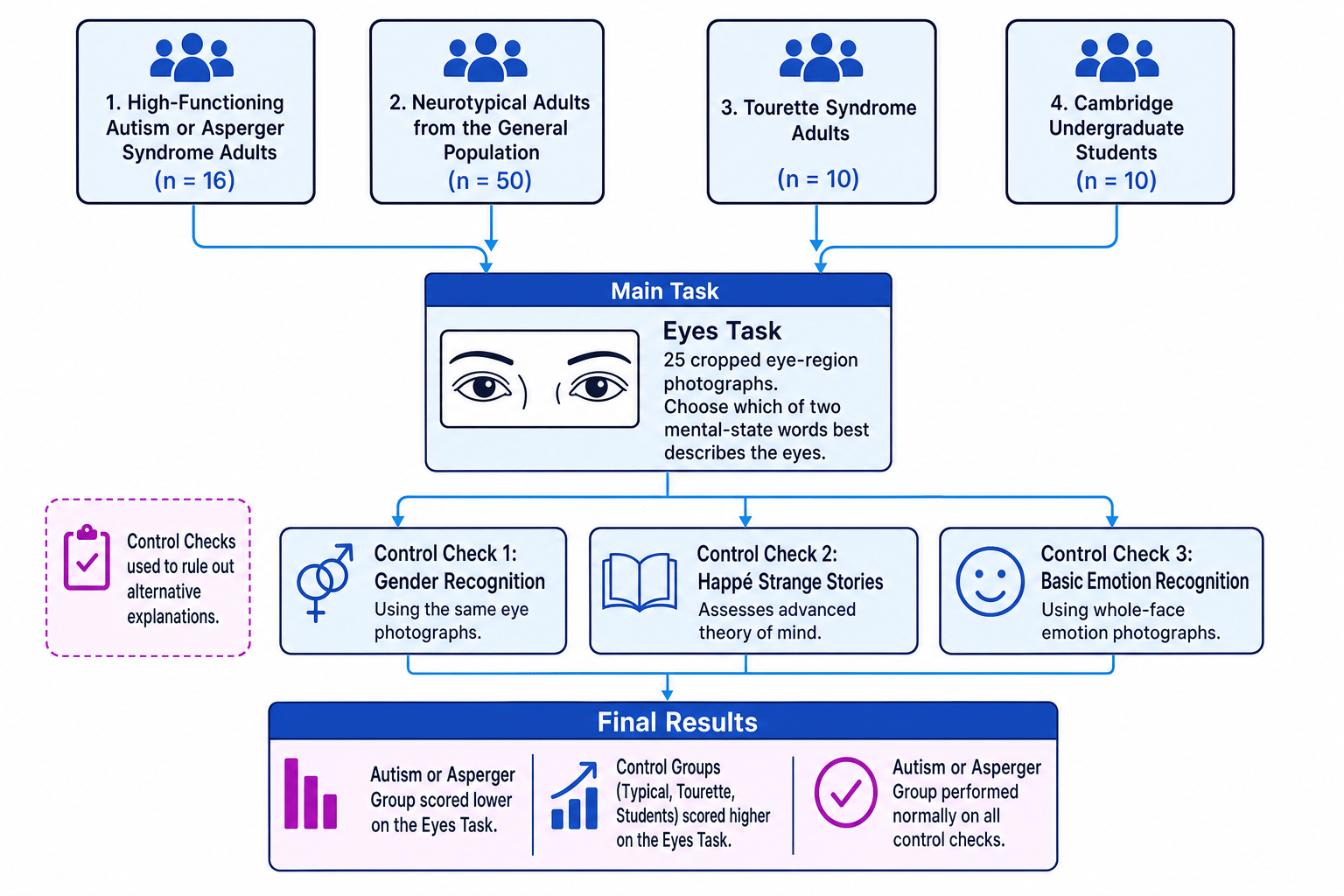
There were four participant groups:
| Group | Participants | Purpose |
|---|---|---|
| Autism/Asperger group | 16 adults | Main experimental group |
| General adult controls | 50 adults | Comparison with typical adults |
| Tourette syndrome group | 10 adults | Clinical control group |
| Cambridge undergraduate controls | 10 students | High-ability comparison group |
The autism/Asperger group were high-functioning adults with normal intelligence. The Tourette syndrome group was useful because Tourette syndrome is a neurological condition involving involuntary motor or vocal tics, but it is not mainly a theory-of-mind disorder.
Why the Tourette group matters
The Tourette group helps rule out the explanation that “any clinical diagnosis” or “being tested as a patient group” would automatically reduce Eyes Task performance.
Materials and procedure
The main task was the Eyes Task. Participants saw 25 black-and-white photographs showing only the eye region of different faces. For each photograph, they chose which of two words best described what the person was thinking or feeling.
For example, a participant might choose between words such as “concerned” and “unconcerned”. Each correct answer scored one point.
The researchers also used control checks, including:
- a gender recognition task, using the same eye photographs;
- Happé’s Strange Stories, an advanced theory-of-mind task using short stories;
- a basic emotion recognition task, using whole-face emotional expressions.
The diagram shows the logic of the study: different groups completed the Eyes Task, and control tasks helped rule out alternative explanations.
Results
The autism/Asperger group scored lower on the Eyes Task than all three control groups.
| Group | Mean Eyes Task score |
|---|---|
| Autism/Asperger group | 16.3 |
| General adult controls | 20.3 |
| Tourette syndrome controls | 20.4 |
| Cambridge undergraduate controls | 21.8 |
The autism/Asperger group did not show the same impairment on the control tasks. This suggests the problem was not simply poor vision, inability to identify gender from eyes, or inability to recognise basic emotions.
In the general adult control group, women tended to score higher than men on the Eyes Task, although the most important finding was the lower performance of the autism/Asperger group.
Using control tasks to interpret results
-
The autism/Asperger group scored lower on the Eyes Task, so the first interpretation is that they had difficulty judging complex mental states from eyes.
-
They performed normally on gender recognition using the same eye photographs, so the result is less likely to be caused by poor visual perception of the eye region.
-
They also performed normally on basic emotion recognition, so the difficulty seems to involve subtle mental-state interpretation rather than basic emotion recognition.
-
The Tourette syndrome group scored similarly to typical controls, so the result is unlikely to be due simply to having a clinical diagnosis.
-
The strongest conclusion is that the Eyes Task detected a specific, subtle theory-of-mind difficulty in high-functioning adults with autism or Asperger syndrome.
Conclusions
Baron-Cohen et al. concluded that adults with high-functioning autism or Asperger syndrome can have subtle theory-of-mind difficulties, even when they have normal intelligence and can pass other theory-of-mind tasks.
The study supports the idea that autism involves difficulty interpreting other people’s mental states, especially from complex social cues such as the eyes.
Do not say the autism group had low intelligence
The study specifically used high-functioning adults with normal intelligence. The point is that the Eyes Task difficulty appeared despite normal IQ.
Evaluation: AO3
Strengths
A major strength is the use of control groups. The general adult controls showed typical performance, while the Tourette syndrome group acted as a clinical control. This improved internal validity because the researchers could argue that the lower score was specific to autism/Asperger syndrome rather than clinical status in general.
The study was also fairly standardised. Participants saw the same set of photographs and had the same forced-choice response format, making the task replicable.
Another strength is usefulness. The study helped develop a more sensitive measure of adult theory of mind and influenced later autism research, assessment tools and social-cognition interventions.
Weaknesses
A key weakness is sampling bias. The autism/Asperger group had only 16 participants, mostly male, and all were high-functioning adults. This limits generalisability to autistic children, autistic people with learning disabilities, women with autism, or people with different support needs.
The Eyes Task also has issues with ecological validity. Real social interaction involves moving faces, tone of voice, body language, context and conversation. Cropped, static eye photographs with only two word options are much more artificial.
There are also questions about construct validity. The task is meant to measure theory of mind, but performance could also depend on vocabulary, familiarity with mental-state words, test-taking strategies or cultural experience with facial expressions.
Reliability
The study has some reliability strengths because the materials and scoring were standardised. However, the original Eyes Task had only 25 items and two response options, meaning chance performance was relatively high. Later versions of the task were revised to improve measurement.
Ethics
Using BPS principles, the study is relatively ethical because it involved adult participants, no major deception, and low risk of harm. Researchers still needed informed consent, confidentiality, the right to withdraw and sensitive debriefing.
However, autism research is socially sensitive. If findings are phrased carelessly, they can reinforce stereotypes, such as the inaccurate idea that autistic people have no emotions or do not care about others.
Be careful with socially sensitive wording
The study suggests difficulty interpreting some mental states from eyes. It does not show that autistic people lack emotions, empathy, or relationships.
Links to the key theme and area
Understanding disorders
This study helps us understand autism/Asperger syndrome by identifying a possible cognitive difference: difficulty reading complex mental states from subtle social cues.
Individual differences area
The individual differences area studies how people vary in behaviour, cognition and experience. Baron-Cohen et al. fits this area because it compares groups of adults who differ in diagnosis and social-cognitive performance.
It also raises classic debates:
- Reductionism: it explains autism partly through theory of mind, which may oversimplify a complex spectrum.
- Nature/nurture: it focuses on cognitive differences, but social experience and learning may also affect performance.
- Psychology as a science: it uses controlled tasks and quantitative scores, but measuring “mind-reading” is difficult.
- Usefulness: it has practical value for assessment and support, but must be applied sensitively.
Comparison with Freud (1909) Little Hans
Baron-Cohen et al. is paired with Freud (1909) Little Hans under the key theme Understanding disorders.
| Feature | Freud (1909) Little Hans | Baron-Cohen et al. (1997) |
|---|---|---|
| Area | Individual differences | Individual differences |
| Disorder focus | Phobia in a child | Autism/Asperger syndrome in adults |
| Explanation | Psychodynamic: unconscious conflict and the Oedipus complex | Cognitive: theory-of-mind difficulty |
| Method | Case study | Quasi experiment |
| Data | Mainly qualitative reports | Mainly quantitative task scores |
| Sample | One boy | Four groups, including controls |
| Scientific control | Very limited | More controlled and standardised |
| Ethics | Child consent and researcher bias are major issues | More ethical, but socially sensitive |
The strongest comparison is that both studies try to understand unusual or disordered behaviour, but they do so in very different ways. Freud gives a deep, detailed account of one child, whereas Baron-Cohen et al. uses a more scientific group comparison with standardised tasks.
In the exam
-
For AO1, tell the story in order: background, aim, sample, materials, procedure, results, conclusions.
-
For AO3, always link the evaluation point to its consequence: for example, “the sample was small and high-functioning, so the results may not generalise to the whole autism spectrum.”
-
For comparison with Freud, use a clear contrast: same key theme, but different explanation, method, data type and level of scientific control.
Check yourself
- Why did Baron-Cohen et al. need a more advanced theory-of-mind task for adults?
- How did the Tourette syndrome group improve the validity of the study?
- Give two reasons why the findings may not generalise to all autistic people.
