What you'll learn
- Why London taxi drivers are useful for studying brain plasticity.
- The full “story” of Maguire et al. (2000): background, method, results and conclusions.
- How to evaluate the study for AO3, including ethics, validity, reliability and sampling bias.
- How to compare it with Blakemore and Cooper (1970) in the brain plasticity theme.
The big idea: can experience change the brain?
Maguire et al. (2000) is a contemporary core study in the Biological area. The biological area explains behaviour and mental processes by looking at physical systems, especially the brain and nervous system.
Brain plasticity
Brain plasticity is the brain’s ability to change its structure or function in response to experience, learning, damage or environmental demands.
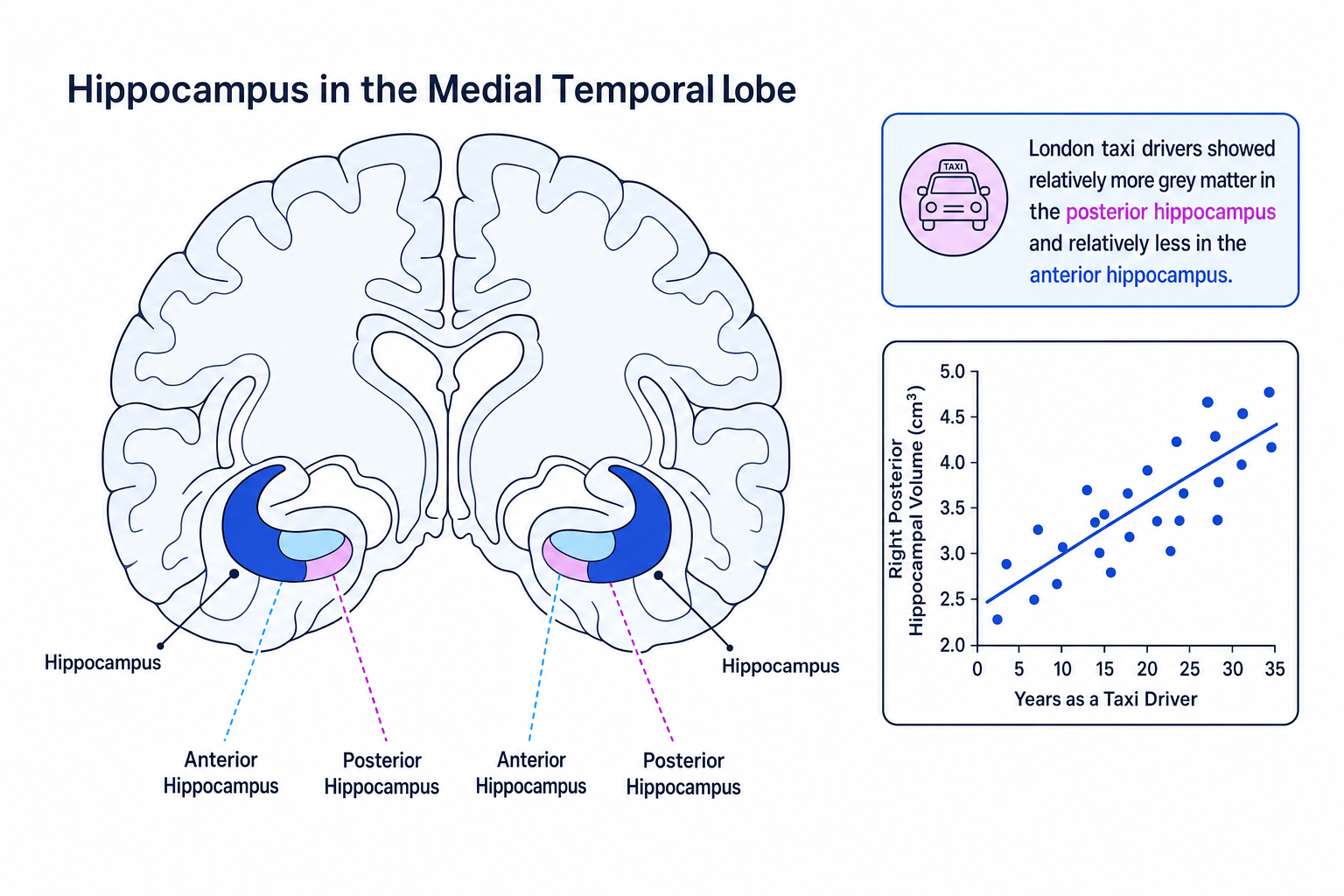
The key structure in this study is the hippocampus, a brain area in the medial temporal lobe involved in memory and spatial navigation. Spatial navigation means finding your way around environments, remembering routes and locating places.
London taxi drivers are an ideal group because they train for “The Knowledge”, learning a huge network of London streets, routes and landmarks. Maguire et al. wanted to know whether this long-term navigational experience was associated with structural differences in the hippocampus.
Core takeaway
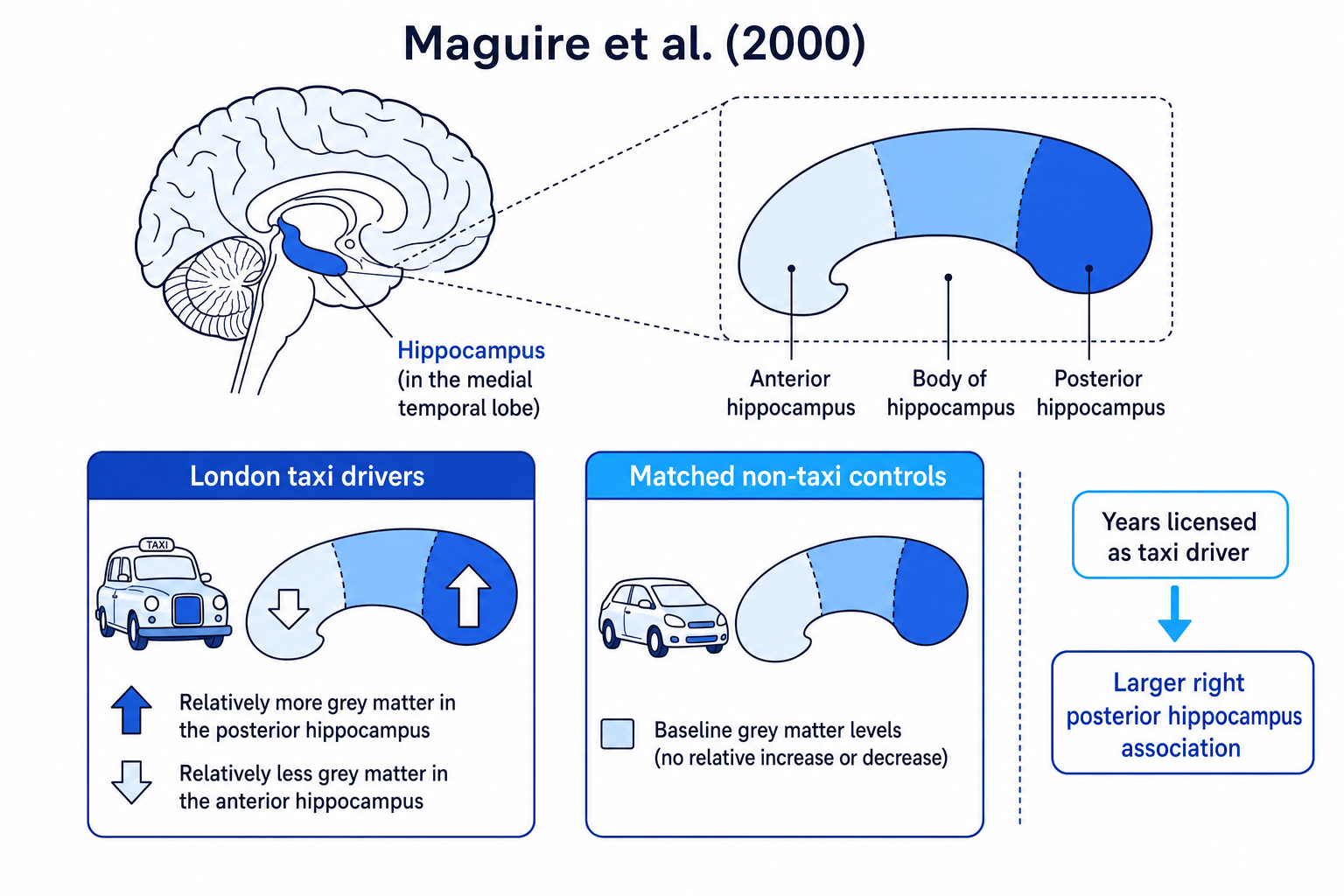
Maguire et al. found that licensed London taxi drivers had relatively more grey matter in the posterior hippocampus, supporting the idea that adult brains can adapt to repeated cognitive demands.
AO1: Tell the story of the study
Background
Earlier research suggested the hippocampus is important for spatial memory. For example, animals that rely heavily on storing locations may show hippocampal differences. Maguire et al. extended this idea to humans with real-world navigation expertise.
Aim
The study aimed to investigate whether the brains of London taxi drivers differed from non-taxi drivers, especially in the hippocampus, and whether any differences were related to length of time working as a taxi driver.
Design
This was a quasi-experiment, meaning the researcher compared naturally occurring groups rather than randomly allocating people to conditions. The main comparison was between taxi drivers and non-taxi controls.
It also had a correlational element, because Maguire et al. looked at whether years spent as a licensed taxi driver were associated with hippocampal volume.
Sample
The taxi-driver sample included 16 healthy, right-handed, male licensed London taxi drivers. Their mean age was 44, and they had been taxi drivers for an average of about 14 years.
The control group consisted of healthy, right-handed males who were not taxi drivers. Controls were matched as closely as possible on relevant factors such as age and sex.
Materials and apparatus
The main apparatus was MRI, or magnetic resonance imaging, a non-invasive brain-scanning technique that produces detailed structural images.
Maguire et al. used two analysis techniques:
- Voxel-based morphometry (VBM): a computerised method for comparing grey matter across the whole brain.
- Pixel counting: a more manual method for measuring specific hippocampal regions.
Grey matter
Grey matter is brain tissue containing many neuronal cell bodies. In this study, differences in grey matter volume were used as evidence of structural brain differences.
Procedure
Participants had structural MRI scans. They were not asked to navigate during the scan; the study measured brain structure rather than real-time route-finding.
Researchers compared taxi drivers’ hippocampi with controls’ hippocampi. They also examined whether hippocampal volume was related to length of time as a taxi driver.
Not a navigation task
Maguire et al. did not put taxi drivers in a scanner and ask them to plan routes. The study used structural MRI scans to compare brain anatomy.
Results
Taxi drivers had significantly more grey matter in the posterior hippocampus than controls. They also had relatively less grey matter in the anterior hippocampus.
The longer someone had worked as a taxi driver, the larger their right posterior hippocampus tended to be. This positive relationship supports the idea that navigational experience may be linked to structural brain adaptation.
However, the study does not prove that taxi driving caused the differences, because the participants were not randomly assigned to become taxi drivers.
Interpreting the hippocampus findings
-
Compare the groups: taxi drivers showed relatively larger posterior hippocampi than controls, so the structural difference is linked to the expert navigation group.
-
Add the correlational evidence: more years as a taxi driver were associated with a larger right posterior hippocampus, which strengthens the link with experience.
-
Make a cautious conclusion: the findings support brain plasticity, but because this is a quasi-experiment, you should say “associated with” rather than “definitely caused by”.
Conclusions
Maguire et al. concluded that the posterior hippocampus is involved in storing spatial representations of the environment. The findings suggest that the adult human brain can show plasticity in response to demanding, repeated learning.
A useful phrase for essays: Maguire et al. provide evidence for experience-dependent plasticity in the adult human hippocampus.
Research methods links
For OCR, you may need to connect this study to methods and statistics.
Data and graphs
- Nominal data are categories, such as taxi driver or control.
- Ordinal data are ranked scores, such as placing participants in order of navigation skill.
- Interval data have equal intervals between values, such as many psychological test scores or brain-volume measurements treated statistically.
Useful descriptive statistics include the mode (most common score), median (middle score), and mean (arithmetic average). Measures of spread include the range (highest minus lowest), variance (average squared spread from the mean), and standard deviation (typical spread around the mean).
Ratios, percentages and fractions can summarise samples: for example, all taxi drivers in this sample were male, which can be written as 100%, but that does not mean all taxi drivers are male.
Standard graphs: use a bar chart for categories, histogram for continuous data, line graph for change over time, pie chart for proportions, and scatter diagram for correlations such as years driving against hippocampal volume.
Choosing inferential tests
A parametric test is appropriate when data are interval-level, roughly normally distributed, and the design matches the test. If these assumptions are not met, OCR usually expects a non-parametric test:
- Mann-Whitney U: difference between two independent groups.
- Wilcoxon Signed Ranks: difference between two related conditions.
- Chi-square: association or difference using nominal frequency data.
- Binomial Sign Test: difference with related nominal data.
- Spearman’s Rho: correlation between two variables.
Choosing a test for a Maguire-style question
-
Decide the aim: if the question compares taxi drivers with controls, it is testing a difference; if it links years driving with hippocampal volume, it is testing a correlation.
-
Decide the design: taxi drivers versus controls are independent groups, so a difference test would need an independent-groups test.
-
Decide the data type and assumptions: if the data are not suitable for a parametric test, Mann-Whitney U fits the group comparison, while Spearman’s Rho fits the correlation.
A significance level is the probability threshold for accepting a result as unlikely to be due to chance. Psychology often uses p<.05p < .05p<.05. Researchers compare their observed statistic with critical values in statistical tables, checking sample size, one-tailed or two-tailed prediction, and test type.
A Type I error is a false positive; a Type II error is a false negative. You may see symbols such as =, <, <<, >>, >, ∞ and ~ in research-methods questions.
AO3 Evaluation
Strengths
Maguire et al. used objective MRI scans, making the study scientific and less reliant on self-report. Using both VBM and pixel counting improves reliability because the findings were checked in more than one way.
The study also has strong ecological validity in its background: London taxi drivers are real people with genuine navigation expertise, not participants trained briefly in an artificial task.
Weaknesses
Validity is limited because the study is not a true experiment. Taxi drivers may have had unusual hippocampi before training, so causation cannot be certain.
Sampling bias is also a problem. The sample was small, male, right-handed and London-based. This limits generalisability to women, left-handed people, drivers in other cities, or people using GPS-based navigation.
The study is culturally specific rather than fully universal. Ethnocentrism means treating one cultural context as if it applies everywhere; London’s taxi system and “The Knowledge” are unusual.
Ethics
Ethically, the study is fairly strong. Adult participants could give informed consent, MRI is non-invasive, and confidentiality could be protected. Under the BPS Code, researchers should show respect, responsibility, competence and integrity.
A small ethical issue is that MRI scans can reveal unexpected medical information, so researchers need clear procedures for consent, screening and follow-up.
Debates
The study supports the nurture side of the nature/nurture debate because experience appears linked to brain structure. However, pre-existing biological differences cannot be ruled out.
It is somewhat reductionist because it explains complex navigation mainly through hippocampal grey matter, while wider factors such as motivation, practice, stress and urban design are also relevant.
Comparison with Blakemore and Cooper (1970)
Maguire et al. is paired with Blakemore and Cooper (1970) in the brain plasticity theme.
Both studies are biological and show that experience can affect the brain. Both use objective methods and support the idea that the nervous system adapts to environmental demands.
The main difference is control. Blakemore and Cooper used kittens in a highly controlled laboratory study of visual experience, giving stronger cause-and-effect evidence but raising more serious ethical issues. Maguire et al. studied adult humans in a natural occupation, making it more ethical and realistic, but weaker for proving causation.
Essay wording
For Maguire, write “experience was associated with hippocampal differences” rather than “taxi driving caused the hippocampus to grow” unless you immediately qualify the claim.
In the exam
-
For AO1, follow the story: background, aim, design, sample, apparatus, procedure, results, conclusions.
-
For AO3, balance strong scientific measurement against weak causal control and limited generalisability.
-
Link findings clearly to the key theme: adult brain plasticity through real-world navigation experience.
-
In comparisons, focus on Maguire versus Blakemore and Cooper: adult humans versus kittens, natural expertise versus controlled deprivation.
Check yourself
- Why is Maguire et al. a quasi-experiment rather than a true experiment?
- Which part of the hippocampus was larger in taxi drivers, and why does this matter?
- What is one strength and one weakness of using MRI evidence in this study?