What you'll learn
- How beta blockers reduce the physical symptoms of stress.
- How stress inoculation training teaches people to cope with stressors.
- How to apply each method to real-life stress scenarios.
- How to evaluate both methods for AO3, including evidence, ethics and research methods.
Starting point: what are we trying to modify?
In this topic, “modifying stress” means reducing the harmful stress response: the physical, emotional and cognitive changes that happen when a person feels that the demands placed on them exceed their ability to cope.
Stress
Stress is a state of physiological and psychological arousal that occurs when a person perceives a situation as threatening, demanding or beyond their coping resources.
Stress can be useful in short bursts because it prepares the body for action. However, long-term or intense stress can interfere with health, concentration, sleep, relationships and performance.
There are two broad ways to reduce stress:
- Biological methods, which target the body’s stress response.
- Psychological methods, which target thoughts, appraisals and coping skills.
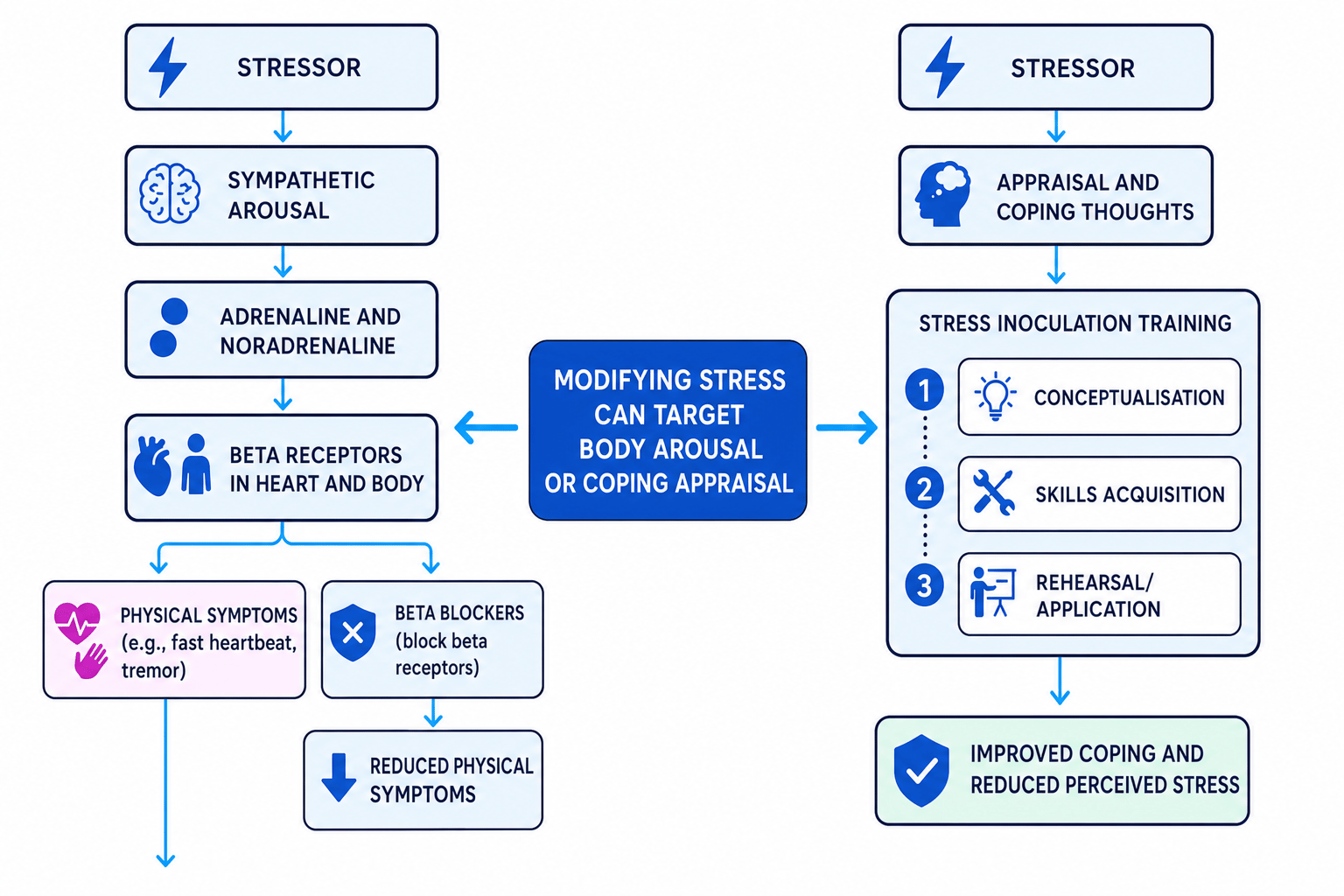
Two targets for stress reduction
Beta blockers mainly reduce physical arousal, while stress inoculation training mainly improves cognitive coping.
Method 1: beta blockers
AO1: what are beta blockers?
Beta blockers
Beta blockers are drugs that block beta-adrenergic receptors, reducing the effects of adrenaline and noradrenaline on the body.
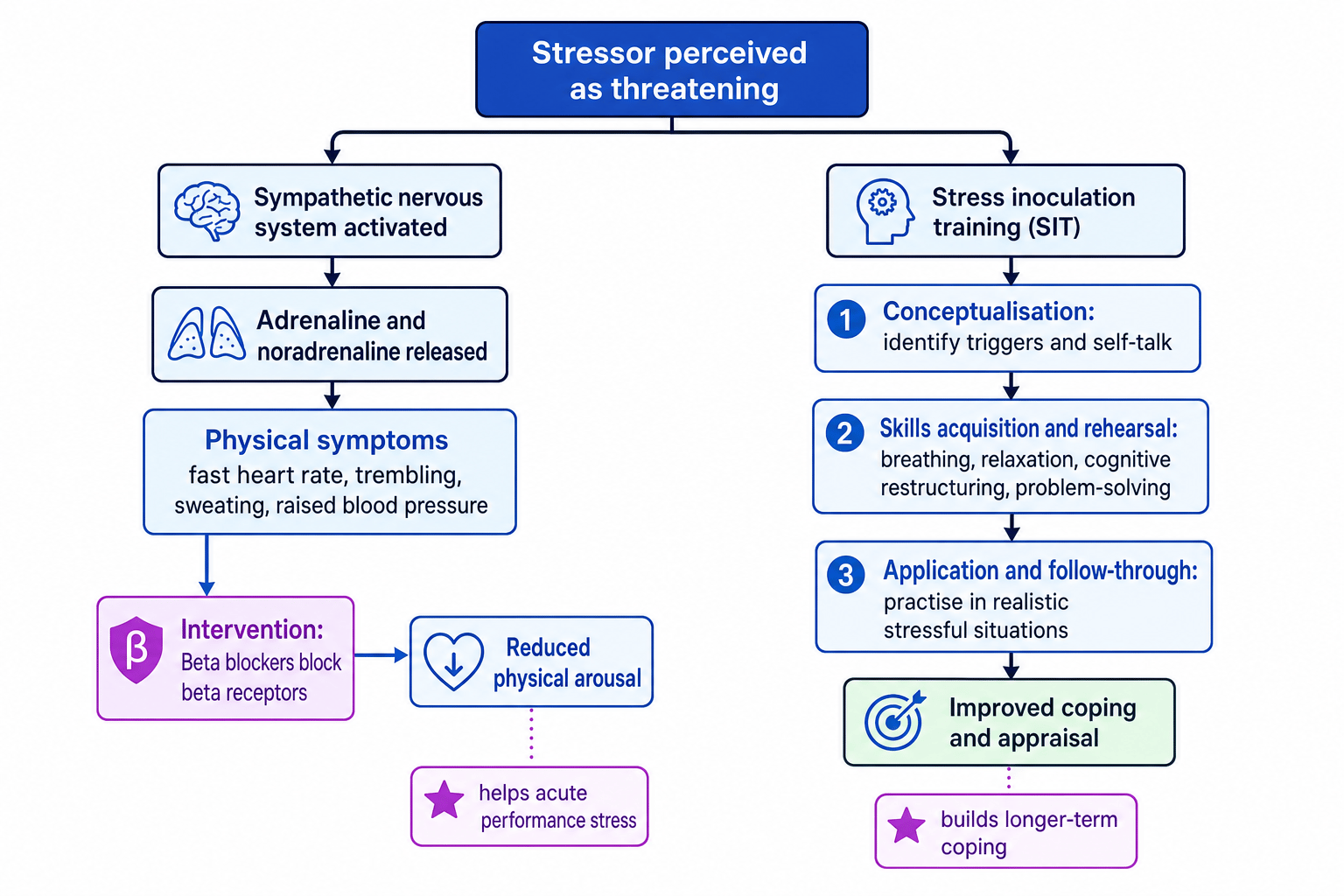
When you experience stress, the sympathetic nervous system becomes active. This is part of the body’s fight-or-flight response. The adrenal glands release adrenaline and noradrenaline, which prepare the body for action.
These chemicals can cause:
- faster heart rate
- trembling
- sweating
- raised blood pressure
- shaky voice
- feelings of physical panic
Beta blockers, such as propranolol, attach to beta receptors in areas such as the heart. This means adrenaline and noradrenaline have less effect. As a result, the person may still know the stressor is present, but their physical symptoms are reduced.
When are beta blockers useful?
Beta blockers are often used for acute, situation-specific stress. This means stress that happens in a clear short-term situation, such as:
- public speaking
- musical performance
- interviews
- examinations
- driving tests
They are not usually seen as a complete treatment for chronic stress because they do not remove the stressor or teach the person coping skills.
Applying beta blockers to performance stress
A student has to give a presentation. They understand the topic well, but their heart races, their hands shake and their voice trembles.
-
The main problem is identified as physical sympathetic arousal, not lack of knowledge or preparation.
-
A beta blocker could reduce the effects of adrenaline and noradrenaline at beta receptors, so symptoms such as trembling and rapid heartbeat may decrease.
-
This method fits best if the stress is short-term and performance-based, but the student would still need medical screening because beta blockers are prescription drugs.
AO3: strengths of beta blockers
One strength is that beta blockers can work quickly. This makes them useful for immediate, predictable stressors, such as a performance or interview.
A second strength is that their effects can be measured objectively. Researchers can record heart rate or blood pressure before and after taking the drug, rather than relying only on self-report.
There is some supporting evidence for performance stress. For example, Brantigan, Brantigan and Joseph (1982) reported that propranolol reduced symptoms of stage fright in musicians. This supports the idea that beta blockers can reduce physical anxiety symptoms in performance situations.
AO3: weaknesses of beta blockers
A key weakness is that beta blockers treat symptoms rather than causes. They do not teach the person how to appraise stressors differently, solve problems or cope in the long term.
They can also have side effects, including tiredness, dizziness, cold hands, sleep disturbance and low blood pressure. They may be unsuitable for people with some medical conditions, such as asthma or certain heart conditions.
Evidence is also mixed when beta blockers are used for wider anxiety disorders. Steenen et al. (2016) reviewed evidence on propranolol for anxiety disorders and concluded that the evidence was not strong enough to support routine use across all anxiety conditions. This suggests beta blockers may be more useful for specific physical symptoms than for complex psychological stress.
Do not say beta blockers remove stress completely
Beta blockers reduce the bodily symptoms of stress. They do not remove the stressor, erase anxious thoughts or directly teach coping strategies.
Method 2: stress inoculation training
AO1: what is stress inoculation training?
Stress inoculation training
Stress inoculation training, often shortened to SIT, is a cognitive-behavioural method that teaches people to understand stress, develop coping skills and practise using them in increasingly stressful situations.
SIT was developed by Donald Meichenbaum in the 1970s. It is called “inoculation” because it works a little like a psychological vaccine: the person is exposed to manageable levels of stress and learns coping skills before facing more demanding stressors.
SIT is usually described in three stages.
Stage 1: conceptualisation
The person learns about their stress response and identifies the thoughts, feelings and situations that trigger stress.
They may explore questions such as:
- What situations make me stressed?
- What do I say to myself during stress?
- Do I exaggerate the threat?
- Do I underestimate my ability to cope?
This links to the idea of cognitive appraisal, which means the person’s interpretation of whether a situation is threatening and whether they have enough resources to cope.
Stage 2: skills acquisition and rehearsal
The person learns practical coping skills. These may include:
- relaxation techniques
- breathing control
- positive coping self-statements
- problem-solving
- cognitive restructuring
- time management
- assertiveness training
Cognitive restructuring
Cognitive restructuring means identifying unhelpful thoughts and replacing them with more realistic, constructive thoughts.
For example, “I will definitely fail” might be replaced with “This is challenging, but I can use my revision plan and answer one question at a time.”
Stage 3: application and follow-through
The person practises using the skills in increasingly realistic stressful situations. This might involve role play, imagery, homework tasks or real-life exposure.
The aim is that coping becomes more automatic, so the person can use the skills when genuine stress occurs.
Using SIT for examination stress
A student panics before timed essays and thinks, “My mind will go blank and I’ll fail.”
-
In the conceptualisation stage, the student identifies that the stress is triggered by timed conditions and made worse by catastrophic self-talk.
-
In the skills stage, they learn breathing control and replace “I’ll fail” with “I can plan for five minutes and start with the strongest point.”
-
In the application stage, they practise under timed conditions, beginning with short plans and building up to full essays, while using the coping statements and breathing technique.
AO3: strengths of SIT
A major strength is that SIT aims to produce long-term coping skills. Unlike beta blockers, it does not just reduce physical symptoms; it helps the person understand and manage stressors more effectively.
SIT is also flexible. It can be adapted to exam stress, workplace stress, medical stress, sport performance or phobias.
There is evidence that stress-exposure training can be effective. Saunders et al. (1996) carried out a meta-analysis of stress training and found that it could reduce anxiety and improve performance under stress. This supports the usefulness of structured coping-skills training.
AO3: weaknesses of SIT
One weakness is that SIT takes time and effort. The person has to attend sessions, practise skills and be motivated to change. This means it may not be suitable when immediate symptom reduction is needed.
Another weakness is that SIT may depend heavily on the therapist’s skill and the person’s willingness to discuss thoughts and feelings. Some people may find this difficult or uncomfortable.
SIT can also be less suitable if the person’s stress is mainly caused by external problems that they cannot control, such as poverty, unsafe work conditions or discrimination. In these cases, teaching coping skills may help, but it does not remove the social cause of stress.
Easy comparison
Think: beta blockers = body first, SIT = thoughts and coping first.
Comparing the two methods
Beta blockers and SIT are based on different assumptions.
Beta blockers fit a biological approach because they target the nervous system and chemical communication in the body.
SIT fits a cognitive-behavioural approach because it focuses on thoughts, appraisals, learned coping responses and practice.
Neither method is automatically “better”. The best method depends on the person, the type of stress and the aim of treatment.
For example, a musician with severe hand tremor before one performance may benefit from beta blockers. A student with long-term exam anxiety and negative self-talk may benefit more from SIT.
Ethics and practical issues
When psychologists study or apply stress-reduction methods, they must consider the BPS Code of Ethics and Conduct.
Important issues include:
- informed consent, especially if medication, role play or exposure tasks are involved
- protection from harm, because stress tasks could increase anxiety
- right to withdraw, particularly during stressful role play or treatment trials
- confidentiality, because stress can involve sensitive personal information
- debriefing, so participants understand the purpose of the study or intervention
Beta blocker studies also raise medical safety issues. Researchers should screen participants carefully and monitor side effects. SIT studies must avoid pushing participants into stressful tasks too quickly.
Component 2 research methods link
If you evaluate evidence for these methods, think like a researcher.
A study comparing beta blockers with a placebo would ideally use:
- random allocation
- a placebo control group
- double-blind procedures
- standardised stress tasks
- both self-report and physiological measures
A study of SIT might compare stress scores before and after treatment. If the same participants are tested twice, the design is repeated measures. If one group receives SIT and another group does not, it is independent groups.
Inferential test choices depend on design and data type:
- Unrelated t-test: independent groups with interval data that meet parametric assumptions.
- Related t-test: repeated measures or matched pairs with interval data that meet parametric assumptions.
- Mann-Whitney U: independent groups with ordinal data or non-parametric data.
- Wilcoxon signed-ranks: repeated measures or matched pairs with ordinal or non-parametric data.
- Spearman’s rho: correlation between two co-variables.
- Chi-square: association between nominal categories.
- Binomial sign test: related nominal data where changes are counted as signs.
In psychology, the usual significance level is p≤0.05p \le 0.05p≤0.05. A one-tailed test is used for a directional hypothesis, while a two-tailed test is used for a non-directional hypothesis. Researchers compare the observed value with the critical value in a table, using the correct significance level and degrees of freedom where needed.
Interpreting significance
A significant result does not prove the method works for everyone. It means the result is unlikely to be due to chance at the chosen significance level. Researchers can still make a Type I error by finding a false positive, or a Type II error by missing a real effect.
Writing about this in essays
For AO1, describe each method clearly:
- what it is
- how it works
- what stage or mechanism is involved
- what symptoms or processes it targets
For AO2, apply the method to the scenario. If the scenario mentions racing heart, trembling and short-term performance stress, beta blockers may fit well. If it mentions negative thoughts, poor coping and repeated stress over time, SIT may fit better.
For AO3, evaluate using:
- supporting or contradictory evidence
- short-term versus long-term effectiveness
- side effects or practical barriers
- ethical issues
- whether the method treats symptoms or causes
- research methodology, such as placebo control or self-report bias
In the exam
-
Start by identifying whether the stress problem is mainly physiological, cognitive, or both.
-
For beta blockers, link the drug to adrenaline/noradrenaline, beta receptors and reduced physical arousal.
-
For SIT, use the three stages: conceptualisation, skills acquisition/rehearsal, and application/follow-through.
-
In evaluation, avoid one-sided answers: mention both usefulness and limitations, including ethics and methodology.
Check yourself
-
How do beta blockers reduce the physical symptoms of stress?
-
What happens in each of the three stages of stress inoculation training?
-
Why might SIT be better than beta blockers for long-term stress management?