What you'll learn
- What cultural bias means and why it matters in psychology.
- How cross-cultural studies can test whether findings are universal or culture-specific.
- How to distinguish cultural difference from bias.
- How ethnocentrism and historical/social context affect research, theory and application.
Why this controversy matters
Psychology often tries to explain “human behaviour”, but many studies have been carried out on narrow samples, especially Western university students. This creates a problem: are psychological theories describing all people, or mainly the culture where the research was done?
Cultural bias
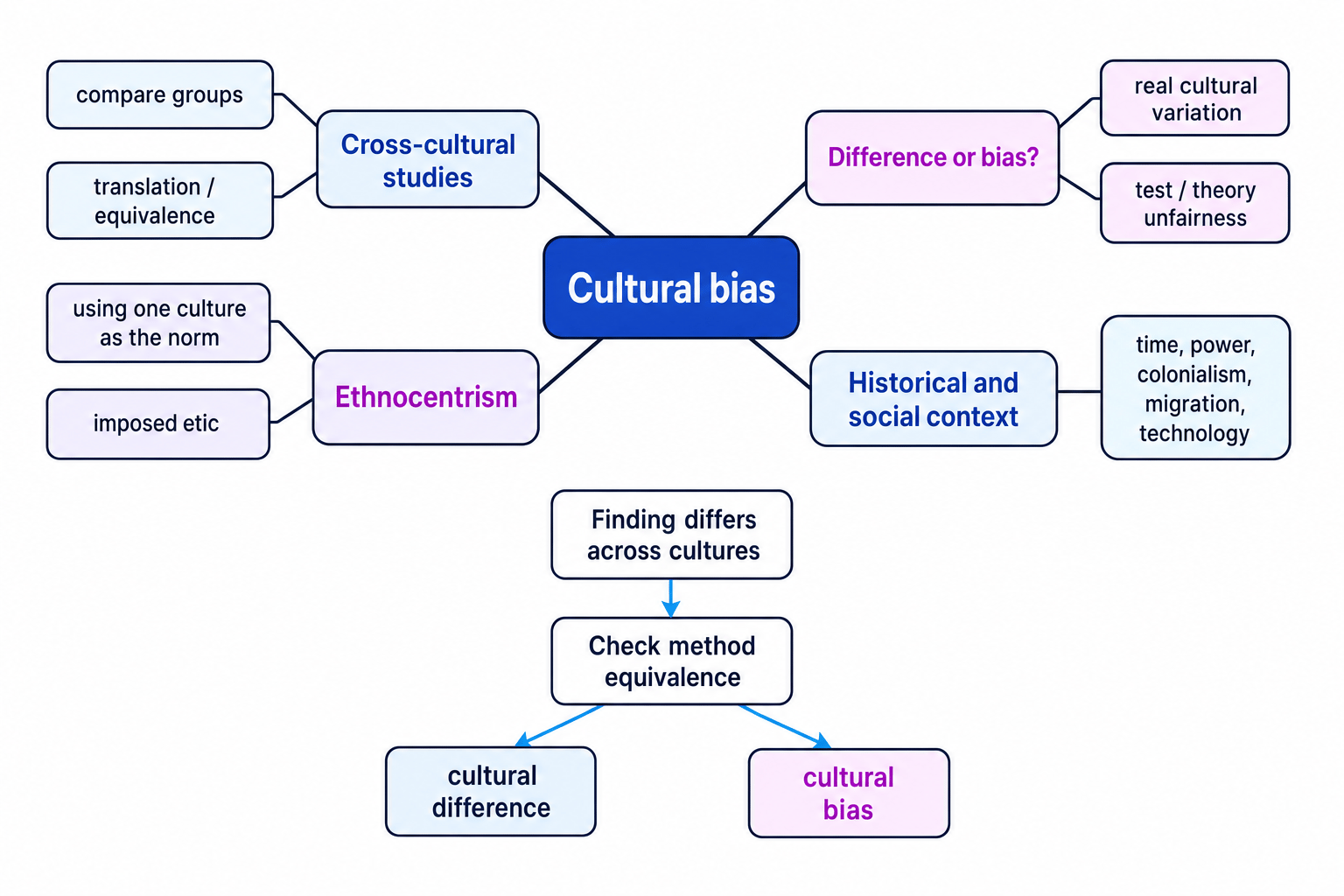
Cultural bias occurs when psychological theories, methods, tests or interpretations unfairly reflect the values, assumptions or norms of one culture, making other cultures appear abnormal, inferior or incorrectly measured.
A culture includes shared values, beliefs, norms, practices, language and ways of living. Culture is not just nationality: age, religion, social class, ethnicity, migration history and local community can all shape experience.
The big issue
The question is not simply “do cultures differ?” The deeper question is whether psychology is measuring and interpreting those differences fairly.
Universal findings and culture-specific findings
A universal finding is one that appears to apply across cultures. A culture-specific finding is limited to particular cultural settings.
For example, if attachment security is found in many countries, that may suggest a universal aspect of child development. But if a particular attachment test classifies children from one culture as “insecure” because they behave differently during separation, the test itself may be culturally biased.
The WEIRD problem
Henrich, Heine and Norenzayan (2010) argued that psychology relies too heavily on WEIRD samples: Western, Educated, Industrialised, Rich and Democratic. These participants are not “the default human mind”; they are a specific social group.
This matters for Eduqas essays because it links directly to generalisability: the extent to which findings from a sample can be applied to wider populations.
Cross-cultural studies
Cross-cultural study
A cross-cultural study compares behaviour, cognition or emotion across two or more cultural groups, usually to test whether a finding is universal or culture-specific.
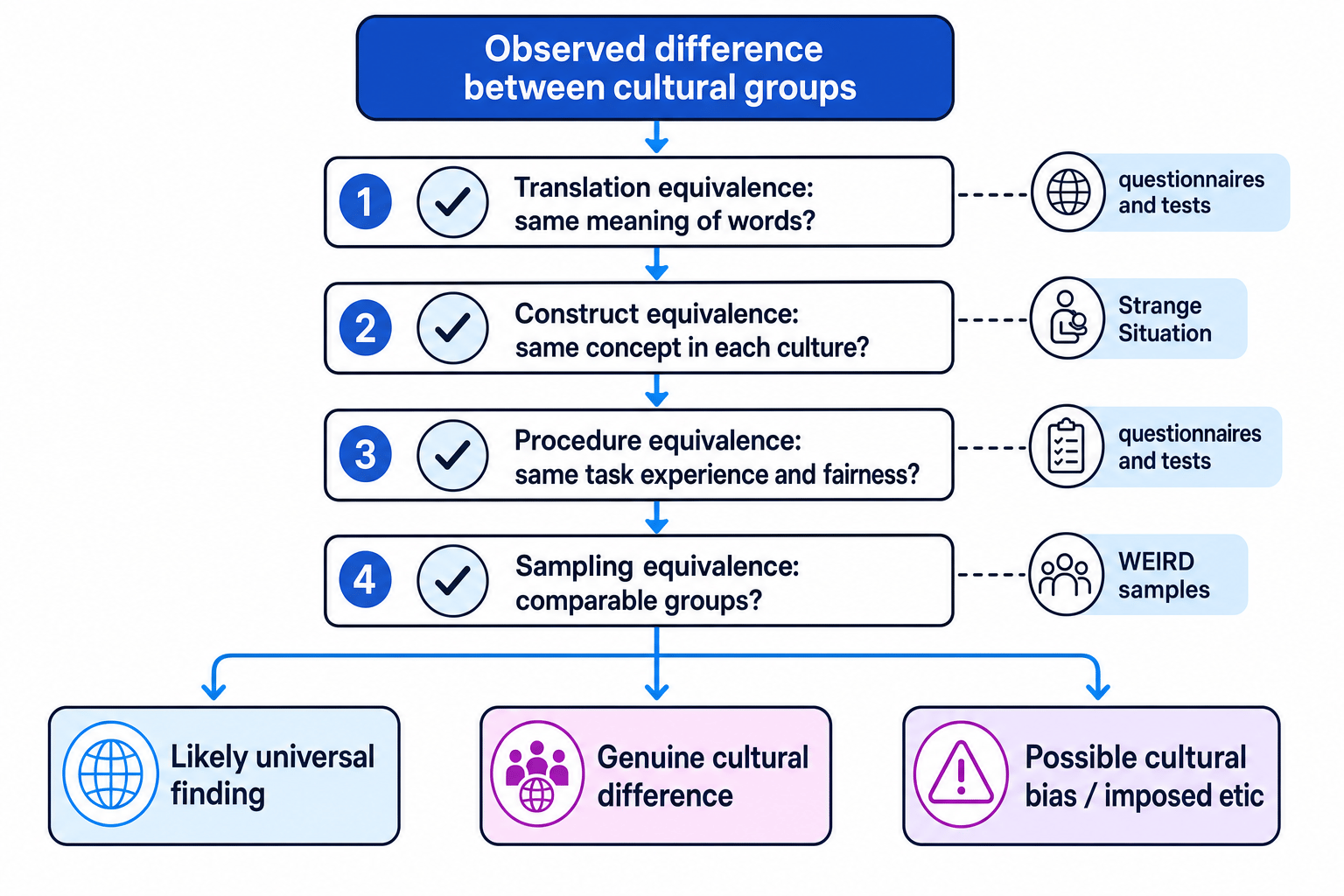
A good cross-cultural study does more than collect data in different countries. It must check whether the method has the same meaning in each culture.
Important checks include:
- Translation equivalence: do translated words carry the same meaning?
- Construct equivalence: does the concept being measured exist in the same way across cultures?
- Procedure equivalence: is the task equally familiar and fair?
- Sampling equivalence: are the groups comparable in age, education, social class and other relevant features?
A classic example is Berry (1967), who studied conformity among the Temne of Sierra Leone, the Inuit of Canada and Scottish participants. He found higher conformity among the Temne and lower conformity among the Inuit, linking this to different subsistence practices. This supports the idea that culture can shape social behaviour, but interpretation must be careful: differences may reflect ecology, education, task familiarity or researcher assumptions.
Another important example is van IJzendoorn and Kroonenberg’s (1988) meta-analysis of attachment across countries. They found secure attachment was the most common classification across cultures, but variation within countries was often greater than variation between countries. This warns you not to stereotype whole cultures.
Use the equivalence check
When evaluating cross-cultural research, ask: same words, same concept, same task, same type of sample? If not, the study may be measuring cultural bias rather than cultural difference.
Difference or bias?
Cultural difference
A cultural difference is a genuine variation in behaviour, beliefs or psychological processes between cultural groups.
A difference is not automatically a bias. For example, cultures may genuinely vary in attitudes to independence, family obligation or emotional expression.
Bias happens when the researcher’s method or interpretation makes one cultural pattern seem “normal” and another seem “deficient”.
Example: attachment research
Ainsworth’s Strange Situation, developed from work by Ainsworth and Bell (1970) and Ainsworth et al. (1978), involves observing infant behaviour during separations and reunions with a caregiver. Cross-cultural findings raised questions about bias.
Takahashi (1990) found Japanese infants were more likely to be classified as resistant. One interpretation is that this shows more insecure attachment. But another is that Japanese infants at the time were less used to being separated from their mothers, so the separation episode may have been unusually stressful.
Deciding whether a finding shows difference or bias
-
Identify the observed difference. Japanese infants in Takahashi’s study were more likely to show intense distress and be classified as resistant compared with some Western samples.
-
Check procedure equivalence. If brief separation is uncommon in one culture, the Strange Situation may not create the same psychological experience for all infants.
-
Check construct equivalence. “Secure attachment” may not look identical across cultures if caregiving values differ, such as greater emphasis on closeness or independence.
-
Reach a balanced conclusion. The finding may reflect real cultural differences in caregiving, but it may also show cultural bias if a Western procedure is treated as the universal standard.
Calling every difference a bias
Do not write that any cross-cultural difference proves bias. First consider whether the method was fair and whether the interpretation pathologised one culture.
Ethnocentrism
Ethnocentrism
Ethnocentrism is judging other cultures by the standards and values of your own culture, often treating your own culture as normal, superior or universal.
In psychology, ethnocentrism can appear when a theory developed in one culture is applied everywhere without checking whether it fits.
Two useful terms are:
- Emic approach: studying behaviour from within one culture, using meanings that make sense to that culture.
- Etic approach: studying behaviour across cultures to find possible universal principles.
- Imposed etic: applying a concept or test from one culture to another as if it is universal, when it may not be.
Ethnocentrism can create both alpha bias and beta bias. Alpha bias exaggerates cultural differences, which can lead to stereotyping. Beta bias minimises or ignores cultural differences, which can make one culture’s norms appear universal.
For example, a Western theory that values independence may label interdependence as immaturity, when in another culture strong family obligation may be valued and adaptive.
Historical and social context
Psychological research is produced in particular times and societies. Ideas about intelligence, mental illness, gender roles and “normal” development have all been shaped by historical power relations.
A clear example is early intelligence testing. Yerkes and colleagues’ Army Alpha and Beta tests during the First World War were used with large numbers of recruits and immigrants. Poor performance by some groups was sometimes interpreted as evidence of lower innate intelligence, despite major confounds such as language, education, literacy, poverty, unfamiliarity with test formats and discrimination. This shows how cultural bias can have serious social consequences.
Historical context also changes. Research carried out before social media, mass migration or changing family structures may not apply neatly to contemporary populations. So, when evaluating older studies, consider whether the social world has changed.
Ethics in culturally sensitive research
Cross-cultural research must follow the BPS Code of Ethics and Conduct. This includes informed consent, avoiding harmful deception, the right to withdraw, protection from harm, confidentiality and debriefing.
In cultural research, these principles need extra care. Consent forms must be understandable in the participant’s language. Researchers should not use community leaders as a substitute for individual consent. They should avoid exploiting communities, misrepresenting findings, or publishing results that increase stigma.
Ethics and interpretation
Cultural bias is not just a methodological problem. It can cause real harm if research labels groups as inferior, abnormal or deficient.
Methods and statistics in cross-cultural research
Cross-cultural studies often use the same research methods you met in Component 2: questionnaires, interviews, observations, experiments and correlations.
The choice of statistical test depends on the design and level of measurement:
- Nominal data means categories, such as attachment type or diagnosis.
- Ordinal data means ranked data or rating scales where intervals are not equal.
- Interval data means numerical scores with equal intervals, such as many standardised test scores.
Choosing a test for a cross-cultural comparison
-
Identify the design. If UK and Japanese participants are different people, the design is independent groups.
-
Identify the level of measurement. If the researcher compares total anxiety questionnaire scores and treats them as interval data, an unrelated t-test may be suitable if parametric assumptions are met.
-
Choose a non-parametric alternative if needed. If the data are ordinal or not suitable for a t-test, Mann-Whitney U would be more appropriate for two independent groups.
-
Use the significance rule carefully. Researchers usually use p≤0.05p \leq 0.05p≤0.05, compare observed and critical values from a table, and decide whether the hypothesis is one-tailed or two-tailed before analysing the data.
For other designs: Wilcoxon signed-ranks or a related t-test may be used for repeated measures or matched pairs; chi-square is used for nominal categories; Spearman’s rho is used for correlations. A Type I error means falsely claiming a significant cultural difference. A Type II error means missing a real cultural difference.
AO3 evaluation points
Strengths of considering cultural bias
Studying cultural bias improves psychology’s validity. It challenges researchers to test whether theories genuinely apply beyond one sample. It also has useful real-world applications in clinical diagnosis, therapy, education and workplace testing.
For example, culturally sensitive therapy may adapt language, examples and family involvement while still using evidence-based principles. In diagnosis, clinicians should consider cultural norms before labelling behaviour as disordered.
Weaknesses and difficulties
Cross-cultural research can accidentally create stereotypes by treating cultures as fixed and uniform. “Japanese culture” or “British culture” contains huge variation by region, class, generation, ethnicity and individual experience.
There are also methodological problems. Translation may not capture meaning. Participants may differ in response style, such as tendency to choose extreme ratings or agree with statements. Researchers may also interpret findings through their own cultural assumptions.
Contradictory evidence is important. Takano and Osaka (1999) argued that the common claim that the USA is individualistic and Japan is collectivist was often overstated and not consistently supported. This is useful AO3 because it challenges simplistic cultural categories.
How to write about cultural bias in essays
A strong Eduqas answer should include:
- AO1: define cultural bias, ethnocentrism and cross-cultural studies.
- AO2: apply the ideas to a named example, such as attachment, intelligence testing, conformity or diagnosis.
- AO3: evaluate using validity, generalisability, ethics, methodological equivalence and real-world consequences.
In the exam
-
Separate difference from bias. Say whether the evidence shows real cultural variation, an unfair method, or both.
-
Use named research. Berry (1967), van IJzendoorn and Kroonenberg (1988), Takahashi (1990), Henrich et al. (2010) and Takano and Osaka (1999) are useful examples.
-
Evaluate with methods and ethics. Mention sample bias, translation, construct equivalence, imposed etics, BPS principles and the risk of social harm.
Check yourself
- What is the difference between a cultural difference and cultural bias?
- How can ethnocentrism lead to an imposed etic?
- Why might the Strange Situation be culturally biased when used outside the culture where it was developed?