What you'll learn
- How biological explanations link stress to adrenaline, evolution and genetic vulnerability.
- How individual differences such as hardiness, self-efficacy and Type A/Type B personality affect stress.
- How social psychological explanations use daily hassles, life events and locus of control.
- How to turn explanations into AO1 description, AO2 application and AO3 evaluation.
Starting point: what is stress?
Stress is not just “having lots to do”. In psychology, stress involves both the event and the person’s response to it. Two people can face the same deadline but experience very different levels of stress.
Stress, stressor and appraisal
- Stress is a psychophysiological state: it involves both psychological experience and physical bodily arousal.
- A stressor is any demand, threat or challenge that may produce stress.
- Appraisal means judging whether a situation is threatening and whether you have enough resources to cope.
Core idea
Stress is best understood as an interaction between the situation, the body’s response and the person’s interpretation of their ability to cope.
Biological explanations
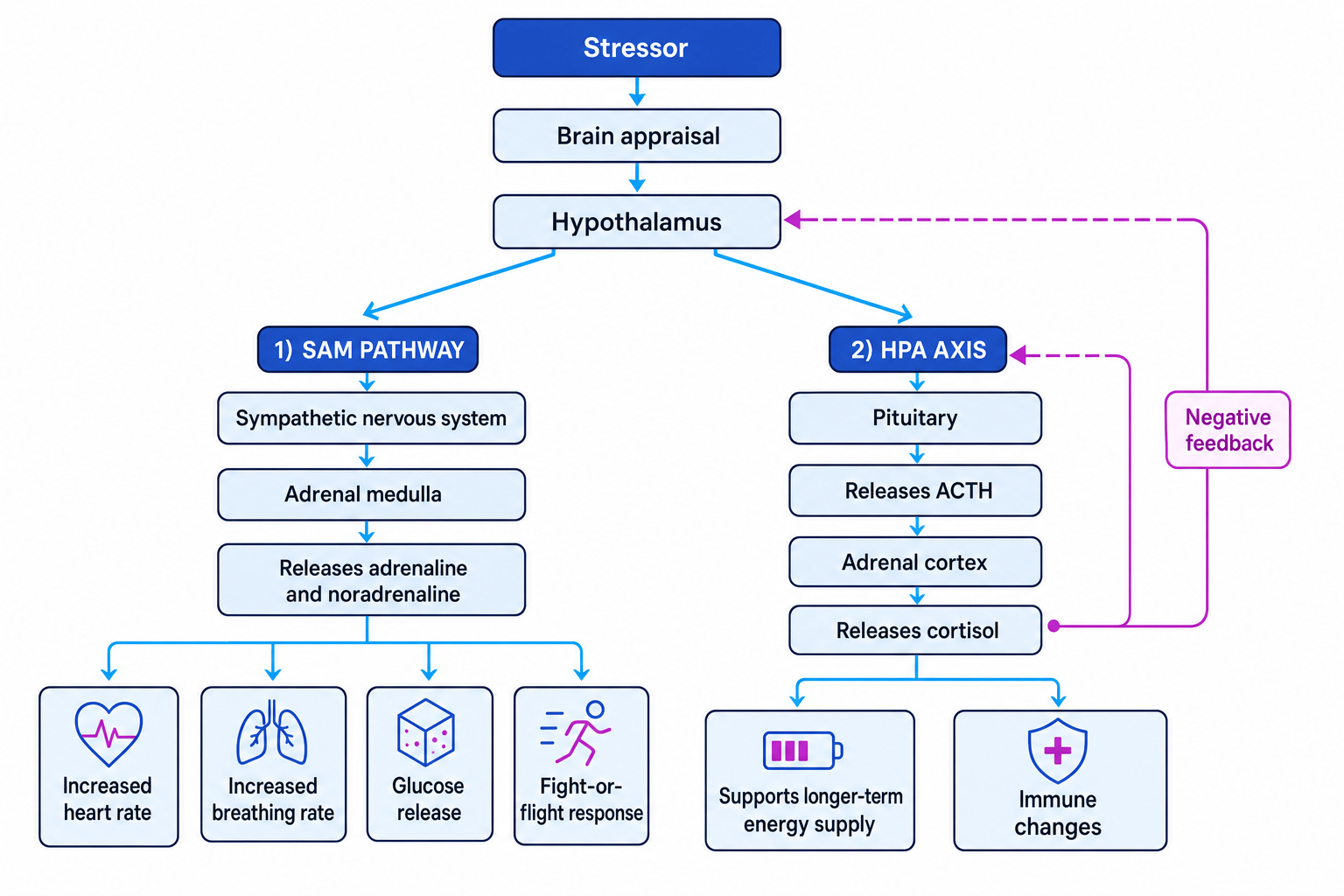
Biological explanations argue that stress is caused or intensified by processes in the body. Before looking at the named explanations, it helps to understand two stress-response systems: the sympathomedullary pathway, or SAM pathway, which is the fast nerve-and-adrenaline route, and the hypothalamic-pituitary-adrenal axis, or HPA axis, which is the slower hormone route involving the hypothalamus, pituitary gland and adrenal cortex. ACTH is adrenocorticotropic hormone, released by the pituitary gland to trigger cortisol release.
Adrenaline and the fight-or-flight response
Adrenaline is a hormone released by the adrenal medulla during acute stress. It prepares the body for fight-or-flight, meaning immediate action against a threat or escape from it. Heart rate increases, breathing becomes faster and glucose is released for energy.
This explanation is linked to Cannon (1932), who described the fight-or-flight response. Selye (1956) later proposed the General Adaptation Syndrome, a biological model of long-term stress with three stages: alarm, resistance and exhaustion.
AO3 evaluation: this explanation is scientific because it uses measurable physiological responses such as heart rate, hormone levels and immune changes. However, it can be reductionist, because it may explain stress as mainly bodily arousal and underplay social meaning, coping skills and personality.
Evolutionary adaptation
An evolutionary adaptation is a characteristic that helped ancestors survive and reproduce. From this view, stress responses evolved because rapid arousal was useful when facing predators, enemies or physical danger.
The strength of this explanation is that it explains why stress responses are so quick and automatic. The weakness is that many modern stressors, such as exams, traffic or money worries, cannot be solved by fighting or running away. This creates a “mismatch” between an ancient response and modern life.
Taylor et al. (2000) also argued that some stress responses may involve tend-and-befriend, where people protect others and seek social support. This challenges a simple fight-or-flight account.
Stress genes
A gene is a section of DNA that influences a characteristic. A stress-gene explanation argues that inherited biological differences can make some people more reactive to stressors than others.
Gene-environment interaction
A gene-environment interaction means that genetic vulnerability only increases risk under certain environmental conditions, such as high levels of life stress.
Caspi et al. (2003) found that people with a short version of the 5-HTT serotonin transporter gene were more likely to develop depression after stressful life events. This is relevant because it suggests genes may affect sensitivity to stress. However, later evidence has been mixed, so you should avoid claiming that there is a single “stress gene”.
Genes are not destiny
Do not write that genes directly “cause stress”. A stronger answer says genes may influence stress reactivity, especially when combined with stressful environments.
Identifying biological processes in a scenario
A student feels their heart racing before a presentation, then feels exhausted and ill after weeks of constant deadlines.
- The racing heart before the presentation fits the SAM pathway, because it is a fast response to an immediate threat.
- The release of adrenaline explains the short-term physical changes: faster heart rate, quicker breathing and increased energy availability.
- The weeks of deadlines suggest chronic stress, so the HPA axis and cortisol are more relevant than adrenaline alone.
- If the student becomes run-down, you could link this to prolonged biological arousal and immune changes, while avoiding the claim that stress automatically causes illness.
Individual differences explanations
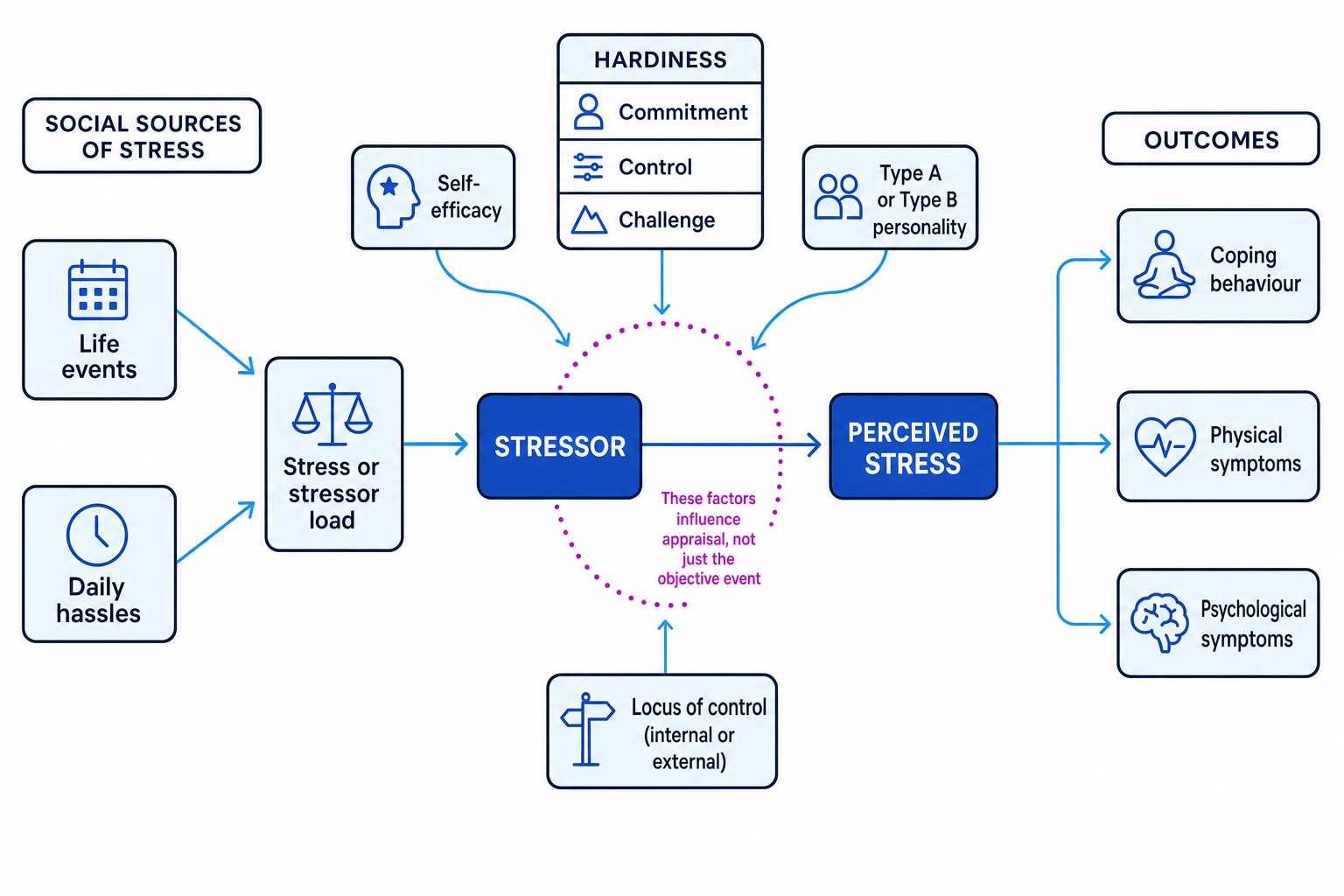
Individual differences are stable ways in which people vary. In stress, the important idea is that people differ in how they interpret pressure and how effectively they cope with it. The model below previews hardiness, a resilient style based on commitment, control and challenge; self-efficacy, belief in your ability to manage a task; Type A/Type B personality, competitive time-urgent behaviour versus a more relaxed pattern; locus of control, belief that outcomes are controlled internally by your actions or externally by chance or others; life events, major changes requiring adjustment; and daily hassles, repeated minor irritations.
Hardiness
Hardiness is a personality style that protects against stress. Kobasa (1979) described three parts:
- Commitment: staying involved rather than withdrawing.
- Control: believing you can influence events.
- Challenge: seeing change as an opportunity rather than only as a threat.
Kobasa studied high-stress business executives and found that those high in hardiness reported fewer stress-related illnesses. AO3: this supports hardiness as a buffer, but the evidence is correlational, so hardiness may be linked with better health rather than directly causing it.
Self-efficacy
Self-efficacy, developed by Bandura (1977, 1997), means belief in your ability to succeed in a specific situation. A student with high self-efficacy may see revision as difficult but manageable. A student with low self-efficacy may see the same revision as overwhelming.
This explanation is useful because it links directly to coping behaviour. High self-efficacy can encourage problem-focused coping, such as planning, practising and asking for help.
Type A and Type B personalities
Friedman and Rosenman (1959) described Type A personality as competitive, time-urgent, impatient and sometimes hostile. Type B personality is calmer, less time-pressured and less competitive.
Early research linked Type A behaviour to coronary heart disease, but later work suggested that hostility may be the most harmful part of Type A. AO3: this makes the explanation more precise, but it also weakens the original broad Type A/Type B distinction.
Evaluation shortcut
For individual differences explanations, evaluate measurement. Ask: was personality measured by interview, questionnaire or observation, and could social desirability affect the results?
Applying individual differences to coping
Two students have the same workload. Aisha makes a plan and says, “This is hard, but I can improve.” Ben says, “There’s no point trying; I always fail.”
- Aisha shows higher self-efficacy, because she believes effort can improve performance.
- Aisha also shows hardiness through challenge, because she interprets the workload as something to tackle rather than only as a threat.
- Ben’s response suggests low self-efficacy, so the same workload is likely to be appraised as more stressful.
- If Ben is also highly impatient and hostile under pressure, Type A characteristics could add to his stress response.
Social psychological explanations
Social psychological explanations focus on the person’s social world: events, relationships, responsibilities and beliefs about control.
Life events
Life events are major changes that require adjustment, such as bereavement, divorce, moving house or starting university. Holmes and Rahe (1967) created the Social Readjustment Rating Scale, which gives life events scores according to how much adjustment they usually require.
A strength is that this made stress easier to measure and compare. A weakness is that the same event can mean different things to different people. For example, moving house may be exciting for one person and frightening for another.
Daily hassles
Daily hassles are small but repeated irritations, such as missing a bus, noise, arguments, lost items or constant notifications. Kanner et al. (1981) found that daily hassles could predict stress symptoms better than major life events.
This explanation is strong because it matches everyday experience: stress often builds through accumulation. However, it relies heavily on self-report, so memory bias and mood at the time of completing a questionnaire may affect results.
Life events and daily hassles
Do not treat daily hassles as simply “less serious life events”. Life events are major changes; daily hassles are repeated minor pressures that can accumulate over time.
Locus of control
Locus of control, proposed by Rotter (1966), refers to where a person believes control over outcomes lies. An internal locus of control means believing your actions influence outcomes. An external locus of control means believing outcomes depend mainly on luck, fate or powerful others.
Internal control can reduce stress when action is possible, because the person feels able to cope. However, it is not always better. If a situation is genuinely uncontrollable, a strong internal locus may increase guilt or frustration.
Separating social explanations in a scenario
Jamie has recently moved house, argues with siblings every morning, and says, “Teachers decide everything anyway.”
- Moving house is a life event, because it is a major change requiring adjustment.
- Morning arguments are daily hassles, because they are repeated minor irritations that can accumulate.
- Jamie’s comment suggests an external locus of control, because they see outcomes as controlled by others.
- A strong answer would explain that these factors combine: social stressor load increases, while perceived control decreases.
Research methods and ethics links
Stress research often uses self-report scales, interviews, physiological measures such as cortisol, or longitudinal designs that follow people over time. A correlation can show a relationship between stress scores and illness scores, but it cannot prove that stress caused illness. In a practical investigation, a relationship between daily hassles and perceived stress might be analysed using Spearman’s rho if the data are ordinal or ranked.
Ethically, stress research must follow the BPS Code of Ethics and Conduct: informed consent, right to withdraw, protection from harm, confidentiality and debriefing are especially important because stress can be sensitive. If deception is used, it must be justified and followed by a full debrief.
Selye’s early work used animals, so animal ethics matter too. Researchers should apply the 3Rs: replacement of animals where possible, reduction in the number used and refinement to minimise suffering.
Building an essay answer
For Eduqas essays, think in AO1, AO2 and AO3.
- AO1: accurately describe the explanation, using named terms and researchers.
- AO2: apply it to a scenario, such as exams, work pressure or caring responsibilities.
- AO3: evaluate evidence, methods, ethics, determinism, reductionism and real-world applications.
A strong answer usually takes an interactionist view: stress is not explained by biology, personality or social context alone. Stress is more convincing when you show how biological vulnerability, coping style and social stressors work together.
In the exam
- Start each paragraph with the explanation clearly named, such as “One biological explanation is adrenaline and the SAM pathway.”
- Use one named researcher or study per explanation where possible, then evaluate the method or evidence rather than just describing it.
- For AO3, avoid one-sided conclusions: say when the explanation works well and when another explanation gives a better account.
Check yourself
- How is adrenaline useful for short-term stress, but less helpful for explaining chronic modern stress?
- What are the three parts of hardiness, and how might each reduce perceived stress?
- How would you distinguish a life event from a daily hassle in a scenario?
