What you'll learn
- How the positive approach understands therapy: building wellbeing, not just reducing symptoms.
- What mindfulness involves and how it can help with stress, rumination and relapse prevention.
- What quality of life therapy involves and how it improves life satisfaction.
- How to evaluate these therapies for AO3, including research evidence, methodology, ethics and application.
The starting point: what makes therapy “positive”?
The positive approach is part of positive psychology, which studies human strengths, happiness, wellbeing and optimal functioning. Instead of only asking “what is wrong with the person?”, it also asks “what helps this person live well?”
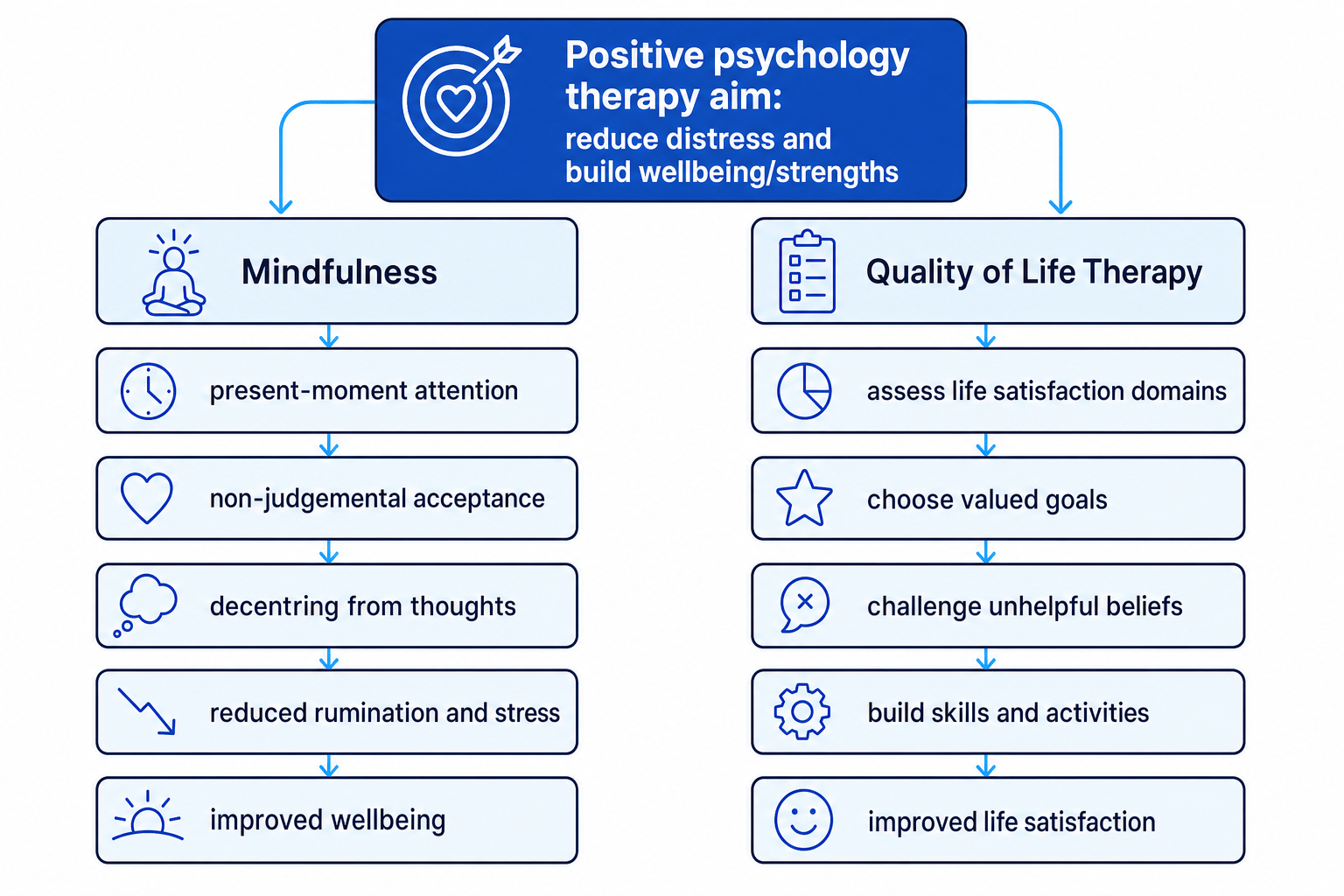
Traditional therapies often focus mainly on reducing symptoms such as anxiety, low mood or compulsions. Positive therapies still care about distress, but they also aim to increase wellbeing, meaning, strengths, resilience and life satisfaction.
Positive psychology
Positive psychology is the scientific study of positive emotions, strengths, wellbeing and the conditions that help people flourish.
A useful distinction is:
- Hedonic wellbeing: feeling pleasure, happiness and life satisfaction.
- Eudaimonic wellbeing: feeling that life has meaning, purpose, growth and authenticity.
Positive therapy aim
Positive therapies are not simply about “being cheerful”. They aim to help people relate differently to their thoughts, build strengths and improve their quality of life in realistic ways.
Positive approach evidence is often linked to Seligman et al. (2005), who tested positive psychology exercises such as “three good things”, and Fredrickson et al. (2008), who found that loving-kindness meditation increased positive emotions and personal resources over time. These studies support the idea that wellbeing can be deliberately developed, although the evidence also needs careful AO3 evaluation.
The two therapy options on the Eduqas spec
For the Positive approach therapy section, centres usually teach one of the following:
- Mindfulness
- Quality of life therapy
You should learn the one your teacher has selected in most depth. However, understanding both helps you see the wider positive approach.
Mindfulness
Mindfulness
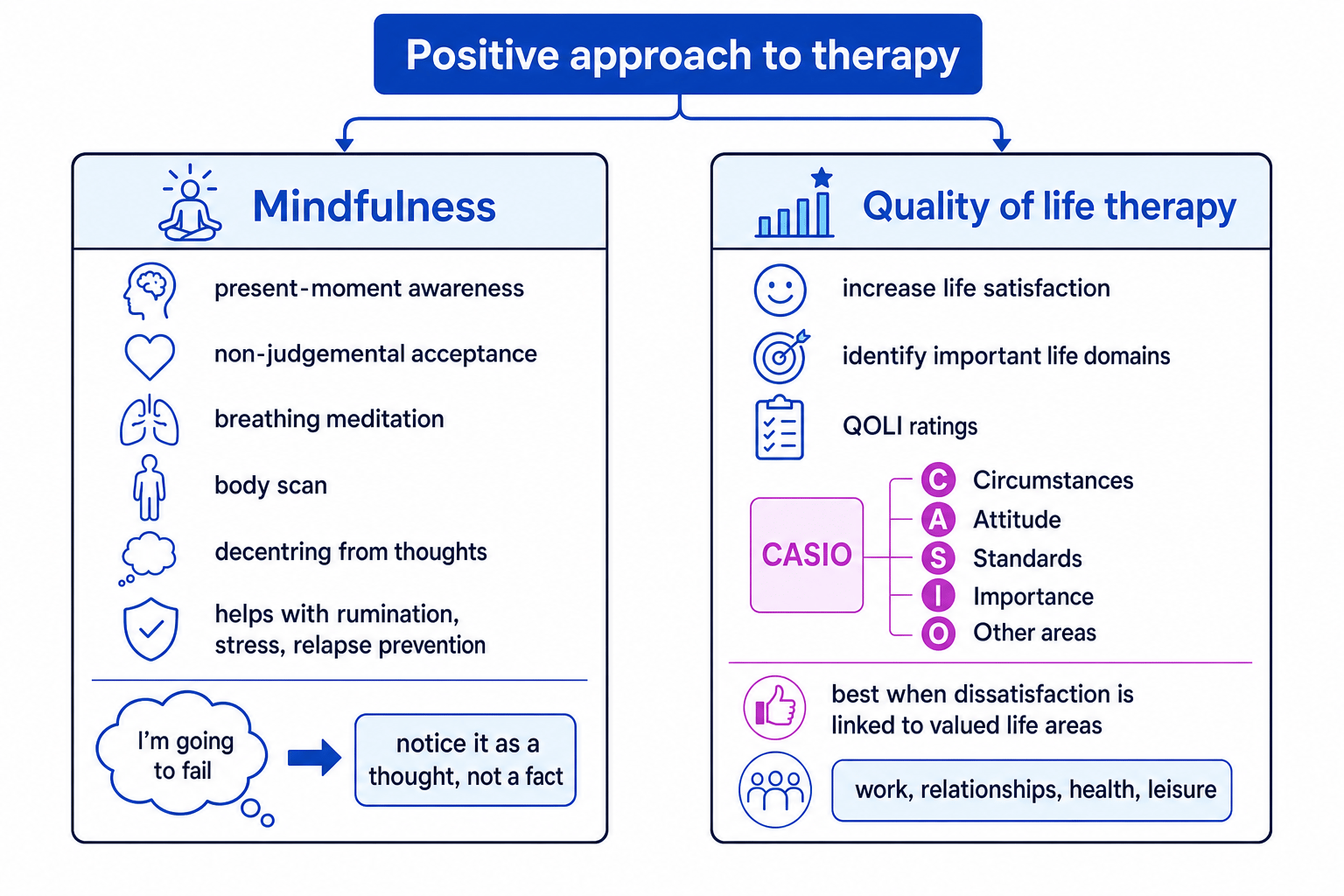
Mindfulness means paying attention to the present moment, deliberately and non-judgementally, rather than being pulled into worries, memories or self-criticism.
Mindfulness is strongly associated with Jon Kabat-Zinn, who developed Mindfulness-Based Stress Reduction. It is also used in Mindfulness-Based Cognitive Therapy or MBCT, developed by Segal, Williams and Teasdale, especially to reduce relapse in depression.
The key idea is not to remove thoughts. Instead, the person learns to notice thoughts, feelings and bodily sensations without automatically reacting to them.
For example, a client might notice the thought “I’m going to fail” and learn to see it as a mental event, not as a fact.
How mindfulness works
Mindfulness usually involves repeated practice. Common techniques include:
- Breathing meditation: focusing attention on the breath and gently returning attention when the mind wanders.
- Body scan: noticing sensations across the body without trying to change them.
- Mindful movement: slow movement while noticing bodily sensations.
- Mindful daily activities: bringing attention to ordinary tasks such as eating or walking.
A key mechanism is decentring.
Decentring
Decentring is the ability to step back from thoughts and feelings, viewing them as temporary mental events rather than absolute truths.
This is especially useful for rumination, which means repeatedly going over negative thoughts. Rumination can maintain depression and anxiety because the person becomes trapped in cycles of self-criticism.
Applying mindfulness to rumination
A student keeps thinking, “I always mess things up,” after receiving a low test mark.
- The therapist identifies that the problem is not just the test mark, but the student’s repeated rumination about being a failure.
- Mindfulness practice would encourage the student to notice the thought “I always mess things up” as a thought, rather than treating it as a fact.
- The student might use breathing meditation to return attention to the present moment when the thought appears.
- Over time, this may reduce the emotional power of the thought, making it easier to respond calmly, revise effectively and maintain wellbeing.
AO1 summary of mindfulness
For AO1, you need to describe the therapy clearly:
- Mindfulness trains present-moment awareness.
- It involves non-judgemental acceptance of thoughts, feelings and sensations.
- It uses practices such as breathing meditation, body scans and mindful movement.
- It aims to reduce rumination and automatic negative reactions.
- It fits the positive approach because it can increase wellbeing, self-awareness and emotional regulation.
Mindfulness is not emptying the mind
Do not write that mindfulness means “having no thoughts”. The aim is to notice thoughts without judgement and return attention to the present.
Quality of life therapy
Quality of life therapy
Quality of life therapy is a positive psychology therapy, associated with Michael Frisch, that aims to increase life satisfaction by improving important areas of a person’s life.
Quality of life therapy is more structured and goal-focused than mindfulness. It asks: which parts of life matter most to this person, and how satisfied are they with those areas?
It often uses the Quality of Life Inventory, or QOLI, where clients rate life domains such as:
- health
- self-esteem
- work
- relationships
- money
- home
- learning
- creativity
- community
- leisure
The therapist looks for areas that are both important and low in satisfaction. These become priorities for change.
The CASIO model
Quality of life therapy often uses the CASIO model. This gives five possible routes for improving life satisfaction:
- C — Circumstances: changing the actual situation.
- A — Attitude: changing how the person thinks about the situation.
- S — Standards: changing unrealistic expectations or goals.
- I — Importance: reconsidering how much weight the person gives to that area.
- O — Other areas: improving other life domains to create balance.
Life satisfaction
Life satisfaction is a person’s overall judgement of how satisfied they are with their life, including important domains such as relationships, work, health and personal goals.
Using CASIO in quality of life therapy
A client rates work as very important but has very low satisfaction because they feel they are “failing” unless they get promoted quickly.
- The therapist identifies work as a priority because it is high in importance and low in satisfaction.
- Using C, the client might improve circumstances by asking for clearer feedback or seeking training.
- Using A, the therapist might challenge the belief “I am failing if I am not promoted immediately.”
- Using S, the client might set a more realistic standard, such as developing specific skills over six months.
- Using O, the client might also build satisfaction in friendships or leisure so that work does not dominate their whole self-worth.
AO1 summary of quality of life therapy
For AO1, you could say:
- Quality of life therapy aims to improve subjective wellbeing and life satisfaction.
- It assesses satisfaction across important life domains.
- It identifies areas where the client feels dissatisfied, especially if those areas are highly important.
- It uses goal-setting, problem-solving, cognitive restructuring and activity planning.
- It fits the positive approach because it focuses on flourishing, strengths and meaningful improvement.
Remember CASIO
Think: Change Circumstances, Adjust Attitudes, Set realistic Standards, reconsider Importance, strengthen Other areas.
Comparing mindfulness and quality of life therapy
| Feature | Mindfulness | Quality of life therapy |
|---|---|---|
| Main focus | Present-moment awareness and acceptance | Increasing satisfaction in valued life areas |
| Key skill | Decentring from thoughts | Setting goals and improving life domains |
| Common techniques | Breathing meditation, body scan, mindful activities | QOLI assessment, CASIO model, problem-solving |
| Best suited for | Rumination, stress, relapse prevention | Low life satisfaction, unclear goals, imbalance |
| Positive approach link | Builds awareness, acceptance and emotional regulation | Builds wellbeing, purpose and life satisfaction |
AO2: applying therapy to scenarios
In an exam scenario, look at what the person’s difficulty seems to involve.
If the person is overwhelmed by anxious thoughts, stuck in rumination or reacting automatically to feelings, mindfulness may be the stronger application.
If the person feels dissatisfied with life, lacks balance, or has problems in important life domains, quality of life therapy may be the stronger application.
Choosing the most suitable positive therapy
A client says, “My job is okay, but I can’t stop worrying about what might go wrong. Even when I’m with friends, my mind is somewhere else.”
- The central difficulty is repeated worry and lack of present-moment attention, rather than a clear problem in one life domain.
- Mindfulness fits because it teaches the client to notice anxious thoughts without automatically following them.
- Breathing meditation and mindful daily activities could help the client return attention to the present when worry appears.
- Quality of life therapy could still help later, but mindfulness is the better first link to this scenario.
AO3 evaluation of mindfulness
Strengths
Mindfulness has strong real-world application. It is used in schools, workplaces, prisons and clinical services. MBCT is especially associated with preventing relapse in depression, particularly for people with repeated episodes.
It is also empowering because clients learn skills they can practise independently. This supports the positive approach’s emphasis on self-development and resilience.
There is research support. For example, Fredrickson et al. (2008) found that loving-kindness meditation increased positive emotions, which then helped build personal resources such as social support and purpose. This supports the positive psychology idea that positive states can have long-term benefits.
Weaknesses
Mindfulness is not suitable for everyone as a stand-alone treatment. Some people may find silent attention to thoughts or bodily sensations distressing, especially if they have trauma histories or severe mental health difficulties.
Methodologically, mindfulness research can rely heavily on self-report questionnaires. This may reduce objectivity because participants might report improvement due to demand characteristics, expectancy effects or wanting to please the therapist.
There can also be high attrition because mindfulness requires regular practice. If many participants drop out, the final sample may only include people who already found mindfulness acceptable.
Mindfulness is not a universal cure
In AO3, avoid claiming mindfulness “works for everyone”. A balanced answer should mention individual differences, severity of symptoms and the need for trained practitioners.
AO3 evaluation of quality of life therapy
Strengths
Quality of life therapy is practical and structured. The QOLI helps identify exactly which life areas need attention, so therapy can be personalised.
It also fits well with the positive approach because it focuses on strengths, meaningful goals and life satisfaction rather than only symptom reduction.
A further strength is that it can be combined with cognitive techniques. For example, a therapist may help a client challenge unrealistic beliefs about success, relationships or self-worth.
Weaknesses
One weakness is cultural bias. Ideas about happiness, independence, work and achievement may reflect Western individualistic values. In some cultures, family duty or community harmony may matter more than personal satisfaction.
Another weakness is that quality of life therapy may underestimate social and economic barriers. A person’s life satisfaction may be affected by poverty, discrimination, illness or unsafe housing. Therapy can help coping and goal-setting, but it cannot remove all external constraints.
It may also have a smaller evidence base than longer-established therapies such as CBT. This does not mean it is ineffective, but AO3 answers should avoid overstating the strength of support.
Blaming the client
Do not imply that low wellbeing is simply caused by “negative thinking”. Positive psychology must still recognise real-life barriers such as inequality, illness and lack of support.
Research methods links for therapy evidence
Therapy effectiveness is often tested using experimental or quasi-experimental designs. For example, researchers might compare a mindfulness group with a control group, or measure life satisfaction before and after quality of life therapy.
The choice of inferential test depends on the design and level of measurement:
- Related t-test: related design with interval data.
- Unrelated t-test: independent groups with interval data.
- Wilcoxon signed-ranks test: related design with ordinal data.
- Mann-Whitney U test: independent groups with ordinal data.
- Spearman’s rho: correlation using ordinal or ranked data.
- Chi-square test: test of association using nominal data.
- Binomial sign test: related design looking at direction of change in nominal data.
Psychology usually uses a significance level of p≤0.05p \le 0.05p≤0.05. Researchers compare the observed value with the critical value from a table, while also considering whether the hypothesis is one-tailed or two-tailed.
Choosing a test for a mindfulness study
A researcher measures participants’ stress ratings before and after an eight-week mindfulness course. Stress is rated on a 1–10 scale.
- The design is related because the same participants are measured before and after the course.
- The data are ordinal because the 1–10 ratings show order, but the gaps between points may not be equal.
- The appropriate inferential test is the Wilcoxon signed-ranks test because the design is related and the data are ordinal.
- If the observed value reaches the critical value at p≤0.05p \le 0.05p≤0.05, the researcher can reject the null hypothesis, while accepting a 5% risk of a Type I error.
Type I and Type II errors
A Type I error is finding a significant effect when there is not really one. A Type II error is failing to find a significant effect when there really is one.
Ethical issues
Any therapy or therapy research should follow the BPS Code of Ethics and Conduct.
Key issues include:
- Consent: clients or participants should understand what the therapy or research involves.
- Right to withdraw: they should be able to stop without pressure.
- Protection from harm: therapy should not expose people to unnecessary distress.
- Confidentiality: personal disclosures must be protected.
- Debrief: participants in research should be told the purpose of the study afterwards.
- Deception: if used in research, it must be justified and minimised.
In group mindfulness sessions, confidentiality is especially important because participants may hear personal information about others.
Essay structure: how to write about positive therapy
For a 10–15 mark essay-style answer, aim for clear AO1 and AO3 balance.
AO1 points
You could describe:
- the positive approach’s aim to build wellbeing
- the chosen therapy’s main assumptions
- key techniques
- how the therapy is supposed to work
- relevant evidence, such as Seligman et al. (2005) or Fredrickson et al. (2008)
AO3 points
You could evaluate using:
- evidence for effectiveness
- practical applications
- methodological issues, such as self-report and control groups
- individual differences
- cultural bias
- ethical issues
- comparison with other therapies, such as CBT or drug therapy
In the exam
- If the question says therapy, keep your answer focused on the therapy’s aims, techniques and how it helps — do not drift into general assumptions only.
- For AO2 scenarios, match the therapy to the person’s problem: rumination suggests mindfulness; low life satisfaction across domains suggests quality of life therapy.
- For AO3, make a balanced judgement: include evidence and usefulness, but also limitations such as self-report, cultural bias, dropout and suitability for severe difficulties.
Check yourself
- How does mindfulness help someone respond differently to negative thoughts?
- What does the CASIO model suggest a therapist can change in quality of life therapy?
- Why might positive therapies be criticised for cultural bias or for overlooking real-life barriers?