What you'll learn
- The three core assumptions of the Positive approach: free will, authentic goodness and excellence, and the good life.
- How Positive psychology differs from approaches that focus mainly on illness, conflict or determinism.
- How to apply these assumptions to scenarios, interventions and research methods.
- How to evaluate the approach for AO3, including ethics, culture and scientific measurement.
The big picture: what is the Positive approach?
An approach is a broad “lens” psychologists use to explain behaviour. An assumption is a starting belief that shapes what the approach looks for and how it explains people.
The Positive approach, often called Positive psychology, focuses on what helps humans flourish: strengths, happiness, meaning, optimism, resilience, relationships and achievement. It developed partly as a reaction against psychology’s older focus on problems such as mental illness, abnormality and distress.
Positive psychology
Positive psychology is the scientific study of positive human experiences, positive individual traits, and the conditions that help individuals and communities function well.
The Positive approach does not say negative experiences are unimportant. Instead, it argues that psychology should study strengths and well-being as seriously as it studies disorders.
Assumption 1: acknowledgement of free will
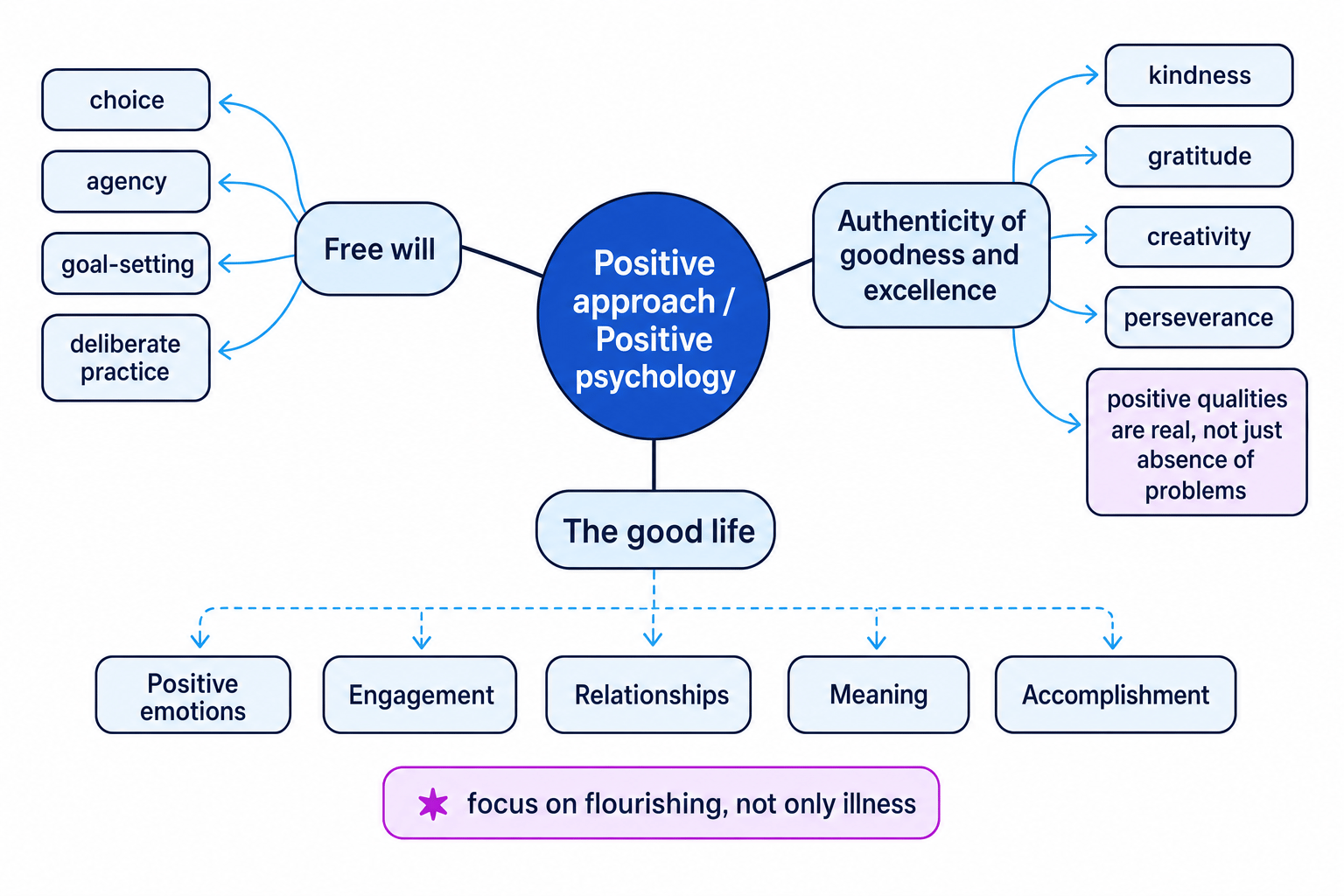
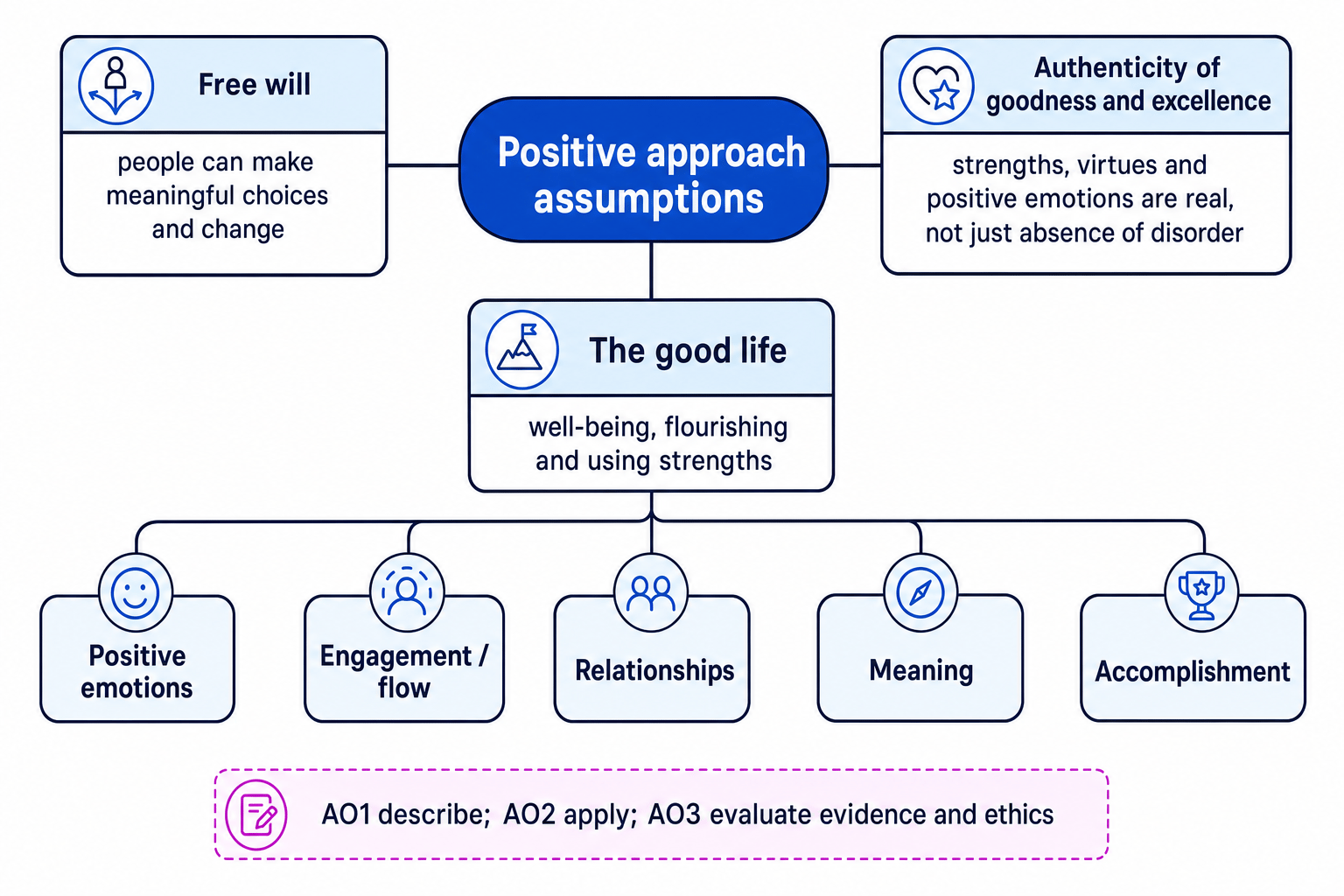
Free will means people can make meaningful choices and are not completely controlled by biology, childhood experiences, reinforcement or unconscious forces.
This contrasts with determinism, the view that behaviour is caused by factors outside a person’s control. For example, a strongly deterministic explanation might say someone is anxious because of genes, brain chemistry or past learning. The Positive approach would not ignore those influences, but it would also ask: What choices, strengths and goals could help this person move forward?
Free will in one sentence
The Positive approach sees people as active agents who can choose goals, build strengths and change aspects of their lives.
This assumption is important for interventions such as gratitude diaries, mindfulness, goal-setting and using “signature strengths”. These all rely on the idea that people can deliberately practise behaviours that improve well-being.
Applying free will to a scenario
A student feels low after poor mock results and decides to make a revision plan, ask for feedback and keep a daily record of three things that went well.
- The student is not being described as passively controlled by the poor result; they are making choices about what to do next.
- The revision plan and feedback-seeking show agency, because the student is selecting actions to influence future outcomes.
- The gratitude record fits the Positive approach because it assumes well-being can be improved through intentional practice, not only through removing distress.
Do not overstate free will
Avoid writing that the Positive approach believes people have total control over their lives. A stronger answer says it acknowledges free will while recognising that biology, environment, poverty, trauma and culture can still constrain choices.
Assumption 2: authenticity of goodness and excellence
The Positive approach assumes that goodness and excellence are real parts of human nature.
Goodness refers to qualities such as kindness, gratitude, compassion, forgiveness and altruism. Excellence refers to valued strengths such as creativity, courage, wisdom, perseverance and social intelligence.
The word authenticity matters here. It means these positive qualities are not treated as fake, accidental, or merely the absence of a problem. For example, being kind is not just “not being aggressive”; creativity is not just “not being disordered”. They are genuine psychological qualities worth studying in their own right.
This links to Peterson and Seligman’s work on character strengths and virtues, where strengths are treated as measurable and developable features of personality.
Identifying authentic strengths
A volunteer helps younger students with reading each week and says it gives them a sense of purpose.
- A purely deficit-focused explanation might only ask whether the volunteer is avoiding guilt, seeking praise or reducing loneliness.
- The Positive approach would also identify genuine strengths, such as kindness, patience and social responsibility.
- It would predict that using these strengths could support well-being because the behaviour involves meaning, connection and personal excellence.
Useful AO1 phrase
For this assumption, use the phrase: “Positive qualities are authentic psychological phenomena, not simply the absence of negative states.”
Assumption 3: focus on “the good life”
The good life means a life involving well-being, fulfilment and flourishing — not just pleasure or the absence of mental illness.
Subjective well-being and flourishing
Subjective well-being means a person’s own evaluation of their happiness and life satisfaction. Flourishing means functioning well and feeling well across important areas of life, such as relationships, purpose and achievement.
Seligman originally described routes to happiness such as the pleasant life pleasure and positive emotion, the engaged life deep involvement in activities, and the meaningful life serving something bigger than the self.
A later model often used to explain the “good life” is PERMA:
- Positive emotions — joy, gratitude, hope and contentment.
- Engagement — being absorbed in an activity, sometimes called flow.
- Relationships — supportive and meaningful social connections.
- Meaning — feeling that life has purpose.
- Accomplishment — achieving valued goals.
Applying the good life
A person joins a community choir, practises regularly, makes friends, performs at a charity event and feels proud of improving.
- The choir gives engagement because regular practice can absorb attention and create flow.
- The friendships show relationships, while the charity performance adds meaning beyond personal enjoyment.
- Improvement and performance show accomplishment, so the Positive approach would describe this as more than “feeling happy”; it is part of flourishing.
Research anchors for essays
For Eduqas essays, link assumptions to named research rather than leaving them as vague ideas.
Jahoda (1958) is a useful classic anchor for positive mental health. Jahoda argued that mental health is not just the absence of disorder; it can include autonomy, personal growth, accurate perception of reality, environmental mastery and positive attitudes to the self. This supports the assumption that goodness and healthy functioning are worth defining directly.
Myers and Diener (1995) reviewed evidence on happiness and argued that demographic factors such as age, gender and income were not the whole story. Close relationships, sense of control and meaningful activity were important. This supports the focus on the good life.
Seligman, Steen, Park and Peterson (2005) tested positive psychology interventions such as “three good things” and using signature strengths in new ways. Some interventions increased happiness and reduced depressive symptoms over follow-up periods, supporting the idea that deliberate choices can improve well-being.
Research methods link: measuring the Positive approach
Positive psychology often uses self-report questionnaires, where participants rate happiness, life satisfaction or strengths. This makes abstract ideas measurable; this is called operationalisation.
In a practical investigation, you might compare happiness scores before and after a gratitude diary. You could summarise results using the mean, median, range or standard deviation, and display them with a bar chart or line graph. If studying a relationship, such as optimism and life satisfaction, a scattergraph would be suitable.
For inferential testing, choose the test from the design and data:
- Mann-Whitney U: difference between two unrelated groups using ordinal data.
- Wilcoxon signed-ranks: difference between two related conditions using ordinal data.
- Unrelated t-test: difference between unrelated groups using interval data.
- Related t-test: difference between related conditions using interval data.
- Spearman’s rho: correlation using ordinal or ranked data.
- Chi-square: association between nominal categories.
- Binomial sign test: change or difference with related nominal data.
Use the usual significance convention of p≤0.05p \le 0.05p≤0.05. A one-tailed test is used for a directional hypothesis; a two-tailed test is used for a non-directional hypothesis.
Choosing a test for a gratitude intervention
A researcher measures the same participants’ happiness scores before and after a one-week gratitude diary using a 1–10 rating scale.
- The design is related because the same participants are measured twice.
- The data are rating scores, so if treated as ordinal, Wilcoxon signed-ranks is suitable; if treated as interval and assumptions are met, a related t-test could be used.
- If the hypothesis predicts that gratitude will increase happiness, the researcher uses a one-tailed test and compares the observed value with the critical value at p≤0.05p \le 0.05p≤0.05.
AO3 evaluation: strengths and weaknesses
A major strength is that the Positive approach has useful real-world applications. It has influenced education, counselling, workplace psychology, coaching and mental health prevention. It is practical because it suggests things people can do, such as building strengths, practising gratitude and improving relationships.
Another strength is that it broadens psychology. Instead of only asking “What causes illness?”, it asks “What helps people live well?” This gives a more balanced view of human behaviour.
However, some concepts are difficult to measure objectively. Happiness, meaning and flourishing are subjective, so research may rely heavily on self-report. Participants may show social desirability bias, giving answers that make them look positive or grateful.
There is also a risk of cultural bias. Ideas such as autonomy, personal achievement and individual choice may reflect Western individualistic values. In some cultures, the “good life” may be defined more through family duty, spirituality or community harmony.
Blaming the individual
Be careful: if free will is overemphasised, the approach can seem to blame people for unhappiness while underplaying poverty, discrimination, trauma or illness.
Ethically, Positive psychology research with humans should follow the BPS Code of Ethics and Conduct: informed consent, right to withdraw, protection from harm, confidentiality and debriefing. Deception should be justified and explained afterwards, especially if a placebo activity is used. Animal research is not usually relevant to this topic; if it were, extra welfare and harm-minimisation requirements would apply.
In the exam
- Start AO1 by naming the assumption clearly: free will, authenticity of goodness and excellence, or the good life.
- For AO2, apply the assumption to the person or behaviour in the scenario, using words like choice, strengths, meaning, relationships and flourishing.
- For AO3, balance usefulness and evidence against measurement problems, cultural bias, ethical issues and the danger of blaming individuals.
Check yourself
- How is free will in the Positive approach different from a deterministic explanation of behaviour?
- Why does “authenticity of goodness and excellence” mean more than simply “not being mentally ill”?
- How could PERMA be applied to explain someone’s well-being in a real-life scenario?