What you'll learn
- What Myers and Diener (1995) meant by “happiness” and subjective well-being.
- The main findings of Who is happy? and how they fit the positive approach.
- How to apply the study to scenarios and practical investigations.
- How to evaluate the research using AO3: method, ethics, culture, usefulness and causality.
Why this study matters
The positive approach in psychology focuses on human strengths, fulfilment, optimism, well-being and “the good life”, rather than only studying disorder or distress.
Myers and Diener’s (1995) article, Who is happy?, is the classic research for the positive approach on the Eduqas specification. It is important because it helped make happiness a serious topic for scientific psychology.
Positive approach
The positive approach is an approach in psychology that studies positive human experiences and qualities, such as happiness, life satisfaction, optimism, resilience, strengths and personal growth.
The key concept: subjective well-being
Before you learn the study, you need one central term: subjective well-being, often shortened to SWB.
“Subjective” means it is based on a person’s own view. So subjective well-being is not simply whether someone looks successful from the outside. It is about how they personally evaluate their life.
Subjective well-being
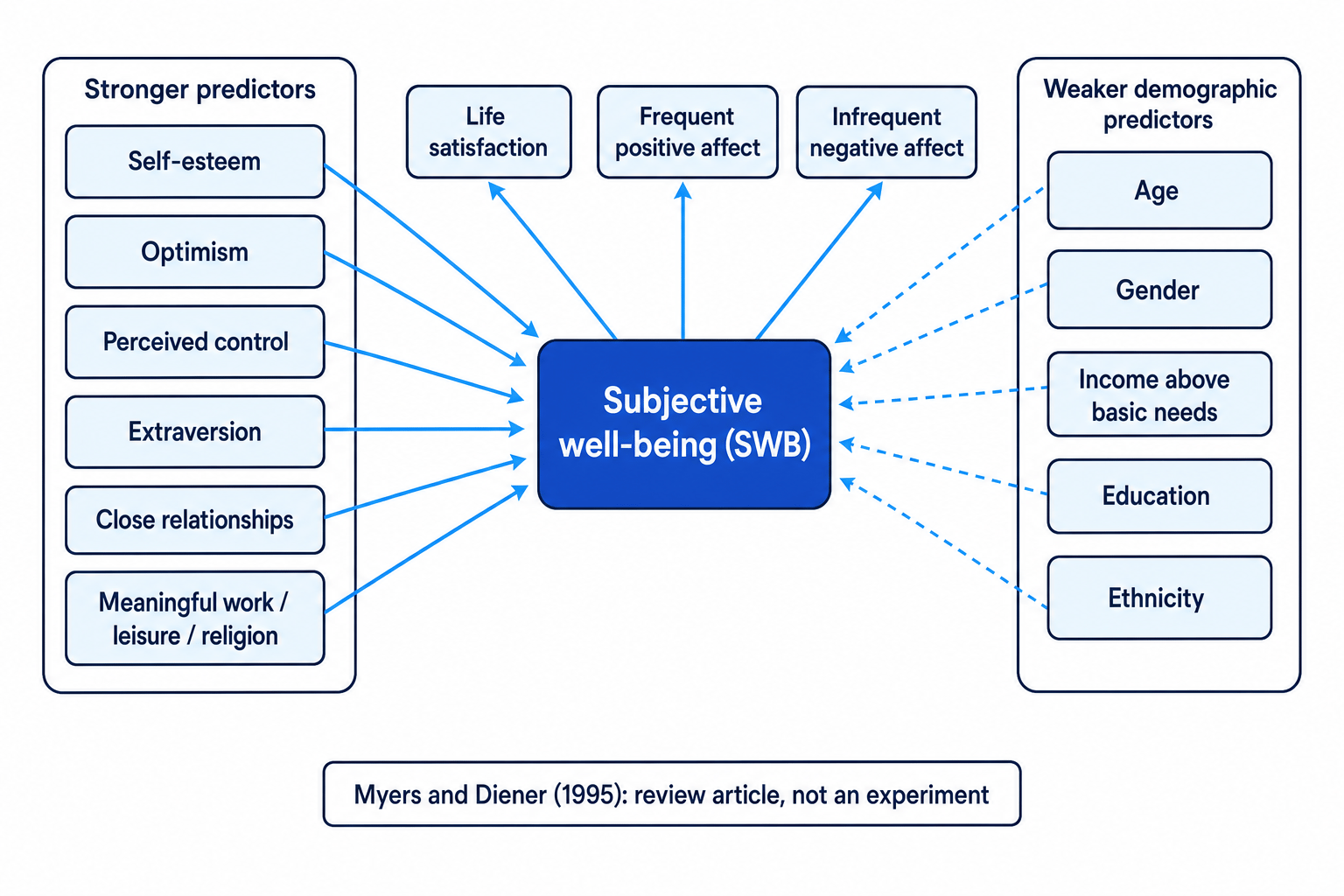
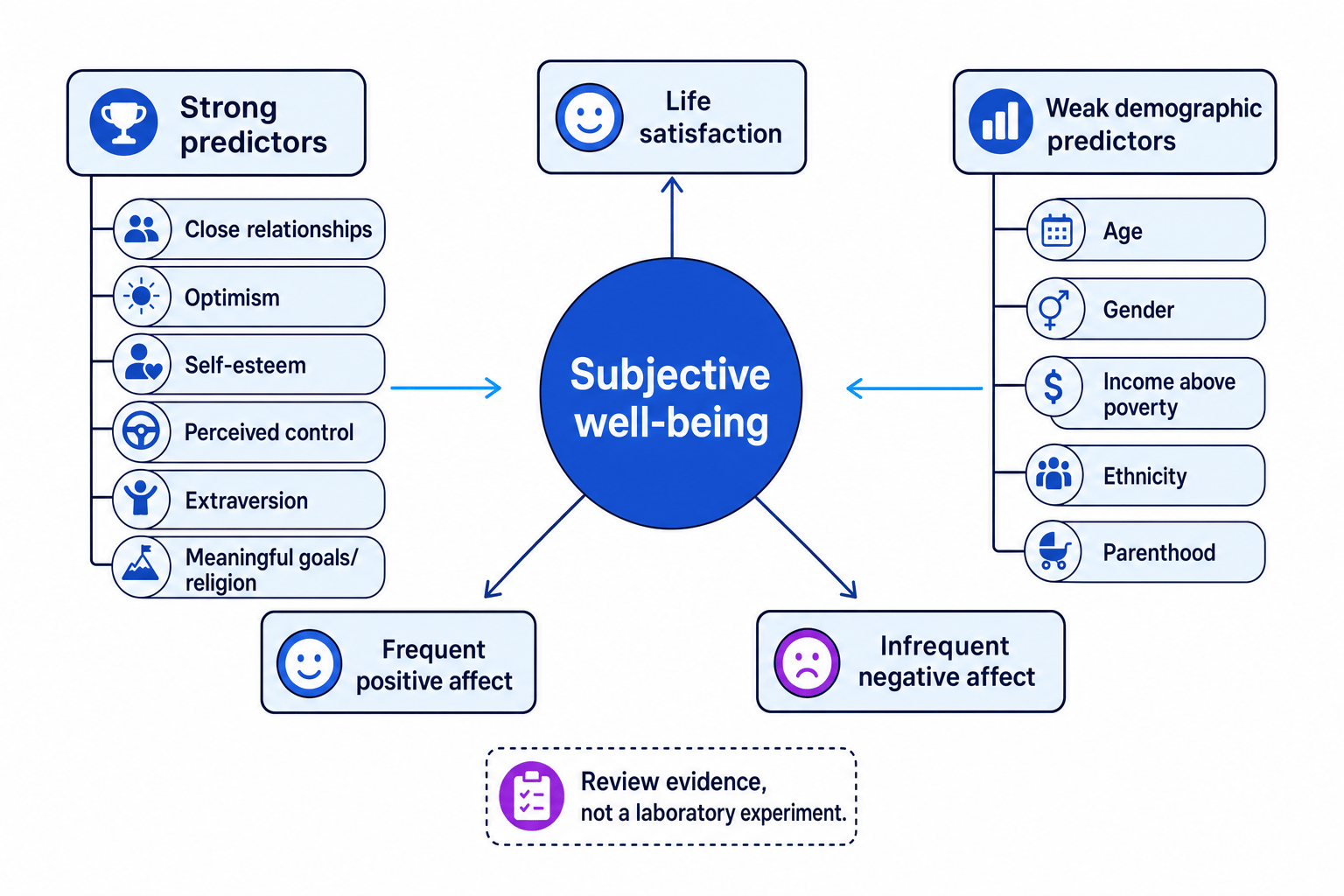
Subjective well-being (SWB) means a person’s own evaluation of their life, usually including life satisfaction, frequent positive affect, and infrequent negative affect.
There are three parts to this definition:
- Life satisfaction: a thinking-based judgement about how satisfied someone is with their life overall.
- Positive affect: pleasant emotions such as joy, calmness, interest or contentment.
- Negative affect: unpleasant emotions such as sadness, anger, guilt or anxiety.
Happiness is not constant excitement
Do not write as if Myers and Diener meant “happy people feel cheerful all the time”. Subjective well-being is broader: it includes life satisfaction and the balance of positive and negative emotions.
AO1: Myers and Diener (1995), Who is happy?
Aim
Myers and Diener aimed to review psychological evidence about happiness and answer a deceptively simple question: who is happy?
More specifically, they wanted to examine which factors are strongly linked with subjective well-being and which factors are surprisingly weak predictors.
Method
This was not a laboratory experiment. It was a review article, meaning Myers and Diener brought together findings from many existing studies, including large-scale surveys, questionnaire research and cross-cultural comparisons.
Review article
A review article summarises and evaluates existing research on a topic. It does not usually collect one new sample of participants in the same way as a single experiment or survey.
Most of the evidence they discussed came from self-report methods, where participants reported their own happiness, life satisfaction or emotions.
This fits the topic well because subjective well-being is, by definition, about the person’s own experience. However, it also creates evaluation issues, which you can use for AO3.
Calling it an experiment
Myers and Diener (1995) should not be described as an experiment with an independent variable and dependent variable. It is best described as a review of existing evidence on subjective well-being.
Main findings
1. Most people report being reasonably happy
A key conclusion was that most people, in many countries, report more positive than negative well-being. Myers and Diener argued that happiness is common enough to be studied scientifically, rather than being rare or mysterious.
2. Demographic factors are weak predictors
A demographic factor is a background characteristic such as age, gender, income, ethnicity, education or marital status.
Myers and Diener found that many demographic variables were weaker predictors of happiness than people might expect. For example, once basic needs are met, extra income does not guarantee much higher happiness.
This does not mean money never matters. Poverty, insecurity and lack of resources can clearly harm well-being. The point is that above a basic level, wealth alone is a limited explanation.
3. Personality and outlook matter more
The article suggested that some personal characteristics are more strongly linked to subjective well-being, including:
- Self-esteem: having a positive view of yourself.
- Optimism: expecting positive outcomes or seeing setbacks as manageable.
- Perceived control: feeling that you have some influence over your life.
- Extraversion: being more sociable and outgoing.
These fit neatly with the positive approach because they focus on strengths, beliefs and personal resources.
4. Relationships, work, leisure and meaning matter
Myers and Diener also highlighted the importance of close relationships and meaningful activity. People tend to report higher well-being when they have supportive social bonds, satisfying work or leisure, and sources of meaning such as religion or purposeful goals.
The headline conclusion
Myers and Diener (1995) argued that happiness is linked less strongly to simple demographics, and more strongly to psychological factors, close relationships, meaningful activity and culture.
AO2: Applying the study
In an exam scenario, you may be given a person who seems “successful” but unhappy, or someone with fewer material advantages but strong relationships and purpose. Myers and Diener help you avoid simplistic explanations.
Applying predictors to a scenario
A student says: “Alex earns a lot of money but feels isolated. Sam has a lower income but has close friendships, enjoys volunteering and describes themselves as optimistic. Who would Myers and Diener predict has higher subjective well-being?”
-
Separate the predictors into demographic/material factors and psychological/social factors. Alex’s high income is relevant, but Sam has close relationships, optimism and meaningful activity.
-
Apply Myers and Diener’s conclusion that income above basic needs is usually a weaker predictor than factors such as relationships, optimism and perceived meaning.
-
Make a cautious judgement: Sam may report higher subjective well-being, but you would need self-report data to know for sure because subjective well-being is based on the person’s own evaluation.
AO2: Linking it to your own practical investigation
You could use Myers and Diener as a basis for a practical investigation into well-being.
For example, you might investigate whether optimism is related to happiness scores. You could collect questionnaire data using rating scales, then calculate descriptive statistics such as the mean, median, range or standard deviation. You could present results using tables, bar charts or scatterplots, depending on the design.
For inferential testing, the correct test depends on the design and level of measurement:
- Use Spearman’s rho for a correlation, such as optimism score and happiness score, especially with ordinal data.
- Use Mann-Whitney U for a difference between two unrelated groups using ordinal or non-parametric data.
- Use an unrelated t-test for a difference between two unrelated group means using interval data where parametric assumptions are reasonable.
- Use Wilcoxon signed-ranks for related scores, such as happiness before and after a gratitude task, using ordinal or non-parametric data.
- Use a related t-test for related interval data where parametric assumptions are reasonable.
- Use chi-square for an association between nominal categories, such as high/low happiness and membership of two groups.
- Use the binomial sign test when you only record the direction of change in related pairs.
In Eduqas research methods, remember the usual significance convention is p≤0.05p \leq 0.05p≤0.05. You compare an observed value with a critical value from a table, following the rule for that specific test. Your choice of a one-tailed or two-tailed test depends on whether your hypothesis is directional.
Methods link
A happiness questionnaire often produces ordinal data if participants choose ratings such as 1 to 5. Treating those ratings as interval data can be acceptable in some practical contexts, but you should justify your choice of statistical test carefully.
AO3: Strengths of Myers and Diener (1995)
It uses a wide evidence base
Because Myers and Diener reviewed many studies, their conclusions were not based on one small or unusual sample. This makes the article useful for identifying broad patterns in happiness research.
It has strong real-world application
The findings can be applied to education, workplaces, therapy and public policy. For example, if relationships and meaning matter to well-being, schools and workplaces should not focus only on achievement or productivity.
Later positive psychology research, such as Seligman, Steen, Park and Peterson (2005), developed this applied focus by testing positive interventions like gratitude exercises and using personal strengths.
It challenged common assumptions
The research challenged the everyday belief that happiness mainly comes from wealth, youth or external success. This is a valuable contribution because it encourages a more psychologically informed understanding of well-being.
AO3: Weaknesses and limitations
It relies heavily on self-report
Self-report is useful because happiness is subjective, but it can be affected by social desirability, mood at the time of answering, memory problems or cultural norms about expressing emotion.
For example, in some cultures people may avoid reporting extreme happiness because modesty is valued.
It is mostly correlational
Many findings reviewed by Myers and Diener show relationships between variables. However, correlation does not prove cause and effect.
For example, close relationships may increase happiness, but happier people may also find it easier to form and maintain close relationships.
It may contain cultural bias
The importance of self-esteem may be especially strong in individualistic cultures, where independence and personal achievement are emphasised. In collectivist cultures, well-being may depend more on harmony, family duties and fitting into the group.
It depends on the quality of existing studies
As a review, the article is only as strong as the research it includes. If the original studies had biased samples, weak measures or poor controls, those limitations affect the review too.
Easy AO3 structure
For an essay paragraph, use: point → evidence from Myers and Diener → why this matters → link back to subjective well-being or the positive approach.
Ethics
Myers and Diener’s article was a review, so the main ethical issues relate to the original studies they discussed. However, happiness research still involves important ethical considerations.
Researchers should follow the BPS Code of Ethics and Conduct, including:
- Consent: participants should know what the questionnaire or study involves.
- Right to withdraw: participants should be able to stop taking part.
- Protection from harm: questions about happiness, loneliness or life satisfaction may be upsetting for some people.
- Confidentiality: personal responses about well-being should be kept private.
- Debriefing: participants should be told the purpose of the research afterwards.
- Deception: if used, it must be justified and dealt with carefully in the debrief.
There are no additional animal ethics issues here because this research concerns human well-being.
How to use this in an essay
For AO1, describe the article accurately as a review of subjective well-being research. Include its main findings: demographics are relatively weak predictors, while relationships, personality, control, optimism, meaning and culture are important.
For AO2, apply those findings to a person, group or investigation. Avoid saying “rich people are happy” or “young people are happy” without nuance.
For AO3, evaluate the method: broad evidence base, useful applications and influence on positive psychology, but limitations with self-report, causality, cultural bias and review methods.
In the exam
-
Identify Myers and Diener (1995) as the classic positive approach research and call it a review, not an experiment.
-
Use the term subjective well-being and break it into life satisfaction, positive affect and negative affect.
-
For AO3, balance usefulness and evidence breadth against self-report bias, correlational evidence, cultural bias and ethical issues.
Check yourself
- What are the three main parts of subjective well-being?
- Why is income a weaker predictor of happiness than many people assume?
- Why is it inaccurate to describe Myers and Diener (1995) as a laboratory experiment?