What you'll learn
- What psychologists mean by scientific status.
- Why being seen as a science can benefit society and the economy.
- Why trying to be “scientific” can also create costs and ethical problems.
- How the five Eduqas approaches use different methodologies, making psychology more or less scientific.
The big question
Psychology studies behaviour and mental processes. Some parts look very scientific: lab experiments, brain scans, controlled variables and statistical testing. Other parts rely more on interpretation, case studies and subjective experience.
So the controversy is not simply “Is psychology a science: yes or no?” A stronger A-Level answer is: some areas of psychology meet scientific criteria more clearly than others.
Scientific status
Scientific status means the extent to which a subject uses systematic, empirical, objective, testable and replicable methods to produce knowledge.
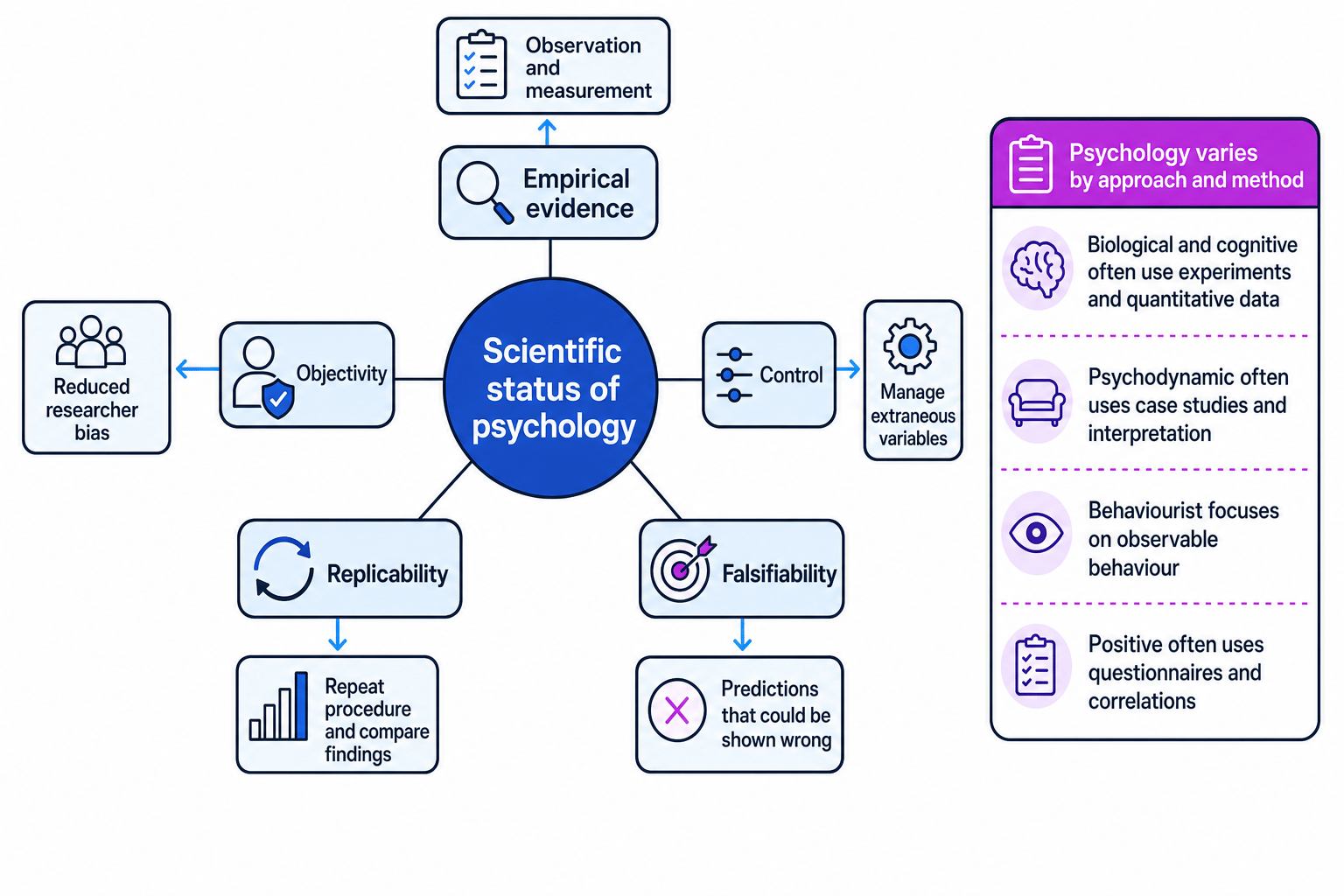
The map below shows the key criteria you can use when judging psychology’s scientific status.
What makes research “scientific”?
Empirical evidence
Empirical evidence is evidence gathered through observation or measurement, rather than opinion or common sense. In psychology, this could be a reaction time, a questionnaire score, a PET scan, or an observed behaviour.
Objectivity
Objectivity means trying to reduce personal bias. A study is more objective if another researcher could follow the same procedure and interpret the results in a similar way.
Control
Control means keeping unwanted variables constant so researchers can test the effect of one main variable. Laboratory experiments are often high in control, but they may be lower in ecological validity if the task feels artificial.
Replicability
Replicability means a study can be repeated to check whether the same findings occur again. Replication is important because one unusual result should not be treated as certain truth.
Falsifiability
Falsifiability means a theory makes predictions that could, in principle, be shown to be wrong. This idea is associated with Karl Popper. A theory that explains every possible outcome after the event is harder to treat as scientific.
The core judgement
Psychology is most scientific when it makes clear, testable predictions, uses transparent methods, gathers empirical evidence, and changes its theories when evidence contradicts them.
Making a claim falsifiable
A vague claim is: “Stress changes people’s behaviour.”
- Operationalise the variables: define stress as a score above a set point on a stress questionnaire, and behaviour as the number of aggressive comments made during a standardised task.
- Make a clear prediction: people with higher stress scores will make more aggressive comments than people with lower stress scores.
- Identify what would count against the claim: if the high-stress group does not show more aggressive comments, the prediction is not supported.
- Test using data: collect quantitative data and use an appropriate inferential test to decide whether any difference is unlikely to be due to chance.
The research-methods link
Component 2 methods are part of this controversy because they show how psychology tries to behave scientifically.
A scientific psychological investigation should usually include:
- Operationalised variables: clear definitions of what is being measured or manipulated.
- Standardised procedures: the same instructions, timings and materials for participants.
- Controls: attempts to reduce extraneous variables.
- Ethics: following the BPS Code of Ethics and Conduct, including consent, right to withdraw, protection from harm, confidentiality and debriefing.
- Appropriate analysis: choosing descriptive statistics, graphs and inferential tests carefully.
Levels of measurement matter too. Nominal data are categories, ordinal data are ordered or ranked, and interval data have equal units. This affects which test is suitable:
| Research situation | Common Eduqas test choice |
|---|---|
| Difference between unrelated groups, ordinal data | Mann-Whitney U |
| Difference between related groups, ordinal data | Wilcoxon signed-ranks |
| Relationship or correlation | Spearman’s rho |
| Association or difference using nominal data | Chi-square |
| Difference with related nominal data | Binomial sign test |
| Difference between unrelated groups, interval data | Unrelated t-test |
| Difference between related groups, interval data | Related t-test |
Psychologists often use a default significance level of p≤0.05p \leq 0.05p≤0.05. They compare an observed value with a critical value from a table, using sample size, significance level and whether the hypothesis is one-tailed or two-tailed. Errors are still possible: a Type I error is a false positive, and a Type II error is a false negative.
Statistics do not guarantee science
A study can use a significance test and still be weak if the variables are poorly operationalised, the sample is biased, the task is artificial, or ethical safeguards are ignored.
Benefits of psychology being a science
Benefits to society
Scientific psychology can improve real lives. For example, research into learning has supported behaviour therapies such as systematic desensitisation. Cognitive research, such as Loftus and Palmer’s 1974 study on eyewitness testimony, has influenced police questioning by showing how leading questions can distort memory.
Biological research can also support medical treatments. For instance, Raine, Buchsbaum and LaCasse’s 1997 PET scan study of murderers used objective brain-imaging data, encouraging debate about biological risk factors in aggression and criminal behaviour.
Benefits to the economy
Psychology can reduce economic costs by improving mental health treatment, workplace productivity, education, rehabilitation and crime prevention. If therapies are evidence-based, services such as the NHS can fund treatments that are more likely to work.
Scientific status also attracts funding. Governments, universities, charities and businesses are more likely to invest in research that appears rigorous, measurable and useful.
Link benefits to evidence
In essays, do not just say “science is useful”. Link the benefit to a method: controlled research gives stronger evidence, which supports better therapies, policies or interventions.
The changing nature of “science”
Science is not fixed. Older views of science often emphasised laboratory control, measurement and certainty. Modern science is more open to probability, complexity and self-correction.
A paradigm is a shared set of assumptions and methods within a discipline. Thomas Kuhn argued that sciences often develop through paradigm shifts. Psychology has several competing paradigms — biological, behaviourist, cognitive, psychodynamic and positive — so some argue it is less unified than sciences such as chemistry.
However, this does not automatically make psychology unscientific. Many modern sciences deal with complex systems and probabilistic findings. Psychology’s replication debates can even be seen as a strength: the discipline is trying to correct itself through open data, preregistration and repeated testing.
Costs of trying to be a science
Reductionism
Reductionism means explaining complex human behaviour in overly simple terms. For example, a biological explanation may reduce aggression to brain activity or genes, while ignoring upbringing, culture, poverty or personal meaning.
Loss of subjective experience
Some parts of human life are difficult to measure precisely, such as grief, identity, happiness or unconscious conflict. Turning these into scores can make research easier to analyse but may remove depth and context.
Ethical risks
Scientific control can create ethical pressure. Watson and Rayner’s 1920 “Little Albert” study is highly controlled and influential, but it raises serious issues around protection from harm, consent and debriefing.
Animal research, often linked with behaviourist and biological approaches, adds further ethical concerns. Researchers must justify harm, minimise suffering, use humane housing and follow principles such as replacement, reduction and refinement.
Ethics is part of scientific quality
A study is not “good science” just because it is controlled. In psychology, scientific value must be balanced against consent, deception, right to withdraw, protection from harm, confidentiality and debriefing.
Methodologies used by the five approaches
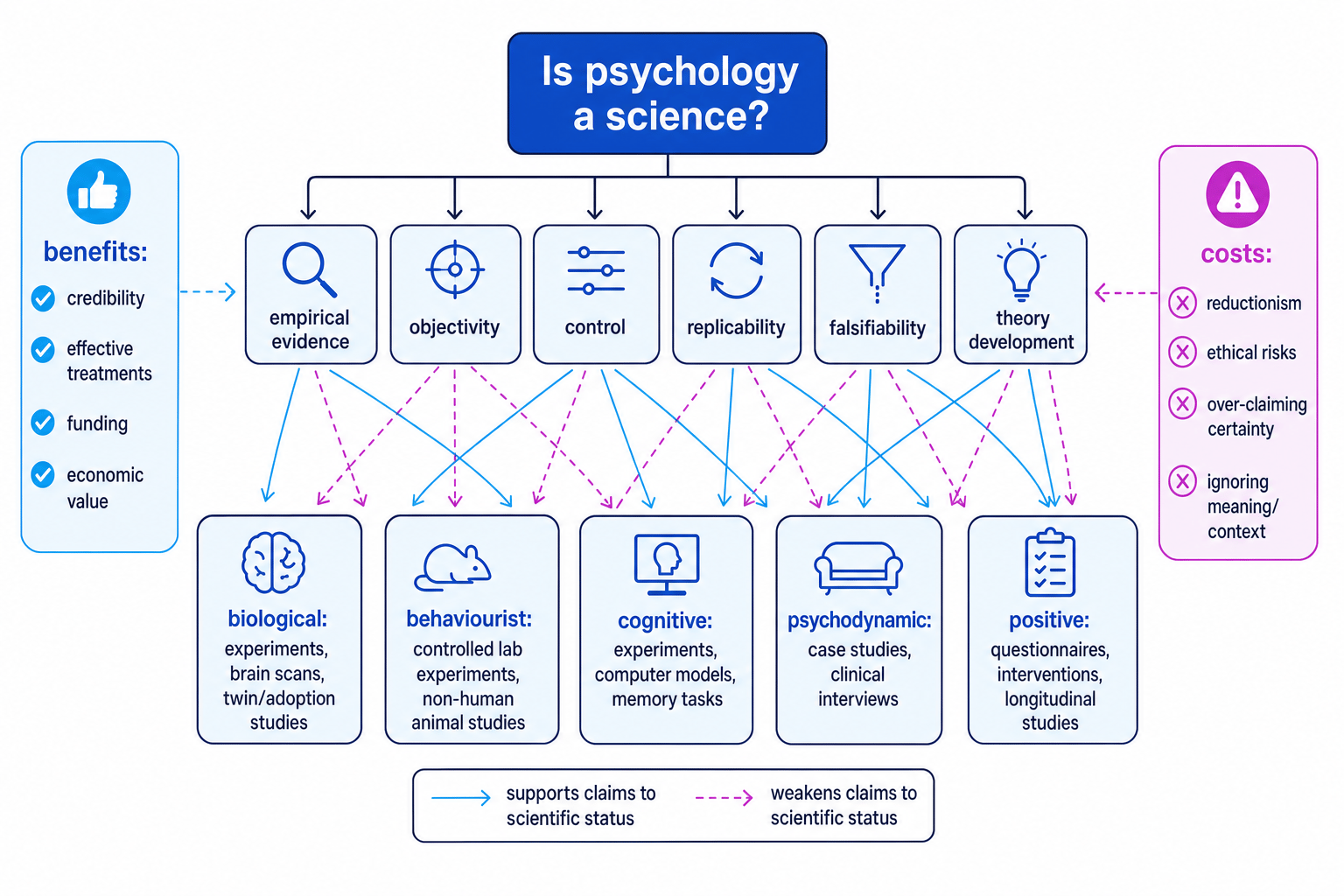
| Approach | Typical methods | Named examples | Scientific strengths | Scientific limits |
|---|---|---|---|---|
| Biological | Lab studies, brain scans, twin studies, physiological measures | Raine et al. 1997; Brendgen et al. 2005 | Objective, quantitative, often replicable | Can be reductionist; causal conclusions may be difficult |
| Psychodynamic | Case studies, clinical interviews, dream analysis | Freud 1909; Bowlby 1944 | Rich detail; useful for developing theories | Low replicability; interpretations can be subjective |
| Behaviourist | Controlled experiments, observation, animal studies | Watson and Rayner 1920; Becker et al. 2002 | Focuses on observable behaviour and cause-effect links | Can be artificial; ethical issues with harm and animal use |
| Cognitive | Lab experiments, memory tasks, computer models | Loftus and Palmer 1974; Grant et al. 1998 | Clear operationalisation and statistical testing | Internal mental processes are inferred, not directly observed |
| Positive | Questionnaires, correlations, interventions, longitudinal research | Myers and Diener 1995; Seligman et al. 2005 | Useful real-world applications for wellbeing | Self-report bias; cultural bias in ideas of happiness |
Comparing approaches scientifically
Suppose an essay asks whether one approach is more scientific than another.
- Compare evidence type: the biological approach often uses objective measures such as scans or genetic data, while the psychodynamic approach often uses qualitative case studies.
- Compare replicability: a brain-scanning procedure can usually be repeated more easily than Freud’s interpretation of Little Hans.
- Add balance: psychodynamic case studies may be less scientific by strict criteria, but they provide depth and real clinical detail that controlled experiments may miss.
- Reach a nuanced judgement: the biological approach may have stronger scientific status, but this does not mean it explains the whole person better.
Building an essay answer
For AO1, define scientific status and describe features such as empiricism, objectivity, control, replicability and falsifiability.
For AO2, apply these ideas to specific approaches, studies or your own practical investigation. Mention methods, data type, controls, ethics and statistical testing where relevant.
For AO3, evaluate. You can argue that psychology gains credibility, funding and useful applications from being scientific, but also risks reductionism, ethical costs, artificiality and overconfidence. A strong conclusion usually says that psychology’s scientific status varies by approach and method.
In the exam
- Start with a clear judgement: psychology is not simply scientific or unscientific; its status depends on the approach and methodology.
- Use named studies as evidence, not decoration: link each study to control, objectivity, replication, ethics or usefulness.
- Balance benefits against costs: society and the economy gain evidence-based applications, but scientific control can reduce human complexity and raise ethical issues.
Check yourself
- Why is falsifiability important when judging whether a theory is scientific?
- Which two approaches would you argue have the strongest and weakest scientific status, and why?
- How could trying to make psychology more scientific create ethical problems?