What you'll learn
- What psychologists mean by sexism, gender bias and heterosexism.
- How sexism can affect research samples, theories, interpretation and real-world applications.
- Why the historical and social context of psychology matters.
- How to write AO1, AO2 and AO3 points for Eduqas Component 3 essays.
The big idea: sexism in psychology
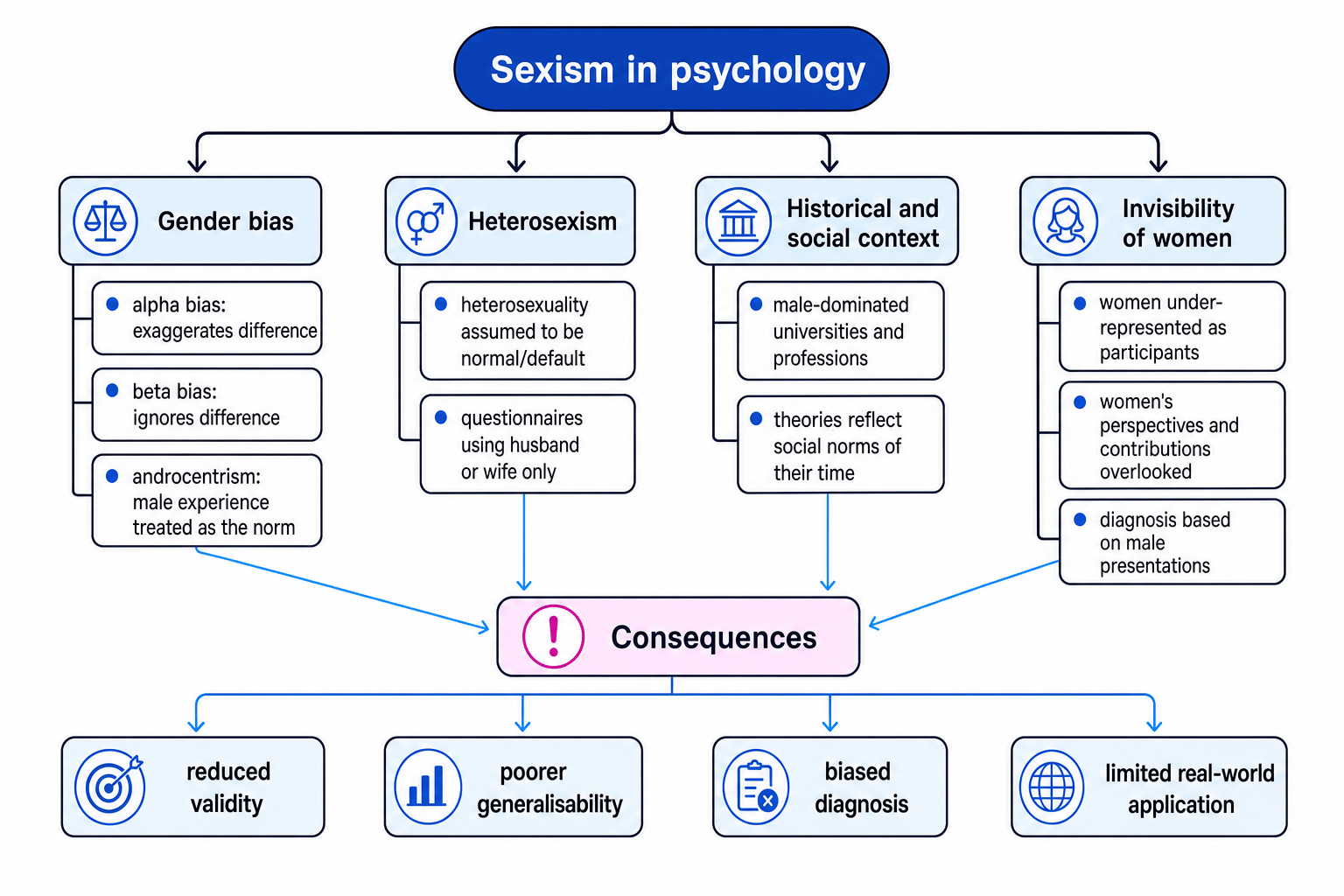
Psychology aims to explain human thought, emotion and behaviour. The controversy is that, historically, “human” has often meant male, heterosexual, and based on the experiences of people with social power.
Sexism in psychology is not just about individual prejudice. It can be built into research questions, samples, diagnostic criteria, language, theories and applications.
Sexism in psychology
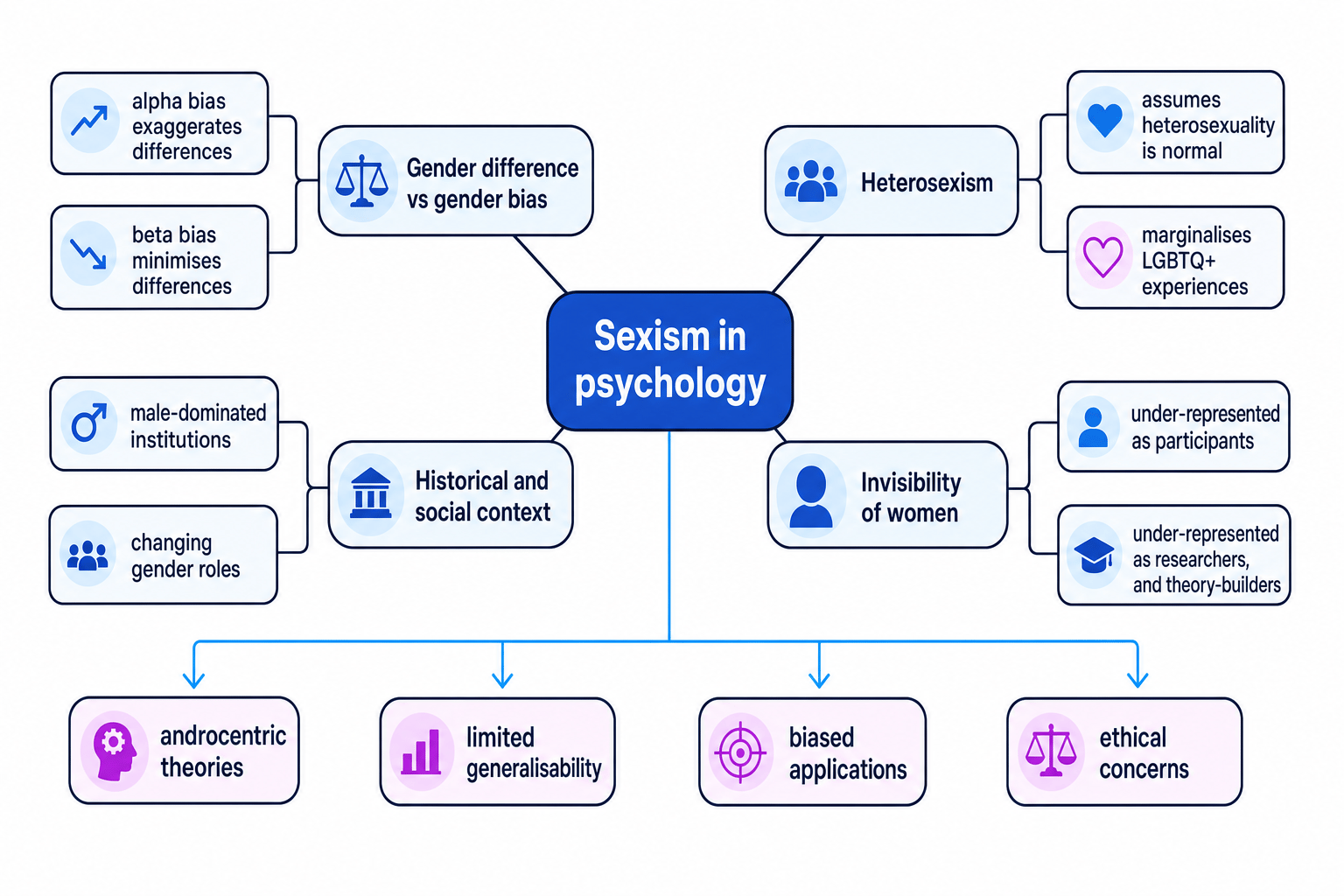
Sexism is bias, discrimination or unfair assumptions based on sex or gender. In psychology, it happens when research or theory represents one sex or gender as the norm, ignores others, or interprets differences in a way that reinforces stereotypes.
A useful starting distinction is between sex and gender. Sex usually refers to biological characteristics, such as chromosomes, hormones and reproductive anatomy. Gender refers to psychological, social and cultural meanings attached to being female, male, both, neither or another gender identity.
Do not treat every gender difference as sexism
A study finding a difference between males and females is not automatically sexist. The issue is whether the research is fair, valid and carefully interpreted, rather than whether it mentions gender at all.
Gender difference or gender bias?
A gender difference is a measured difference between gender groups. For example, a study may find that one group reports higher stress scores than another.
A gender bias occurs when psychology unfairly favours or disadvantages one gender. This might happen through the sample, the measuring tool, the theory, or the interpretation.
Alpha bias and beta bias
Alpha bias exaggerates differences between genders. Beta bias minimises or ignores differences between genders, often by assuming findings from male participants apply equally to everyone.
Alpha bias: exaggerating difference
Alpha bias can make gender differences seem natural, fixed and unavoidable. For example, some early psychodynamic ideas suggested women were psychologically defined by their lack of male anatomy. Freud’s explanations of femininity have often been criticised as androcentric, meaning male-centred.
Androcentrism
Androcentrism means taking male experience as the standard or norm, then judging other groups in relation to it.
Alpha bias can also appear when evolutionary or biological explanations are presented as if they fully determine behaviour, with little attention to social learning, culture or power.
Beta bias: ignoring difference
Beta bias happens when researchers assume one group represents everyone. For example, classic studies such as Asch’s conformity research in 1951 and Milgram’s obedience study in 1963 used male participants, yet their conclusions were often discussed as if they applied to all people.
This does not make the studies worthless. It means you should evaluate their population validity, which is the extent to which findings can be generalised to the wider population.
Spotting alpha and beta bias
A researcher tests aggression using only boys, then concludes: “Children are naturally aggressive when frustrated.”
-
Compare the sample with the target population. The sample is boys only, but the conclusion refers to all children.
-
Decide whether the problem is exaggerating or ignoring gender. The researcher is not claiming boys and girls are very different; they are ignoring the absence of girls.
-
Classify the bias. This is mainly beta bias, because findings from one gender group are being generalised to everyone.
The balanced view
Good psychology can study gender differences, but it must avoid turning social stereotypes into “scientific facts” or pretending that one gender represents all humans.
Heterosexism
Sexism also overlaps with assumptions about sexuality. Heterosexism means treating heterosexuality as normal, natural or superior, while marginalising lesbian, gay, bisexual and other LGBTQ+ experiences.
Heterosexism
Heterosexism is bias that assumes heterosexuality is the default or preferred sexual orientation, often making non-heterosexual people invisible or abnormal.
In research, heterosexism may appear in questionnaires that only ask about “husband” and “wife”, relationship studies that only include heterosexual couples, or clinical theories that treat same-sex attraction as a problem.
Historically, homosexuality was classified as a mental disorder in major diagnostic systems. The American Psychiatric Association removed homosexuality from the DSM in 1973. This is an important example of how psychological and psychiatric categories can reflect social values as well as scientific evidence.
Making a questionnaire less heterosexist
A relationship questionnaire asks: “How often does your husband or wife support you when you are stressed?”
-
Identify the assumption. The item assumes the participant is in a heterosexual marriage or uses the labels husband/wife.
-
Identify the construct being measured. The researcher is really measuring perceived support from an intimate partner, not marital status or heterosexuality.
-
Rewrite the item to fit the construct. A fairer version would be: “How often does your partner support you when you are stressed?”
Heterosexism creates ethical issues too. Questions about sexuality can be sensitive, so researchers must protect confidentiality, gain informed consent, allow the right to withdraw, avoid unnecessary harm, and provide a clear debrief.
Historical and social context
Psychology developed within societies where men often had more access to universities, professional status, publication and public authority. This matters because research is not produced in a vacuum.
Historical and social context
Historical context means the time period in which ideas were developed. Social context means the wider cultural norms, power relations and expectations shaping those ideas.
For example, early psychological theories often reflected assumptions about men as rational, active and public, and women as emotional, passive and domestic. These assumptions influenced what psychologists studied and how they interpreted behaviour.
This does not mean you should simply dismiss older research. Instead, evaluate it carefully. Some classic studies are valuable but limited by the assumptions and samples of their time.
Use context without making excuses
A strong AO3 point says: “This theory reflected the gender norms of its time, which helps explain the bias, but the bias still limits its validity and application today.”
Research has changed because society has changed. Feminist psychology, LGBTQ+ psychology, equal opportunities legislation, and ethical review procedures have encouraged more inclusive research. Meta-analytic work such as Hyde’s 2005 gender similarities hypothesis also challenged the idea that males and females are psychologically opposite, suggesting many differences are small or context-dependent.
The “invisibility” of women in psychology
The invisibility of women refers to women being under-represented as participants, researchers, theorists and examples in textbooks. It can also mean women are included only in restricted roles, such as mothers, carers or patients.
Invisibility of women
The invisibility of women means women’s experiences, contributions and perspectives are left out or treated as less central in psychological research and theory.
This affects validity. If research is based mainly on male participants, conclusions may not generalise well. If diagnostic criteria are based mainly on male presentations, women and girls may be misdiagnosed or diagnosed later. This has been discussed in areas such as autism, where female presentations may be less visible because early models were strongly influenced by male cases.
Women’s theoretical contributions have also sometimes been overshadowed. Gilligan in 1982 criticised Kohlberg’s theory of moral development for being male-centred, arguing that care, responsibility and relationships had been undervalued compared with justice-based reasoning.
Bandura, Ross and Ross’s 1961 Bobo doll study is a useful contrast because it included boys and girls and examined the sex of the model. However, even then, interpretation needs care: if boys show more physical aggression, psychologists must ask whether this reflects biology, socialisation, expectations, measurement, or a combination.
Applying this to your own practical work
If your Component 2 practical or an AO2 scenario involves gender, avoid careless assumptions.
For example, if you compare stress scores between men and women, you should ask whether gender is genuinely relevant to the aim. You should also describe the sample accurately and avoid implying that a small convenience sample represents all men and women.
If you were choosing statistics, the choice depends on the design and level of measurement. Two independent gender groups with interval data may suit an unrelated t-test, while ordinal or non-parametric data may suit Mann-Whitney U. Repeated-measures data may use a related t-test or Wilcoxon signed-ranks. Nominal frequency data may suit chi-square, and correlations may use Spearman’s rho. Usual significance convention is p≤0.05p \leq 0.05p≤0.05, with care over one-tailed versus two-tailed hypotheses and Type I or Type II errors.
Ethically, follow the BPS Code of Ethics and Conduct: informed consent, protection from harm, confidentiality, right to withdraw, debrief, and careful handling of deception if used. If animal research is ever used to make claims about sex-linked behaviour, you would also consider animal welfare, the 3Rs of replacement, reduction and refinement, and whether generalising to human gender is valid.
AO3 evaluation: why sexism matters
Sexism weakens psychology because it reduces validity. A theory based on male experience may not explain everyone. A questionnaire written in heterosexist language may not measure the intended construct fairly. A diagnosis based on male symptoms may lead to biased treatment.
However, recognising sexism has improved psychology. Researchers now more often use diverse samples, report participant characteristics, test for gender as a variable, and avoid assuming that heterosexual or male experience is universal.
There is also a careful counterargument: avoiding sexism does not mean pretending all people are the same. Sometimes sex and gender differences are important, especially in health, stress, development, aggression, relationships and diagnosis. The key is to investigate differences without stereotyping or overgeneralising.
Best evaluative judgement
The controversy is not “men versus women”. It is about whether psychology produces knowledge that is fair, representative, valid and useful for the people it claims to explain.
In the exam
-
Define the key term clearly: sexism, gender bias, heterosexism, androcentrism, or invisibility of women.
-
Use a concrete example, such as male-only classic samples, Freud’s androcentric assumptions, Gilligan’s 1982 critique, or heterosexist questionnaire wording.
-
Evaluate the consequence: link the bias to validity, generalisability, ethics, diagnosis, treatment, or real-world applications.
Check yourself
- What is the difference between alpha bias and beta bias?
- How can heterosexism appear in psychological research?
- Why does the invisibility of women reduce the validity of psychological theories?