What you'll learn
- Why psychologists use non-human animals in research and therapy.
- How the BPS Guidelines for Psychologists Working with Animals shape ethical decisions.
- The difference between comparative psychology and ethological psychology.
- How to evaluate speciesism in essay answers.
The basic controversy
Psychology uses non-human animals to understand learning, attachment, stress, brain mechanisms and therapy. The controversy is not simply “animals good” versus “animals bad”. It is about whether the scientific or therapeutic benefits justify the ethical costs, and whether findings from animals can validly apply to humans.
Non-human animals
In psychology, non-human animals means any animal species used to study behaviour, cognition, emotion or treatment, rather than human participants. Common examples include rats, mice, pigeons, dogs and non-human primates.
The core debate
A strong essay balances two questions: Is the use of animals ethically justified? and Are animal findings scientifically useful for understanding humans?
BPS Guidelines for Psychologists Working with Animals
The British Psychological Society, or BPS, publishes ethical guidance for psychologists. The general BPS Code of Ethics and Conduct covers human research issues such as consent, deception, right to withdraw, protection from harm, confidentiality and debriefing. Animal research needs extra safeguards because animals cannot give informed consent or verbally withdraw.
The BPS Guidelines for Psychologists Working with Animals emphasise:
- Legal compliance: UK animal research is tightly regulated, including by the Animals (Scientific Procedures) Act 1986.
- Competence: researchers must be trained to handle and care for the species used.
- Cost-benefit analysis: expected scientific or practical benefits must justify possible suffering.
- Species-specific needs: housing, social contact, food, enrichment and handling should suit the animal’s biology.
- Humane endpoints: researchers must know when to stop a procedure to prevent unnecessary suffering.
- The 3Rs: Replacement, Reduction and Refinement.
The 3Rs
Replacement means using non-animal alternatives where possible. Reduction means using the smallest number of animals consistent with valid research. Refinement means minimising pain, distress and deprivation, while improving welfare.
This decision process is useful for evaluating both research and therapy involving animals.
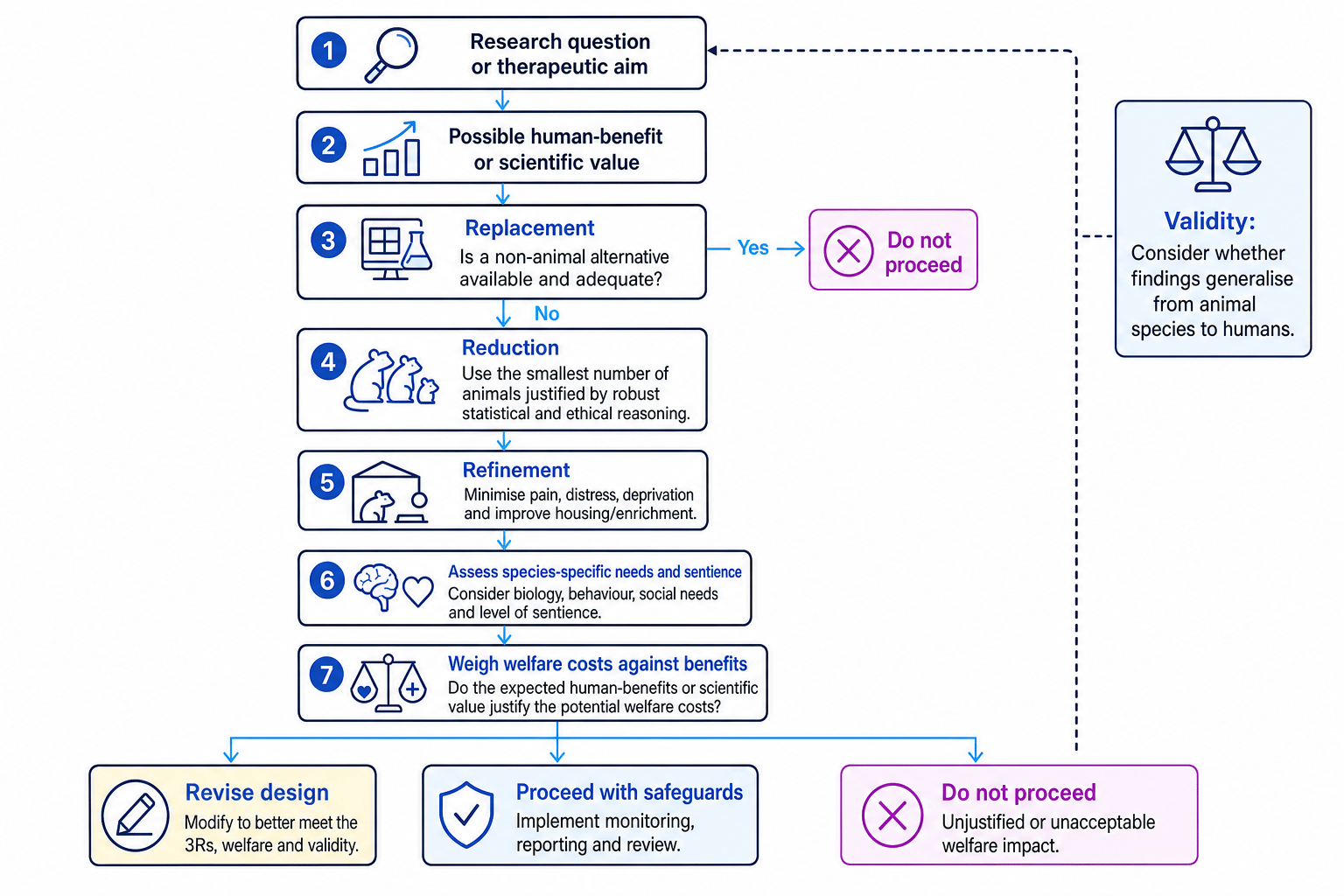
Applying the BPS safeguards
A researcher wants to test a new anxiety-reducing drug using rats in a maze.
- Judge the benefit: if the drug could lead to a treatment for severe human anxiety, the potential benefit is stronger than if the study is only for curiosity.
- Apply Replacement: if a computer model, cell study or non-invasive human study could answer the same question, the animal study should not go ahead.
- Apply Reduction: if animals are needed, the researcher should justify the sample size statistically and ethically, avoiding both too many animals and too few to produce meaningful data.
- Apply Refinement: the maze should avoid unnecessary fear, rats should have suitable housing and enrichment, and there should be clear stopping rules if distress becomes unacceptable.
- Evaluate validity: even if the study is ethical, rat anxiety in a maze may not fully represent complex human anxiety disorders.
Forgetting animal-specific ethics
Do not just write “they gave consent and were debriefed”. Animals cannot give informed consent, so you need to discuss welfare, species-specific needs, the 3Rs and cost-benefit analysis.
Comparative and ethological psychology
Comparative psychology
Comparative psychology studies similarities and differences between species to understand behaviour, cognition and evolution. It often uses controlled laboratory research.
Classic examples include Pavlov’s (1927) work on classical conditioning in dogs, Skinner’s (1938) research on operant conditioning in rats, and Harlow’s (1958) studies of attachment in rhesus monkeys. These studies supported theories about learning, reinforcement and emotional bonds.
Ethological psychology
Ethological psychology studies animal behaviour in natural or naturalistic settings, often focusing on how behaviour helps survival and reproduction.
For example, Lorenz (1935) studied imprinting in geese, while Tinbergen (1951) argued that animal behaviour can be explained through causes, development, function and evolution.
| Feature | Comparative psychology | Ethological psychology |
|---|---|---|
| Main focus | Comparing species to understand behaviour | Studying species-typical behaviour in context |
| Common setting | Laboratory or controlled environment | Field or naturalistic setting |
| Strength | High control, easier cause-and-effect conclusions | High ecological validity |
| Weakness | May be artificial | Less control over extraneous variables |
Classifying animal research
A psychologist observes wild birds giving alarm calls when predators appear.
- Assess the setting: the behaviour is being observed in the birds’ natural environment, not created in a laboratory.
- Assess the aim: the study asks how alarm calls function in survival, rather than testing a general learning law under controlled conditions.
- Make the judgement: this is mainly ethological psychology, because it studies species-typical behaviour in context.
- Add evaluation: ecological validity is strong, but cause-and-effect conclusions may be weaker because many variables cannot be controlled.
Useful named studies
For essays, you can use animal studies as evidence, but always link them to the controversy. Harlow (1958) is especially useful because it produced influential attachment evidence but involved serious emotional harm to infant monkeys.
Why psychologists use non-human animals
Animal research can offer practical and methodological advantages. Animals may have shorter lifespans, simpler nervous systems, and more controllable environments than humans. Some procedures, such as invasive brain research or tightly controlled drug testing, would be unethical with human participants.
This has led to real-world applications. Learning research using animals contributed to behaviour therapy, token economy principles and animal training. Biological research using animals has contributed to understanding stress, addiction and medication effects.
However, there are major limitations. Findings may not generalise from animals to humans because humans have language, culture, self-reflection and complex social meanings. Laboratory environments may also produce abnormal behaviour, reducing ecological validity.
Anthropomorphism
Anthropomorphism means wrongly attributing human thoughts, feelings or motives to animals. It can make animal behaviour seem more human-like than the evidence supports.
Animals as a therapeutic device
Animals can also be used in therapy. Animal-assisted therapy involves animals, often dogs or horses, being used to support psychological treatment, communication, emotional regulation or wellbeing.
Early work by Levinson (1962) described dogs as “co-therapists” helping children engage with therapy. Later research, such as Odendaal and Meintjes (2003), suggested that positive human-dog interaction may be linked with physiological changes associated with bonding and reduced stress.
Possible uses include:
- helping anxious clients feel calmer;
- supporting children with autistic spectrum behaviours in communication;
- reducing loneliness in older adults;
- encouraging responsibility and routine in prison or rehabilitation programmes.
Evaluating an animal-assisted therapy claim
A school says a therapy dog reduces anxiety before exams.
- Identify the outcome measure: anxiety should be measured using a clear scale or behavioural measure, not just teacher impressions.
- Compare against a control: anxiety should be compared with a similar group receiving no dog visit, or another calming activity, to separate the animal effect from attention or novelty.
- Consider human ethics: students may have allergies, phobias or cultural objections, so participation should be voluntary and safe.
- Consider animal welfare: the dog needs rest, suitable training, calm handling and removal from the setting if signs of stress appear.
Therapy animals are not tools
The phrase “therapeutic device” appears in the controversy, but ethically the animal should not be treated like equipment. Its welfare matters throughout the intervention.
Speciesism
Speciesism
Speciesism is discrimination or unequal moral consideration based only on species membership. The term is linked with philosophers such as Peter Singer (1975).
A speciesism argument says it is unfair to assume human interests automatically matter more than animal interests just because humans are human. For example, if a rat can experience pain, a speciesism critic would argue that its suffering deserves serious moral consideration.
This does not mean humans and animals must always be treated identically. The key question is whether different treatment is based on a relevant difference, such as capacity for language, long-term planning or moral responsibility, rather than mere species membership.
Spotting speciesism in an argument
Someone says, “It is acceptable to distress monkeys in research because they are not human.”
- Identify the basis of the claim: the argument relies mainly on species membership, not on the level of harm, benefit or alternatives.
- Consider sentience: monkeys are capable of distress, social attachment and suffering, so their welfare is morally relevant.
- Test for justification: a stronger argument would need to show major benefit, lack of alternatives, strong safeguards and high validity.
- Reach a balanced conclusion: the original claim is speciesist if “not human” is treated as enough justification on its own.
AO3 evaluation points for essays
A balanced answer should include both sides.
Strengths of using animals include high control, replicability, practical applications, and the ability to study processes that cannot ethically be manipulated in humans.
Weaknesses include animal suffering, inability to consent, species differences, artificial laboratory settings, and the risk of anthropomorphism.
Research methods link
When evaluating evidence, check the design and data. For example, animal-assisted therapy studies may use pre-test/post-test anxiety scores, independent-group comparisons, correlations or nominal outcome categories. This links to choices such as related or unrelated t-tests, Wilcoxon, Mann-Whitney U, Spearman’s rho, chi-square or binomial sign tests, with the usual significance convention of p≤0.05p \leq 0.05p≤0.05.
In the exam
- Define the controversy clearly: animal use raises both ethical and scientific validity issues.
- Use the named content: BPS Guidelines, comparative/ethological psychology, therapeutic use and speciesism.
- Support evaluation with examples, such as Pavlov (1927), Skinner (1938), Harlow (1958), Lorenz (1935) or animal-assisted therapy research.
- Always balance benefits against welfare costs, and avoid one-sided “animal research is always good/bad” answers.
Check yourself
- How do Replacement, Reduction and Refinement protect animal welfare?
- What is the difference between comparative psychology and ethological psychology?
- Why might speciesism be used to criticise animal research or animal-assisted therapy?
