What you'll learn
- What psychological formulation means in criminological psychology.
- How psychologists use understanding the offender, offence analysis, and case formulation.
- How to explain the function of offending behaviour for an individual.
- How to evaluate formulation for AO3: usefulness, subjectivity, ethics, and real-world application.
The basic idea: why formulate offending?
In criminological psychology, theories of offending often explain why groups of people may be more likely to offend. For example, biological, social, or cognitive explanations might identify risk factors across a population.
Psychological formulation works differently. It asks: Why does this person offend, in this way, at this time, in this context?
Psychological formulation
A psychological formulation is a structured, evidence-based explanation of a person’s difficulties. In offending behaviour, it links the offender’s background, thoughts, emotions, circumstances, triggers, and consequences to explain the function of their offending.
Function of offending behaviour
The function of offending behaviour means what the behaviour does for the individual — for example gaining money, gaining status, reducing anxiety, expressing anger, avoiding shame, or feeling in control.
A formulation is not the same as saying the offence is acceptable. It is about explanation, not excuse. If psychologists understand the function of the behaviour, they can plan treatment and risk management more effectively.
Understanding is not excusing
Do not write as if formulation “justifies” crime. A strong answer says formulation helps explain and manage offending while still recognising responsibility, victim impact, and public protection.
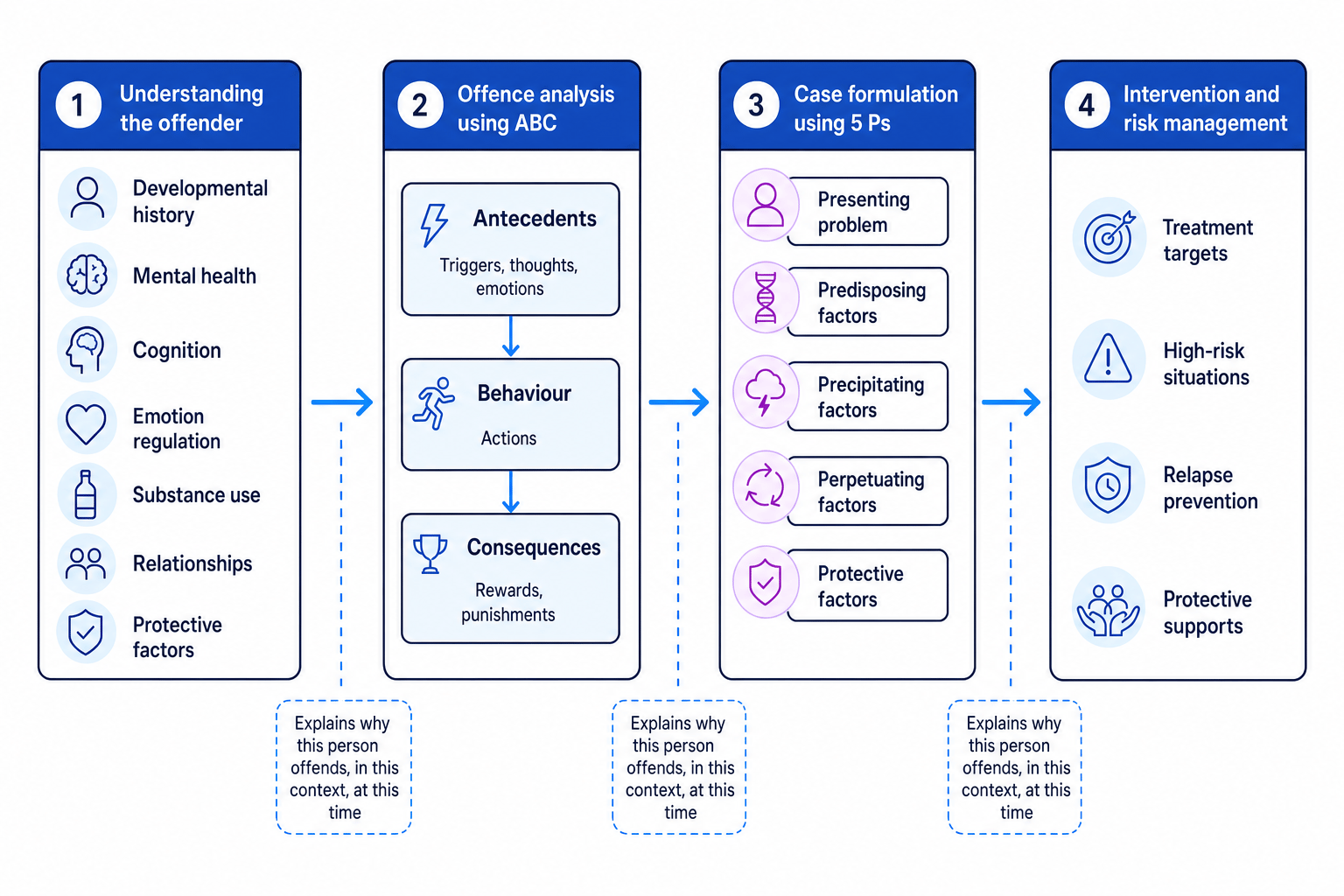
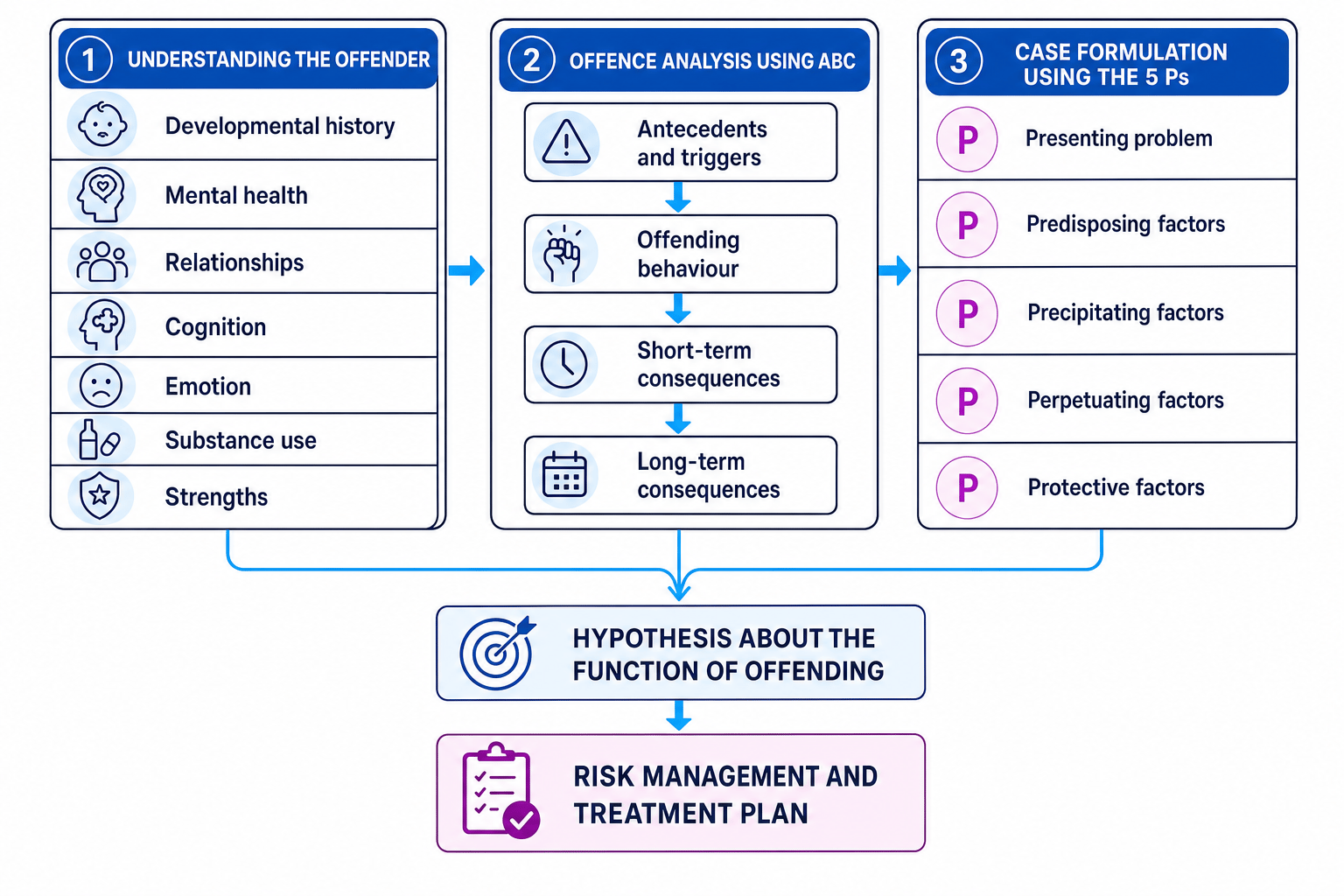
Here is the overall process: psychologists build a picture of the offender, analyse the offence sequence, then integrate the information into a case formulation.
Stage 1: understanding the offender
Before analysing the offence itself, a psychologist gathers information about the individual.
This might include:
- Developmental history: childhood experiences, attachment, trauma, education.
- Mental health: anxiety, depression, psychosis, personality difficulties.
- Cognition: beliefs, attitudes, thinking patterns, hostile interpretations.
- Emotion regulation: how the person manages anger, fear, shame, or rejection.
- Substance use: alcohol or drug use before or around offences.
- Relationships and social context: peers, family, gangs, isolation, employment.
- Strengths and protective factors: motivation to change, stable support, skills, values.
Protective factor
A protective factor is something that reduces the likelihood of offending or reoffending, such as supportive relationships, employment, problem-solving skills, or willingness to engage in treatment.
This stage is idiographic, meaning it focuses on the individual person rather than only using general laws or averages.
Sources of information can include interviews, official records, court reports, victim statements, psychological questionnaires, behavioural observations, and accounts from staff or family members.
Stage 2: offence analysis
Offence analysis
Offence analysis is the detailed reconstruction of an offence, focusing on what happened before, during, and after it. The aim is to identify triggers, decisions, emotions, thoughts, and consequences.
A common way to structure offence analysis is the ABC model:
- A — Antecedents: what came before the offence, including triggers and context.
- B — Behaviour: what the person actually did.
- C — Consequences: what happened afterwards, including rewards or punishments.
The consequences are especially important because they may reveal the function of the behaviour. Some consequences are obvious, such as money from theft. Others are psychological, such as relief from humiliation or a temporary sense of power.
Reinforcement
Reinforcement is any consequence that makes a behaviour more likely to happen again. Positive reinforcement adds something rewarding, while negative reinforcement removes something unpleasant.
For example, if an offender assaults someone and then feels feared and respected, the behaviour may be positively reinforced by status. If they offend to escape anxiety or debt pressure, the behaviour may be negatively reinforced because it temporarily removes distress.
Identifying the function of an assault
A young man assaults another person outside a pub after believing he has been disrespected.
- Identify the antecedents: he had been drinking, was with peers, felt embarrassed, and interpreted a comment as disrespectful.
- Identify the behaviour: he punched the other person and continued aggression after friends began watching.
- Identify the short-term consequences: his peers paid attention, the other person backed away, and his feeling of humiliation reduced.
- Infer the likely function: the assault may have helped him regain status and reduce shame in front of peers.
- Link this to intervention: treatment might target alcohol use, hostile interpretations, emotion regulation, and alternative ways to manage perceived disrespect.
Why offence analysis matters
Two people may commit the same offence for different reasons. Formulation focuses on the individual function, not just the legal category of the crime.
Stage 3: case formulation
Case formulation
A case formulation is the psychologist’s integrated explanation of why the offending developed, why it occurred at a particular time, and what keeps the risk going.
A helpful structure is the 5 Ps model:
| Part of formulation | What it means in offending |
|---|---|
| Presenting problem | The current offence or offending pattern. |
| Predisposing factors | Long-term vulnerabilities that made offending more likely. |
| Precipitating factors | Immediate triggers that helped set off the offence. |
| Perpetuating factors | Factors that maintain the behaviour or risk. |
| Protective factors | Strengths or supports that reduce risk. |
Predisposing, precipitating, and perpetuating factors
Predisposing factors are background vulnerabilities, precipitating factors are immediate triggers, and perpetuating factors are things that keep the behaviour going.
A formulation is best seen as a hypothesis: a reasoned explanation based on evidence, which can be revised if new information appears.
Building a 5 Ps formulation for burglary
An offender repeatedly burgles houses after losing work and increasing drug use.
- Classify the presenting problem: repeated burglary, mainly targeting empty homes, with escalating frequency.
- Identify predisposing factors: early exposure to criminal peers, poor school attachment, and limited employment skills may have increased vulnerability.
- Identify precipitating factors: job loss, debt, and increased drug dependence may have triggered the recent offences.
- Identify perpetuating factors: burglary provides money quickly, reduces withdrawal discomfort, and is reinforced by peer approval.
- Identify protective factors: a supportive sibling and previous periods of stable employment could be used in a treatment plan.
How formulation guides intervention
The point of formulation is not just to describe the offender. It should guide what happens next.
For example:
- If offending functions to gain money for drugs, intervention may focus on substance misuse treatment and practical support.
- If offending functions to gain status, intervention may target peer influences, self-esteem, and non-criminal ways to gain respect.
- If offending functions to reduce anger or shame, intervention may focus on emotion regulation and cognitive restructuring.
- If offending is linked to impulsivity, intervention may include problem-solving, delay strategies, and relapse prevention.
This links well to the Risk-Need-Responsivity model developed by Andrews and Bonta, often discussed in offender rehabilitation. The idea is that intervention should target criminogenic needs — changeable factors directly linked to offending risk. It also links to Ward and Brown’s Good Lives Model (2004), which argues that rehabilitation should build meaningful, prosocial ways for offenders to meet their needs.
AO2 shortcut
When applying formulation to a scenario, keep asking: What need is the offending meeting for this person, and what safer alternative could meet that need?
Evaluation: strengths of psychological formulation
It is individualised
A major strength is that formulation is idiographic. It avoids assuming that all offenders who commit the same offence have the same motivation.
This is useful because the same offence type can have different functions. One person may steal for excitement, another for survival, another to fund addiction, and another for peer approval.
It supports treatment and risk management
Formulation has strong real-world application. It can guide prison rehabilitation, probation work, forensic mental health treatment, and relapse prevention.
A formulation can identify:
- high-risk situations,
- warning signs,
- treatment targets,
- protective factors,
- practical management strategies.
This makes it more useful than simply labelling someone as “a violent offender” or “a thief”.
It can integrate different explanations
Formulation can combine biological, cognitive, social, and developmental explanations. For example, it could include childhood trauma, hostile attribution bias, substance misuse, and peer reinforcement in one coherent account.
AO3 strength
A strong evaluation point is that formulation is holistic: it combines multiple sources of information to produce a practical, personalised explanation.
Evaluation: limitations of psychological formulation
It can be subjective
A formulation depends on the psychologist’s judgement. Two psychologists might interpret the same case differently, especially if the evidence is incomplete.
This creates a possible problem with reliability, meaning consistency. If formulations vary too much between professionals, their usefulness may be reduced.
It relies on accurate information
Offenders may minimise their behaviour, blame victims, forget details, or deliberately mislead professionals. Official records may also be incomplete or biased.
This can affect validity, meaning whether the formulation is really explaining what it claims to explain.
It can be time-consuming
Good formulation requires detailed assessment, multiple sources of information, and careful revision. This may be difficult in busy prisons, probation services, or court settings.
It may underplay wider social factors
Some formulations focus heavily on the individual and may pay less attention to poverty, inequality, discrimination, housing instability, or lack of opportunity. A balanced answer can say formulation is strongest when it includes both individual and social context.
Ethical issues
Psychological formulation in forensic settings raises important ethical issues. The BPS Code of Ethics and Conduct (2009) highlights principles such as consent, confidentiality, protection from harm, deception, right to withdraw, and debriefing.
In offender work, confidentiality has limits. If a psychologist believes someone poses a serious risk to others, they may need to share information with relevant professionals. This should be explained clearly.
Consent can also be complicated because offenders may feel pressured to engage if assessment affects parole, sentencing, or treatment decisions. Psychologists must be honest about how information will be used.
Forensic confidentiality is limited
In ordinary therapy, confidentiality is very strong. In forensic work, psychologists must balance the offender’s privacy with victim safety and public protection.
AO1, AO2, AO3 in one paragraph
For AO1, describe formulation as an individualised explanation involving understanding the offender, offence analysis, and case formulation. For AO2, apply the process to a scenario by identifying triggers, thoughts, emotions, consequences, and function. For AO3, evaluate its practical value for treatment and risk management, but balance this against subjectivity, reliance on self-report, time demands, and ethical issues.
In the exam
- Define formulation clearly: it is a hypothesis about the function of offending, not just a description of the offence.
- Use the sequence offender background → offence analysis → 5 Ps → treatment/risk plan to structure AO1 and AO2.
- For AO3, balance usefulness with limitations: individualised and practical, but potentially subjective, time-consuming, and ethically complex.
Check yourself
- What is meant by the function of offending behaviour?
- How would you use the ABC model to analyse an offence?
- Why might psychological formulation be useful but also subjective?