What you'll learn
- How interview evidence helps with offence analysis and case formulation.
- How the cognitive interview improves eyewitness recall using memory principles.
- What makes an interview ethical, including BPS safeguards.
- How to evaluate these techniques for AO3 exam answers.
Why interviews matter in criminological psychology
In criminological psychology, interviews may be used with eyewitnesses, victims, suspects, offenders, police officers, or other people connected to an offence. The aim is not just to “get a story”. A good interview should gather accurate information, reduce contamination of memory, and protect the person being interviewed.
Offence analysis and case formulation
Offence analysis means examining the details of an offence, such as what happened before, during and after it. Case formulation means building a structured psychological explanation of why the offence may have happened and what could reduce future risk.
A formulation might include triggers, emotions, thinking patterns, social pressures, substance use, previous trauma, or learned behaviour. It should be evidence-based and provisional, not a label that “proves” why someone offended.
Accuracy and care go together
The best forensic interviews are both cognitive and ethical: they help memory work well, while avoiding pressure, distress, leading questions, and unfair treatment.
The memory problem: recall is not a recording
A major reason interview technique matters is that human memory is reconstructive. This means people rebuild memories using stored information, expectations, emotions, and later information.
Bartlett (1932) showed that recall can be shaped by schemas, which are mental frameworks based on previous experience. Tulving (1972) also argued that retrieval works best when helpful cues are available.
Retrieval cue
A retrieval cue is a prompt that helps someone access a memory, such as the location, sounds, smells, emotions, or order of events present when the memory was encoded.
This matters for eyewitness testimony because a poorly worded question can change what a witness reports. For example, “Did you see the knife?” suggests there was a knife. “What, if anything, did you see in the person’s hand?” is less leading.
Improving a witness question
A witness saw a street robbery. The interviewer asks: “Was the attacker wearing a black hoodie?”
- Identify the risk: the question is leading because it suggests both “attacker” and “black hoodie”, so the witness may agree even if unsure.
- Replace it with an open question: “Can you describe what the person was wearing?” This allows the witness to generate details from memory.
- Add a non-pressuring follow-up: “Is there anything else you remember about their clothing?” This encourages more recall without planting information.
- Preserve uncertainty: if the witness says “I’m not sure”, record that rather than pushing them to choose.
The cognitive interview
The cognitive interview was developed by Geiselman et al. (1985), later expanded by Fisher and Geiselman (1992). It is mainly used with eyewitnesses to improve the amount and accuracy of recall.
Cognitive interview
The cognitive interview is a structured interview technique that uses psychological principles of memory retrieval to help a witness recall more accurate information about an event.
The diagram shows the main flow of a cognitive interview and the ethical safeguards that should run through the whole process.
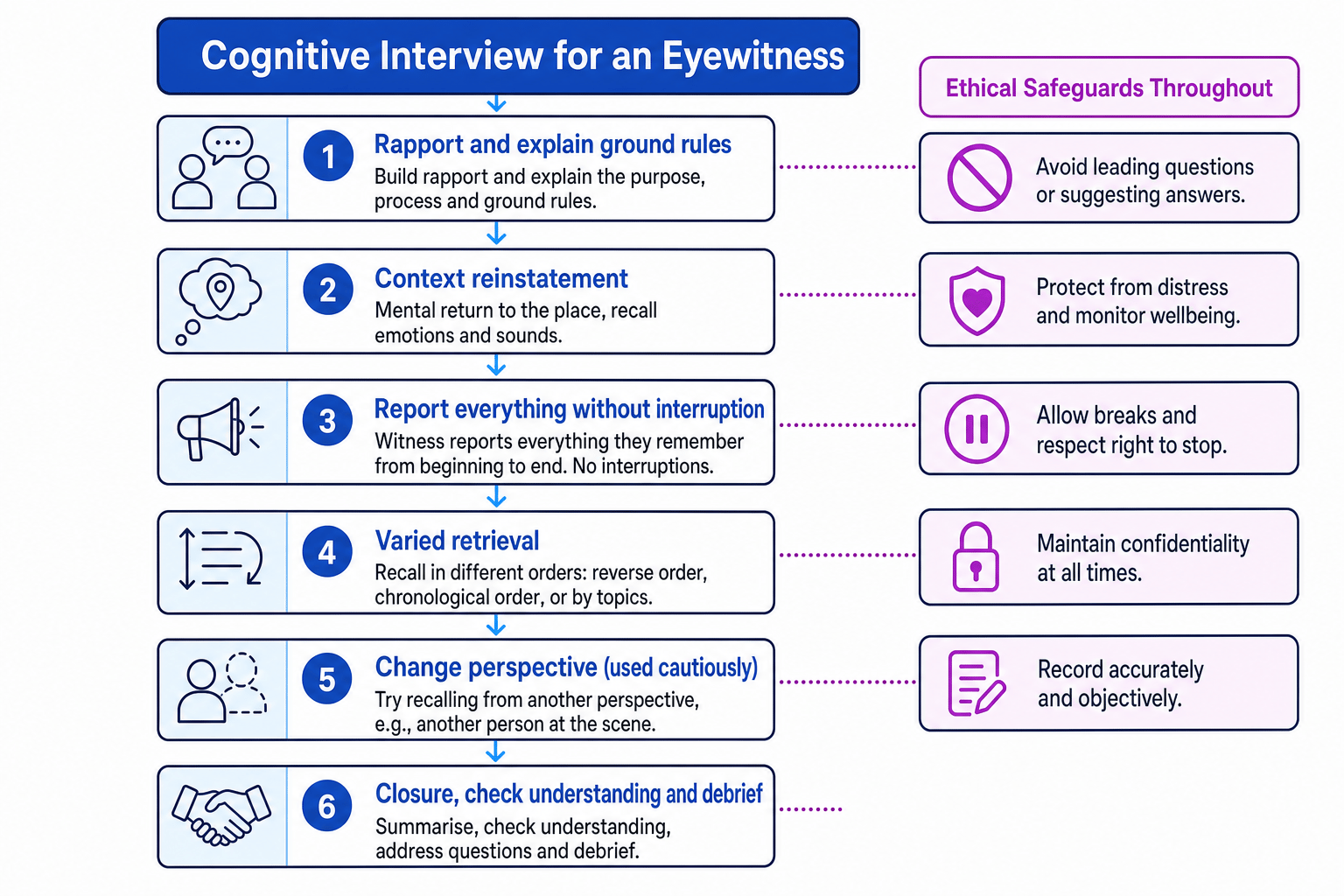
The four core cognitive interview techniques
1. Context reinstatement
Context reinstatement means asking the witness to mentally return to the situation. They may be asked to think about the location, weather, sounds, smells, lighting, their emotions, and what they were doing just before the event.
This is based on the encoding specificity principle: recall is better when the cues available during retrieval match the cues present when the memory was first encoded.
2. Report everything
The witness is encouraged to report every detail, even if it seems trivial, incomplete, or out of order. A small detail may cue another memory or become useful when combined with other evidence.
3. Recall in a different order
The witness may be asked to recall events from the end backwards, or from a different starting point. This can reduce the influence of schemas because the person is less able to rely on a neat, expected “story”.
4. Recall from a changed perspective
The witness may be asked to describe the event from another viewpoint, such as where another witness was standing. This can sometimes cue further details.
However, this technique must be used carefully because it may encourage guessing or imagination, especially with children or distressed witnesses.
Treating the cognitive interview as interrogation
The cognitive interview is not about pressuring someone to confess or forcing a witness to be certain. Its purpose is to support accurate recall while minimising contamination.
Choosing cognitive interview prompts
A witness saw a burglary from a window but is anxious and says, “It all happened too fast.”
- Start with rapport and control: explain that they can take breaks and should say if they are unsure, reducing pressure to please the interviewer.
- Use context reinstatement: ask them to picture where they were standing, what they could see from the window, and what sounds they heard.
- Use report everything: invite them to describe even partial details, such as movement, clothing, direction of travel, or fragments of speech.
- Delay changed-order recall until after the free account, because asking for reverse order too early may increase cognitive load.
- Avoid changed perspective if it requires guessing what the burglar saw; only ask about viewpoints the witness could realistically know.
The enhanced cognitive interview
The enhanced cognitive interview adds social and communication techniques to the original four methods. Fisher et al. (1987, 1989) found that interviewer behaviour matters: witnesses recall more when they feel listened to and are not constantly interrupted.
Useful features include:
- Rapport-building: creating a calm, respectful relationship.
- Open-ended questions: questions that allow detailed answers, such as “Tell me everything you remember.”
- Witness-compatible questioning: following the witness’s mental order rather than forcing the interviewer’s checklist.
- Active listening: showing attention without suggesting answers.
- Transfer of control: making it clear that the witness, not the interviewer, has the information.
AO1 shortcut
For description questions, remember: context, everything, order, perspective. Then add enhanced features such as rapport, open questions, no interruptions, and witness control.
Ethical interview techniques
An ethical interview gathers information while respecting rights, dignity, welfare, and the integrity of evidence. In UK psychology, this links to the BPS Code of Ethics and Conduct (2009): consent, protection from harm, confidentiality, right to withdraw, debrief, and honesty.
In forensic settings, ethics also link to legal safeguards such as PACE and the PEACE model used in investigative interviewing:
- Planning and preparation
- Engage and explain
- Account, clarification and challenge
- Closure
- Evaluation
PEACE is non-accusatory and information-gathering, which makes it more ethical than coercive interrogation.
Key ethical safeguards
Interviewers should:
- Explain the purpose of the interview and what will happen.
- Avoid deception, threats, false promises, and leading questions.
- Allow breaks and monitor distress.
- Respect the right to stop where possible, or explain legal limits clearly.
- Protect confidentiality and explain its limits.
- Use appropriate adults or specialist support for children and vulnerable people.
- Debrief by explaining next steps and checking wellbeing.
Confidentiality is not absolute
In forensic work, confidentiality may be limited by safeguarding concerns, serious risk of harm, or legal requirements. The ethical point is to explain these limits honestly rather than pretending secrecy is guaranteed.
Using interviews for case formulation
Interview information can help psychologists understand patterns in offending, but it must be combined with other evidence such as official records, victim statements, psychometric assessments, and observations.
A formulation may consider:
- Predisposing factors: long-term vulnerabilities, such as childhood abuse or impulsivity.
- Precipitating factors: immediate triggers, such as debt, alcohol, humiliation, or peer pressure.
- Perpetuating factors: things that maintain risk, such as antisocial peers or hostile thinking.
- Protective factors: strengths that reduce risk, such as employment, family support, or motivation to change.
Building a simple case formulation
An offender convicted of assault says he had been drinking, felt disrespected, and was with peers who encouraged him to “stand up for himself”.
- Separate evidence from interpretation: the interview provides possible triggers — alcohol, perceived disrespect, peer encouragement — but these are not yet proven causes.
- Form a cautious hypothesis: the assault may be linked to lowered inhibition, hostile interpretation of others’ behaviour, and social reinforcement from peers.
- Link the formulation to intervention: anger management, alcohol support, and work on peer influence may reduce future risk.
- Check the ethics: avoid presenting the formulation as an excuse or fixed personality label; it is a working explanation to guide support and risk management.
Evaluation: strengths and weaknesses
Strengths
The cognitive interview has strong research support. Geiselman et al. (1985) found that it improved recall compared with standard police interviews and hypnosis. Köhnken et al. (1999) and Memon et al. (2010) reviewed evidence showing that cognitive interviews generally increase correct detail.
It also has real-world value. Fisher et al. (1989) trained police detectives and found improvements in witness recall, suggesting the technique can be applied outside the laboratory.
Ethically, cognitive and PEACE-style interviews reduce pressure on witnesses and suspects. This may improve both wellbeing and evidence quality.
Weaknesses
The cognitive interview can take longer than a standard interview and requires training. In busy policing contexts, interviewers may not use all components properly.
Some techniques are more demanding than others. Recall in reverse order can increase cognitive load, and changed perspective can risk speculation. Evidence is also more mixed with very young children, people with learning difficulties, and highly traumatised witnesses unless the interview is adapted.
Many studies use staged events or videos, so ecological validity can be limited. Real crimes involve stress, fear, weapons, delay, and personal consequences, which may affect recall differently.
There is also an ethical tension: context reinstatement may improve recall but could make a victim relive distressing details. A skilled interviewer must balance evidence gathering with protection from harm.
In the exam
- For AO1, describe the cognitive interview using the four core techniques, then add enhanced features such as rapport and open-ended questioning.
- For AO2, apply the technique to the person in the scenario: witness, victim, suspect, child, distressed person, or offender in formulation.
- For AO3, balance research support with practical and ethical issues: time, training, ecological validity, distress, leading questions, and vulnerable interviewees.
Check yourself
- Why does context reinstatement help memory retrieval?
- Which cognitive interview technique is most likely to encourage guessing if used badly?
- How can an interviewer protect both the quality of evidence and the wellbeing of the interviewee?
