What you'll learn
- What cognitive-behavioural treatment means in criminological psychology.
- How anger management works as one cognitive-behavioural treatment for offenders.
- How to use Ireland (2004) as a study of effectiveness.
- How to evaluate the treatment using AO3: evidence, methodology, ethics, and real-world usefulness.
Why treat offenders?
In criminological psychology, treatment is not just about “being nice” to offenders. It is about reducing future harm by changing the factors that make offending more likely.
Punishment may deter some people, but if an offender still has poor impulse control, hostile thinking, or weak social skills, they may reoffend when they return to similar situations.
Recidivism
Recidivism means reoffending after conviction, punishment, or treatment. It is often measured using reconviction rates, but reconviction can underestimate true reoffending because not all crimes are detected or prosecuted.
What is a cognitive-behavioural treatment?
A cognitive-behavioural treatment is a psychological intervention that tries to change behaviour by changing the thoughts, interpretations, and learned responses that lead to that behaviour.
Cognitive-behavioural treatment
A cognitive-behavioural treatment combines cognitive work, which targets thoughts and beliefs, with behavioural work, which practises new actions and responses.
For offenders, the cognitive part might target thoughts such as “he disrespected me, so I had to hit him”. The behavioural part might involve practising calm communication, relaxation, or walking away from conflict.
Cognitive distortion
A cognitive distortion is a faulty or biased way of thinking that can make offending seem acceptable, justified, or unavoidable.
Common offender-related cognitive distortions include:
- Hostile attribution bias: assuming other people are deliberately trying to provoke or threaten you.
- Minimisation: downplaying the seriousness of harm caused.
- Entitlement thinking: believing you deserve something even if it harms others.
- Externalising blame: saying “they made me do it” instead of accepting responsibility.
Linking thoughts to aggressive offending
- An offender is pushed in a crowded corridor. The trigger is being pushed, but this alone does not fully explain the assault.
- The offender interprets the push as deliberate disrespect: “He thinks I’m weak.” This is a hostile attribution.
- That interpretation increases anger and physiological arousal, making aggression feel more justified.
- A cognitive-behavioural treatment would challenge the thought and practise a different response, such as checking the intention, using self-talk, or leaving the situation.
The treatment example: anger management
The specification gives examples such as CBT, social skills training, anger management, and assertiveness training. Here, we will focus on anger management as the cognitive-behavioural treatment.
Anger management
Anger management is a structured cognitive-behavioural treatment that teaches offenders to recognise anger triggers, challenge aggressive thoughts, reduce arousal, and practise non-violent responses.
Anger management is strongly linked to Novaco (1975), who argued that anger has three connected components:
- Cognitive: how the person interprets the situation.
- Physiological: bodily arousal, such as tension, sweating, or increased heart rate.
- Behavioural: what the person actually does, such as shouting, threatening, or attacking.
Anger is not the offence
Anger management does not aim to remove anger completely. It aims to help the offender notice anger earlier, reinterpret the situation, and choose a response that does not lead to harm or crime.
This diagram shows the basic CBT logic: treatment can interrupt the chain between trigger, thought, arousal, feeling, behaviour, and consequences.
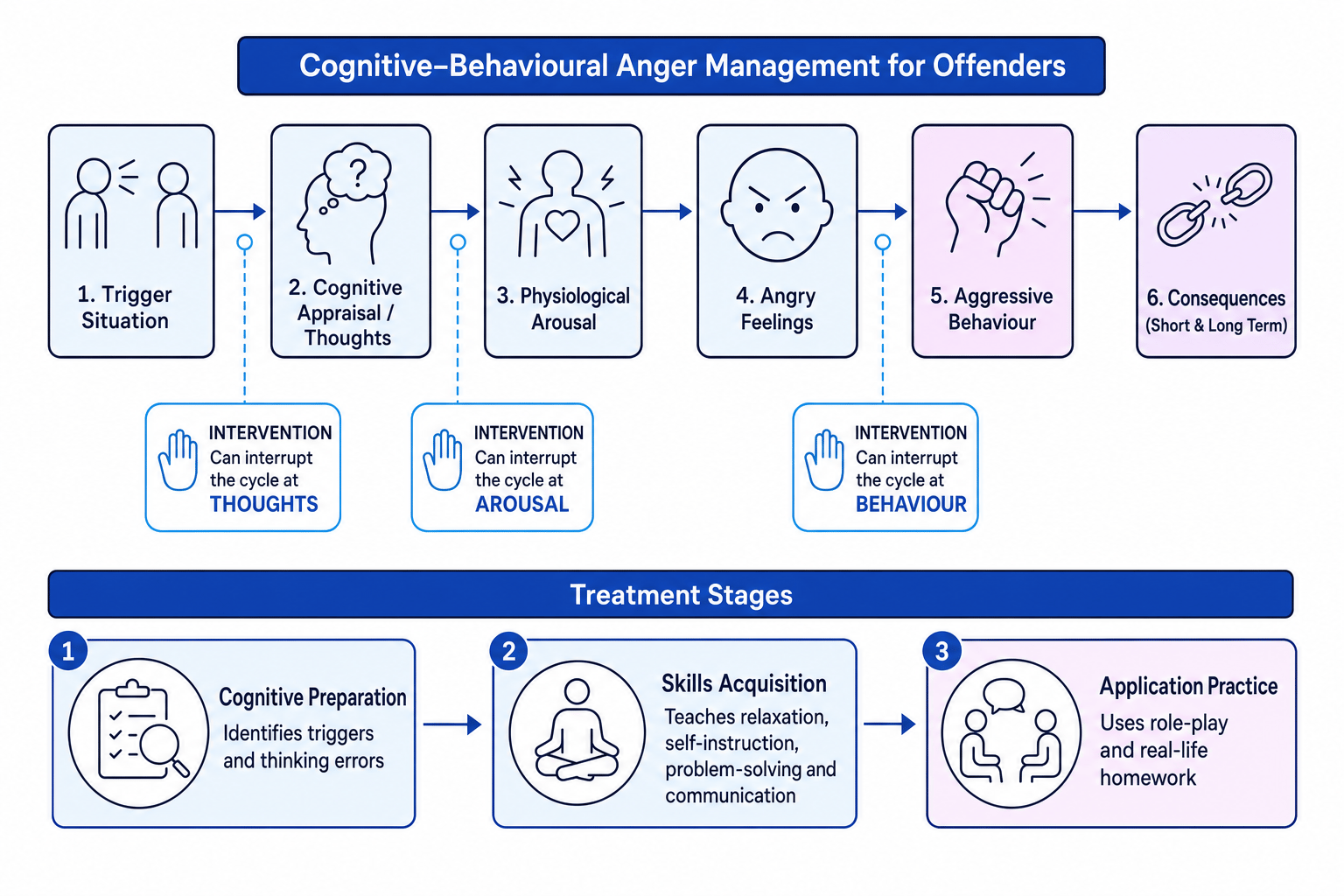
How anger management works
Most anger management programmes follow three broad stages.
1. Cognitive preparation
In cognitive preparation, the offender learns to understand their own anger pattern. They identify triggers, warning signs, and the thoughts that escalate anger.
A therapist may use anger diaries or the ABC model.
ABC model
The ABC model explains behaviour through an Activating event, a Belief or interpretation about that event, and a Consequence, such as anger or aggression.
For example, the activating event might be “someone laughed nearby”. The belief might be “they are laughing at me”. The consequence might be shouting or violence.
2. Skills acquisition
In skills acquisition, the offender learns practical techniques to control anger and behave differently.
These may include:
- Relaxation training, such as breathing exercises.
- Self-instruction, such as saying “stop and think” internally.
- Problem-solving, such as considering consequences before acting.
- Social skills training, such as listening, apologising, or negotiating.
- Assertiveness training, which means expressing needs or boundaries without aggression.
Assertiveness
Assertiveness means communicating your views, needs, or limits clearly without becoming passive or aggressive.
3. Application practice
In application practice, the offender rehearses the new skills in realistic situations. This might involve role-play, therapist feedback, group discussion, or homework tasks in prison or the community.
The aim is generalisation, meaning the offender can use the skills outside therapy when real provocation happens.
Choosing the right anger-management technique
- If an offender says, “When someone looks at me, they’re challenging me,” the main target is cognitive. The therapist would focus on challenging hostile interpretations.
- If the offender says, “I know I overreact, but my body takes over,” the main target is physiological arousal. Relaxation, breathing, and self-instruction would be useful.
- If the offender behaves calmly in therapy but becomes aggressive with peers, the main issue is applying skills in real contexts. Role-play, feedback, and homework would be needed.
When is this treatment most suitable?
Anger management is most relevant when offending is linked to aggression, impulsivity, or poor emotional regulation. It may be used with violent offenders, some young offenders, or offenders who regularly get into fights in prison.
It is less suitable when anger is not a main cause of the crime. For example, fraud, burglary, and some planned offences may involve calculation rather than anger.
Assuming all offending is anger-based
Do not write as if anger management treats every type of offender equally well. It is most appropriate when anger, aggression, or impulsive conflict is part of the offending pattern.
Study of effectiveness: Ireland (2004)
A useful study for this treatment is Ireland (2004), which investigated whether anger management reduced anger and aggression in young male offenders.
Aim
Ireland aimed to assess the effectiveness of an anger management programme for offenders in a secure setting.
Procedure
The study involved young male offenders. Some received anger management, while others acted as a comparison group. Anger and aggression were measured before and after the programme.
Measures included:
- Self-report questionnaires, where offenders rated their own anger.
- Staff ratings, where prison staff assessed behaviour and aggression.
Findings
Ireland found that offenders who completed anger management showed improvement on measures of anger and behaviour. A commonly reported finding is that most treated offenders improved on at least one measure, whereas the comparison group showed much less improvement.
Conclusion
The study suggests that anger management can be effective, especially for offenders whose crimes or institutional behaviour are linked to anger and aggression.
Measuring whether it works
Effectiveness can be measured in several ways:
- Reduced anger questionnaire scores.
- Fewer aggressive incidents in prison.
- Better staff ratings.
- Lower reconviction or reoffending rates after release.
- Qualitative feedback from offenders or staff.
Linking this to research methods
If you are asked about analysing treatment data, match the test to the design: Wilcoxon signed-ranks for before-and-after scores from the same offenders, Mann-Whitney U for treatment versus control groups, Spearman’s rho for a correlation such as anger score and number of incidents, and chi-square for an association such as treatment completion and reoffending category. Use critical-value tables and the usual significance level of p≤.05p \le .05p≤.05, with p≤.01p \le .01p≤.01 stricter and p≤.10p \le .10p≤.10 more lenient.
For Mann-Whitney U and Wilcoxon, the observed value normally needs to be equal to or less than the critical value. For Spearman’s rho and chi-square, the observed value normally needs to be equal to or greater than the critical value. A one-tailed test is only suitable if the direction of the prediction was stated in advance; otherwise, use a two-tailed test.
Strengths of anger management
It targets causes of aggression
A strength is that anger management targets the thought processes and skills deficits that may directly lead to violence. This gives offenders tools they can use in future situations, rather than simply punishing past behaviour.
It has real-world application
The treatment can be used in prisons, young offender institutions, probation settings, and community programmes. Group delivery can also make it relatively cost-effective.
It is less physically invasive than biological treatments
Compared with some biological treatments, cognitive-behavioural programmes do not directly alter the body. This can make them more ethically acceptable, especially when they support autonomy and informed participation.
Weaknesses of anger management
Evidence may be methodologically limited
Studies such as Ireland (2004) are useful because they take place in real offender settings, but they may have weaknesses. Samples can be small, male-only, or not randomly allocated. Self-report data can be affected by social desirability bias, where offenders give answers that make them look improved.
Improvement in anger scores may not equal reduced crime
An offender may learn to score better on questionnaires or behave better in prison but still reoffend after release. Long-term recidivism is harder to measure and can be affected by employment, peer groups, substance misuse, and housing.
It depends on motivation and engagement
CBT-style treatments require the offender to reflect on their thinking, practise skills, and accept some responsibility. Offenders who are unmotivated, have low literacy, or distrust professionals may benefit less.
It does not tackle all causes of crime
Anger management focuses mainly on individual cognition and behaviour. It may underplay wider social factors such as poverty, family conflict, peer pressure, and neighbourhood crime.
Ethics in offender treatment
The BPS Code of Ethics and Conduct (2009) still matters in secure settings: offenders should understand consent, right to withdraw, confidentiality, protection from harm, and debriefing. However, confidentiality may have limits if someone discloses a serious risk to others.
Overall judgement
Anger management is a strong example of a cognitive-behavioural treatment because it clearly combines thought change with behavioural practice. It is especially useful for aggressive or impulsive offenders.
However, your evaluation should be balanced. The treatment may reduce anger and improve behaviour, but it is not a universal cure for offending. The best answer links effectiveness to offender type, programme quality, motivation, and the strength of supporting evidence.
In the exam
- Start with clear AO1: define cognitive-behavioural treatment, then describe anger management using cognitive preparation, skills acquisition, and application practice.
- Use Ireland (2004) for evidence, but evaluate the method: self-report bias, comparison groups, sample issues, and whether recidivism was measured.
- Make your AO3 specific: say anger management is most suitable for aggression-related offending, not all crime.
Check yourself
- What makes anger management a cognitive-behavioural treatment rather than just “talking about anger”?
- How could hostile attribution bias lead to aggressive offending?
- What are two methodological weaknesses of using self-report questionnaires to measure treatment success?
