What you'll learn
- How brain structure and brain functioning can help explain aggression.
- Why the prefrontal cortex, amygdala and hypothalamus are especially important.
- How to apply this explanation to real-life aggressive behaviour.
- How to evaluate the explanation using research such as Raine et al. (1997).
Starting point: what counts as aggression?
Aggression
Aggression is behaviour intended to harm another person or living creature who is motivated to avoid that harm. In this topic, the brain explanation is especially useful for reactive aggression: impulsive aggression triggered by threat, frustration or anger.
Not all aggression is the same. Someone who lashes out after being insulted is showing reactive aggression. Someone who calmly plans violence to gain money or status is showing proactive aggression. Brain explanations often fit reactive, impulsive aggression best because they focus on threat, arousal and impulse control.
Brain structure versus brain functioning
Brain structure means the physical organisation of the brain: its regions, tissues and connections. Brain functioning means how active those areas are and how well they communicate.
A key idea is localisation of function, which means different brain areas are specialised for different jobs. However, aggression is not “stored” in one place. It is better understood as the result of neural circuits: networks of brain areas working together.
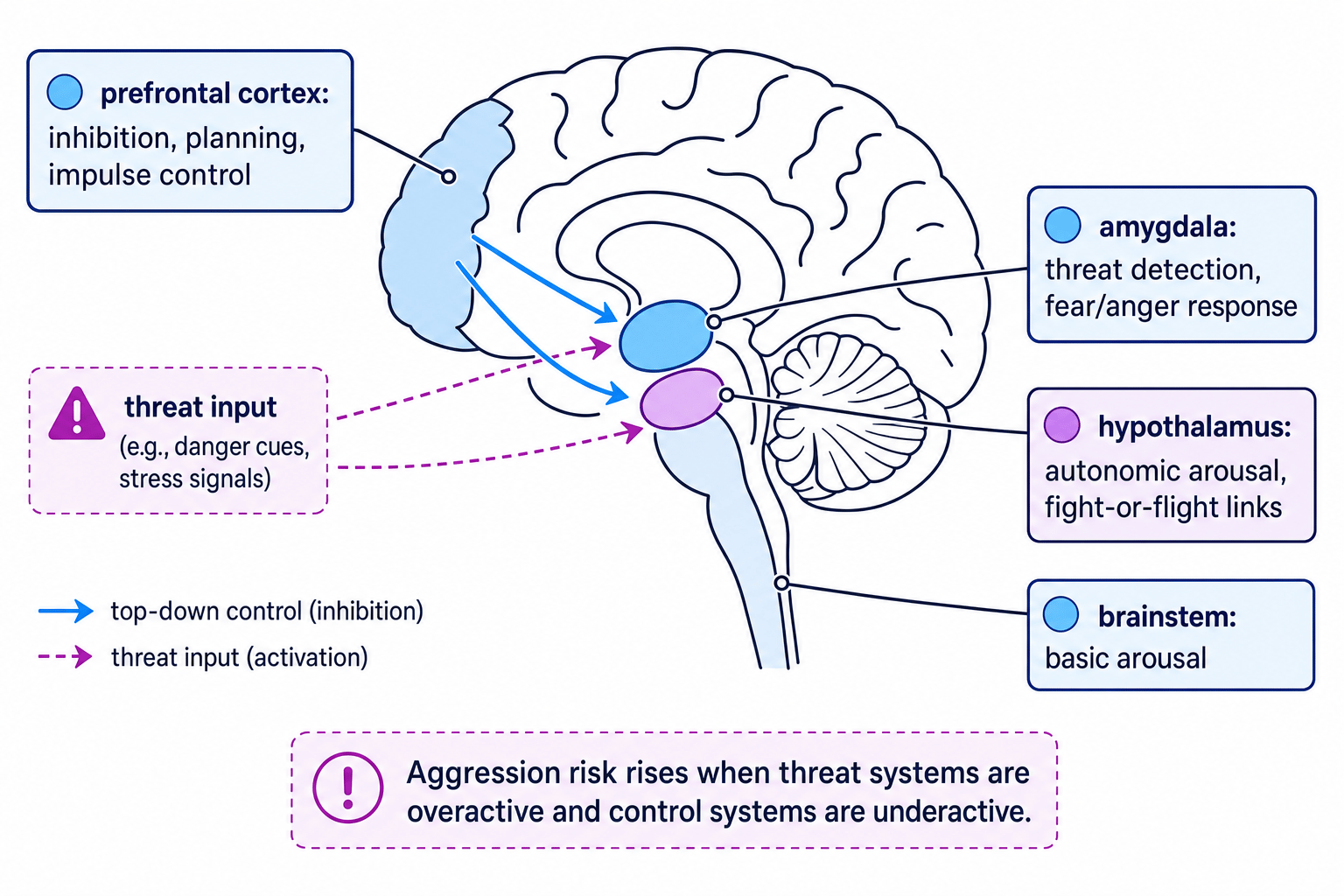
The diagram shows the main circuit you need for this spec point: threat systems such as the amygdala and hypothalamus, and control systems such as the prefrontal cortex.
The core explanation
Aggression becomes more likely when brain areas involved in threat and arousal are highly active, while brain areas involved in self-control and decision-making are underactive or poorly connected.
The prefrontal cortex: control and inhibition
The prefrontal cortex — sometimes written as the pre-frontal cortex in the specification — is the front part of the brain’s outer layer. It is involved in executive functions, meaning higher-level mental processes such as planning, decision-making, impulse control and considering consequences.
For aggression, the prefrontal cortex matters because it helps you pause before acting. It supports inhibition, which means suppressing an impulse that would be inappropriate or harmful.
If the prefrontal cortex is damaged, underactive or poorly connected to emotional brain areas, a person may find it harder to stop an aggressive impulse. This does not mean aggression is guaranteed, but it may increase risk, especially in provoking situations.
Reading the spec wording
The specification says “e.g. pre-frontal cortex”, so the prefrontal cortex is the safest core area to use. To build a stronger answer, link it to the amygdala and hypothalamus so you explain a circuit, not just one brain part.
The amygdala: threat detection and emotional response
The amygdala is a small structure in the limbic system, a group of brain areas involved in emotion and motivation. The amygdala helps detect threat and process fear, anger and emotionally important cues.
If the amygdala is overactive to threat cues — such as angry faces, insults or sudden movements — a person may interpret situations as more hostile than they really are. This can increase anger and make reactive aggression more likely.
However, the relationship is not simple. Some forms of aggression, especially cold or instrumental aggression, may involve reduced emotional responsiveness rather than over-arousal. For example, a person with low fear or low empathy may harm others without feeling much emotional distress.
The hypothalamus: arousal and fight-or-flight
The hypothalamus is a small brain area below the thalamus. It helps regulate basic survival responses, including arousal, stress and links with the autonomic nervous system.
The autonomic nervous system controls automatic bodily processes such as heart rate and sweating. When a threat is detected, the hypothalamus helps prepare the body for fight-or-flight. In an aggressive situation, this arousal can make a physical response more likely.
The hypothalamus is not a “violence button”. It is better seen as part of the system that prepares the body for action when the brain interprets something as dangerous.
The aggression centre mistake
Do not write that one brain area “causes aggression” on its own. A stronger A-Level answer explains interaction: threat detection, bodily arousal and reduced inhibitory control.
How the brain explanation works
A simple sequence looks like this:
- A person notices a possible threat, such as being pushed or insulted.
- The amygdala evaluates the cue as emotionally significant or dangerous.
- The hypothalamus increases arousal and prepares the body for action.
- The prefrontal cortex should evaluate context and consequences.
- Aggression is more likely if the control system is weak compared with the threat/arousal system.
Applying the brain explanation to impulsive aggression
A student is shoved in a corridor, instantly assumes it was deliberate, and hits the other person.
- Classify the behaviour as reactive aggression because it is sudden, emotional and triggered by provocation rather than carefully planned.
- Apply the amygdala: the shove may be interpreted as a threat, increasing anger and focusing attention on danger cues.
- Apply the hypothalamus: bodily arousal rises, preparing the student for a fight-or-flight response.
- Apply the prefrontal cortex: if inhibitory control is weak, the student may fail to weigh consequences such as punishment, injury or guilt.
- Add balance: this explanation increases the likelihood of aggression; it does not prove the student had no choice or that social factors were irrelevant.
Evidence for brain structure and aggression
Raine et al. (1997): PET scans of murderers
A key classic study is Raine et al. (1997). They used PET scanning, a brain-imaging technique that estimates activity by measuring glucose metabolism. Higher glucose use suggests higher brain activity.
Raine et al. compared 41 murderers pleading not guilty by reason of insanity with 41 matched controls. Participants completed an attention task during the scan. The murderers showed reduced activity in areas including the prefrontal cortex, and abnormal patterns in limbic areas such as the amygdala, hippocampus and thalamus.
This supports the explanation because reduced prefrontal activity could mean weaker impulse control, while abnormal limbic functioning could affect emotion and threat processing.
AO3 evaluation: the study used objective biological measures and a matched control group, which strengthens scientific credibility. However, it is correlational, so we cannot be sure whether brain differences caused the violence. The sample was also extreme, so findings may not generalise to everyday aggression.
Harlow (1868): Phineas Gage
An early case often used for background support is Harlow’s (1868) account of Phineas Gage. Gage survived serious frontal-lobe damage and reportedly became more impulsive, rude and socially inappropriate afterwards.
This supports the idea that frontal brain areas help regulate behaviour. But it is only a single case study, reported historically, so it lacks control and cannot prove a general rule.
Contemporary support: Yang and Raine (2009), Coccaro et al. (2007)
Yang and Raine (2009) reviewed brain-imaging evidence and found that antisocial and violent individuals often show structural or functional abnormalities in the prefrontal cortex. This is useful because a review can show whether findings are consistent across studies.
Coccaro et al. (2007) used brain imaging with people showing impulsive aggression and found atypical responses in the amygdala and orbitofrontal cortex when processing social threat. The orbitofrontal cortex is a prefrontal region involved in evaluating rewards, punishments and social consequences.
Together, these studies support the idea that aggression involves both emotional reactivity and reduced regulation.
Ethics when studying aggressive brains
Research with offenders, psychiatric patients or people with impulsive aggression raises ethical issues. The BPS Code of Ethics and Conduct (2009) highlights consent, right to withdraw, protection from harm, confidentiality and debrief.
PET scans may involve radioactive tracers, so protection from harm is important. Researchers must also avoid labelling people as “born aggressive” based on brain data, because this could create stigma and affect legal or social treatment.
Evaluation of the explanation
Strengths
One strength is that brain explanations are supported by scientific methods such as PET and fMRI scans. These methods provide objective evidence rather than relying only on self-report.
Another strength is real-world application. If aggression is partly linked to poor impulse control, interventions can target self-regulation, emotional recognition and decision-making. This could be useful in offender rehabilitation or clinical treatment for impulsive aggression.
Weaknesses
A major weakness is the problem of cause and effect. Brain differences may contribute to aggression, but aggressive lifestyles, childhood trauma, substance misuse or head injury may also change brain functioning.
The explanation can also be criticised as biologically reductionist, meaning it may oversimplify aggression by focusing on biology while underplaying learning, culture, social norms and situational triggers.
Finally, it can become deterministic if written badly. Determinism means suggesting behaviour is controlled by forces outside personal choice. A balanced answer should say brain differences increase risk; they do not make aggression inevitable.
In the exam
- Start with clear AO1: name the brain area, define its function, then link it directly to aggression.
- Use evidence carefully: Raine et al. (1997) is strong for PET evidence, but evaluate causality, sample issues and generalisability.
- Keep your conclusion balanced: brain structure and functioning can explain vulnerability to aggression, not a guaranteed “aggressive brain”.
Check yourself
- How does reduced prefrontal cortex activity make impulsive aggression more likely?
- Why might an overactive amygdala increase reactive aggression?
- What is one strength and one weakness of using Raine et al. (1997) as evidence?
