What you'll learn
- How Darwin’s idea of natural selection can be used to explain behaviour.
- Why evolutionary explanations focus on survival and reproductive success.
- How aggression may have been adaptive in some ancestral contexts.
- How to evaluate evolutionary explanations using evidence, methodology, ethics, and real-world application.
The big idea: why evolution matters in psychology
Evolutionary explanations ask: why might a behaviour have helped humans survive or reproduce in the past?
Charles Darwin (1859) argued that species change over time because some inherited characteristics make survival and reproduction more likely. Psychology applies this logic to behaviour: if a behaviour helped our ancestors solve important problems, the biological tendency for that behaviour may have become more common over generations.
Evolutionary psychology
Evolutionary psychology is an approach that explains behaviour as the result of psychological mechanisms shaped by evolution because they helped ancestors survive, reproduce, or protect relatives.
This does not mean every behaviour is directly caused by genes, or that humans are “programmed” to behave in one fixed way. It means humans may have inherited predispositions: tendencies that make some behaviours more likely in particular situations.
The logic of natural selection
To understand natural selection, build it in small steps.
A trait is a characteristic of an organism. Traits can be physical, such as height, or behavioural, such as a tendency to respond quickly to threat. Genes are sections of DNA that influence characteristics, although most human behaviours are affected by many genes and by the environment.
A selection pressure is a challenge in the environment that affects survival or reproduction. Examples include predators, food shortages, competition for mates, or threats from rival groups.
Natural selection
Natural selection is the process where inherited traits that increase survival or reproductive success become more common in a population over many generations.
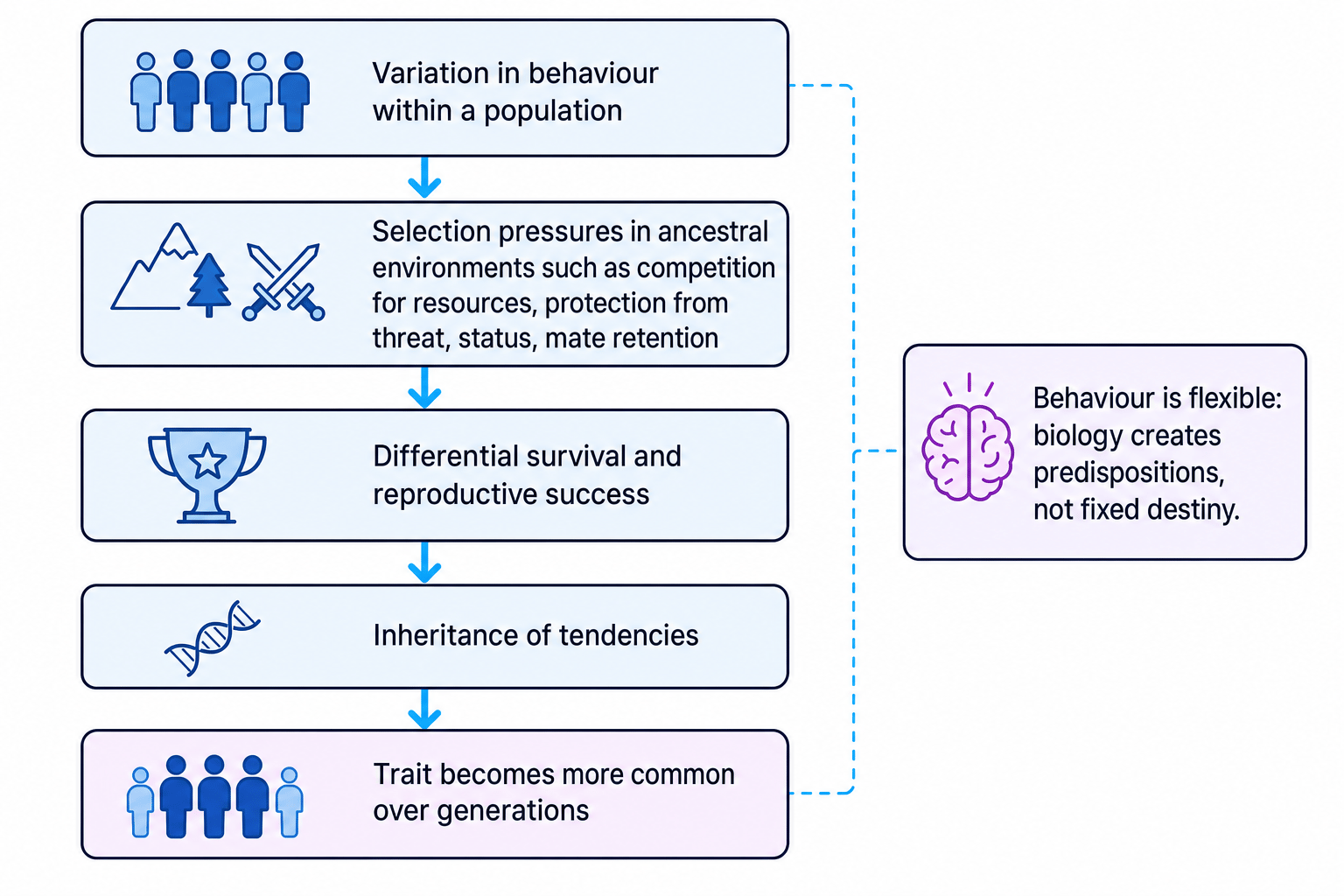
Natural selection is easiest to see as a chain: people vary, some variations fit the environment better, those individuals are more likely to survive and reproduce, and their traits are more likely to be passed on.
Population change, not individual change
Natural selection does not mean an individual changes because they “need” to. It means inherited traits become more or less common in a population over generations.
Applying natural selection to aggression
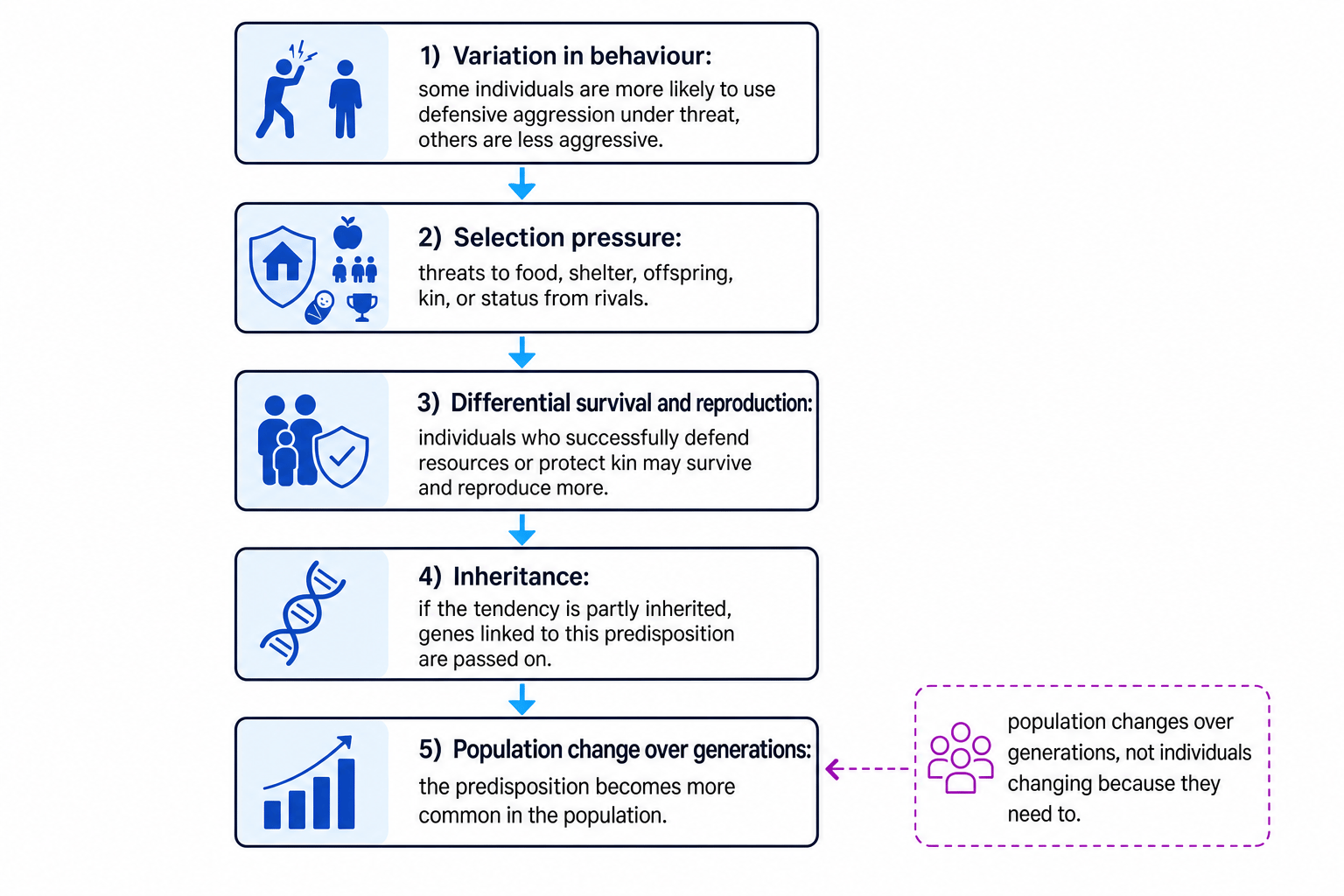
Imagine an ancestral environment where individuals sometimes had to defend food, shelter, or family members from attack.
- Identify the behavioural variation: Some individuals may have been more willing to use aggression when threatened, while others avoided confrontation.
- Link the variation to a selection pressure: If resources or safety were at risk, defensive aggression could sometimes reduce harm or protect access to food and shelter.
- Connect this to reproductive success: Individuals who survived threats and protected dependants may have been more likely to live long enough to reproduce or help relatives survive.
- Add inheritance carefully: If the tendency to respond aggressively under threat was partly inherited, genes linked to that predisposition could become more common over generations.
Adaptations and reproductive fitness
An adaptation is an inherited characteristic that has been shaped by selection because it helped ancestors survive or reproduce. In psychology, an adaptation might be a mental mechanism, such as fear of danger, preference for high-energy food, attachment to caregivers, or rapid detection of social threat.
Reproductive fitness means success in passing genes to future generations. This can happen directly, by having offspring, or indirectly, by helping close relatives survive because relatives share some genes. This indirect route is called inclusive fitness.
Adaptive does not mean morally good
In evolutionary psychology, “adaptive” means useful for survival or reproduction in an ancestral environment. It does not mean acceptable, desirable, or justified today.
Ultimate and proximate explanations
Evolutionary explanations are often called ultimate explanations because they ask what a behaviour may have been for in terms of evolutionary function.
A proximate explanation focuses on the immediate cause of behaviour, such as brain activity, hormones, neurotransmitters, learning, or social cues.
Both levels can be true at the same time.
| Type of explanation | Main question | Example for aggression |
|---|---|---|
| Proximate | What causes the behaviour now? | High arousal, testosterone, alcohol, provocation, amygdala activity |
| Ultimate | Why might the tendency have evolved? | Defending resources, deterring rivals, protecting offspring, gaining status |
Distinguishing proximate and ultimate explanations
A person becomes aggressive after being publicly insulted in front of peers.
- Proximate level: The immediate trigger is the insult, which may increase arousal and anger in that social situation.
- Ultimate level: An evolutionary explanation might argue that public status threats were important in ancestral groups because low status could reduce access to resources, allies, or mates.
- Balanced conclusion: The evolutionary account explains why humans may be sensitive to status threats, but the actual behaviour still depends on learning, culture, self-control, and the situation.
Evolutionary explanations of aggression
Aggression is behaviour intended to cause physical or psychological harm. In evolutionary psychology, aggression is usually explained as a conditional strategy: it may be more likely when the potential benefits outweigh the costs.
Aggression is costly. It can lead to injury, retaliation, punishment, or exclusion from the group. So an evolutionary explanation does not predict constant aggression. It predicts aggression in contexts where it may historically have improved survival or reproductive success.
Resource defence
Aggression may have helped ancestors defend valuable resources such as food, territory, shelter, or tools. Someone able to deter theft or invasion may have improved their own survival and the survival of dependants.
Protection of self, offspring, and kin
Aggression may also be explained through protection. If a threat endangered offspring or close relatives, defensive aggression could increase inclusive fitness because protecting relatives also protects shared genes.
Status and rivalry
In some social groups, status affects access to resources, allies, and mates. Aggression may have evolved partly as a way to deter rivals or avoid being exploited.
Wilson and Daly (1985) described a “young male syndrome”, arguing that young men may be more likely to take risks and use violence in status competition, especially when they have less to lose. Daly and Wilson (1988) also used homicide evidence to argue that male-male violence often relates to rivalry, status, and sexual jealousy.
Sexual selection and mate retention
Sexual selection is a form of selection where traits evolve because they increase mating success. Intrasexual competition means competition within one sex, often over access to mates. In evolutionary explanations of aggression, this is often used to explain male rivalry or mate-guarding behaviour.
Buss et al. (1992) linked sexual jealousy to mate retention, suggesting that jealousy may have evolved because ancestral humans faced reproductive threats such as infidelity or loss of a partner. However, this is socially sensitive and must be treated carefully.
Aggression as a flexible predisposition
Evolutionary explanations do not say humans are naturally violent all the time. They suggest humans may have evolved flexible tendencies to use aggression in certain contexts, such as threat, rivalry, resource defence, or protection of kin.
Evidence you can use
Darwin (1859) provides the foundation: inherited traits that increase survival and reproduction become more common. Lorenz (1966) later argued that aggression in animals can have adaptive functions such as spacing individuals out and protecting territory, though applying animal behaviour directly to humans is a weakness.
Daly and Wilson (1988) provide useful evidence because homicide patterns often involve young males, rivalry, and jealousy. This supports the idea that some forms of aggression may be linked to evolved pressures around status and reproduction.
Buss et al. (1992) can be used for sexual jealousy and mate retention, although findings about sex differences in jealousy are debated and may be influenced by culture, social norms, and measurement methods.
Ethically, research on aggression, jealousy, and sex differences is socially sensitive. Under the BPS Code of Ethics and Conduct (2009), researchers must consider consent, confidentiality, protection from harm, right to withdraw, and debriefing. Archival research using homicide records must be anonymised and reported respectfully to avoid harm to victims’ families or reinforcing stereotypes.
Evaluating evolutionary explanations
Strengths
Evolutionary explanations are useful because they explain why some behaviours appear across cultures and history. If similar patterns of rivalry, jealousy, or defensive aggression appear in many societies, this may suggest a shared evolved basis.
They also fit well with biological psychology. For example, aggression can be studied through hormones, brain regions, genetics, and neurotransmitters as proximate mechanisms, while evolution explains why those mechanisms may exist.
A further strength is real-world application. Understanding status threat, jealousy, and resource competition can help design violence-reduction strategies, such as de-escalation training, conflict mediation, and interventions that reduce humiliation or rivalry.
Weaknesses
A major weakness is that evolutionary explanations can be difficult to test directly. We cannot observe ancestral environments, so explanations may become “just-so stories”: plausible accounts that are hard to prove or falsify.
Another weakness is reductionism. Aggression is not caused by evolution alone. Learning, culture, family environment, social norms, alcohol, poverty, peer influence, and self-control all affect aggressive behaviour.
There is also contradictory evidence. Levels and forms of aggression vary greatly between societies and across historical periods. This suggests that culture and environment strongly shape whether any evolved predispositions are expressed.
Finally, evolutionary explanations can be socially sensitive. If presented badly, they may seem to excuse violence or reinforce gender stereotypes. In an exam, make it clear that explaining possible origins of aggression does not justify harmful behaviour.
A strong AO3 chain
For evaluation, try to move from point to why it matters to impact on the explanation. For example: “Ancestral environments cannot be directly observed, so the explanation is hard to falsify; this weakens scientific validity because alternative explanations may fit the same behaviour.”
Bringing AO1, AO2, and AO3 together
For AO1, describe the evolutionary logic: inherited variation, selection pressures, reproductive success, and traits becoming more common over generations.
For AO2, apply this to the scenario. If the question gives you aggression after jealousy, status threat, or resource competition, link the behaviour to an adaptive problem.
For AO3, evaluate with evidence and limitations. Use named research where possible, but avoid sounding as if evolution is the only explanation.
In the exam
- Start with the natural selection chain: variation, selection pressure, survival/reproduction, inheritance, population change.
- For aggression, apply the theory to a specific adaptive problem such as resource defence, status rivalry, mate retention, or protection of kin.
- Evaluate carefully: use evidence such as Daly and Wilson (1988), then balance it with issues of testability, cultural variation, reductionism, and social sensitivity.
Check yourself
- Can you explain the difference between a proximate and an ultimate explanation of aggression?
- Why does “adaptive” not mean “morally acceptable”?
- What is one strength and one weakness of using evolutionary theory to explain human aggression?