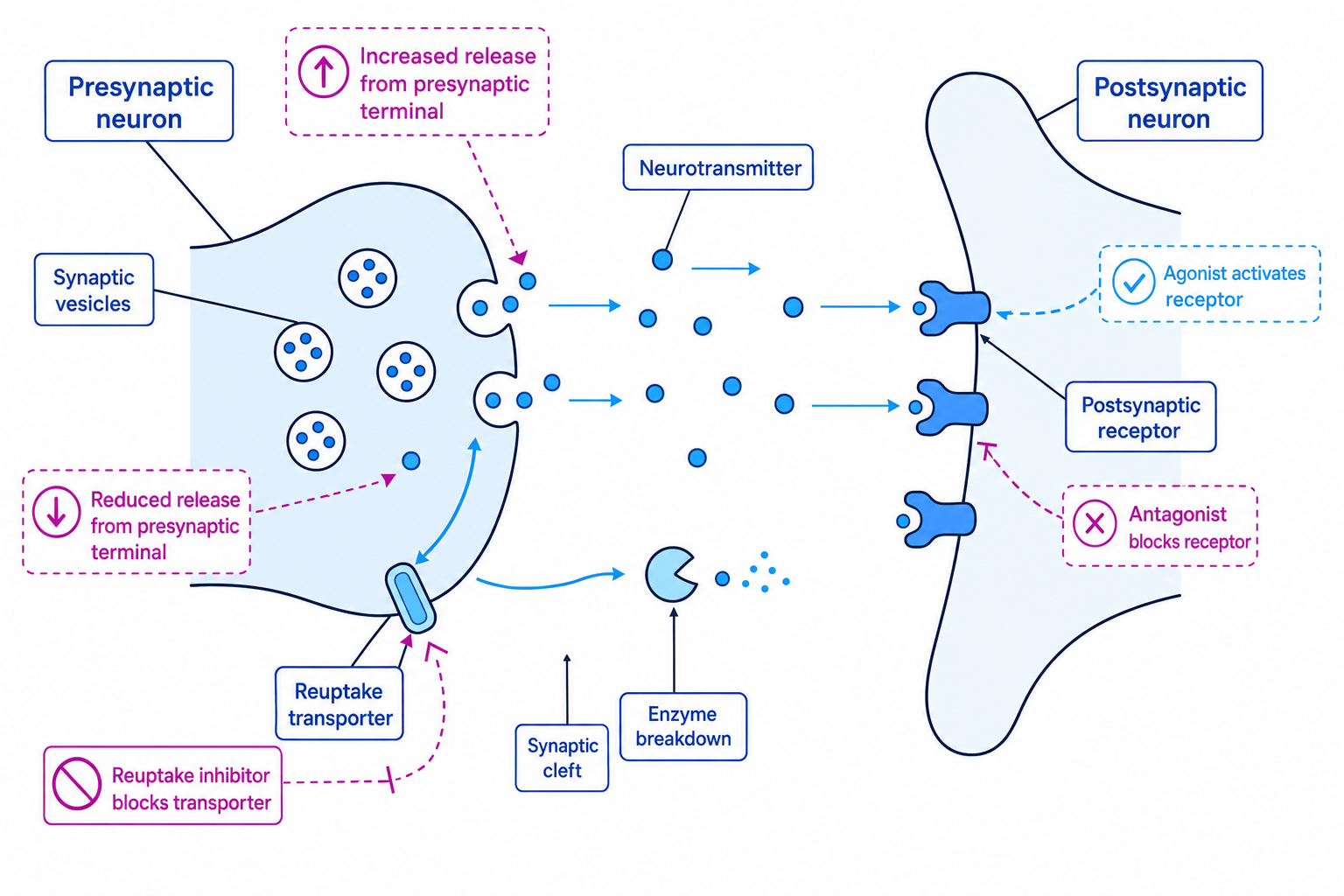
What you'll learn
- How messages are transmitted between neurons in the central nervous system.
- How recreational drugs alter synaptic transmission.
- The key drug mechanisms: agonists, antagonists, reuptake inhibition, and altered neurotransmitter release.
- How to write clear AO1, AO2 and AO3 points about drug effects.
The starting point: the central nervous system
The central nervous system, or CNS, is the part of the nervous system made up of the brain and spinal cord. It processes information, coordinates responses, and is involved in thoughts, emotions, movement, perception and behaviour.
A neuron is a nerve cell specialised for sending and receiving information. Neurons communicate using both electrical and chemical signals.
Central nervous system
The central nervous system is the brain and spinal cord. Recreational drugs affect behaviour because they change communication between neurons in the CNS.
Neural transmission: how neurons communicate
A message travels along a neuron as an action potential, which is a brief electrical impulse. When the action potential reaches the end of the neuron, communication becomes chemical.
The small gap between two neurons is called a synapse. The neuron sending the message is the presynaptic neuron, and the neuron receiving the message is the postsynaptic neuron.
Synaptic transmission
Synaptic transmission is the process by which a neuron communicates with another neuron across a synapse using chemical messengers called neurotransmitters.
The basic sequence
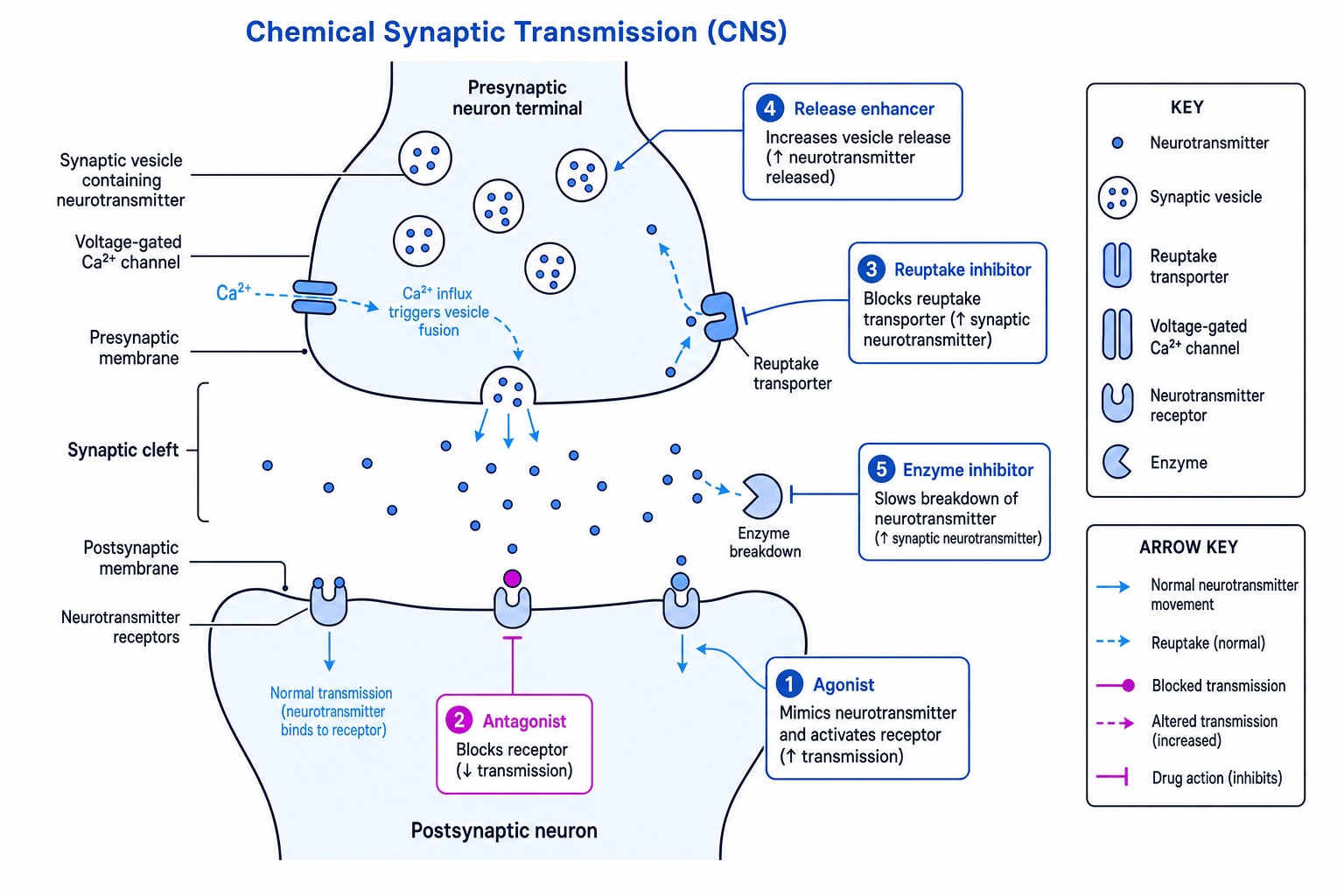
In normal chemical transmission:
- An action potential reaches the presynaptic terminal.
- Tiny sacs called vesicles release neurotransmitters into the synaptic cleft, the gap between neurons.
- The neurotransmitter diffuses across the cleft.
- It binds to receptors, which are specialised sites on the postsynaptic neuron.
- This changes the activity of the postsynaptic neuron, making it more or less likely to fire.
- The neurotransmitter is removed by reuptake, where it is taken back into the presynaptic neuron, or by enzymatic breakdown, where enzymes break it down.
The diagram below shows normal synaptic transmission and the main points where recreational drugs can interfere with the process.
Transmission is targeted
Most recreational drugs do not create behaviour directly. They alter the chemical communication between neurons, which then affects brain systems involved in mood, reward, perception, memory and control.
Neurotransmitters: chemical messengers
A neurotransmitter is a chemical messenger released by a neuron. Different neurotransmitters are linked with different kinds of activity in the CNS.
Important examples include:
- Dopamine: involved in reward, motivation, pleasure and movement.
- Serotonin: involved in mood, sleep, appetite and emotional regulation.
- GABA: the main inhibitory neurotransmitter, meaning it reduces neural activity.
- Glutamate: the main excitatory neurotransmitter, meaning it increases neural activity.
- Endorphins: natural opioid chemicals involved in pleasure and pain reduction.
Excitatory and inhibitory effects
An excitatory effect makes a postsynaptic neuron more likely to fire. An inhibitory effect makes it less likely to fire.
This matters because a drug can increase one neurotransmitter but still reduce overall activity in a brain pathway if that neurotransmitter is inhibitory.
Assuming all drugs simply increase transmission
Some drugs increase transmission, some decrease it, and some increase one pathway while reducing another. Always explain the specific neurotransmitter and receptor involved.
What is a recreational drug?
A recreational drug is a substance taken for its psychological effects, such as pleasure, relaxation, confidence, altered perception or stimulation, rather than mainly for medical treatment. Some are illegal, such as cocaine and MDMA, while others may be legal but still psychoactive, such as alcohol and nicotine.
Psychoactive drug
A psychoactive drug is a substance that affects the CNS and changes mood, perception, cognition or behaviour.
Main ways recreational drugs affect transmission
1. Agonists: increasing receptor activity
An agonist is a drug that activates a receptor. It may mimic the neurotransmitter and produce a similar effect, or it may increase the receptor’s response.
For example, nicotine acts as an agonist at nicotinic acetylcholine receptors. This can indirectly increase dopamine activity in reward pathways, contributing to reinforcement and dependence.
2. Antagonists: blocking receptor activity
An antagonist is a drug that blocks a receptor. It prevents the neurotransmitter from binding properly, so the postsynaptic neuron is less affected by that neurotransmitter.
Some drugs have antagonist effects at certain receptors, reducing normal transmission in those pathways.
3. Reuptake inhibitors: keeping neurotransmitters in the synapse
A reuptake inhibitor blocks the transporter that normally takes neurotransmitter back into the presynaptic neuron. This means more neurotransmitter remains in the synaptic cleft for longer.
For example, cocaine blocks the reuptake of dopamine, and also affects noradrenaline and serotonin. This increases stimulation of postsynaptic receptors, especially in reward-related areas.
Explaining cocaine’s effect on dopamine
- Cocaine blocks dopamine reuptake transporters, so dopamine is not removed from the synaptic cleft as quickly as usual.
- Because dopamine remains in the cleft for longer, it binds repeatedly to dopamine receptors on the postsynaptic neuron.
- This increases activity in reward pathways, helping to explain short-term euphoria, alertness and the reinforcing effects of cocaine.
4. Increasing neurotransmitter release
Some drugs cause the presynaptic neuron to release more neurotransmitter than usual.
For example, MDMA, also called ecstasy, increases serotonin release and interferes with serotonin reuptake. This can produce short-term feelings of empathy, energy and emotional closeness. However, later serotonin depletion may be linked with low mood, irritability or fatigue.
5. Reducing neurotransmitter release
Some drugs reduce the amount of neurotransmitter released from the presynaptic neuron.
For example, THC, the main psychoactive chemical in cannabis, binds to CB1 cannabinoid receptors. These receptors are often found on presynaptic terminals and can reduce the release of other neurotransmitters. This can affect memory, perception, attention and coordination.
Key examples of recreational drugs
| Drug | Main transmission effect | Possible psychological or behavioural effect |
|---|---|---|
| Cocaine | Blocks dopamine reuptake | Euphoria, alertness, increased reinforcement |
| MDMA/ecstasy | Increases serotonin release and affects reuptake | Empathy, energy, later low mood |
| Cannabis/THC | Activates CB1 receptors and alters neurotransmitter release | Relaxation, altered perception, memory impairment |
| Alcohol | Enhances GABA and reduces glutamate activity | Slower reaction times, disinhibition, impaired coordination |
| Heroin/opioids | Activates opioid receptors | Euphoria, pain reduction, respiratory risk |
| Nicotine | Activates nicotinic acetylcholine receptors | Increased alertness, dopamine-related reinforcement |
Use the three-link chain
For AO1 or AO2, link drug mechanism → neurotransmitter effect → behaviour. For example: cocaine blocks dopamine reuptake → more dopamine stimulates receptors → increased reward and euphoria.
A slightly trickier idea: disinhibition
Disinhibition means reducing the activity of an inhibitory neuron, which can increase activity elsewhere.
This is important for understanding opioids such as heroin. Heroin is converted into morphine-like chemicals in the body. These activate opioid receptors. In some reward pathways, opioids inhibit GABA neurons. Since GABA normally inhibits dopamine neurons, reducing GABA activity can allow dopamine activity to increase.
Explaining opioid disinhibition
- GABA neurons usually reduce the firing of dopamine neurons, so they act like a brake on dopamine activity.
- Heroin activates opioid receptors on these GABA neurons, reducing GABA release.
- With less GABA inhibition, dopamine neurons become more active, which can increase reward and euphoria.
Why effects vary between drugs and people
Drug effects depend on several factors:
- Dose: larger doses usually produce stronger effects and more risk.
- Route of administration: smoking, injecting, swallowing or snorting can affect how quickly the drug reaches the CNS.
- Tolerance: after repeated use, the brain may become less responsive, so more of the drug is needed for the same effect.
- Individual differences: genes, previous experience, mental health and context can influence effects.
- Brain region: the same neurotransmitter can have different effects in different pathways.
Same neurotransmitter, different outcome
Do not assume dopamine, serotonin or GABA has one fixed effect everywhere in the brain. The outcome depends on the receptor type, brain region and whether the pathway is excitatory or inhibitory overall.
AO3: evaluating explanations based on drug transmission
Strength: strong biological plausibility
This explanation is strong because recreational drugs can be shown to act on receptors, transporters and neurotransmitter systems. For example, cocaine’s effect on dopamine reuptake is a clear biological mechanism that links synaptic activity to reward and reinforcement.
Strength: real-world applications
Understanding transmission helps explain addiction and informs treatment. For example, treatments for nicotine dependence may target receptor systems, while harm-reduction advice for MDMA can be linked to its effects on serotonin, overheating and dehydration risk.
Weakness: reductionism
A reductionist explanation reduces complex behaviour to a small number of biological processes. Drug use is not only about neurotransmitters. Social factors, expectations, stress, peer influence and learning also affect whether someone uses a drug and how they respond to it.
Weakness: ethical and methodological issues
Research on recreational drugs can be difficult because it may be unethical to expose participants to harmful substances. Researchers must consider the BPS Code of Ethics and Conduct, 2009, including informed consent, protection from harm, right to withdraw, confidentiality and debriefing.
Naturalistic studies of drug users may have better real-world validity, but they often have weaker control over dose, purity, previous drug history and other confounding variables.
Forgetting AO3 balance
A strong answer should not just describe neurotransmitters. Add evaluation: biological evidence is useful, but drug effects are also shaped by context, expectations, individual differences and ethical limits in research.
Pulling it together for an essay paragraph
A clear AO1 paragraph might say:
Recreational drugs affect transmission in the CNS by altering synaptic communication between neurons. For example, cocaine blocks dopamine reuptake transporters, so dopamine remains in the synaptic cleft for longer and continues to stimulate postsynaptic receptors. This increases activity in reward pathways, which helps explain the pleasurable and reinforcing effects of cocaine.
A clear AO3 point might add:
However, this explanation may be biologically reductionist because it focuses on neurotransmitters and receptors while underplaying social and cognitive factors, such as expectations, peer influence and the context in which the drug is taken.
In the exam
- Start with the normal transmission process: neurotransmitter release, receptor binding, and removal by reuptake or breakdown.
- Name the drug mechanism precisely, such as agonist, antagonist, reuptake inhibitor or increased release.
- Link the mechanism to a neurotransmitter and then to behaviour, rather than jumping straight from “drug” to “effect”.
- For evaluation, include one strength, one limitation, and where relevant an ethical issue about researching drug effects.
Check yourself
- What is the difference between an agonist and an antagonist?
- How does cocaine affect dopamine transmission?
- Why can reducing an inhibitory neurotransmitter sometimes increase activity in another pathway?