What you'll learn:
- How minority influence differs from majority influence (conformity).
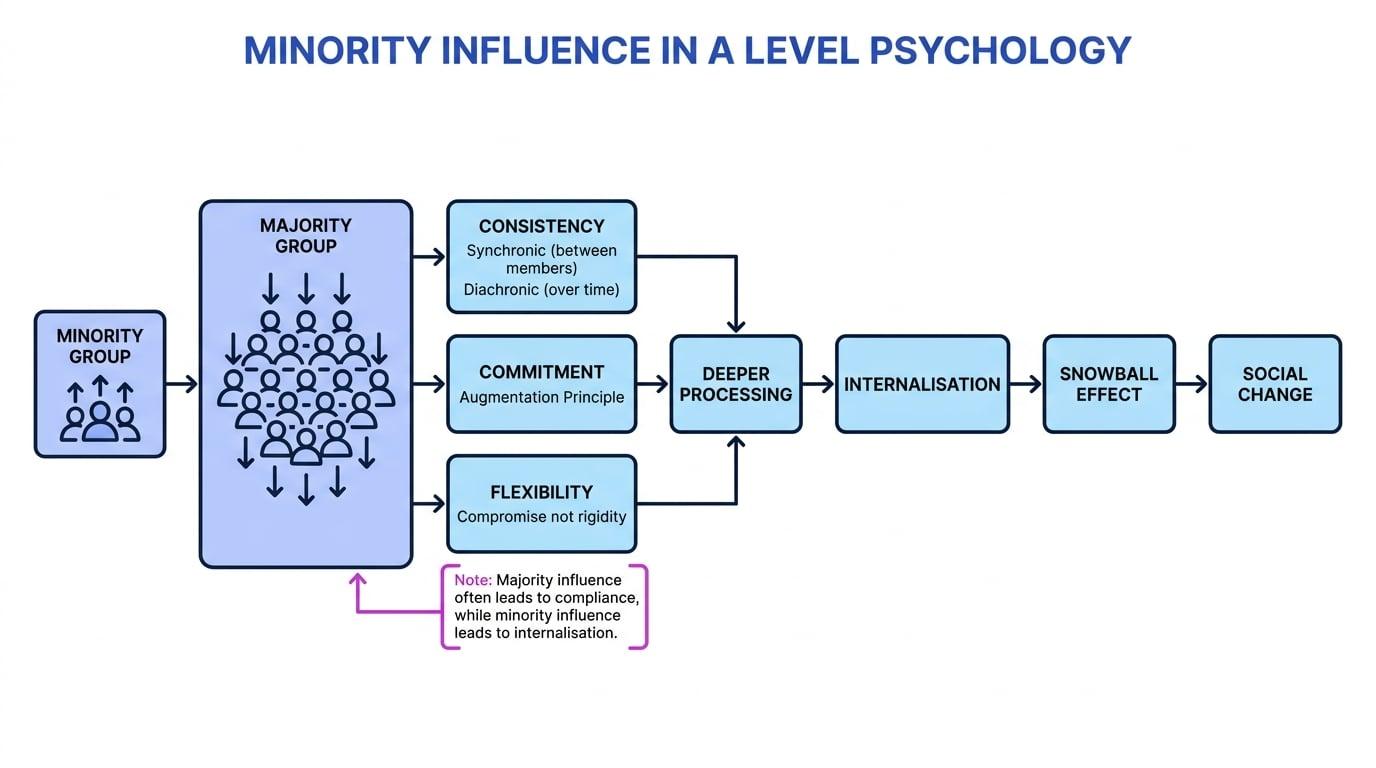
- The three key behavioural styles a minority must adopt to be persuasive: consistency, commitment, and flexibility.
- How to evaluate the theory using classic studies like Moscovici (1969) and Nemeth (1986).
When we look at conformity (like Asch's line study), we see the majority influencing the minority. But if the majority always won, society would never change. Women wouldn't have the vote, civil rights movements wouldn't succeed, and recycling would still be a fringe idea. Minority influence occurs when a small group (or even one person) persuades others to adopt their beliefs, attitudes, or behaviours.
Minority Influence
A form of social influence where a persuasive minority changes the attitudes and behaviours of the majority. Unlike conformity (which often leads to temporary compliance), minority influence usually leads to internalisation — both private and public acceptance of the new view.
The three factors for success
For a minority to convince a majority, they face an uphill battle. People naturally want to fit in with the crowd. To break this default, the minority must adopt a specific behavioural style.
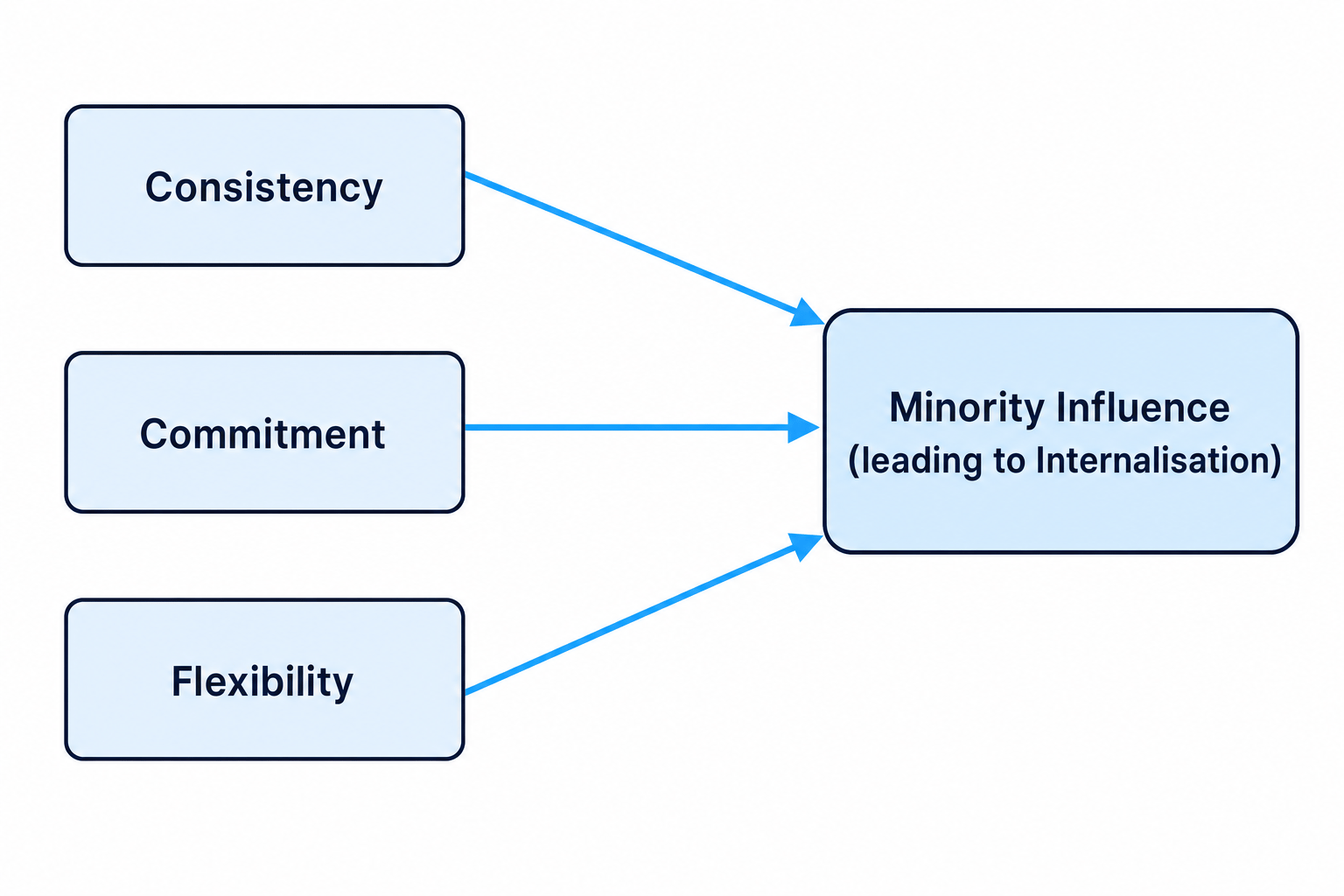
Psychologists have identified three crucial factors that make a minority persuasive:
1. Consistency
If a minority keeps changing its mind, the majority will simply ignore them. Consistency increases interest from other people and makes them rethink their own views ("If they are this sure, maybe they have a point").
There are two types of consistency you need to know:
- Synchronic consistency: Everyone in the minority group says the exact same thing. They are in agreement with each other.
- Diachronic consistency: The minority has been saying the same thing for a long time. They haven't changed their message.
Mixing up the 'chronics'
Students often swap these two in the exam.
- Synchronic = Sync (acting in sync right now).
- Diachronic = Diary (kept over a long period of time).
Moscovici et al. (1969) demonstrated the power of consistency in his classic "blue-green slides" study. He placed groups of six participants (four real participants, two confederates) in a room and asked them to state the colour of 36 slides. All the slides were actually blue, but varied in brightness.
- When the confederates were consistent and called all 36 slides "green", the real participants agreed with them on 8.42% of the trials.
- When the confederates were inconsistent (called 24 green and 12 blue), agreement fell to just 1.25%.
2. Commitment
Minorities can also exert influence by showing deep dedication to their cause. This is most effective when the minority engages in extreme, risky, or self-sacrificing activities.
When majority group members see someone suffering or taking massive risks for a belief, they pay closer attention. This is called the augmentation principle. The majority thinks, "Wow, they must really believe in what they are saying if they are willing to go to prison for it," which prompts them to consider the minority view more deeply.
3. Flexibility
Consistency is important, but if a minority is too consistent, they can seem rigid, dogmatic, and unreasonable. A majority is unlikely to listen to a group that refuses to listen to counter-arguments.
Nemeth (1986) argued that being relentlessly consistent can actually be off-putting. She demonstrated this in a mock jury experiment where groups had to decide on the amount of compensation to pay a ski-lift accident victim.
- When a confederate argued for a very low amount and refused to budge (inflexible), he had no effect on the majority.
- When the confederate compromised and moved his offer slightly higher (flexible), the majority was much more likely to lower their own initial demands and meet him in the middle.
The balancing act
The trick to minority influence is striking the right balance. You must be consistent enough to be taken seriously, but flexible enough to be seen as reasonable and cooperative.
The Snowball Effect
When a minority uses consistency, commitment, and flexibility effectively, they trigger a deeper level of cognitive processing in the majority. Over time, individuals in the majority start to convert to the minority position.
As more and more people switch sides, the pace of conversion speeds up. This is known as the snowball effect. Eventually, the minority view becomes the new majority view, and social change has occurred.
Applying minority influence to a scenario
Scenario: Samira wants her Sixth Form to introduce a "Meat-Free Monday" in the canteen. Most of the student council (the majority) are opposed to the idea. Explain how Samira could use the processes of minority influence to persuade the student council.
- Demonstrate consistency: Samira must present the same core message at every single council meeting (diachronic consistency) and ensure that the few friends supporting her on the council repeat the exact same statistics about environmental impact (synchronic consistency).
- Demonstrate commitment: Samira could show her dedication by undertaking a sponsored fast or volunteering every weekend at an animal sanctuary, invoking the augmentation principle to show she isn't just making a casual suggestion.
- Demonstrate flexibility: If the council outright refuses a full "Meat-Free Monday", Samira should show willingness to compromise. She could suggest a "Meat-Free Menu Option" first, showing she is not rigid or dogmatic, which makes the council more likely to listen.
Evaluating Minority Influence (AO3)
When evaluating minority influence in an essay, you need a mix of supporting evidence and methodological critiques.
Strength: Research support for consistency
There is strong empirical support for the importance of consistency. As discussed, Moscovici (1969) found that a consistent minority had a significantly greater effect on other people than an inconsistent opinion. Furthermore, Wood et al. (1994) carried out a meta-analysis of almost 100 similar studies and found that minorities who were seen as being consistent were by far the most influential.
Strength: Research support for depth of thought
Minority influence theories claim that the minority makes the majority think more deeply about an issue. Martin et al. (2003) supported this. They gave participants a message supporting a particular viewpoint and measured their agreement. One group then heard a minority group agree with the initial view, while another group heard a majority group agree with it. Participants were finally exposed to a conflicting view.
Martin found that people were much less willing to change their minds if they had listened to a minority group compared to a majority group. This suggests that the minority message had been processed more deeply and had a more enduring effect (internalisation).
Weakness: Artificial tasks
A major methodological issue with minority influence research is that the tasks are often highly artificial. Identifying the colour of a slide in Moscovici's study is completely divorced from how minorities attempt to change majority opinion in real life.
In cases like jury decision making or political campaigning, the outcomes are vastly more important, sometimes a matter of life or death. Because Moscovici's study lacks mundane realism, the findings may lack external validity. They might not accurately reflect how minority influence works in high-stakes real-world situations.
Expanding on ethics
If you need an extra evaluation point, look at the ethics of Moscovici’s study. The participants were deceived about the true aim of the experiment and the status of the confederates. This means they could not give fully informed consent. However, this deception was necessary; if they knew the real aim, they would have displayed demand characteristics, invalidating the results.
In the exam
- Watch the command word: If an exam question asks you to "Outline how a minority can bring about social change", make sure you specifically define and name consistency, commitment, and flexibility.
- Link to internalisation: Examiners love it when you draw the distinction between compliance (majority influence) and internalisation (minority influence). Mention that minority influence changes private beliefs, not just public behaviour.
- Use the augmentation principle: When writing about commitment, explicitly use the phrase "augmentation principle" to access the top terminology marks.
Check yourself
- What is the difference between synchronic and diachronic consistency?
- How did Nemeth's ski-lift study demonstrate the importance of flexibility?
- Why might Moscovici's blue-green slide study be criticised for lacking external validity?
- What is the 'snowball effect' in the context of minority influence?