What you'll learn
- How the multi-store model explains memory as three linked stores.
- The key features of the sensory register, short-term memory and long-term memory.
- What coding, capacity and duration mean in memory research.
- How to use classic studies as AO3 evaluation in an essay.
The big picture: memory as a system
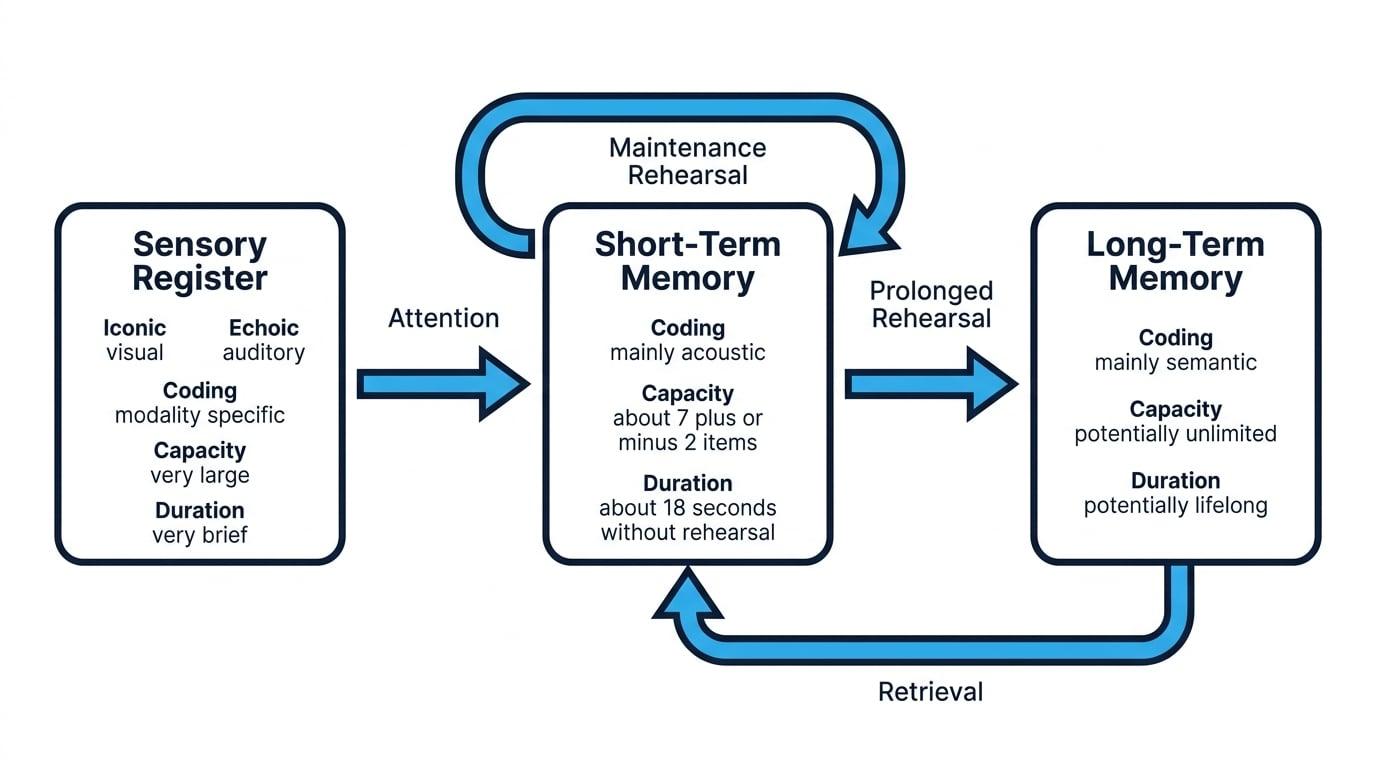
The multi-store model of memory was proposed by Atkinson and Shiffrin in 1968. It describes memory as a sequence of separate stores: the sensory register, short-term memory and long-term memory.
Information is not simply “in memory” or “forgotten”. The model suggests it moves through different stores depending on whether you pay attention, rehearse it and later retrieve it.
Multi-store model
The multi-store model is a theory that describes memory as three separate stores: sensory register, short-term memory and long-term memory, with information passing between them through processes such as attention, rehearsal and retrieval.
Key terms before the model
Coding, capacity and duration
Psychologists describe each memory store using three features.
Coding, capacity and duration
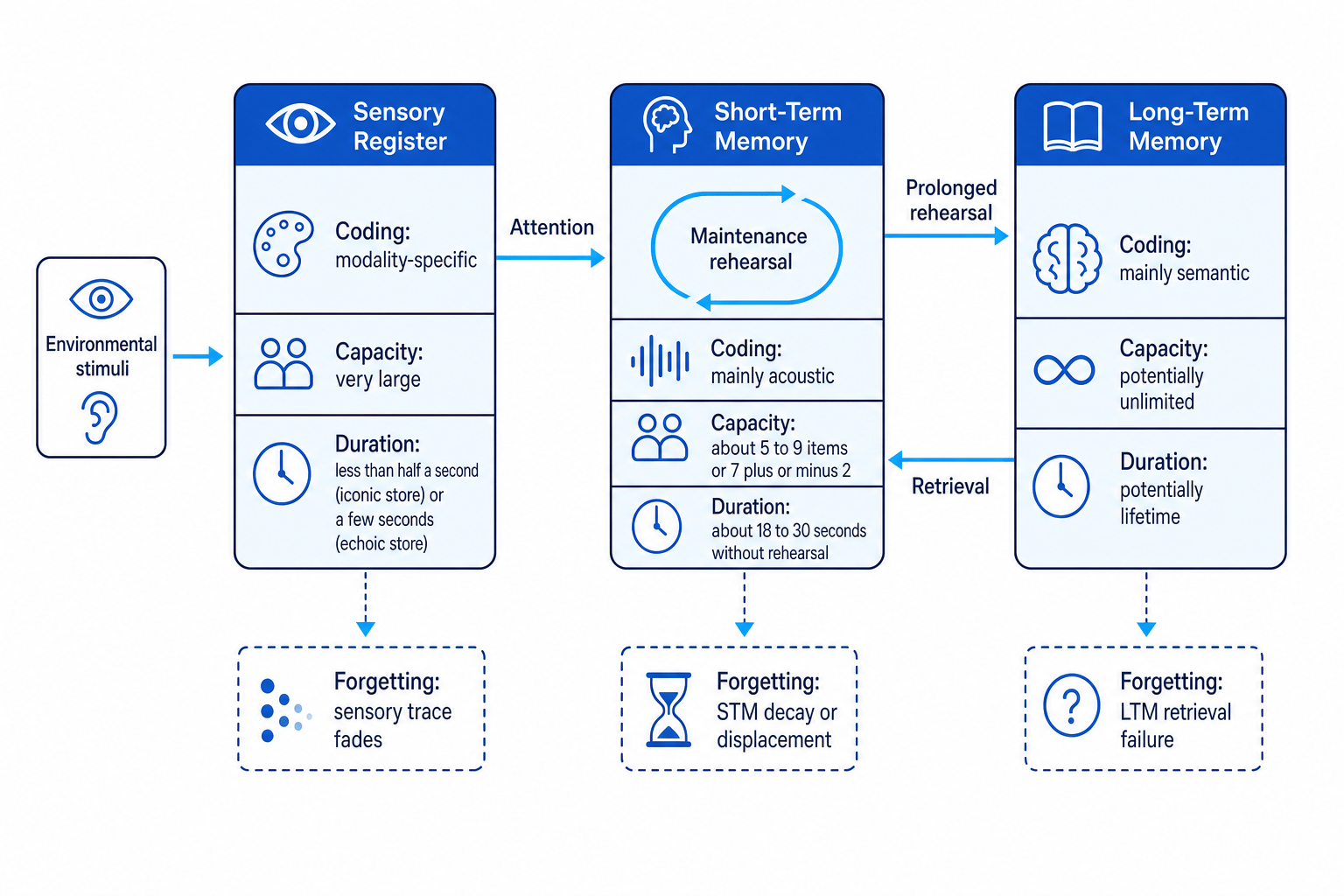
Coding means the form in which information is stored, such as sound, meaning or visual images. Capacity means how much information a store can hold. Duration means how long information lasts in that store.
For example, if you remember the word “dog” because of how it sounds, that is acoustic coding. If you remember it because it means a furry pet, that is semantic coding.
Remember CCD
For each store, revise the same three features: Coding, Capacity, Duration. This makes comparison questions much easier.
Store 1: the sensory register
The sensory register is the first store in the model. It briefly holds information from the senses, such as sights, sounds and touch.
It has different parts for different senses. The iconic store holds visual information. The echoic store holds auditory information.
Sensory register
The sensory register is a very brief memory store that holds raw sensory information from the environment before attention selects some of it for further processing.
Features of the sensory register
The sensory register has modality-specific coding, meaning information is stored in the same form as the sense that detected it. Visual information is coded visually; sounds are coded acoustically.
Its capacity is thought to be very large because you take in huge amounts of sensory information at once.
Its duration is very short. Visual sensory information may last less than half a second, while auditory sensory information may last a few seconds.
Evidence: Sperling 1960
Sperling (1960) briefly showed participants grids of letters. When asked to recall all the letters, they could only report some. However, when given a tone telling them which row to recall immediately after the display, they could report that row quite well. This suggested that many letters were briefly available in the sensory register, but faded quickly.
AO3: This was a highly controlled laboratory study, so it supports cause-and-effect conclusions about sensory memory. However, recalling letters from a brief display is artificial, so it may not fully represent everyday memory. Ethically, the task was low risk, but participants should still have given informed consent, had the right to withdraw and been debriefed.
Store 2: short-term memory
Short-term memory, often shortened to STM, is the store for information you are currently aware of and actively using.
Short-term memory
Short-term memory is a temporary memory store with limited capacity and brief duration, used for information currently being processed.
For example, if you repeat a new phone number while looking for your phone, you are using STM.
Features of STM
STM is mainly coded acoustically, meaning information is often stored by sound. This is why you might confuse similar-sounding words when trying to remember them.
STM has a limited capacity. Miller (1956) suggested it can hold about 7±27 \pm 27±2 items. He also proposed chunking, where several pieces of information are grouped into one meaningful unit. For example, 1, 9, 4, 5 can become “1945”.
STM has a short duration. Peterson and Peterson (1959) found that when participants were prevented from rehearsing, recall of three-letter trigrams became very poor after around 18 seconds.
Maintenance rehearsal
Maintenance rehearsal means repeating information over and over to keep it in short-term memory. In the multi-store model, prolonged rehearsal can transfer information into long-term memory.
Applying STM to a phone number
- You hear a new phone number and pay attention to it, so it moves from the echoic sensory register into STM.
- You repeat the number aloud, which uses maintenance rehearsal and keeps the acoustic information active.
- If someone interrupts you before you save it, the number may be lost through decay or displacement because STM has limited duration and capacity.
- If you rehearse it repeatedly over time, the model predicts it may transfer into long-term memory.
Mixing up capacity and duration
Do not say “STM lasts 7 items” or “STM holds 18 seconds”. Capacity is about amount; duration is about time.
Store 3: long-term memory
Long-term memory, or LTM, stores information for extended periods, from minutes to a lifetime.
Long-term memory
Long-term memory is a memory store with potentially unlimited capacity and very long duration, where information is mainly coded by meaning.
Examples include your birthday, the route to school, facts from Psychology and memories of important personal events.
Features of LTM
LTM is mainly coded semantically, meaning by meaning. For instance, you are more likely to remember the meaning of a sentence than its exact wording.
Its capacity is thought to be potentially unlimited. Its duration can be potentially lifelong.
Bahrick et al. (1975) studied American graduates’ memory for their high school classmates. Participants could recognise names and faces many decades later, suggesting that LTM can last for a very long time.
AO3: Bahrick’s research has good ecological validity because recognising classmates is more realistic than recalling random lists. However, participants may have rehearsed names and faces over the years, for example through reunions or yearbooks, so it is hard to know exactly what caused the long-lasting memory. Ethical issues were relatively mild, but confidentiality and informed consent were still important.
How information moves between stores
The model includes several processes.
Attention moves selected information from the sensory register into STM. You receive far more sensory information than you can process, so attention acts like a filter.
Rehearsal keeps information in STM. If rehearsal continues for long enough, the model claims information transfers into LTM.
Retrieval brings information from LTM back into STM so you can consciously use it.
The flow of memory
In the multi-store model, information flows from sensory register → STM → LTM, but only if attention and rehearsal occur.
Explaining the serial position effect
- In a word-list task, people often recall the first few words well because these words receive more rehearsal.
- Rehearsal allows early words to transfer into LTM, creating the primacy effect.
- People also recall the last few words well because they are still active in STM, creating the recency effect.
- Words in the middle are less likely to be rehearsed enough for LTM and are no longer fresh in STM, so recall is weaker.
This pattern is supported by Glanzer and Cunitz (1966). They found that delaying recall reduced the recency effect, which supports the idea that the last items depended on STM.
AO3: strengths of the multi-store model
It is supported by research into coding
Baddeley (1966) gave participants word lists that were acoustically similar, acoustically dissimilar, semantically similar or semantically dissimilar. Immediate recall was worse for acoustically similar words, suggesting STM uses acoustic coding. Delayed recall was worse for semantically similar words, suggesting LTM uses semantic coding.
This supports the idea that STM and LTM are separate stores with different coding systems.
However, the task used artificial word lists, so it may not reflect how memory works in everyday life. Participants should also have been protected through consent, the right to withdraw and debriefing.
It is supported by case studies
The case of HM, reported by Scoville and Milner (1957), supports the distinction between STM and LTM. After brain surgery involving the hippocampus, HM could hold information briefly but struggled to form new long-term memories.
This suggests STM and LTM are separate because one could be impaired while the other remained relatively intact.
However, case studies involve unusual individuals, so findings may not generalise. HM’s case also raises ethical issues because his memory impairment made informed consent more complicated, and researchers had to protect his confidentiality and dignity.
AO3: weaknesses of the multi-store model
It is too simple
The model treats STM as one single store. Later research challenges this. Baddeley and Hitch (1974) proposed the working memory model, which argues that STM has several components, such as a verbal system and a visual-spatial system.
This means the multi-store model may be a useful starting point, but it oversimplifies active short-term processing.
LTM is not one single store
The model also treats LTM as one unitary store. However, Tulving (1972) argued that LTM includes different types, such as episodic memory for personal events, semantic memory for facts and procedural memory for skills.
For example, a person might forget personal events but still remember how to ride a bike. This suggests LTM is more complex than Atkinson and Shiffrin proposed.
Rehearsal may not be enough
The model says rehearsal transfers information into LTM. But Craik and Lockhart (1972) argued that the depth of processing matters more than simple repetition. Information processed for meaning is more likely to be remembered than information repeated without understanding.
Overclaiming rehearsal
Do not write that rehearsal is the only way to create long-term memories. The multi-store model emphasises rehearsal, but evaluation shows that meaningful processing can be more important.
AO2: applying the model to scenarios
If a scenario mentions someone briefly noticing a sound or image, think sensory register. If they are actively repeating information, think STM. If they remember something from years ago, think LTM.
A strong application answer should name the store and link it to a feature. For example: “Because she remembers her primary school teacher’s name after many years, this is long-term memory, which has potentially lifelong duration.”
In the exam
- For AO1, describe the three stores and include coding, capacity and duration for each.
- For AO2, apply the correct store to the scenario and explain why using evidence such as rehearsal, attention or long-lasting recall.
- For AO3, use named studies such as Baddeley (1966), Peterson and Peterson (1959), Bahrick et al. (1975) or Glanzer and Cunitz (1966), then add a clear strength or limitation.
- Avoid vague evaluation like “it is reductionist” unless you explain exactly what is oversimplified, such as STM or LTM being treated as single stores.
Check yourself
- What are the coding, capacity and duration of STM?
- How does the multi-store model explain the movement of information from sensory register to LTM?
- Why does evidence from HM support separate memory stores, and why is it not perfect evidence?