What you'll learn
- What resistance to social influence means in conformity and obedience situations.
- How social support helps people resist pressure from a group or authority figure.
- How locus of control can affect whether someone stands firm or gives in.
- How to evaluate these explanations using key evidence and exam-ready AO3 points.
Starting point: what are you resisting?
In Social Influence, you have already met two major forms of pressure:
- Conformity: changing your behaviour or beliefs because of real or imagined group pressure.
- Obedience: following a direct order from someone perceived as an authority figure.
Resistance is about the opposite outcome: the person does not go along with the pressure.
Resistance to social influence
Resistance to social influence is the ability to withstand pressure to conform to a group or obey an authority figure, so that a person behaves according to their own judgement rather than simply following others.
Resistance is not the same as automatically doing the opposite of everyone else. A person is resisting when they make an independent choice, even when there is social pressure pushing them in another direction.
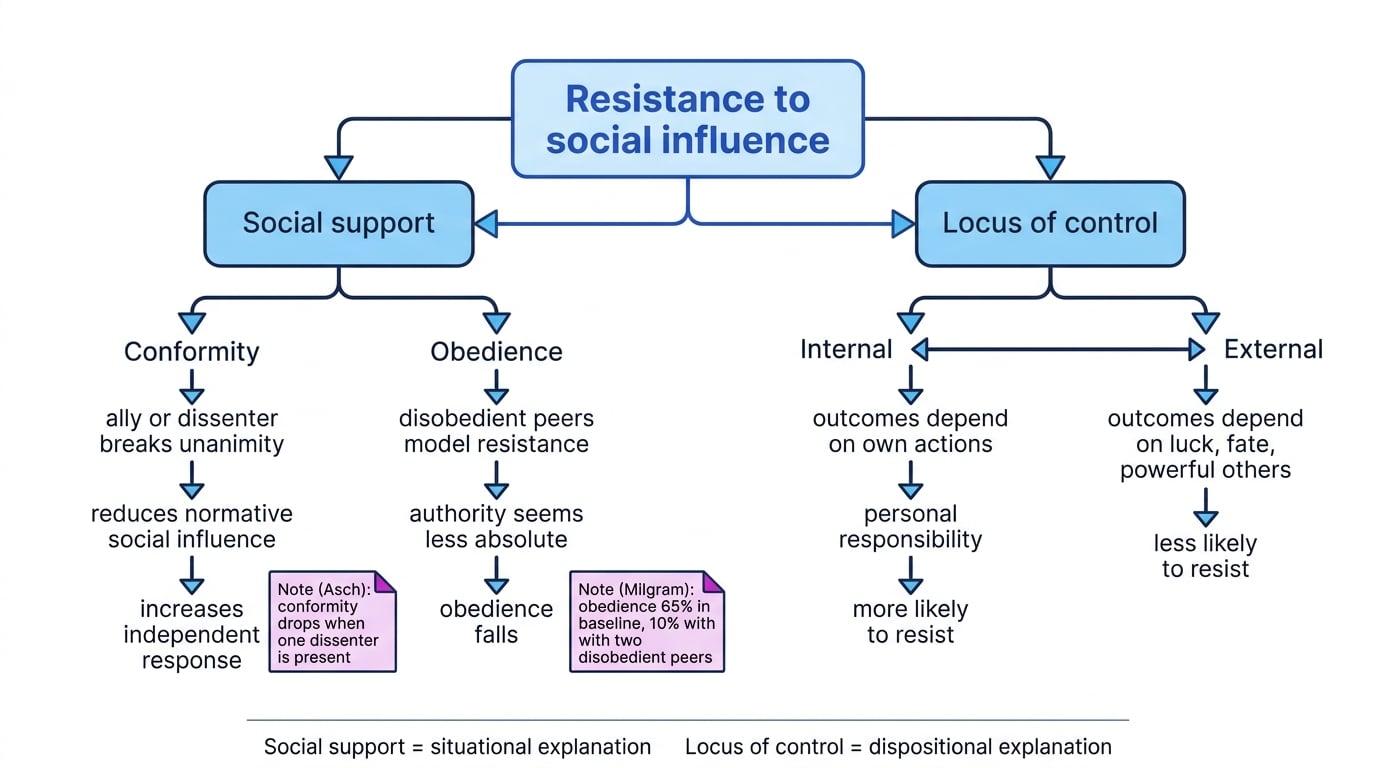
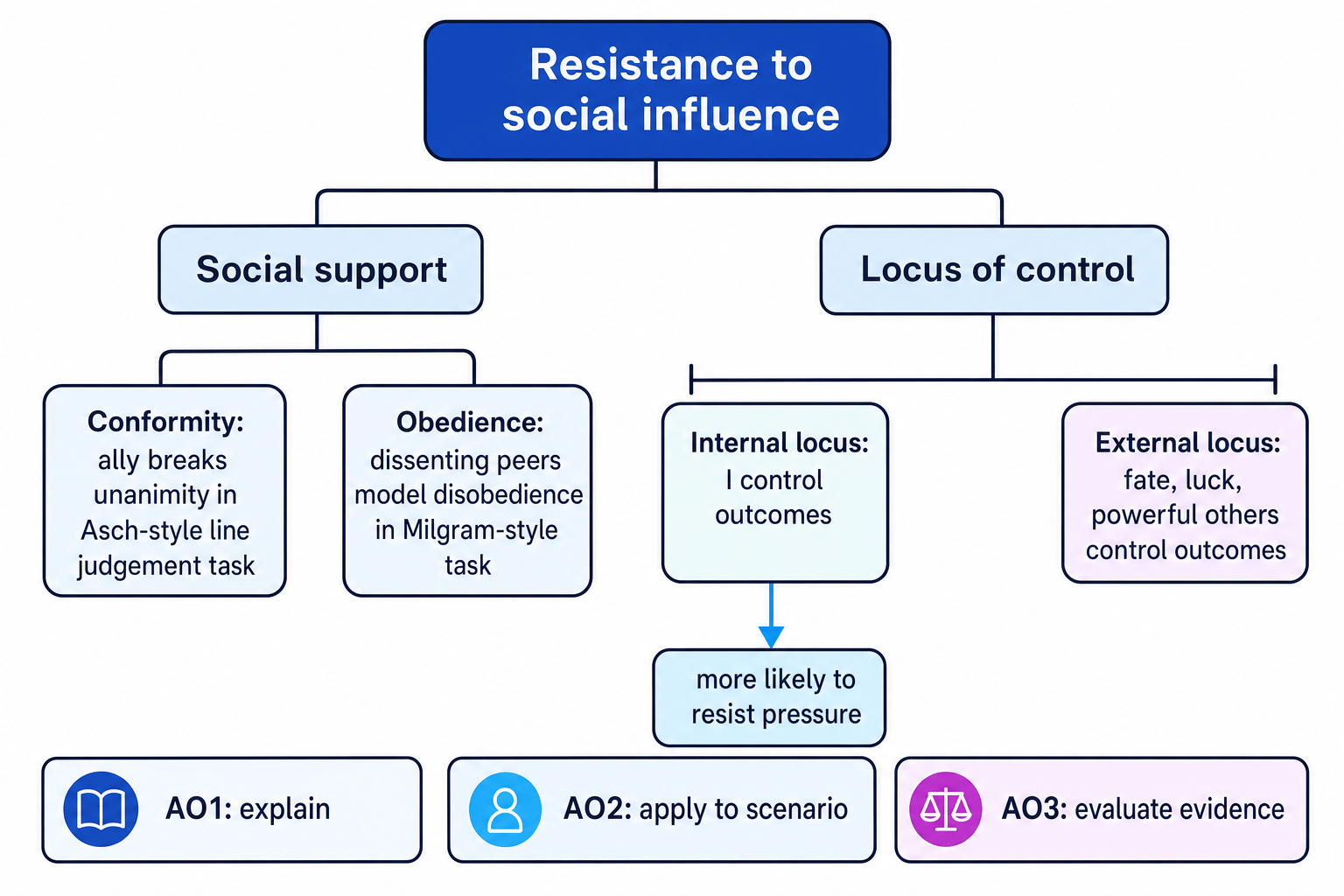
The two explanations on the AQA specification are social support and locus of control. Keep them separate: social support is mainly a situational explanation, while locus of control is mainly a dispositional explanation, meaning it focuses on a person’s characteristics.
The big distinction
Social support explains resistance through other people being present and supportive. Locus of control explains resistance through a person’s belief about how much control they have over events in their life.
Social support
Social support
Social support is the presence of other people who help an individual resist social influence, either by agreeing with them, breaking group agreement, or modelling disobedience.
Social support can help with both conformity and obedience, but it works slightly differently in each case.
Social support and resisting conformity
In conformity situations, the group often feels powerful because it seems unanimous, meaning everyone appears to agree.
If just one other person disagrees with the majority, that unanimity is broken. The individual no longer feels completely alone. This makes it easier to give the answer they truly believe is correct.
Asch’s conformity research is the key evidence here. In Asch’s (1956) line judgement studies, participants often conformed to an obviously wrong majority. In the baseline condition, conformity occurred on about one-third of the critical trials. However, when there was a dissenter who gave the correct answer, conformity dropped sharply.
This suggests that social support reduces normative social influence, which is conformity based on wanting approval and avoiding rejection.
Social support and resisting obedience
In obedience situations, social support can come from other people refusing to obey. This shows the participant that disobedience is possible.
In Milgram’s (1963) baseline obedience study, 65% of participants continued to the maximum 450-volt shock. In a variation where two other “teachers” refused to continue, obedience dropped to 10%. The disobedient peers acted as models of resistance.
This matters because an authority figure can seem less powerful when other people challenge them. The person may think, “If they can refuse, maybe I can too.”
Applying social support to peer pressure
A student, Aisha, is in a group chat where several classmates are pressuring her to mock another student. One friend says, “I’m not doing that — it’s cruel.”
-
The pressure on Aisha is conformity pressure because it comes from a peer group rather than a direct order from an authority figure.
-
The friend provides social support by breaking the group’s unanimity. Aisha is no longer the only person who disagrees.
-
This reduces normative social influence because Aisha has an ally, so the social cost of refusing is lower.
-
Aisha is therefore more likely to resist the pressure and refuse to join in.
Evaluation of social support
A strength of social support is that there is strong research evidence from both conformity and obedience studies. Asch’s (1956) unanimity variation shows that an ally reduces conformity, while Milgram’s disobedient-peer variation shows that dissent reduces obedience. This makes social support a broad explanation across different types of social influence.
There is also supporting evidence from Allen and Levine (1971), who found that a dissenter reduced conformity even when the dissenter seemed less credible, such as when they wore thick glasses and claimed to have visual difficulty. This suggests that simply not being alone can help resistance.
A real-world application is that social support can encourage people to resist bullying, peer pressure, unethical workplace practices, or unjust authority. For example, whistleblowing may be easier when employees know others share their concerns.
However, much of the classic evidence comes from artificial laboratory tasks. Asch’s line judgement task is low in everyday realism because judging line lengths is not as meaningful as resisting real peer pressure. Milgram’s procedure was more emotionally powerful, but it raises serious ethical concerns: participants were deceived, showed signs of distress, and may not have felt fully able to withdraw despite being debriefed afterwards.
Social support is not just comfort
Do not write only that social support “makes someone feel better”. For AO1, explain the mechanism: it breaks unanimity, reduces pressure to fit in, or models disobedience.
Locus of control
Locus of control
Locus of control, proposed by Rotter (1966), is a person’s general belief about whether the things that happen to them are mainly controlled by their own actions or by external forces.
Locus of control is usually described as a continuum, not two fixed personality types.
Internal locus of control
A person with an internal locus of control believes they have significant control over what happens to them. They are more likely to think outcomes depend on their choices, effort, and behaviour.
For example, they might think: “If I speak up, I can make a difference.”
People with a high internal locus of control are generally expected to be more resistant to social influence because they:
- feel more responsible for their own actions;
- are less likely to blame fate or authority;
- may be more confident in their own judgement;
- may actively seek information before deciding what to do.
External locus of control
A person with an external locus of control believes that outcomes are mainly controlled by luck, fate, chance, or powerful others.
For example, they might think: “There’s no point arguing — people in charge decide everything anyway.”
People with a high external locus of control may be less likely to resist social influence because they feel they have less personal control over the situation.
Predicting resistance from locus of control
Two students are told by a senior student to exclude someone from a group activity. Sam says, “I choose how I treat people, and I’ll deal with the consequences.” Riley says, “There’s nothing I can do — older students always get their way.”
-
Sam shows an internal locus of control because they focus on their own choice and responsibility.
-
Riley shows an external locus of control because they focus on powerful others controlling the outcome.
-
Sam would be predicted to show greater resistance because they see themselves as able to act independently.
-
Riley would be predicted to be more vulnerable to obedience or peer pressure because they see the situation as outside their control.
Evaluation of locus of control
There is research support for the link between internal locus of control and resistance. Holland (1967) found that participants with a more internal locus of control were more likely to resist obedience in a Milgram-style procedure. This supports the idea that internals are more able to take responsibility for disobedience.
Spector (1983) found that people with an external locus of control were more likely to conform, especially in situations involving normative social influence. This suggests locus of control may be particularly useful when the pressure is about social approval rather than uncertainty about the correct answer.
Avtgis (1998) carried out a meta-analysis and found that people with an external locus of control were more easily persuaded and more likely to conform. A meta-analysis is useful because it combines findings from many studies, making the overall pattern more reliable than a single study.
There is also real-world supporting evidence. Oliner and Oliner (1988) found that people who rescued Jewish people during the Holocaust tended to have a higher internal locus of control than non-rescuers. This suggests internal control may be linked to moral courage and resistance to destructive authority.
However, locus of control is not a perfect explanation. Twenge et al. (2004) found that, over time, young Americans became more external in locus of control, even though wider social trends suggest people have become less obedient to authority. This challenges the simple idea that internal locus of control automatically leads to resistance.
Another weakness is that much of the evidence is correlational. This means we cannot be sure that locus of control causes resistance. It could be that resisting authority makes people feel more internal afterwards, or that a third factor, such as confidence or education, affects both.
There are also measurement issues. Locus of control is often measured using questionnaires, so responses may be affected by social desirability or by how a person interprets the questions. Ethically, questionnaire research still needs informed consent, confidentiality, and the right to withdraw.
Locus of control is not destiny
Do not argue that an internal person will always resist or that an external person will always obey. AQA expects a balanced explanation: locus of control affects likelihood, but the situation still matters.
Comparing the two explanations
Social support and locus of control can work together. Imagine someone with a strong internal locus of control who also has a friend openly supporting them. That person has both a personal belief in control and a social ally, so resistance becomes more likely.
But they explain different things:
- Social support focuses on the immediate social situation.
- Locus of control focuses on the individual’s belief system.
- Social support can change quickly if an ally appears.
- Locus of control is more stable, although it is not completely fixed.
Essay shortcut
For a 16-mark answer, organise your AO1 around the two explanations: one paragraph on social support, one on locus of control. Then evaluate each using named evidence and at least one limitation.
In the exam
-
Start by defining resistance clearly, then state that AQA names social support and locus of control as explanations.
-
For social support, link your AO1 to breaking unanimity in Asch and modelling disobedience in Milgram.
-
For locus of control, explain the internal/external continuum and evaluate with evidence such as Holland, Spector, Avtgis, or Twenge.
-
Keep AO3 precise: say whether evidence supports, challenges, or limits the explanation, rather than just describing studies.
Check yourself
- How does social support help someone resist conformity differently from obedience?
- Why might an internal locus of control make resistance more likely?
- What is one limitation of using locus of control to explain resistance?