What you'll learn
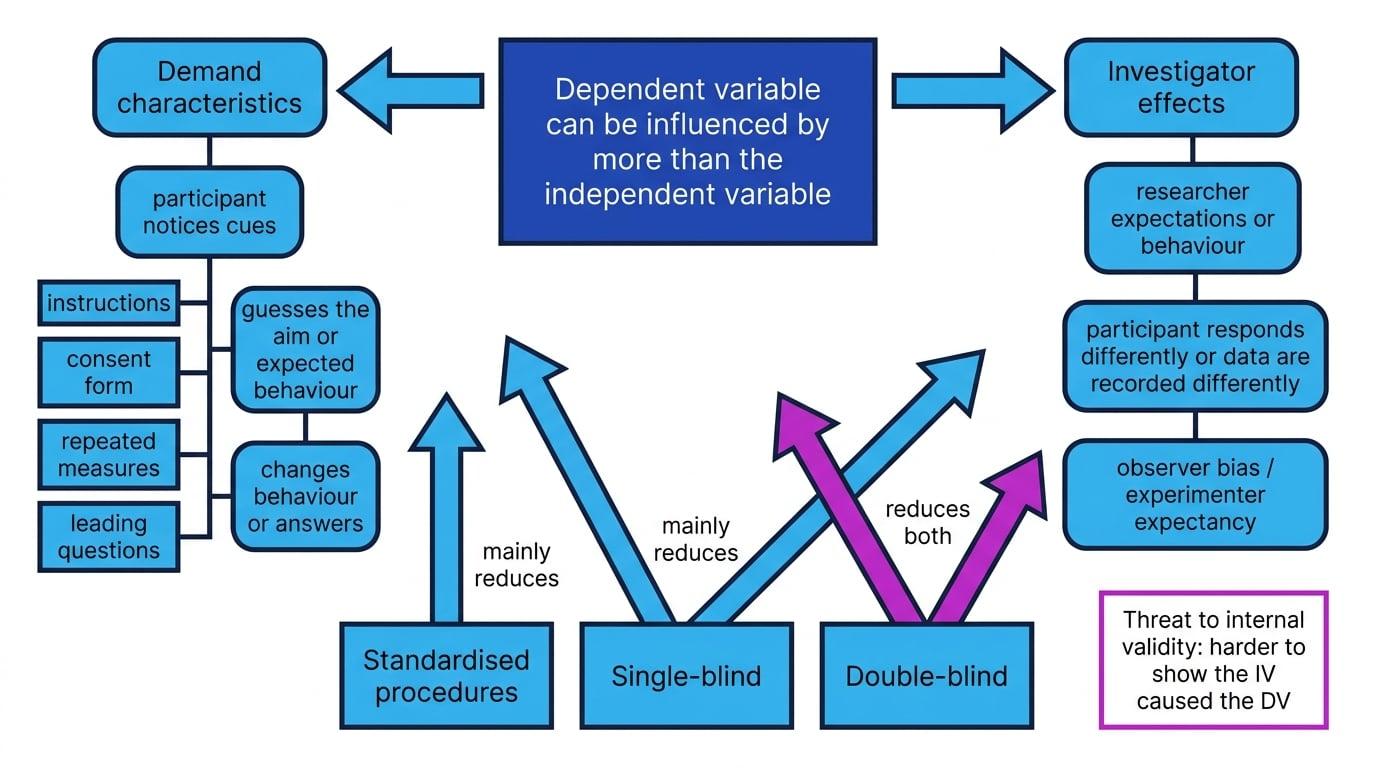
- What demand characteristics are and how they can change participant behaviour.
- What investigator effects are and how researchers can accidentally influence results.
- How these issues threaten validity in psychological research.
- How psychologists reduce them using standardisation, single-blind and double-blind procedures.
Why this matters in scientific psychology
Psychology aims to study behaviour in a way that is as objective and controlled as possible. But humans are not passive “test subjects”: participants think about what is happening, and researchers may unintentionally communicate expectations.
This means a study’s findings can be affected by things other than the intended independent variable.
Independent variable and dependent variable
The independent variable is what the researcher changes or compares. The dependent variable is what the researcher measures.
If demand characteristics or investigator effects influence the dependent variable, the study may lose internal validity.
Internal validity
Internal validity means the study really measures the effect of the independent variable on the dependent variable, rather than the effect of some other uncontrolled factor.
The big picture
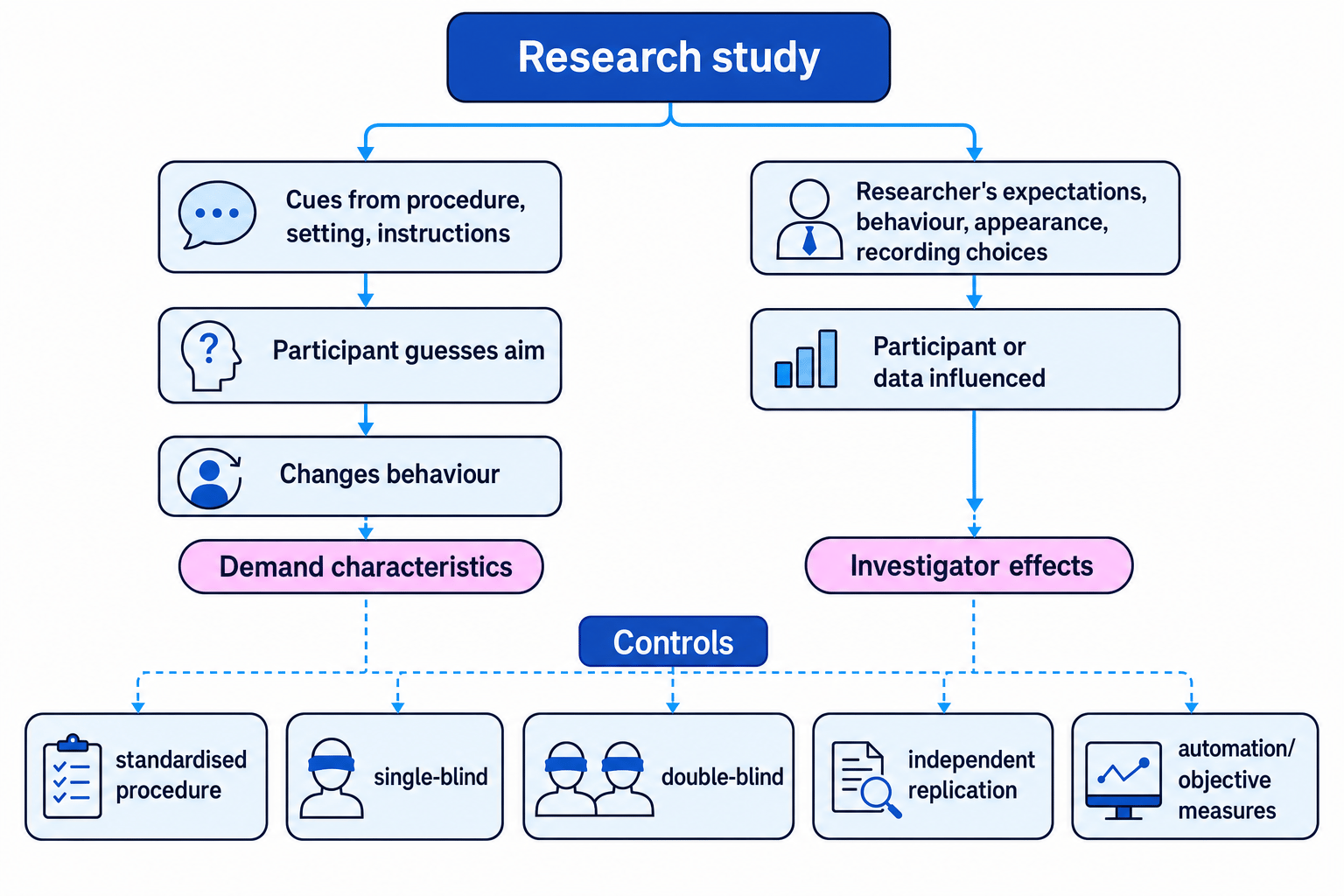
Demand characteristics come mainly from what the participant works out about the study. Investigator effects come mainly from what the researcher communicates or does, often without meaning to.
Extraneous and confounding variables
Before looking at the two key terms, you need two research-methods ideas.
Extraneous variable
An extraneous variable is any variable other than the independent variable that could affect the dependent variable.
For example, in a memory experiment, participants’ tiredness, noise in the room, or the researcher’s tone of voice could all affect recall.
Confounding variable
A confounding variable is an extraneous variable that changes systematically with the independent variable, making it difficult to tell what caused the result.
For example, if the researcher gives extra encouragement only to the experimental group, any difference in performance might be due to encouragement rather than the independent variable.
Spotting a confounding risk
A psychologist tests whether background music improves memory. Group A learns words in silence with a calm researcher. Group B learns words with music, but the researcher is enthusiastic and says, “Most people do really well in this condition.”
- Compare what differs between the groups. Music differs, but the researcher’s behaviour also differs.
- Decide whether the extra factor could affect the dependent variable. Enthusiasm and positive expectations could make Group B try harder.
- Judge whether it changes systematically with the independent variable. It occurs only in the music condition, so it is a possible confounding variable.
- Explain the consequence. If Group B recalls more words, we cannot be sure whether music or researcher encouragement caused the improvement.
Demand characteristics
Demand characteristics
Demand characteristics are cues in a study that lead participants to guess the aim or expected behaviour, causing them to change how they act.
Participants often try to make sense of a study. They may use clues from the setting, instructions, consent form, tasks, questions, or the researcher’s behaviour.
For example, if participants are asked to drink coffee and then complete an attention task, they may guess the study is about caffeine and concentration. If they believe caffeine should improve performance, they might try harder.
Common sources of demand characteristics
Demand characteristics can come from:
- Instructions that hint at what the researcher expects.
- Leading questions, where wording pushes participants towards a particular answer.
- The research setting, such as a laboratory, which may make participants feel they are being closely judged.
- Repeated measures designs, where participants take part in more than one condition and may work out the comparison.
- The task itself, especially if it obviously relates to the hypothesis.
Repeated measures design
A repeated measures design is an experimental design where the same participants take part in every condition of the independent variable.
Repeated measures designs can be efficient because participant differences are controlled. However, they can make demand characteristics more likely because participants see more of the study.
How participants may respond
Participants do not all react in the same way. They may take on different “roles”.
A good participant tries to help the researcher by behaving in a way that confirms the perceived hypothesis. A negative participant deliberately behaves in the opposite way. A participant may also show social desirability bias, where they answer in a way that makes them look socially acceptable.
Social desirability bias
Social desirability bias occurs when participants give answers that present themselves in a favourable way rather than answering honestly.
Martin Orne (1962) argued that participants are active interpreters of research situations. This was important because it challenged the idea that experimental participants simply respond naturally to the independent variable.
Demand characteristics in classic research
Loftus and Palmer (1974) investigated how leading questions affect eyewitness memory. Participants watched film clips of car accidents and were asked questions such as, “About how fast were the cars going when they smashed into each other?” or “...when they hit each other?”
The verb “smashed” may have acted as a demand characteristic because it suggested a more severe crash. Participants may have inferred that a higher speed estimate was expected.
Ethically, this kind of study may involve mild deception because participants are not always told the full aim in advance. Researchers should gain consent, protect participants from distress, allow withdrawal, maintain confidentiality, and debrief participants afterwards.
Identifying demand characteristics
A student researcher investigates whether energy drinks improve reaction time. Before the task, participants see a poster saying, “Do energy drinks make you faster?” They then drink either an energy drink or water.
- Identify the cue. The poster directly suggests the likely aim: energy drinks may improve speed.
- Link the cue to participant thinking. Participants who drink the energy drink may guess they are expected to be faster.
- Predict the behavioural change. They may concentrate more, respond more quickly, or report feeling more alert.
- Explain the validity problem. Any faster reaction time may be partly due to expectations rather than the drink itself.
Calling every weakness demand characteristics
Do not use “demand characteristics” as a vague criticism. You need to identify the specific cue, explain what the participant might infer, and show how this could affect behaviour or responses.
Investigator effects
Investigator effects
Investigator effects occur when the researcher’s characteristics, expectations or behaviour influence participants or the recording of data.
This can happen even if the researcher is not deliberately trying to affect the results. Small cues such as smiling, tone of voice, body language, wording, appearance, age, gender, ethnicity or status may affect how participants respond.
Investigator effects can also occur during data recording. For example, if an observer expects boys to be more aggressive than girls, they may be more likely to interpret ambiguous playground behaviour as aggression in boys.
Observer bias
Observer bias is a type of investigator effect where the researcher’s expectations influence what they notice, record or interpret.
Experimenter expectancy effect
A key type of investigator effect is the experimenter expectancy effect.
Experimenter expectancy effect
The experimenter expectancy effect occurs when a researcher’s expectations about the outcome unintentionally influence participant behaviour or data recording.
Rosenthal and Fode (1963) demonstrated this using rats in a maze-learning task. Student experimenters were told that some rats were “maze-bright” and others were “maze-dull”, even though the rats had actually been randomly assigned. Rats labelled “maze-bright” performed better, possibly because the students handled them differently or recorded performance more favourably.
This study shows how expectations can become self-fulfilling. However, there are ethical issues: the student experimenters were deceived and the use of animals raises questions about welfare and humane treatment.
Rosenthal and Jacobson (1968) later investigated teacher expectations in a school setting. Teachers were told that some pupils were “intellectual bloomers”, although these pupils had been randomly selected. Some later showed greater progress, suggesting that teacher expectations may influence pupil outcomes. This has real-world relevance for education, but also ethical concerns about deception, possible unfair treatment, and the need to protect children from harm.
Investigator effects versus demand characteristics
The two can overlap, but they are not the same.
- If the participant changes behaviour because they have guessed the aim, this is mainly demand characteristics.
- If the researcher’s actions or expectations influence behaviour or recording, this is mainly investigator effects.
Distinguishing the source of bias
A psychologist studies whether praise improves puzzle-solving. The researcher smiles and nods more when participants in the praise condition solve a puzzle. The consent form also says, “This study investigates whether encouragement improves performance.”
- Separate the two possible sources of bias. The consent form gives participants a clue about the aim, while the researcher’s smiling and nodding is researcher behaviour.
- Classify the consent form issue. Participants may guess they are expected to perform better when encouraged, so this is a demand characteristic.
- Classify the smiling and nodding. The researcher is giving extra non-verbal feedback in one condition, so this is an investigator effect.
- Explain the combined impact. Improved performance may be due to the praise manipulation, participant expectations, researcher feedback, or a mixture of all three.
A simple distinction
Ask yourself: “Is the bias coming from what the participant works out, or from what the researcher does?” That usually points you towards demand characteristics or investigator effects.
How psychologists reduce these problems
Researchers cannot always remove demand characteristics and investigator effects completely, but they can reduce them through careful design.
Standardised procedures
Standardised procedure
A standardised procedure means every participant is treated in the same way, with the same instructions, timings, materials and environment as far as possible.
Standardisation helps reduce investigator effects because the researcher is less free to improvise. For example, using a written script prevents one participant receiving more encouragement than another.
It also improves reliability, because another researcher can repeat the same procedure more easily.
Reliability
Reliability means consistency. A reliable study should produce similar findings when repeated under the same conditions.
Single-blind procedures
Single-blind procedure
A single-blind procedure is when participants do not know key information, such as which condition they are in or the exact aim of the study.
This reduces demand characteristics because participants have fewer clues about what is expected. In a drug trial, for example, participants may not know whether they have received the real drug or a placebo.
Placebo
A placebo is a fake treatment that looks like the real treatment but does not contain the active ingredient.
However, single-blind procedures often involve some deception. This must be justified by the value of the research, and participants should be debriefed afterwards.
Double-blind procedures
Double-blind procedure
A double-blind procedure is when neither the participants nor the researcher interacting with them knows which condition each participant is in.
This is especially powerful because it reduces both demand characteristics and investigator effects. Participants cannot easily guess what should happen, and the researcher cannot unintentionally treat conditions differently.
Double-blind methods are commonly used in clinical trials because expectations from both patients and researchers can influence outcomes.
Other useful controls
Researchers may also use:
- Computerised instructions, so every participant receives the same wording.
- Objective measures, such as reaction times or scores, rather than subjective judgements.
- Independent observers, who record behaviour without knowing the hypothesis.
- Inter-observer reliability checks, where two or more observers compare recordings to see whether they agree.
- Pilot studies, small trial versions of research used to identify problems before the main study.
Inter-observer reliability
Inter-observer reliability is the extent to which different observers record behaviour in the same way.
Choosing controls for a drug trial
A psychologist tests whether a new anti-anxiety medication reduces anxiety scores compared with a placebo.
- Identify the likely demand characteristic. Participants who know they received the real drug may expect to feel better and report lower anxiety.
- Choose a control for that issue. A single-blind procedure helps because participants do not know whether they received the drug or placebo.
- Identify the likely investigator effect. A researcher who knows a participant received the real drug may speak more positively or interpret answers more favourably.
- Choose a stronger control. A double-blind procedure reduces this because the researcher interacting with participants also does not know their condition.
- Add standardisation. All participants should receive the same instructions, timings and anxiety questionnaire so that differences are more likely to be due to the medication.
Overstating counterbalancing
Counterbalancing helps with order effects in repeated measures designs. It does not automatically remove demand characteristics, because participants may still guess the aim after seeing multiple conditions.
Evaluation: why this matters for AO3
Strength: improves scientific control
Recognising demand characteristics and investigator effects improves the scientific quality of psychology. If researchers can identify and control these sources of bias, they can make stronger cause-and-effect claims.
For example, double-blind procedures make it more likely that differences between conditions are due to the independent variable rather than expectations.
Weakness: difficult to detect
Demand characteristics are hard to measure because participants may not admit they guessed the aim. Suspicion checks after the study can help, but they are imperfect because participants may reconstruct what they think happened after the event.
Investigator effects can also be subtle. A researcher might not realise that their tone, posture or recording decisions are influencing results.
Weakness: ethical tension
Reducing demand characteristics often involves hiding the true aim of the study. This creates tension with informed consent, because participants cannot fully consent if they do not know what the research is really about.
Informed consent
Informed consent means participants agree to take part after receiving enough information about the study to make a knowledgeable decision.
Ethical research must balance scientific value with participant rights. If deception is used, researchers should minimise harm, allow the right to withdraw, protect confidentiality and provide a full debrief.
Application: useful beyond the laboratory
These ideas are not just exam terms. They matter in clinical trials, interviews, education, eyewitness research and workplace studies. Any time humans are studied by other humans, expectations and cues can shape behaviour.
In the exam
- For AO1, define the term clearly and give one concrete example of how it could occur.
- For AO2, apply it directly to the scenario: identify the cue or researcher behaviour, then explain the likely effect on the dependent variable.
- For AO3, link the issue to internal validity, ethics, control methods such as standardisation or double-blind procedures, and evidence such as Rosenthal and Fode (1963).
Check yourself
- What is the difference between demand characteristics and investigator effects?
- How could a double-blind procedure reduce both types of bias?
- Why might deception be useful scientifically but problematic ethically?