What you'll learn
- What peer review is and where it fits into the scientific process.
- How reviewers judge psychological research before publication or funding.
- Why peer review improves quality, validity and credibility.
- Key AO3 evaluation points: bias, fraud detection, publication bias and conservatism.
Why science needs checks
Psychology aims to be a science: it tries to produce knowledge based on systematic observation, evidence and careful reasoning.
A single research study is not automatically “scientific truth”. Researchers can make mistakes, use weak methods, misinterpret statistics, or overclaim what their findings show. This is why scientific work needs quality control before it is treated as credible.
Scientific process
The scientific process is the set of procedures used to develop and test knowledge, including forming hypotheses, collecting data, analysing results, drawing conclusions, publishing findings, and allowing other researchers to scrutinise or replicate the work.
In A-Level Psychology, peer review sits inside this wider process. It is one way the scientific community tries to check whether research is trustworthy before it becomes part of the published literature.
What is peer review?
Peer review
Peer review is the assessment of a piece of research by other experts in the same field before it is published in a journal, presented as credible evidence, or funded.
The word peer means someone of similar professional status. In psychology, a peer reviewer might be another researcher who understands the topic, the research methods, the statistical analysis and the ethical issues.
Peer review usually happens when:
- a researcher submits a manuscript — a written report of a study — to an academic journal
- a researcher applies for a research grant — money to fund future research
- an academic book chapter or conference paper is being considered
Core idea
Peer review is a gatekeeping process: it tries to prevent poor-quality, unethical or unsupported research from being published or funded.
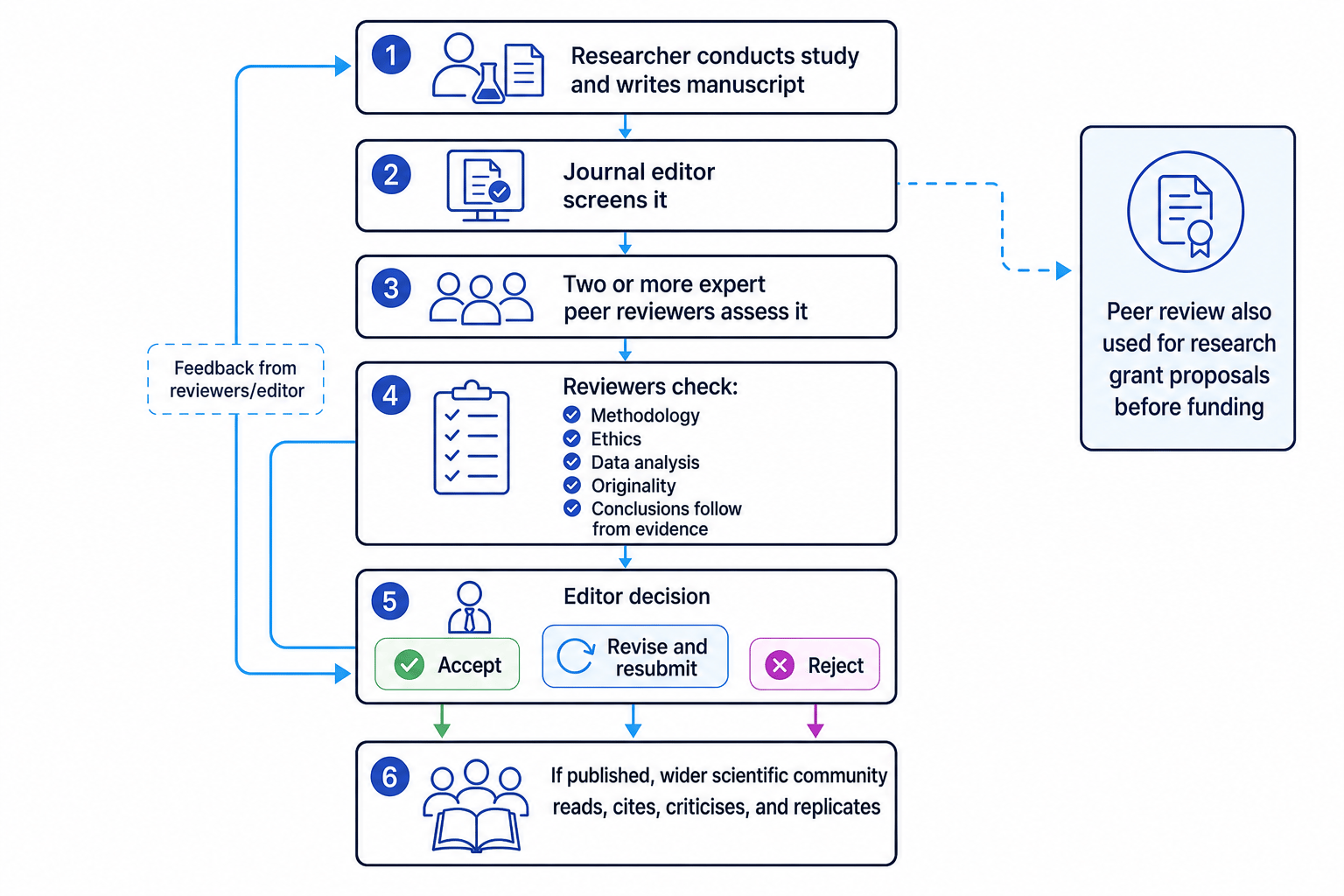
The basic peer-review process
The process varies between journals, but the main stages are usually similar.
Stage 1: The researcher submits work
A psychologist writes up their study, including:
- the aim and hypotheses
- the method and sample
- the procedure and controls
- the results and statistical analysis
- the conclusion and implications
- ethical safeguards such as consent, confidentiality and debriefing
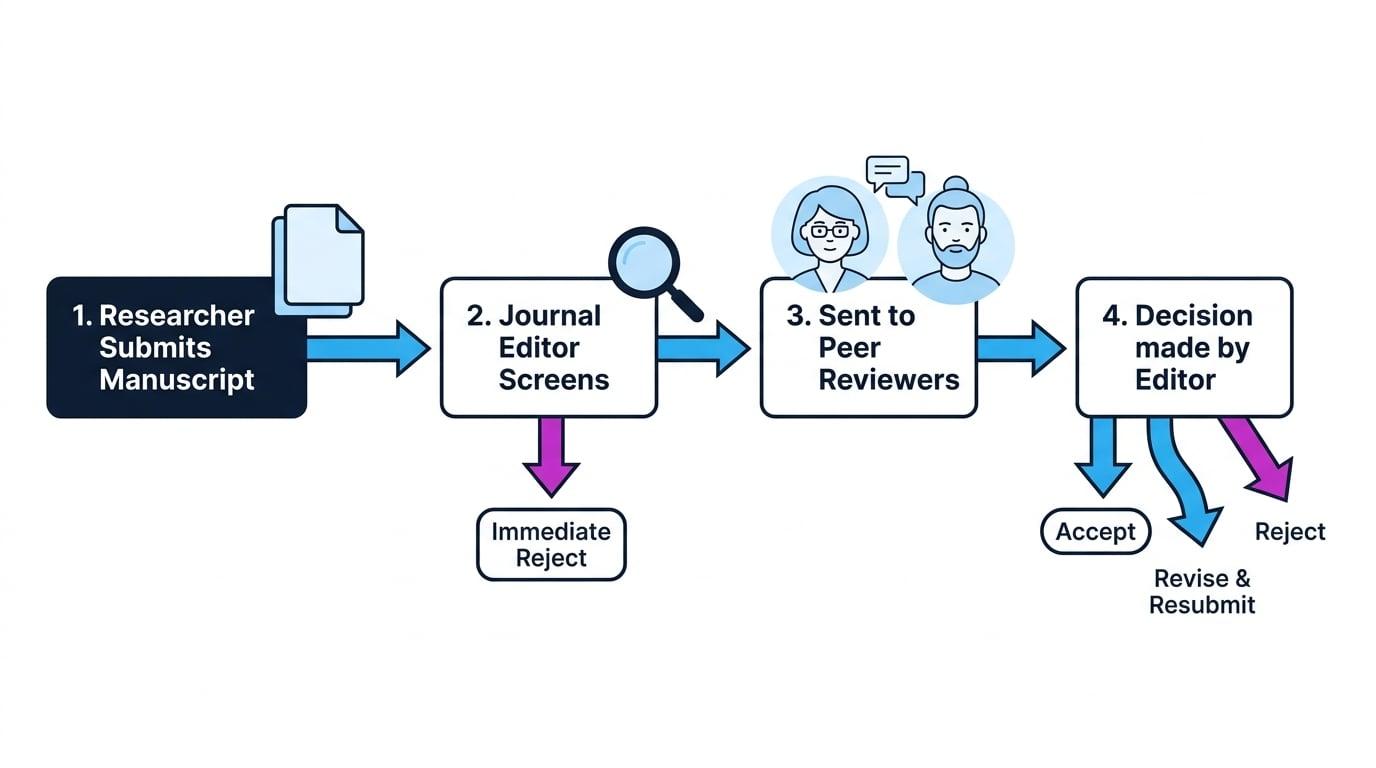
Stage 2: The editor screens it
The editor is the person responsible for deciding whether a journal should consider the paper. They may reject it immediately if it is irrelevant, obviously flawed, or not original enough.
Stage 3: Expert reviewers assess it
The editor sends the paper to two or more expert reviewers. These reviewers read it closely and comment on its strengths and weaknesses.
They may ask:
- Is the research question important?
- Are the variables clearly operationalised — defined in measurable terms?
- Is the sample appropriate?
- Are there enough controls to reduce extraneous variables — unwanted variables that could affect the results?
- Are the statistical tests suitable?
- Do the conclusions follow from the evidence?
- Were ethical guidelines followed?
Stage 4: A decision is made
The editor then makes a decision. The paper may be:
- accepted — published as it is, although this is relatively rare
- accepted with revisions — published if the author makes changes
- revise and resubmit — sent back for major improvements and checked again
- rejected — not published in that journal
Remember the three outcomes
For exam purposes, the simplest decision pattern is: accept, revise, or reject.
What reviewers are looking for
Peer reviewers do not just check spelling or presentation. Their job is to judge the quality of the science.
Methodological quality
Methodological quality
Methodological quality refers to how well a study is designed and carried out, including sampling, controls, standardisation, measurement and analysis.
In psychology, reviewers may question whether a study has good internal validity — whether it really measures the effect it claims to measure — and external validity — whether the findings can be generalised beyond the study.
For example, if a memory study only uses 12 psychology students, reviewers might question whether the sample is too small and unrepresentative.
Ethics
Reviewers also check whether the study appears ethically acceptable.
Relevant ethical issues include:
- informed consent — participants know enough to agree freely
- deception — participants are misled, which must be justified
- right to withdraw — participants can leave without penalty
- protection from harm — participants are not exposed to unnecessary distress
- confidentiality — personal data is protected
- debriefing — participants are told the true aims afterwards, especially if deception was used
Ethics and credibility
A study can be methodologically clever but still scientifically unacceptable if it breaches ethical standards.
Data analysis and conclusions
Reviewers check whether the correct analysis has been used and whether the authors have overinterpreted their findings.
For example, a study might find a statistically significant result at p<0.05p < 0.05p<0.05, but that does not automatically mean the effect is large, important or applicable to real life.
Overclaiming significance
Do not write that peer review “proves” research is true. Peer review improves confidence, but published research can still be wrong, biased or later contradicted.
Reviewing a memory study
A researcher submits a paper claiming that “listening to classical music causes major improvements in exam memory”. The study used 20 volunteer students, compared a music group with a silence group, and measured recall of 10 words.
-
Check the claim against the design. The word “causes” is only reasonable if the study used strong experimental control, such as random allocation and standardised instructions. If students chose their own group, participant variables could explain the difference.
-
Judge whether the sample supports the conclusion. A sample of 20 volunteer students may be too small and narrow to justify a broad claim about “exam memory” in all students. Reviewers might ask for a larger, more representative sample.
-
Assess measurement validity. Recalling 10 words may not reflect real exam memory, which involves understanding, long-term retention and applying knowledge. Reviewers might say the measure has limited ecological validity.
-
Evaluate the conclusion. A more cautious conclusion would be that classical music may improve short-term word recall under these specific conditions, not that it causes major improvements in exam performance.
Why peer review matters: AO1 roles
1. Allocation of research funding
Peer review helps decide which research projects receive funding. Grant proposals are reviewed before money is awarded.
This matters because research funding is limited. Peer review helps prioritise studies that are:
- original
- ethically acceptable
- methodologically strong
- likely to contribute useful knowledge
2. Publication in scientific journals
Peer review helps journals decide what to publish. This protects the quality of the academic record.
When a psychology textbook or exam answer cites published research, it is usually relying on the assumption that the work has passed some form of expert scrutiny.
3. Quality control
Peer review can identify problems before publication, such as:
- unclear hypotheses
- poor sampling
- weak controls
- unsuitable statistical tests
- unsupported conclusions
- missing ethical information
Authors may then improve the paper before it is published.
4. Detecting fraud or plagiarism
Fraud and plagiarism
Fraud means deliberate scientific dishonesty, such as inventing or manipulating data. Plagiarism means presenting someone else’s ideas or writing as your own.
Peer review can sometimes detect suspicious claims, copied material or results that seem implausible. However, this is not foolproof, because reviewers usually do not repeat the whole study or inspect every raw data point.
Types of peer review
Different journals use different systems.
Single-blind review
In single-blind review, the reviewers know who the author is, but the author does not know who the reviewers are.
This may encourage honest criticism, but it can allow bias because reviewers know the author’s name, university, gender or reputation.
Double-blind review
In double-blind review, the author and reviewers do not know each other’s identities.
This is intended to reduce personal bias, although complete anonymity can be difficult if the topic, writing style or references reveal who the author is.
Open review
In open review, identities may be known, and sometimes reviewer comments are published.
This can increase transparency, but reviewers may become less critical if they know their comments will be linked to their name.
Best exam phrase
A strong phrase is: peer review is an attempt to make publication decisions more objective, but it cannot remove all human bias.
AO3 evaluation: strengths of peer review
It improves scientific credibility
A major strength is that peer review gives research extra credibility. If several experts have checked a study, readers can have more confidence that the design, analysis and conclusions are reasonable.
This is especially important in psychology because research may influence therapy, education, policing, parenting advice and mental health policy.
It helps improve research before publication
Peer reviewers often ask authors to clarify procedures, justify sample sizes, report ethical safeguards, or tone down exaggerated claims.
This means peer review is not only a filter; it can also improve the final quality of published research.
It supports replication and debate
Once research is published, other psychologists can try to replicate it — repeat the study to see whether similar results are found.
Replication
Replication is the process of repeating a study, often with new participants or slightly different procedures, to test whether the original findings are reliable.
Peer review therefore contributes to a wider scientific conversation. Research becomes open to criticism, comparison and further testing.
AO3 evaluation: limitations of peer review
Peer review may be biased
Reviewers are human. They may be influenced by the author’s reputation, institution, country, gender, theoretical approach or whether the findings support their own work.
For example, a famous researcher from a prestigious university may be treated more favourably than an unknown early-career researcher.
Assuming experts are neutral
Expertise does not guarantee objectivity. Peer reviewers can still have personal preferences, theoretical commitments or conflicts of interest.
Publication bias
Publication bias
Publication bias is the tendency for journals to publish positive, significant or exciting findings more often than negative or non-significant findings.
This creates a distorted picture of psychology. If studies showing “no effect” are less likely to be published, students and researchers may wrongly believe an effect is stronger or more reliable than it really is.
This is sometimes called the file drawer problem, because non-significant studies may remain unpublished in researchers’ files.
It may slow down scientific progress
Peer review can take months or even years. Reviewers are often unpaid academics with many other responsibilities.
This delay can be a problem when research has urgent real-world relevance, such as mental health interventions or public health behaviour.
It may be conservative
Peer review can protect science from weak research, but it can also discourage innovative ideas. Reviewers may be more comfortable with familiar theories and methods.
This means unusual, creative or controversial research may be rejected even if it is potentially valuable.
It does not always detect fraud
Peer reviewers usually judge the written report, not the full reality of how the study was conducted.
They may not see all raw data, and they usually do not directly observe the research taking place. As a result, fraud can still pass peer review.
Not a guarantee
Peer-reviewed does not mean error-free. It means the work has passed a professional screening process at a particular time.
Applying peer review in AO2 scenarios
In an exam scenario, you may be given a description of a study and asked how peer review might be involved.
Look for issues such as:
- weak sampling
- lack of controls
- unclear operationalisation
- inappropriate conclusions
- ethical concerns
- whether the work should be revised before publication
- whether funding should be awarded
For example, if a researcher proposes a study involving deception and possible distress, reviewers might ask whether the deception is necessary, whether participants can withdraw, and how they will be debriefed and protected from harm.
Peer review and ethical responsibility
Although peer review is mainly a scientific quality-control process, it also has an ethical dimension.
Psychological research can affect real people. Poor-quality research might lead to harmful advice, ineffective treatments, unfair policies or inaccurate media claims. Peer review helps reduce this risk by challenging weak evidence before it gains authority.
However, reviewers also have ethical duties. They should:
- keep manuscripts confidential
- declare conflicts of interest
- avoid stealing ideas from unpublished work
- provide fair and constructive feedback
How to write about peer review in essays
For AO1, describe what peer review is and what it does.
For AO3, evaluate both sides. A balanced paragraph might say:
- Peer review improves credibility because experts check methods and conclusions.
- However, it is not completely objective because reviewers may be biased.
- Therefore, peer review is useful but should be supported by replication, transparency and open data.
In the exam
-
Define it clearly first: peer review is expert assessment of research before publication or funding.
-
Link to the scientific process: explain that it acts as quality control by checking methodology, analysis, ethics and conclusions.
-
Evaluate, don’t worship it: include at least one strength, such as improving credibility, and one limitation, such as bias, publication bias or failure to detect fraud.
Check yourself
- What is the difference between peer review and replication?
- How might peer review improve the quality of a psychology study before publication?
- Why can peer review still allow biased or flawed research to be published?