What you'll learn
- What control means in psychological research and why it matters for internal validity.
- How to use random allocation, randomisation, standardisation, control groups, and counterbalancing.
- How to apply these ideas to research scenarios in AO2 questions.
- How to evaluate control procedures for AO3, including practical and ethical issues.
Why control matters
In an experiment, the independent variable is the factor the researcher deliberately changes, and the dependent variable is the outcome measured. For example, a researcher might change the amount of sleep participants have and measure their memory score.
Control
Control means keeping possible influences on the dependent variable as constant as possible, so the researcher can judge whether the independent variable caused the effect.
A controlled study aims to improve internal validity, which means the study genuinely tests what it claims to test. If a memory study finds that participants who heard music recalled more words, you need to know whether music caused the improvement — not age, motivation, noise, time of day, or researcher behaviour.
Extraneous and confounding variables
An extraneous variable is any variable other than the independent variable that could affect the dependent variable. A confounding variable is an extraneous variable that varies systematically between conditions, making it a serious alternative explanation for the results.
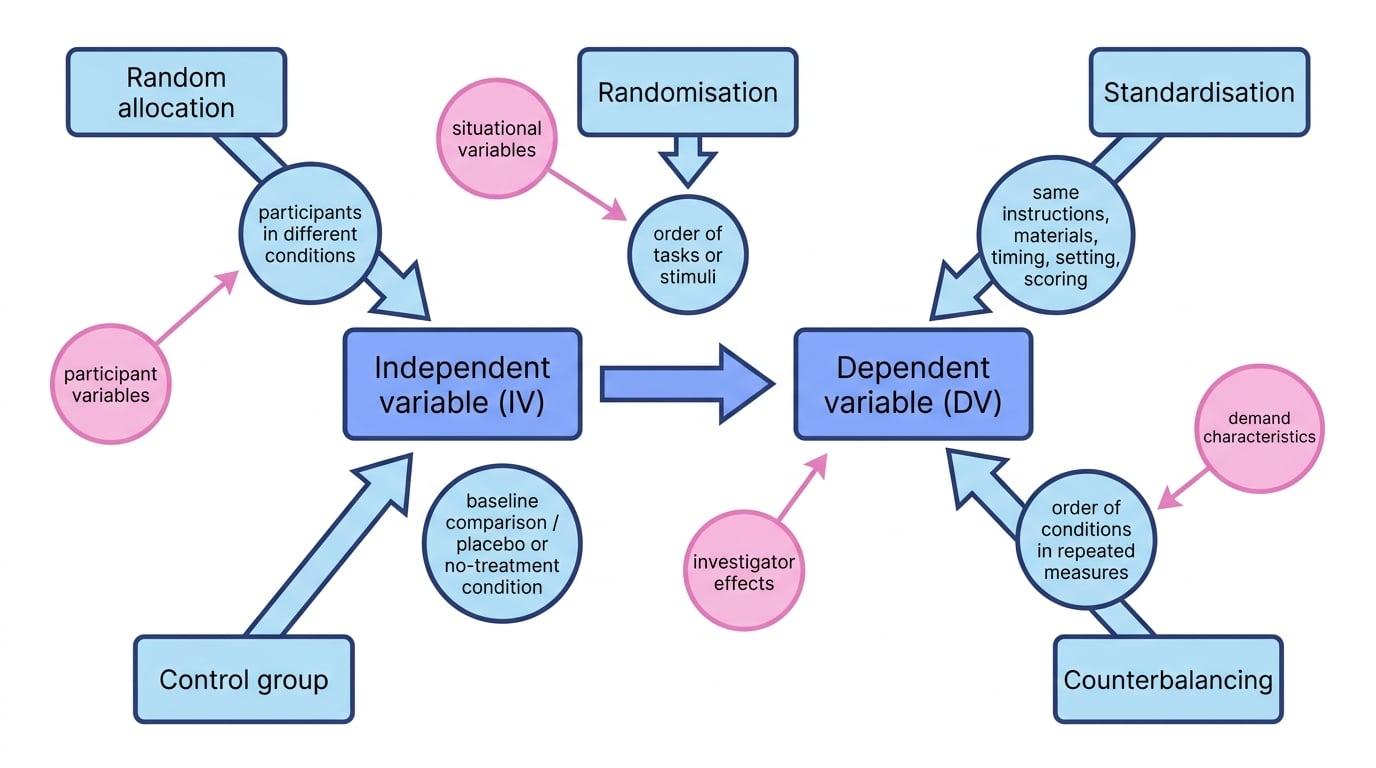
Common extraneous variables include:
- Participant variables: individual differences such as age, intelligence, mood, motivation, or prior experience.
- Situational variables: features of the environment such as noise, lighting, temperature, timing, or materials.
- Investigator effects: ways the researcher’s expectations or behaviour unintentionally influence participants.
- Demand characteristics: clues in a study that lead participants to guess the aim and change their behaviour.
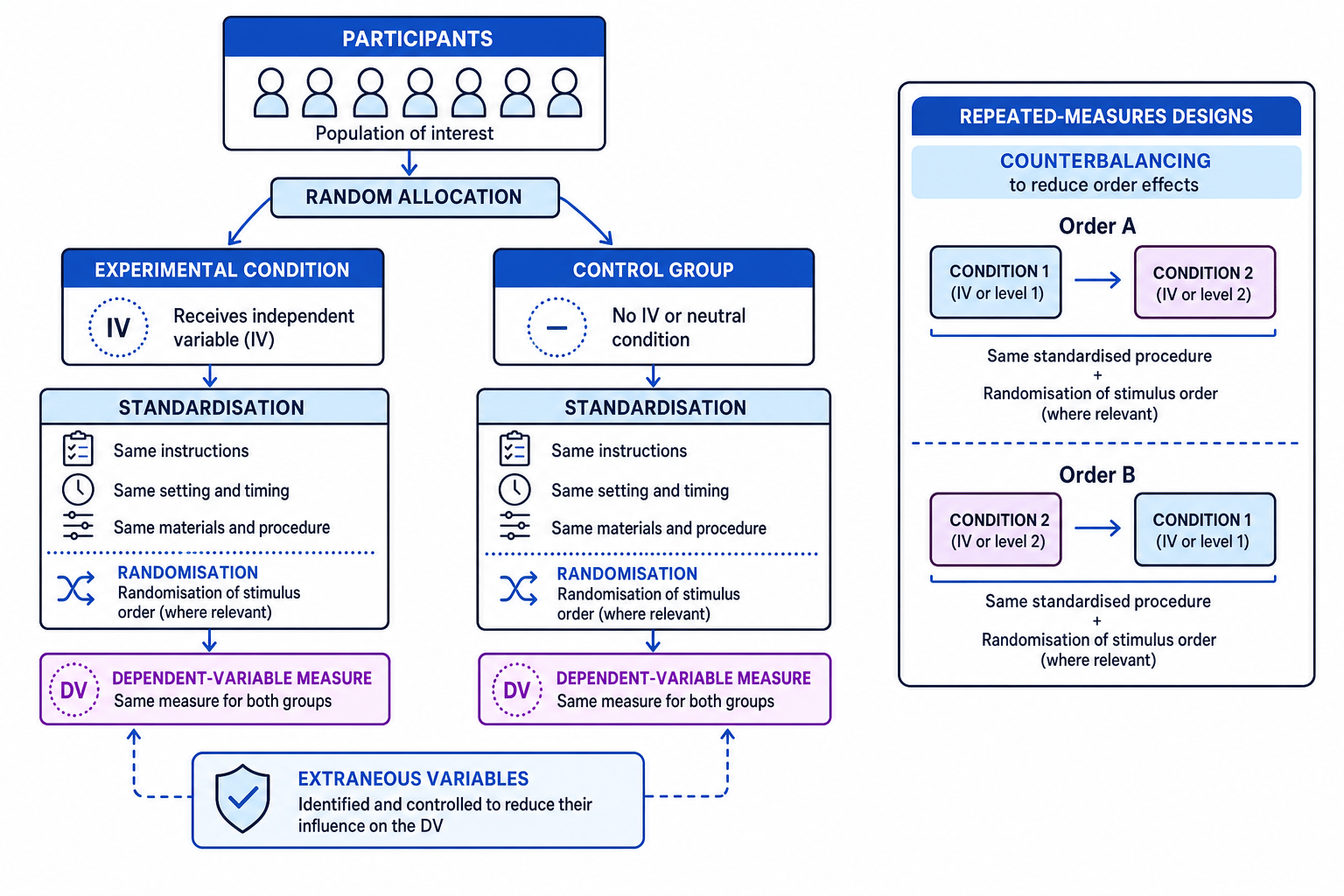
The main control techniques fit together like this:
Spotting a confounding variable
A researcher tests whether background music improves recall. The music group is tested in the morning in a quiet room. The no-music group is tested after lunch in a noisy room.
- Identify the independent variable and dependent variable: the IV is background music versus no music, and the DV is the number of words recalled.
- Compare what else changes between the conditions: time of day and room noise both differ systematically between the music and no-music groups.
- Decide whether those variables could affect the DV: tiredness after lunch or distraction from noise could reduce recall.
- Conclude the problem: time of day and noise are confounding variables because any difference in recall might not be caused by the music.
The core aim
Control is about ruling out alternative explanations. The stronger the control, the more confidently you can say the IV caused the change in the DV.
Random allocation
Random allocation means assigning participants to experimental conditions using chance. It is especially important in an independent-groups design, where different participants take part in each condition.
For example, in a study on caffeine and reaction time, participants could be randomly allocated to a caffeine condition or a no-caffeine condition using a random number generator.
Random allocation
Random allocation is the use of chance to decide which condition each participant enters, reducing the risk that participant variables are unevenly distributed across conditions.
Random allocation helps control participant variables. You cannot make every participant identical, but you can reduce the chance that one group contains all the highly motivated, well-rested, or experienced participants.
Improving participant allocation
A researcher puts the first 15 volunteers in the experimental condition and the next 15 in the control condition.
- Identify the allocation method: participants are assigned by arrival order, not by chance.
- Consider why arrival order might matter: early volunteers may be more punctual, motivated, or less tired than later volunteers.
- Explain the control problem: these participant variables could affect the DV and become an alternative explanation.
- Improve the design: give each participant a number and use a random number generator to allocate them to conditions.
Random allocation is not random sampling
Random allocation decides which condition participants enter. Random sampling selects participants by chance from the target population, which is the wider group the researcher wants to generalise to. A study can use random allocation without having a random sample.
Evaluation of random allocation
A strength is that random allocation reduces researcher bias and improves internal validity. It is a simple, transparent procedure that can be reported clearly and replicated by others.
A limitation is that chance does not guarantee perfectly equal groups, especially with small samples. If a known participant variable is very important, such as baseline anxiety in an anxiety-treatment study, a matched pairs design may be stronger. In matched pairs, participants are paired on a relevant characteristic and then split across conditions.
Randomisation
Randomisation is broader than random allocation. It means using chance within the procedure to avoid systematic bias.
Randomisation
Randomisation means using chance to decide aspects of the procedure, such as the order of stimuli, questions, tasks, trials, or conditions.
For example, in a memory study, the order of words should be randomised so that easy words are not always at the beginning and difficult words are not always at the end. In a questionnaire, randomising item order can reduce order effects or response patterns.
Randomisation helps prevent the researcher from accidentally arranging materials in a way that favours one condition. It also reduces the impact of predictable sequences.
Random allocation vs randomisation
- Random allocation: chance decides which participants go into which condition.
- Randomisation: chance decides features of the procedure, such as stimulus order.
- Both improve control, but they solve different problems.
Standardisation
Standardisation means keeping the procedure the same for all participants.
Standardisation
Standardisation is the use of identical procedures, instructions, materials, timings, settings, and scoring rules for every participant or condition, except for the intended change in the independent variable.
Standardisation usually includes:
- the same instructions read from a script
- the same testing environment
- the same time limits
- the same equipment and materials
- the same researcher behaviour
- the same scoring system for the DV
A classic example is Loftus and Palmer’s study on eyewitness testimony (1974). Participants watched the same film clips and answered standardised questions, although the critical verb changed between conditions. This helped isolate the effect of leading questions on speed estimates. Ethically, such research also needs informed consent where possible, protection from distress when showing accident footage, confidentiality, the right to withdraw, and a debrief if the true aim is not fully revealed beforehand.
Evaluation of standardisation
Standardisation improves reliability, meaning the procedure is consistent. It also improves replicability, meaning other researchers can repeat the study in the same way.
However, highly standardised procedures can feel artificial. This may reduce ecological validity, which means the findings may not generalise well to real-world behaviour. For example, recalling a staged film clip in a lab may not be the same as witnessing a real accident.
Standardised does not mean realistic
A procedure can be very carefully controlled but still lack realism. In AO3, separate internal validity from ecological validity.
Control groups
A control group is a comparison group that does not receive the experimental treatment or receives a neutral version of it.
Control group
A control group provides a baseline for comparison, helping researchers judge whether the experimental condition caused a change in the dependent variable.
For example, if a researcher tests whether a new therapy reduces anxiety, the experimental group receives the therapy. The control group might receive no treatment, standard care, a waiting-list place, or a placebo.
A placebo is an inactive treatment that looks or feels like the real treatment. Placebo controls are useful because improvement may occur simply because participants expect to improve.
Choosing a suitable control group
A psychologist wants to test whether a mindfulness app reduces exam stress.
- Identify the intended treatment: the IV is use of the mindfulness app versus another condition.
- Choose a comparison that controls expectations: a suitable control group might use a neutral study-planning app for the same amount of time.
- Keep the procedure equivalent: both groups should have the same duration, contact, instructions, and stress measure.
- Interpret the comparison: if the mindfulness group improves more than the neutral-app group, the app’s specific mindfulness content is a more plausible explanation.
Evaluation of control groups
Control groups strengthen causal conclusions because they show what happens without the active treatment. They are especially useful when people might improve naturally over time due to maturation, meaning natural change, or because they are being observed.
There can be ethical issues. If a potentially helpful treatment is withheld, researchers must consider protection from harm. A waiting-list control or standard-care control can be more ethical than giving no support at all.
Counterbalancing
Counterbalancing is used mainly in a repeated-measures design, where the same participants take part in every condition.
Repeated measures are useful because participant variables are controlled: each person acts as their own comparison. However, they create order effects, which are changes in performance caused by the order of conditions rather than the IV. These include practice effects, where participants improve through repetition, and fatigue effects, where they get worse because they are tired or bored.
Counterbalancing
Counterbalancing means arranging condition orders so that each condition appears equally often in each position, reducing the impact of order effects.
With two conditions, half the participants might do condition A then condition B, while the other half do condition B then condition A. With more than two conditions, researchers may use a Latin square, a planned arrangement where each condition appears equally often in each order position.
Counterbalancing a repeated-measures study
A psychologist tests whether silence or background noise affects word recall. The same participants complete both conditions.
- Identify the order-effect risk: participants may recall more words in the second condition because they understand the task better, or fewer because they are tired.
- Create two orders: half the participants complete silence then noise, while the other half complete noise then silence.
- Control the materials: use equivalent word lists and rotate them so one list is not always paired with one condition.
- Interpret the results more confidently: if recall is lower in noise across both orders, the effect is less likely to be due to practice or fatigue.
Counterbalancing does not eliminate order effects
Counterbalancing spreads order effects evenly across conditions. It does not stop individual participants becoming practised, tired, bored, or influenced by a previous condition.
Putting control into AO1, AO2 and AO3
For AO1, describe the technique accurately. For example: “Random allocation uses chance to assign participants to conditions.”
For AO2, apply the technique to the scenario. For example: “In this study, the researcher should randomly allocate pupils to the revision-app group or the textbook group.”
For AO3, evaluate the technique. For example: “This reduces participant-variable bias, but with a small sample the groups may still differ by chance.”
Strong answers link control directly to internal validity. Do not just say “it makes the study better”. Say what alternative explanation is being reduced and why that matters.
In the exam
- Name the control technique precisely: random allocation, randomisation, standardisation, control group, or counterbalancing.
- Apply it to the exact study in the question by mentioning the IV, DV, participants, materials, or procedure.
- Explain the purpose: say which extraneous or confounding variable is being reduced.
- Add balanced AO3 when needed: control improves internal validity, but may reduce ecological validity, be impractical, or raise ethical issues.
- Keep random allocation and randomisation separate — examiners reward this distinction.
Check yourself
- What is the difference between an extraneous variable and a confounding variable?
- How would you counterbalance a repeated-measures study with two conditions?
- Why might a control group be ethically difficult in a therapy study?