What you'll learn
- What independent, dependent and extraneous variables are.
- How psychologists manipulate and control variables to make research scientific.
- What operationalisation means, and why vague variables cause weak research.
- How to apply variables to classic A-Level Psychology examples such as Loftus & Palmer (1974) and Asch (1956).
The starting point: what is a variable?
Psychologists investigate behaviour scientifically by asking questions that can be tested with evidence. To do this, they need to identify the things that might change in a situation.
Variable
A variable is any feature of a person, situation or task that can vary, meaning it can take different values, levels or conditions.
Examples of variables in psychology include memory score, noise level, type of therapy, level of anxiety, number of bystanders, wording of a question, or amount of sleep.
A good study is not just about choosing variables. It is about making clear which variable is being changed, which variable is being measured, and which other variables must be kept under control.
Experiments: changing one thing to see what happens
An experiment is a research method where the researcher tests whether one variable affects another. The logic is simple:
- Change one variable deliberately.
- Measure another variable.
- Try to keep everything else the same.
This is what allows psychologists to make stronger claims about cause and effect.
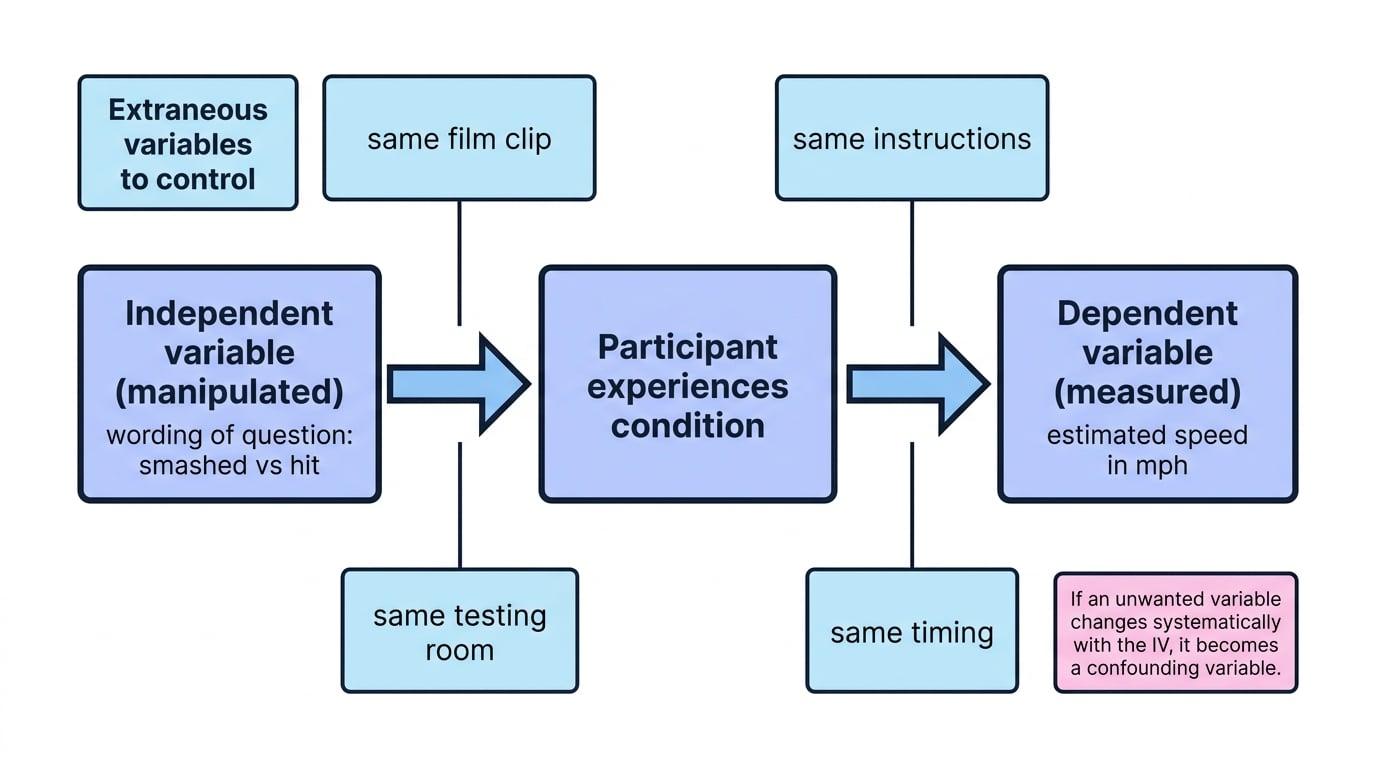
For example, Loftus & Palmer (1974) investigated whether the wording of a question affected eyewitness memory. Participants watched film clips of car accidents and were asked questions using different verbs, such as “smashed” or “hit”. The researchers then measured participants’ estimates of speed. This is a clear example of a variable being manipulated and another being measured.
The overall structure of an experiment looks like this:
Independent variables: what the researcher changes
Independent variable
The independent variable, often shortened to IV, is the variable the researcher deliberately changes or manipulates to see whether it has an effect.
The IV usually has two or more conditions, meaning the different levels or versions of the variable.
In Loftus & Palmer (1974), the IV was the wording of the critical question. Different participants heard different verbs, such as “smashed”, “collided”, “bumped”, “hit” or “contacted”.
In Asch’s conformity research (1956), one possible IV was the size of the majority group. Asch varied how many confederates gave the same wrong answer before the real participant responded.
IV = changed
If you are identifying the IV, ask: what is the researcher changing between conditions?
Dependent variables: what the researcher measures
Dependent variable
The dependent variable, often shortened to DV, is the variable the researcher measures to see whether it has been affected by the independent variable.
The DV is called “dependent” because, in an experiment, it is expected to depend on the IV.
In Loftus & Palmer (1974), the DV was the participants’ estimated speed of the cars. In Asch (1956), the DV was conformity, often measured as whether the participant gave the same incorrect answer as the majority.
A strong DV should be:
- Measurable — it can be recorded clearly.
- Objective — it does not depend too much on the researcher’s personal judgement.
- Relevant — it genuinely measures the behaviour or mental process being studied.
DV = measured
If you are identifying the DV, ask: what outcome is being recorded?
Extraneous variables: other things that might affect the results
Extraneous variable
An extraneous variable is any variable other than the IV that could affect the DV if it is not controlled.
Extraneous variables are a problem because they make it harder to know whether the IV really caused the change in the DV.
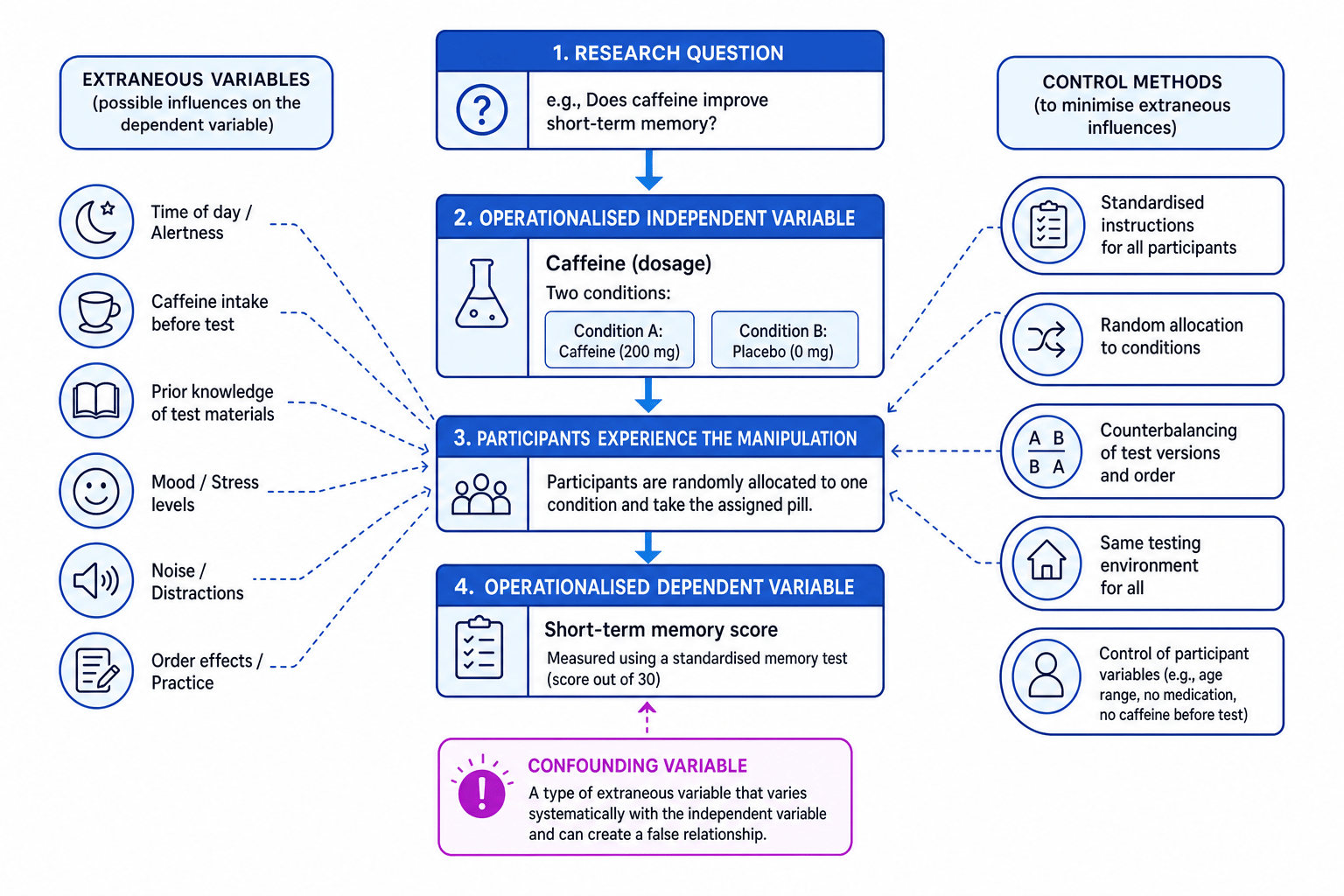
For example, imagine a study testing whether listening to music improves memory. If the “music” group is tested in the morning and the “no music” group is tested in the afternoon, time of day could affect alertness and therefore memory score. Time of day would be an extraneous variable.
Common types include:
- Participant variables — differences between participants, such as age, intelligence, mood, motivation or previous experience.
- Situational variables — features of the environment, such as noise, lighting, room temperature or distractions.
- Experimenter effects — when the researcher unintentionally influences participants through tone of voice, facial expression or expectations.
- Order effects — when doing one condition first affects performance in another condition, such as through practice or fatigue.
Confounding variable
A confounding variable is an extraneous variable that varies systematically with the IV, making it impossible to tell whether the IV or the confounding variable caused the change in the DV.
So, all confounding variables are extraneous variables, but not all extraneous variables become confounds.
Calling every extraneous variable a confounding variable
An extraneous variable only becomes a confounding variable if it changes systematically with the IV. If it is just a possible background influence, call it an extraneous variable.
Identifying variables in a memory study
A researcher investigates whether revising with music affects recall. One group revises a word list in silence in the morning. Another group revises with pop music in the afternoon. Both groups then complete a recall test.
-
The IV is the revision condition because this is what differs between the groups: revising in silence or revising with pop music.
-
The DV is recall performance because this is the outcome being measured, such as the number of words correctly recalled.
-
Time of day is an extraneous variable because it could affect alertness and memory performance.
-
Time of day may become a confounding variable because it changes systematically with the IV: the silence group is always tested in the morning, while the music group is always tested in the afternoon.
-
A better design would test both groups at the same time of day, or randomly allocate participants to times and conditions so time of day is not linked to only one condition.
Controlling variables
To control a variable means to keep it constant or reduce its influence so it does not distort the results.
Psychologists use several control techniques:
Standardisation
Standardisation means using the same procedure for all participants. This includes the same instructions, same materials, same timing and same testing environment.
This improves replicability, meaning another researcher could repeat the study in the same way.
Random allocation
Random allocation means assigning participants to conditions by chance. This helps spread participant variables, such as confidence or memory ability, evenly across groups.
For example, in a drug trial, participants might be randomly assigned to a drug condition or placebo condition.
Counterbalancing
Counterbalancing is used in a repeated measures design, where the same participants take part in all conditions. It means changing the order of conditions for different participants.
For example, half the participants do condition A then B, while the other half do B then A. This helps control order effects such as practice or fatigue.
Control groups
A control group is a comparison group that does not receive the experimental treatment. This allows researchers to compare the treatment condition against a baseline.
For example, if a study investigates whether a new therapy reduces phobias, the control group might receive no therapy or a standard therapy.
Choosing the right control method
If the problem is participant differences, think about random allocation or matched pairs. If the problem is order effects, think about counterbalancing. If the problem is inconsistent procedure, think about standardisation.
Operationalisation: making variables measurable
Some psychological variables are abstract. “Anxiety”, “aggression”, “memory”, “attachment” and “conformity” are not directly visible in the same way as height or age. Researchers therefore need to define exactly what they mean.
Operationalisation
Operationalisation means defining a variable clearly and precisely so it can be measured or manipulated in a practical, observable way.
Operationalisation applies to both the IV and the DV.
For an IV, you need to state exactly what the conditions are. For a DV, you need to state exactly how the outcome is measured.
For example, “stress” is too vague by itself. It could be operationalised as:
- score on a standardised stress questionnaire;
- number of stress-related behaviours observed in a task;
- self-rated stress on a scale from 1 to 10;
- amount of time taken to complete a stressful task.
Each version may produce different findings, so researchers must be precise.
Operationalising conformity in an Asch-style study
A researcher wants to investigate whether group size affects conformity in a line judgement task.
-
The abstract IV, group size, must be turned into clear conditions, such as one confederate, three confederates or six confederates giving the same incorrect answer.
-
The abstract DV, conformity, must be measured in an observable way, such as the percentage of critical trials where the real participant gives the same incorrect answer as the majority.
-
Important extraneous variables should be controlled, such as using the same line stimuli, same instructions and same number of trials for each participant.
-
The researcher should consider ethics because, as in Asch (1956), the use of confederates involves deception. Participants should be protected from harm, have the right to withdraw, be debriefed afterwards, and have their data kept confidential.
Why operationalisation matters
Operationalisation improves research because it makes studies more scientific.
A well-operationalised variable is easier to:
- measure consistently;
- replicate in future research;
- compare with other studies;
- evaluate for validity.
Validity
Validity refers to whether a study or measure actually tests what it claims to test.
A DV can be easy to measure but still not very valid. For example, measuring “aggression” as the number of times a participant presses a loud noise button may be controlled and ethical in a lab, but it may not fully represent real-world aggression.
This is an AO3 issue: tight control can improve scientific reliability, but it may reduce ecological validity, meaning the findings may not apply well to everyday behaviour.
Writing vague operational definitions
Do not write “the DV was memory” if you can be more precise. Write something like: “memory was operationalised as the number of words correctly recalled from a 20-word list after a five-minute delay.”
AO3: strengths and limitations of controlling variables
Good control of variables is a major strength of experimental research. It allows psychologists to isolate the effect of the IV and make stronger cause-and-effect conclusions.
For example, Loftus & Palmer (1974) controlled the procedure by showing participants the same accident clips and asking standardised questions. This made it more likely that differences in speed estimates were due to the wording of the verb rather than random differences in the task.
However, too much control can make research artificial. Participants may behave differently in a laboratory than they would in real life. This is especially important in topics like obedience, conformity, eyewitness testimony and aggression, where real-world behaviour can be emotionally intense and socially complex.
There are also ethical issues. Manipulating variables sometimes requires deception, stress or concealment of the true aim. In Asch’s study, participants were deceived because they thought the other people were genuine participants. In Loftus & Palmer, participants were not simply told that the study was testing leading questions, because that might have changed their behaviour. Ethical research should therefore consider informed consent, deception, right to withdraw, protection from harm, confidentiality and debriefing.
Control versus realism
Highly controlled studies are often better for cause-and-effect conclusions, but less natural settings can reduce how well findings apply to real life.
Quick comparison
| Term | Main question | Simple example |
|---|---|---|
| Independent variable | What is changed? | Type of question asked |
| Dependent variable | What is measured? | Estimated speed |
| Extraneous variable | What else might affect the DV? | Participant eyesight, alertness, distractions |
| Confounding variable | What unwanted factor varies with the IV? | One condition tested in a noisy room, the other in silence |
| Operationalisation | How is it precisely defined? | Memory measured as number of words recalled |
In the exam
-
When asked to identify variables, write them in full and link them to the scenario: “The IV is…” and “The DV is measured by…”
-
When asked about operationalisation, avoid vague words such as “memory”, “stress” or “aggression” on their own. Say exactly how the variable is manipulated or measured.
-
For AO3, balance control and realism: controlled variables improve cause-and-effect conclusions, but artificial procedures may reduce ecological validity and can raise ethical issues.
Check yourself
- Can you explain the difference between an extraneous variable and a confounding variable?
- How would you operationalise “anxiety” in a psychological study?
- Why might controlling variables improve internal validity but reduce ecological validity?