

What you'll learn
- What power means in physics, and why its unit is the watt.
- How to use P=W/tP = W/tP=W/t for the rate of doing work or transferring energy.
- How to derive and use P=FvP = FvP=Fv from first principles.
- How to calculate the efficiency of a mechanical system.
Starting point: work and energy
Before power makes sense, you need one key idea from the work and energy topic:
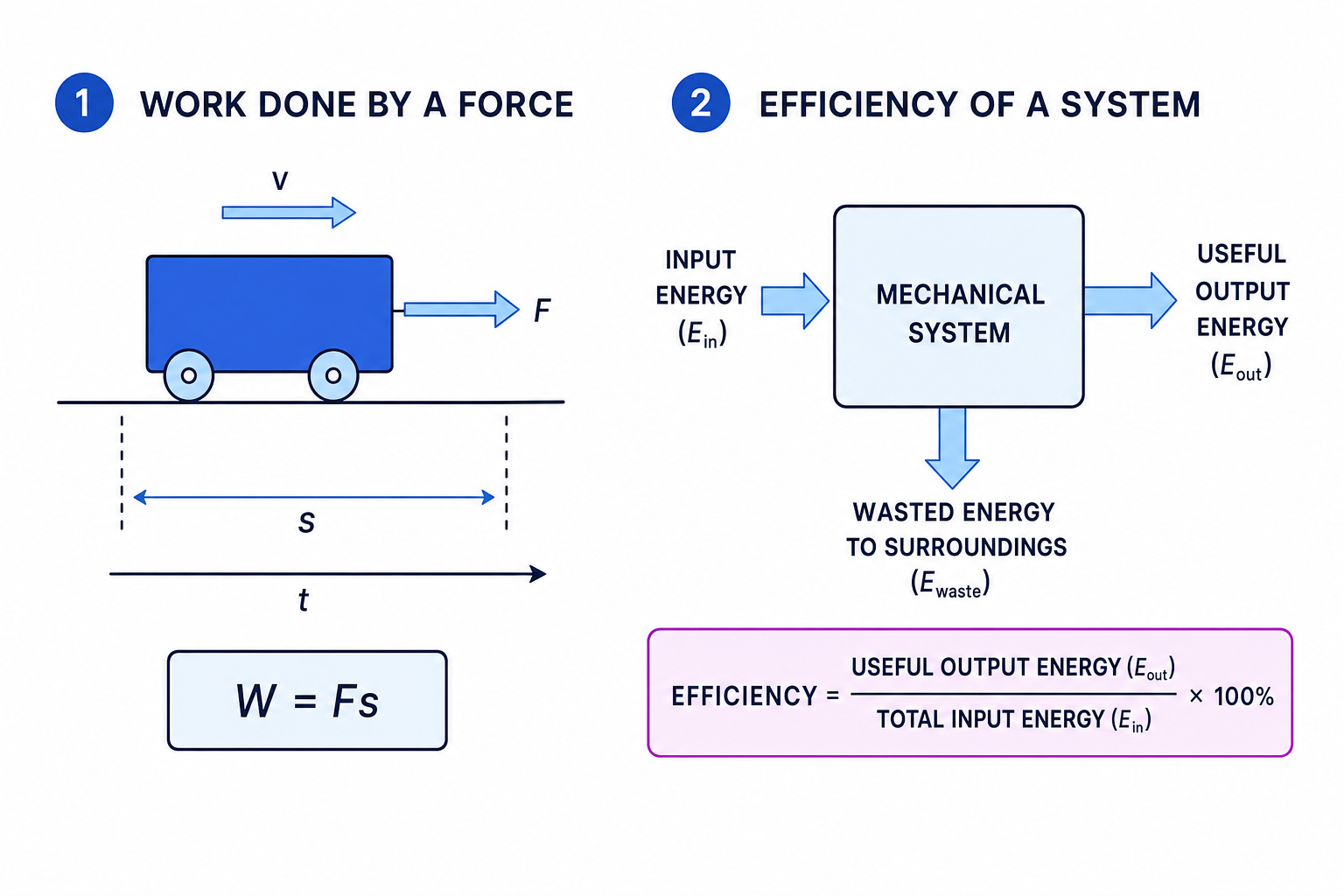
When a force causes an object to move, the force may transfer energy. The energy transferred by a force is called work done.
For a constant force acting in the direction of motion:
W=FsW = FsW=Fswhere:
- WWW is the work done, measured in joules, J
- FFF is the force, measured in newtons, N
- sss is the displacement in the direction of the force, measured in metres, m
Power is about how quickly this work is done.
W can mean two different things
In equations, italic WWW usually means work done or energy transferred. As a unit, W means watt. For example, W=500 JW = 500\ \text{J}W=500 J uses WWW as a symbol, while “500 W” means 500 watts of power.
Power as the rate of doing work
In everyday language, a “powerful” machine is one that can do a lot of work quickly. Physics makes this precise.
Power
Power is the rate at which work is done, or the rate at which energy is transferred.
The OCR equation is:
P=WtP = \frac{W}{t}P=tWwhere:
- PPP is power, measured in watts, W
- WWW is work done or energy transferred, measured in joules, J
- ttt is time taken, measured in seconds, s
So one watt means one joule per second:
1 W=1 J s−11\ \text{W} = 1\ \text{J s}^{-1}1 W=1 J s−1A large power does not necessarily mean a large total energy transfer. It means energy is being transferred quickly.
Power is about rate
Two devices can transfer the same total energy, but the one that does it in a shorter time has the greater power.
Calculating power from work done
A crane does 18 kJ of work lifting a load in 6.0 s. Calculate its useful power output.
-
Convert the energy into joules so the answer comes out in watts:
18 kJ=18 000 J18\ \text{kJ} = 18\,000\ \text{J}18 kJ=18000 J. -
Substitute into the power equation:
P=Wt=18 000 J6.0 sP = \frac{W}{t} = \frac{18\,000\ \text{J}}{6.0\ \text{s}}P=tW=6.0 s18000 J. -
Calculate the value and unit:
P=3000 J s−1=3000 WP = 3000\ \text{J s}^{-1} = 3000\ \text{W}P=3000 J s−1=3000 W. -
Quote using a sensible prefix:
P=3.0 kWP = 3.0\ \text{kW}P=3.0 kW.
Check the scale
Human power outputs for sustained effort are often hundreds of watts. Machines such as motors, kettles, and lifts are often measured in kilowatts.
Deriving P=FvP = FvP=Fv
You also need to know and be able to derive:
P=FvP = FvP=FvThis connects power to a force and a velocity.
Velocity
Velocity is the rate of change of displacement. In one-dimensional motion at constant velocity, v=s/tv = s/tv=s/t, where sss is displacement and ttt is time.
The derivation from first principles
Start with the definition of power:
P=WtP = \frac{W}{t}P=tWFor a constant force acting in the direction of motion, the work done is:
W=FsW = FsW=FsSubstitute this into the power equation:
P=FstP = \frac{Fs}{t}P=tFsSince v=s/tv = s/tv=s/t:
P=FvP = FvP=FvSo, for a force acting along the direction of motion:
P=FvP = FvP=Fvwhere:
- PPP is power in watts, W
- FFF is force in newtons, N
- vvv is velocity in metres per second, m s⁻¹
Force times velocity
P=FvP = FvP=Fv tells you the power needed to maintain a force FFF while moving at velocity vvv, provided the force is acting in the direction of motion.
Direction matters
Use P=FvP = FvP=Fv directly only when the force is parallel to the velocity. If the force is at an angle, only the component of the force in the direction of motion does work.
Calculating power from force and speed
A motor pulls a trolley along a horizontal track with a constant force of 250 N. The trolley moves at a constant speed of 1.6 m s⁻¹. Calculate the power supplied to the trolley.
-
The force and motion are in the same direction, so P=FvP = FvP=Fv can be used directly.
-
Substitute the values:
P=250 N×1.6 m s−1P = 250\ \text{N} \times 1.6\ \text{m s}^{-1}P=250 N×1.6 m s−1. -
Use the unit connection:
N m s−1=J s−1=W\text{N m s}^{-1} = \text{J s}^{-1} = \text{W}N m s−1=J s−1=W. -
Calculate the power:
P=400 WP = 400\ \text{W}P=400 W.
Rearranging P=FvP = FvP=Fv
You may also need to find force or velocity:
F=PvF = \frac{P}{v}F=vP v=PFv = \frac{P}{F}v=FPThis is common in questions about vehicles, lifts, winches, and engines.
Finding the driving force
A car engine provides 24 kW of useful power to maintain a steady speed of 12 m s⁻¹ against resistive forces. Calculate the total resistive force.
-
At steady speed, the driving force balances the resistive force, so the useful driving power is used against that force.
-
Convert the power into watts:
24 kW=24 000 W24\ \text{kW} = 24\,000\ \text{W}24 kW=24000 W. -
Rearrange P=FvP = FvP=Fv to find force:
F=PvF = \frac{P}{v}F=vP. -
Substitute and calculate:
F=24 000 W12 m s−1=2000 NF = \frac{24\,000\ \text{W}}{12\ \text{m s}^{-1}} = 2000\ \text{N}F=12 m s−124000 W=2000 N.
Efficiency of a mechanical system
Real mechanical systems are never perfect. Some input energy is transferred in useful ways, but some is wasted, often as thermal energy or sound.
A mechanical system is a system involving forces and motion, such as a crane, motor, pulley, vehicle, or winch.
Efficiency
The efficiency of a mechanical system is the percentage of the total input energy that is transferred as useful output energy.
The OCR equation is:
efficiency=useful output energytotal input energy×100%\text{efficiency} = \frac{\text{useful output energy}}{\text{total input energy}} \times 100\%efficiency=total input energyuseful output energy×100%Efficiency has no unit because it is a ratio. It is usually given as a percentage.
For example, an efficiency of 80% means 80% of the input energy becomes useful output energy. The remaining 20% is wasted.
Useful divided by total
Efficiency is always based on useful output compared with total input, not useful output compared with wasted energy.
Calculating efficiency from energies
A lifting mechanism transfers 4.8 kJ of useful gravitational potential energy to a load. The total input energy supplied to the mechanism is 6.0 kJ. Calculate the efficiency.
-
The energies are both in kilojoules, so they can be used directly in the ratio because the units match.
-
Substitute into the efficiency equation:
efficiency=4.8 kJ6.0 kJ×100%\text{efficiency} = \frac{4.8\ \text{kJ}}{6.0\ \text{kJ}} \times 100\%efficiency=6.0 kJ4.8 kJ×100%. -
Calculate the fraction of input energy that is useful:
4.86.0=0.80\frac{4.8}{6.0} = 0.806.04.8=0.80. -
Convert to a percentage:
efficiency=0.80×100%=80%\text{efficiency} = 0.80 \times 100\% = 80\%efficiency=0.80×100%=80%.
Dividing by the wrong energy
Do not calculate efficiency using useful output divided by wasted energy. The denominator must be the total input energy.
Efficiency and power
Because power is energy transferred per second, efficiency can also be found using powers when the input and output are measured over the same time interval.
So for a steady mechanical system:
efficiency=useful output powertotal input power×100%\text{efficiency} = \frac{\text{useful output power}}{\text{total input power}} \times 100\%efficiency=total input poweruseful output power×100%This is just the energy equation applied every second.
Calculating efficiency from powers
An electric motor takes in 500 W of electrical power and delivers 360 W of useful mechanical power to a rotating shaft. Calculate the efficiency.
-
Identify the useful output power and total input power:
useful output power is 360 W, total input power is 500 W. -
Substitute into the power version of the efficiency equation:
efficiency=360 W500 W×100%\text{efficiency} = \frac{360\ \text{W}}{500\ \text{W}} \times 100\%efficiency=500 W360 W×100%. -
Calculate the ratio and percentage:
efficiency=0.72×100%=72%\text{efficiency} = 0.72 \times 100\% = 72\%efficiency=0.72×100%=72%.
Percentage as a decimal
If an efficiency is given as a percentage, divide by 100 before using it as a multiplier. For example, 72% means 0.72.
Real systems and wasted energy
In real machines, wasted energy is often transferred to the surroundings by:
- heating due to friction in bearings, gears, ropes, or air resistance
- sound from vibrations
- deformation or internal heating of materials
Improving efficiency matters because it can reduce energy costs, fuel use, heating, and environmental impact. In practical or evaluation-style questions, you may be asked to comment on both the numerical efficiency and the physical reasons energy is wasted.
In the exam
- Start by deciding whether the question is about energy over time using P=W/tP = W/tP=W/t, or force at speed using P=FvP = FvP=Fv.
- Convert units before substituting, especially kJ to J and kW to W.
- For efficiency, always put useful output on the top and total input on the bottom, then multiply by 100%.
Check yourself
- A machine transfers the same energy in half the time. What happens to its power?
- How do you derive P=FvP = FvP=Fv starting from P=W/tP = W/tP=W/t?
- Why can the efficiency of a real mechanical system never be greater than 100%?
